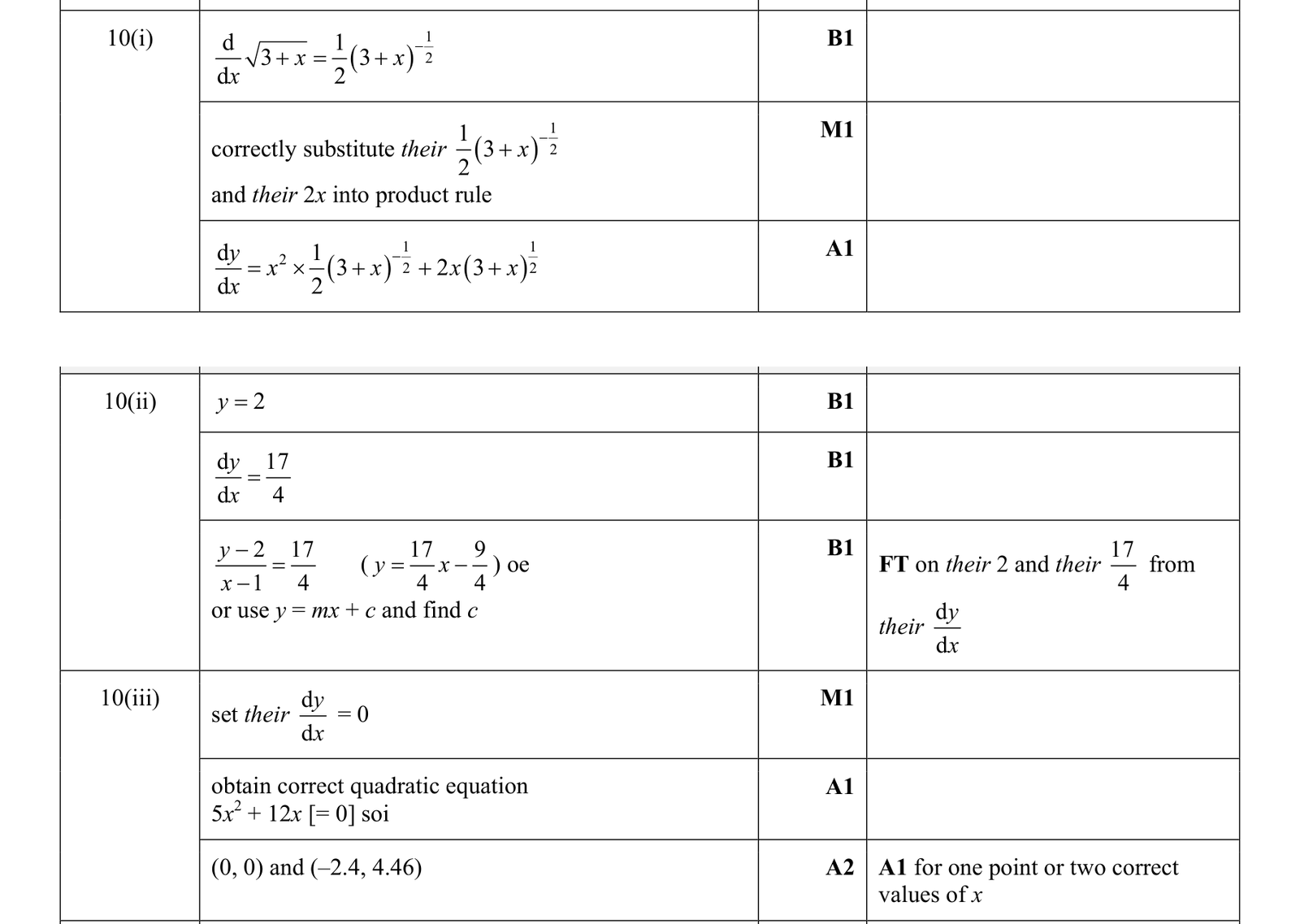
Answer: (i) \(\dfrac{dy}{dx}=2x\sqrt{3+x}+\dfrac{x^2}{2\sqrt{3+x}}\). (ii) \(y=\dfrac{17}{4}x-\dfrac94\). (iii) \((0,0)\) and \((-2.4,4.46)\).
(i) Write the curve as
\(y=x^2(3+x)^{1/2}.\)
Use the product rule:
\(\frac{dy}{dx} = 2x(3+x)^{1/2} + x^2\cdot\frac12(3+x)^{-1/2}.\)
Thus
\(\frac{dy}{dx} = 2x\sqrt{3+x}+\frac{x^2}{2\sqrt{3+x}}.\)
This can also be written as
\(\frac{dy}{dx} = \frac{x(5x+12)}{2\sqrt{3+x}}.\)
(ii) At \(x=1\),
\(y=1^2\sqrt4=2.\)
The gradient is
\(\frac{dy}{dx} = 2(1)\sqrt4+\frac{1}{2\sqrt4} = 4+\frac14 = \frac{17}{4}.\)
So the tangent is
\(y-2=\frac{17}{4}(x-1).\)
Hence
\(y=\frac{17}{4}x-\frac94.\)
(iii) Turning points occur when \(\dfrac{dy}{dx}=0\):
\(\frac{x(5x+12)}{2\sqrt{3+x}}=0.\)
Since \(x\geq-3\), the denominator is non-zero except at the endpoint \(x=-3\). The numerator gives
\(x=0 \quad\text{or}\quad 5x+12=0.\)
Thus
\(x=0 \quad\text{or}\quad x=-\frac{12}{5}=-2.4.\)
When \(x=0\),
\(y=0.\)
When \(x=-2.4\),
\(y=(-2.4)^2\sqrt{0.6}=4.46\)
to 3 significant figures. Hence the turning points are
\(\boxed{(0,0)\quad\text{and}\quad(-2.4,4.46)}.\)