Answer: \(x=\dfrac{40}{\sqrt{\pi}}\approx22.6\), and the minimum perimeter is \(40\sqrt{\pi}\approx70.9\text{ cm}\).
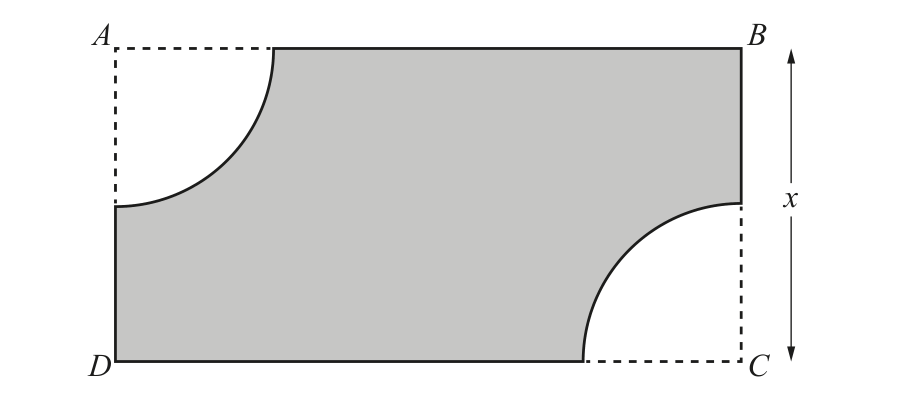
We start with the main method. Use the measurements and relationships shown in the diagram, then translate them into algebraic or trigonometric equations. Model the quantity to be optimised as a function of one variable, then differentiate to locate the stationary value.
Let the other side of the rectangle be \(L\). Since the area is \(400\),
\(Lx=400\), so \(L=\frac{400}{x}\).
Each removed arc is a quarter-circle of radius \(\frac{x}{2}\).
The arc length of one quarter-circle is
\(\frac14(2\pi r)=\frac14\left(2\pi\cdot\frac{x}{2}\right)=\frac{\pi x}{4}.\)
There are two such arcs, so their total arc length is
\(\frac{\pi x}{2}.\)
The remaining straight parts of the perimeter consist of the top and bottom edges after the quarter-circles are removed.
Each of those straight parts has length
\(L-\frac{x}{2}=\frac{400}{x}-\frac{x}{2}.\)
There are two of them, so the perimeter is
\(P=\frac{\pi x}{2}+2\left(\frac{400}{x}-\frac{x}{2}\right)+x.\)
The \(+x\) and \(-x\) terms cancel, giving
\(P=\frac{\pi x}{2}+\frac{800}{x}.\)
Differentiate:
\(\frac{dP}{dx}=\frac{\pi}{2}-\frac{800}{x^2}.\)
For a minimum, set \(\frac{dP}{dx}=0\):
\(\frac{\pi}{2}=\frac{800}{x^2}.\)
So
\(x^2=\frac{1600}{\pi}\), and therefore
\(x=\frac{40}{\sqrt{\pi}}\).
This is positive, as required.
The minimum perimeter is
\(P=\frac{\pi}{2}\cdot\frac{40}{\sqrt{\pi}}+\frac{800}{40/\sqrt{\pi}}.\)
Hence
\(P=20\sqrt{\pi}+20\sqrt{\pi}=40\sqrt{\pi}.\)
So
\(x=\frac{40}{\sqrt{\pi}}\approx22.6\)
and the minimum perimeter is
\(40\sqrt{\pi}\approx70.9\text{ cm}.\)
This completes the solution and gives the required result.