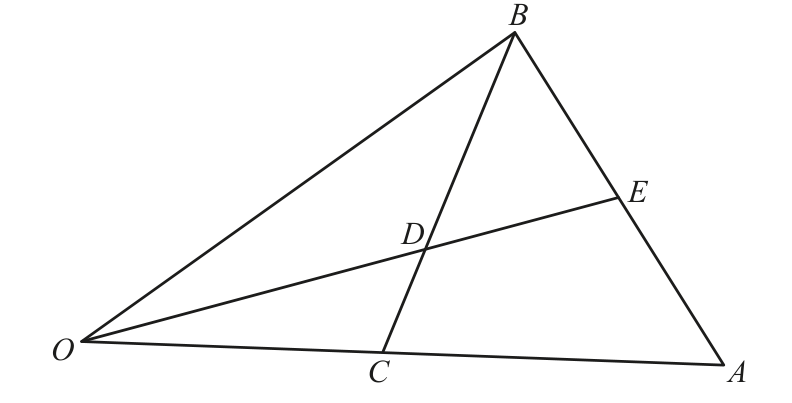
Answer: \(\overrightarrow{OE}=\lambda\left(\mathbf c+\frac25\mathbf b\right)\), \(\overrightarrow{OE}=\mu\mathbf b+(2-\mu)\mathbf c\), and \(AE:EB=4:3\).
Write each position or direction vector in terms of the given basis vectors, then compare coefficients to find the required constants or ratio.
Since \(C\) is the midpoint of \(OA\),
\(\overrightarrow{OA}=2\mathbf c.\)
Also,
\(\overrightarrow{OB}=\overrightarrow{OC}+\overrightarrow{CB} =\mathbf c+\mathbf b.\)
Since \(CD:DB=2:3\),
\(\overrightarrow{CD}=\frac25\overrightarrow{CB} =\frac25\mathbf b.\)
Therefore
\(\overrightarrow{OD}=\overrightarrow{OC}+\overrightarrow{CD} =\mathbf c+\frac25\mathbf b.\)
Using \(\overrightarrow{OE}=\lambda\overrightarrow{OD}\),
\(\overrightarrow{OE}=\lambda\left(\mathbf c+\frac25\mathbf b\right).\)
This is one expression for \(\overrightarrow{OE}\).
Now use \(\overrightarrow{AE}=\mu\overrightarrow{AB}\). Since
\(\overrightarrow{AB}=\overrightarrow{OB}-\overrightarrow{OA} =\mathbf c+\mathbf b-2\mathbf c =\mathbf b-\mathbf c,\)
we have
\(\overrightarrow{AE}=\mu(\mathbf b-\mathbf c).\)
Therefore
\(\overrightarrow{OE} =\overrightarrow{OA}+\overrightarrow{AE} =2\mathbf c+\mu(\mathbf b-\mathbf c).\)
So
\(\overrightarrow{OE}=\mu\mathbf b+(2-\mu)\mathbf c.\)
Now equate the two expressions for \(\overrightarrow{OE}\):
\(\lambda\mathbf c+\frac25\lambda\mathbf b =\mu\mathbf b+(2-\mu)\mathbf c.\)
Equating coefficients of \(\mathbf b\) and \(\mathbf c\),
\(\frac25\lambda=\mu\)
and
\(\lambda=2-\mu.\)
Substitute \(\mu=\frac25\lambda\) into the second equation:
\(\lambda=2-\frac25\lambda.\)
So
\(\frac75\lambda=2,\)
giving
\(\lambda=\frac{10}{7}.\)
Then
\(\mu=\frac25\cdot\frac{10}{7}=\frac47.\)
Since \(\overrightarrow{AE}=\mu\overrightarrow{AB}\),
\(AE=\frac47AB\)
and
\(EB=\frac37AB.\)
Therefore
\(AE:EB=4:3.\)