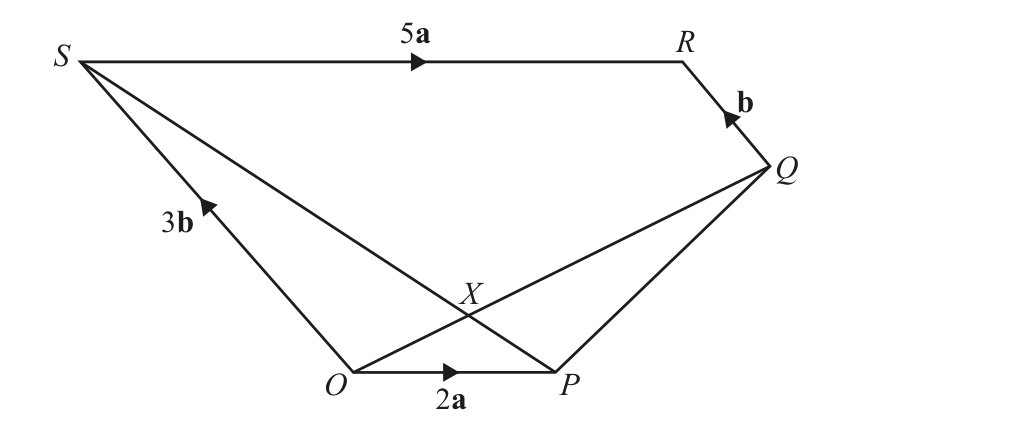
Answer: \(\lambda=\frac4{19}\), \(\mu=\frac6{19}\), \(OX:OQ=6:19\), \(PX:XS=4:15\).
(a) Since \(OP=2\mathbf a\) and \(OS=3\mathbf b\),
\(\overrightarrow{PS}=\overrightarrow{OS}-\overrightarrow{OP}=3\mathbf b-2\mathbf a.\)
Also, \(PX=\lambda PS\), so
\(\overrightarrow{PX}=\lambda(3\mathbf b-2\mathbf a).\)
Therefore
\(\overrightarrow{OX}=\overrightarrow{OP}+\overrightarrow{PX}.\)
Thus
\(\overrightarrow{OX}=2\mathbf a+\lambda(3\mathbf b-2\mathbf a).\)
So
\(\overrightarrow{OX}=(2-2\lambda)\mathbf a+3\lambda\mathbf b.\)
(b) Since \(SR=5\mathbf a\),
\(\overrightarrow{OR}=\overrightarrow{OS}+\overrightarrow{SR}=3\mathbf b+5\mathbf a.\)
Also \(QR=\mathbf b\), so
\(\overrightarrow{OQ}=\overrightarrow{OR}-\overrightarrow{QR}=5\mathbf a+2\mathbf b.\)
(c) Since \(OX=\mu OQ\),
\(\overrightarrow{OX}=\mu(5\mathbf a+2\mathbf b)=5\mu\mathbf a+2\mu\mathbf b.\)
Compare this with
\((2-2\lambda)\mathbf a+3\lambda\mathbf b.\)
Equating coefficients gives
\(2-2\lambda=5\mu,\)
and
\(3\lambda=2\mu.\)
From \(3\lambda=2\mu\),
\(\mu=\frac32\lambda.\)
Substitute into \(2-2\lambda=5\mu\):
\(2-2\lambda=5\left(\frac32\lambda\right).\)
So
\(2=\frac{19}{2}\lambda,\qquad \lambda=\frac4{19}.\)
Then
\(\mu=\frac32\cdot\frac4{19}=\frac6{19}.\)
(d) Since \(OX=\mu OQ\),
\(OX:OQ=\frac6{19}:1=6:19.\)
(e) Since \(PX=\lambda PS\), the remaining fraction is
\(XS=(1-\lambda)PS.\)
Thus
\(PX:XS=\lambda:(1-\lambda)=\frac4{19}:\frac{15}{19}=4:15.\)