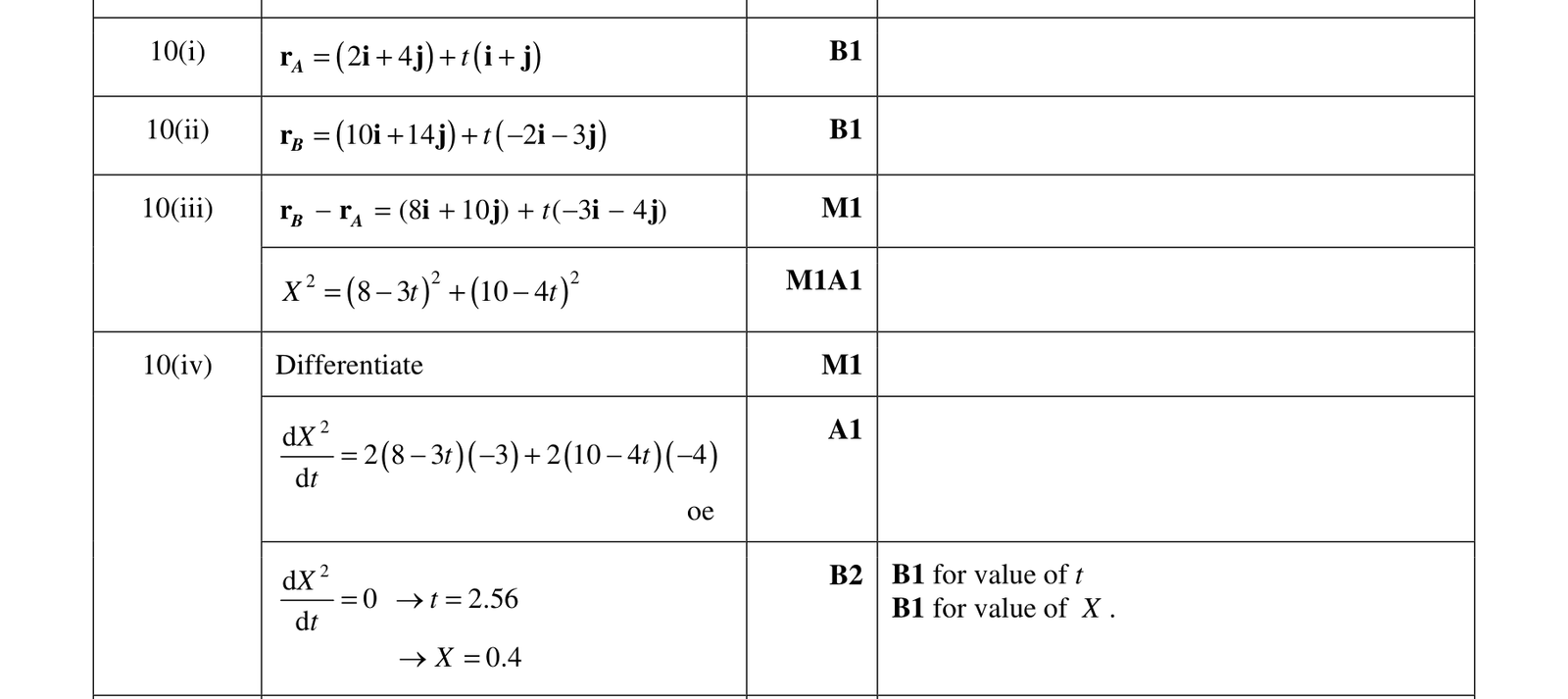
0606 P21 - Nov 2017 - Q10 - 9 marks
In this question \(\mathbf i\) is a unit vector due east and \(\mathbf j\) is a unit vector due north. Units of length and velocity are metres and metres per second respectively.
The initial position vectors of particles \(A\) and \(B\), relative to a fixed point \(O\), are \(2\mathbf i+4\mathbf j\) and \(10\mathbf i+14\mathbf j\) respectively. Particles \(A\) and \(B\) start moving at the same time. \(A\) moves with constant velocity \(\mathbf i+\mathbf j\) and \(B\) moves with constant velocity \(-2\mathbf i-3\mathbf j\). Find
(i) the position vector of \(A\) after \(t\) seconds,
(ii) the position vector of \(B\) after \(t\) seconds.
It is given that \(X\) is the distance between \(A\) and \(B\) after \(t\) seconds.
(iii) Show that \(X^2=(8-3t)^2+(10-4t)^2\).
(iv) Find the value of \(t\) for which \((8-3t)^2+(10-4t)^2\) has a stationary value and the corresponding value of \(X\).