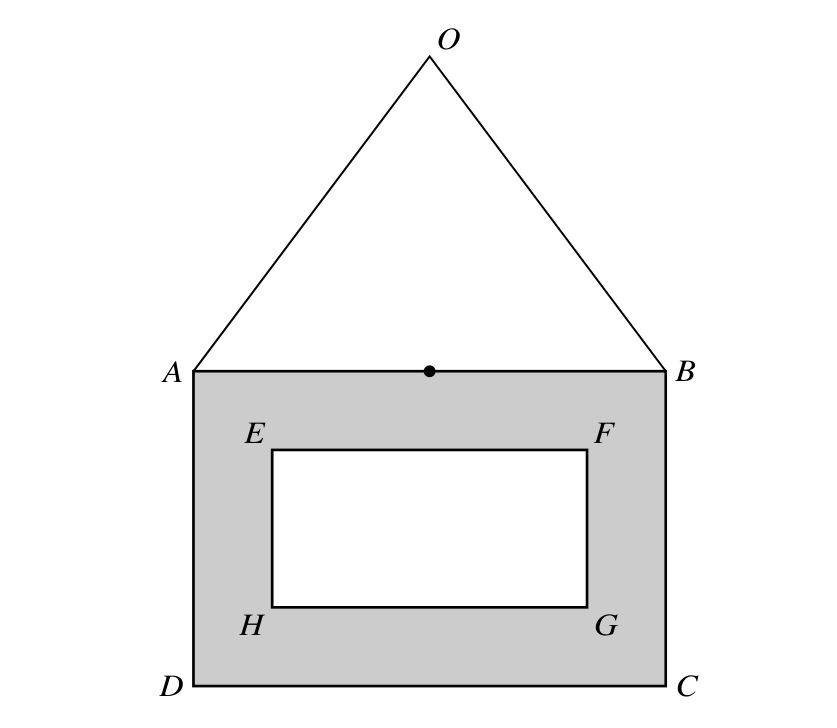
Answer: \(I=\boxed{\dfrac{169}{3}ma^2}\), and the period of small oscillations is \(\boxed{26\pi\sqrt{\dfrac{a}{29g}}}\).
(i) The outer rectangle has area
\[24a^2,\]
and the removed inner rectangle has area
\[8a^2.\]
So the frame has area
\[24a^2-8a^2=16a^2.\]
Since the frame has mass \(m\), the mass of a full outer rectangle of the same material would be
\[\frac{24}{16}m=\frac32m,\]
and the mass of the removed inner rectangle would be
\[\frac{8}{16}m=\frac12m.\]
Let \(Q\) be the common centre of the two rectangles.
For a rectangle of sides \(2b\) and \(2c\), the moment of inertia about an axis through its centre perpendicular to the plane is
\[\frac13M(b^2+c^2).\]
For the outer rectangle, \(b=3a\) and \(c=2a\). Hence
\[I_{\text{outer},Q}=\frac13\left(\frac32m\right)\{(3a)^2+(2a)^2\}=\frac{13}{2}ma^2.\]
For the inner rectangle, \(b=2a\) and \(c=a\). Hence
\[I_{\text{inner},Q}=\frac13\left(\frac12m\right)\{(2a)^2+a^2\}=\frac56ma^2.\]
Therefore the moment of inertia of the frame about the axis through \(Q\) is
\[I_{\text{frame},Q}=\frac{13}{2}ma^2-\frac56ma^2=\frac{17}{3}ma^2.\]
Now find the distance from \(Q\) to \(O\). Since the string has length \(10a\), each half has length \(5a\). The half-width \(AB/2\) is \(3a\), so the vertical distance from \(O\) to \(AB\) is
\[\sqrt{(5a)^2-(3a)^2}=4a.\]
The centre \(Q\) is another \(2a\) below \(AB\), so
\[OQ=6a.\]
By the parallel-axis theorem,
\[I_{\text{frame},O}=I_{\text{frame},Q}+m(6a)^2.\]
Thus
\[I_{\text{frame},O}=\frac{17}{3}ma^2+36ma^2=\frac{125}{3}ma^2.\]
The small object has mass \(\frac{11}{12}m\) and is fixed at the midpoint of \(AB\), which is \(4a\) from \(O\). Hence its moment of inertia about \(O\) is
\[I_{\text{object},O}=\frac{11}{12}m(4a)^2=\frac{44}{3}ma^2.\]
Therefore the total moment of inertia is
\[I=\frac{125}{3}ma^2+\frac{44}{3}ma^2=\boxed{\frac{169}{3}ma^2}.\]
(ii) Suppose the system is displaced through a small angle \(\theta\) from its equilibrium position.
The frame has weight \(mg\), acting at \(Q\), a distance \(6a\) from \(O\). The small object has weight \(\frac{11}{12}mg\), acting a distance \(4a\) from \(O\).
The restoring moment about \(O\) is therefore
\[-mg(6a)\sin\theta-\frac{11}{12}mg(4a)\sin\theta.\]
So the equation of rotational motion is
\[I\frac{d^2\theta}{dt^2}=-\left(6+\frac{11}{3}\right)mga\sin\theta.\]
That is
\[I\frac{d^2\theta}{dt^2}=-\frac{29}{3}mga\sin\theta.\]
Using \(I=\frac{169}{3}ma^2\),
\[\frac{169}{3}ma^2\frac{d^2\theta}{dt^2}=-\frac{29}{3}mga\sin\theta.\]
For small oscillations, \(\sin\theta\approx\theta\). Therefore
\[\frac{d^2\theta}{dt^2}=-\frac{29g}{169a}\theta.\]
This has the form
\[\frac{d^2\theta}{dt^2}=-\omega^2\theta,\]
so the motion is approximately simple harmonic, with
\[\omega^2=\frac{29g}{169a}.\]
The period is
\[T=\frac{2\pi}{\omega}=2\pi\sqrt{\frac{169a}{29g}}.\]
Hence
\[T=\boxed{26\pi\sqrt{\frac{a}{29g}}}.\]