Past Exam Questions
← Back0606 P12 - Jun 2019 - Q7 - 8 marks
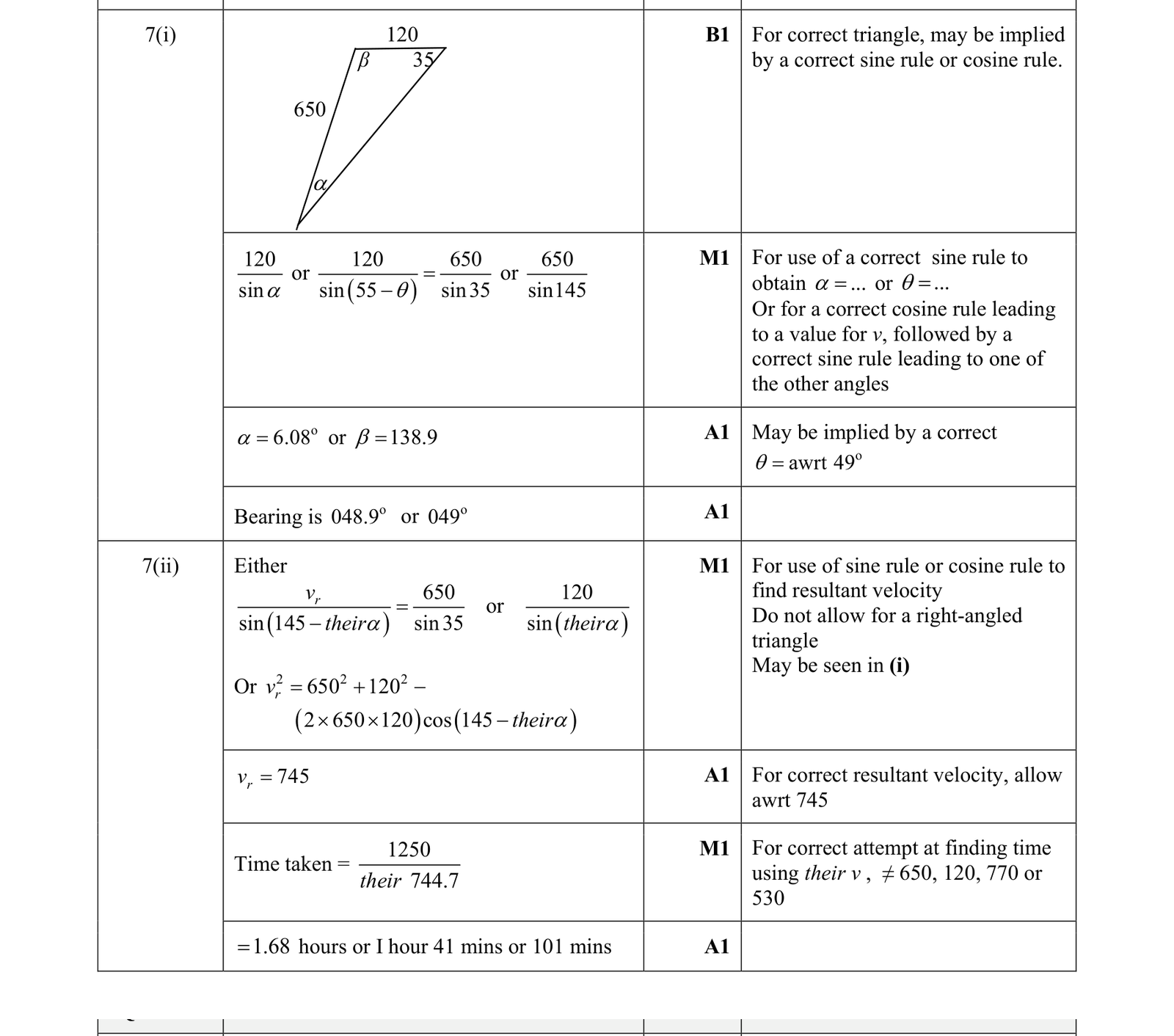
A pilot wishes to fly his plane from a point \(A\) to a point \(B\) on a bearing of \(055^\circ\). There is a wind blowing at \(120\text{ km h}^{-1}\) from the west. The plane can fly at \(650\text{ km h}^{-1}\) in still air.
(i) Find the direction in which the pilot must fly his plane in order to reach \(B\).
(ii) Given that the distance between \(A\) and \(B\) is \(1250\) km, find the time it will take the pilot to fly from \(A\) to \(B\).
0606 P13 - Jun 2019 - Q11 - 8 marks
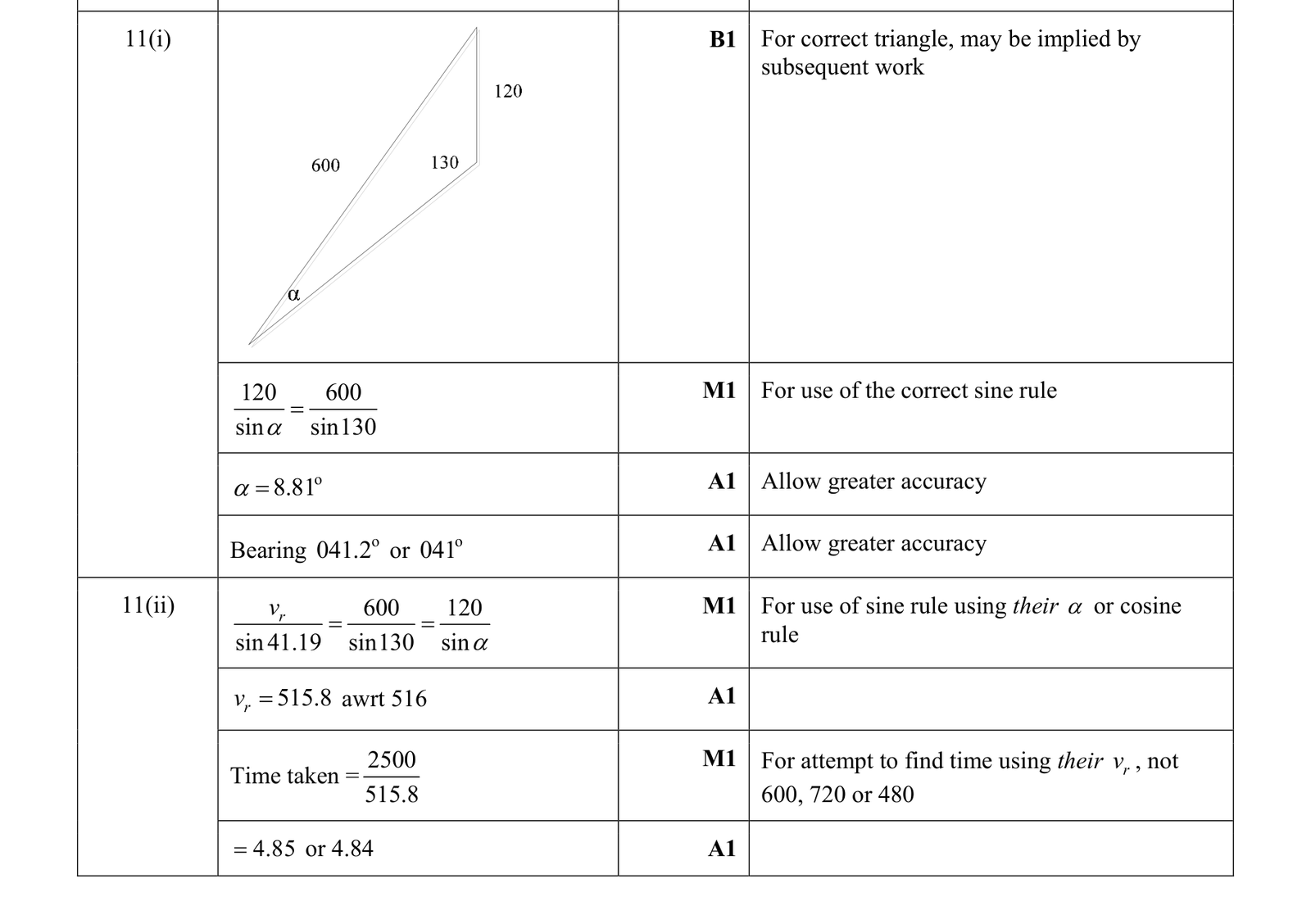
A pilot wishes to fly his plane from a point \(A\) to a point \(B\). The bearing of \(B\) from \(A\) is \(050^\circ\). A wind is blowing from the north at \(120\text{ km h}^{-1}\). The plane can fly at \(600\text{ km h}^{-1}\) in still air.
(i) Find the bearing on which the pilot must fly his plane in order to reach \(B\).
(ii) Given that the distance from \(A\) to \(B\) is \(2500\) km, find the time taken to fly from \(A\) to \(B\).
0606 P21 - Nov 2019 - Q11 - 6 marks
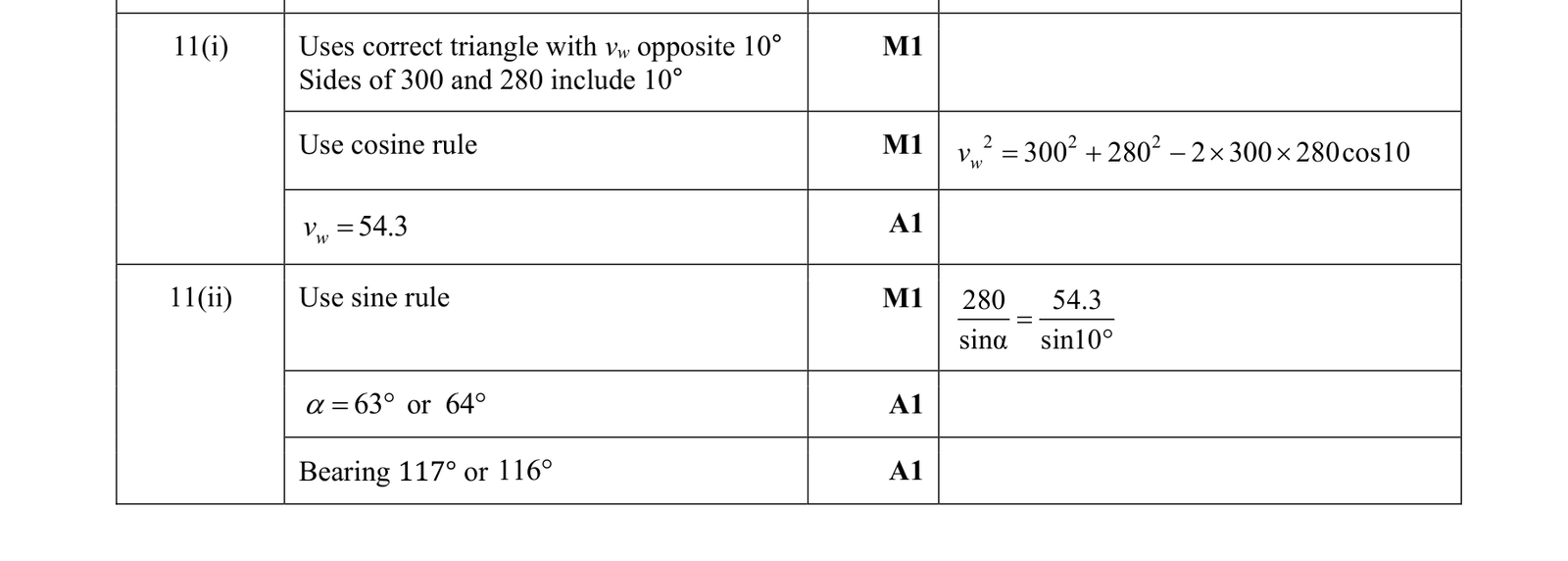
A plane, which can travel at a speed of \(300\text{ km h}^{-1}\) in still air, heads due north. The plane is blown off course by a wind so that it travels on a bearing of \(010^\circ\) at a speed of \(280\text{ km h}^{-1}\).
(i) Find the speed of the wind.
(ii) Find the direction of the wind as a bearing correct to the nearest degree.
0606 P22 - Nov 2019 - Q8 - 9 marks
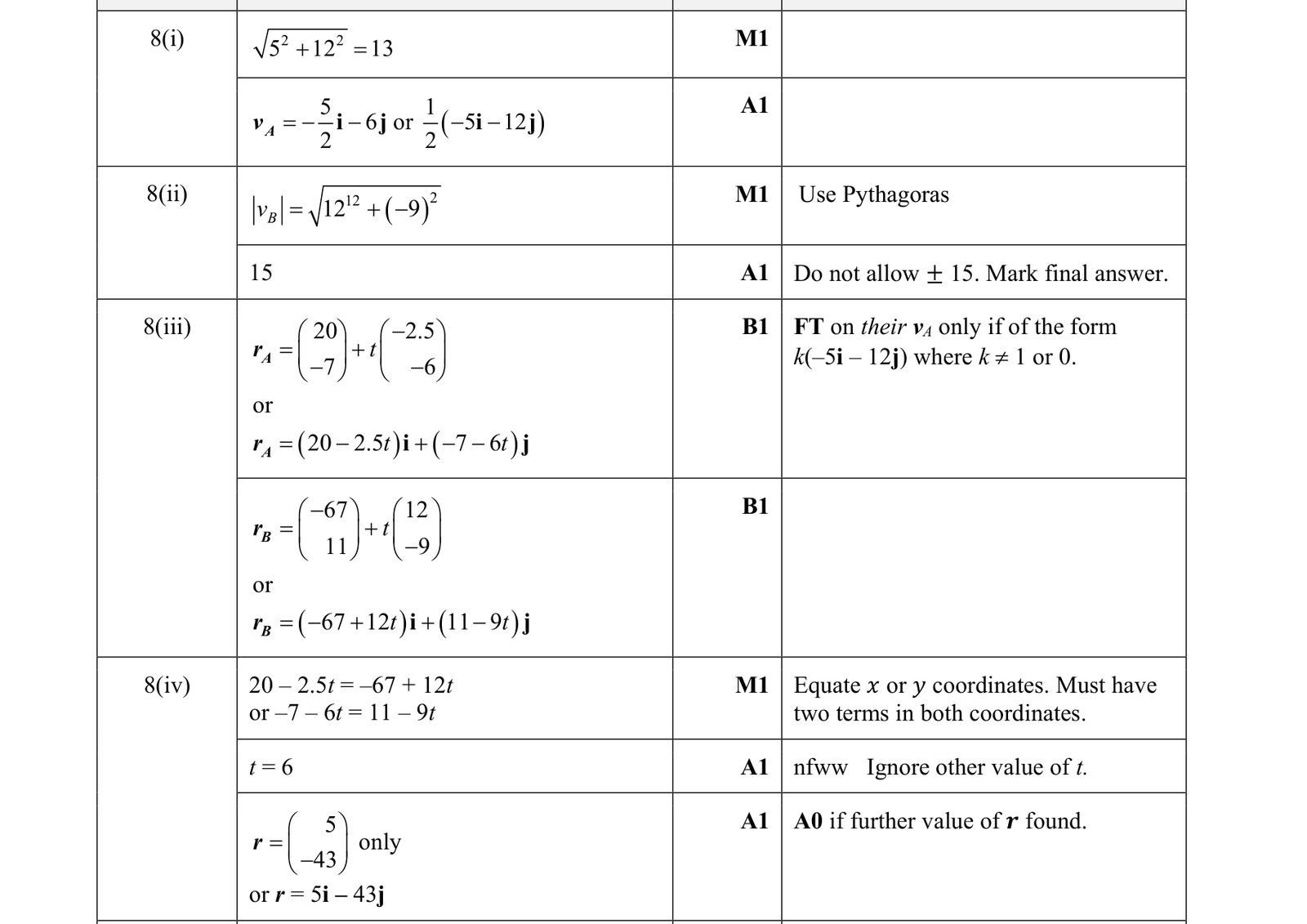
(i) A particle \(A\) travels with a speed of \(6.5\text{ m s}^{-1}\) in the direction \(-5\mathbf{i}-12\mathbf{j}\). Find the velocity \(\mathbf{v}_A\) of \(A\).
(ii) A particle \(B\) travels with velocity \(\mathbf{v}_B=12\mathbf{i}-9\mathbf{j}\). Find the speed of \(B\).
Particle \(A\) starts from the point with position vector \(20\mathbf{i}-7\mathbf{j}\). At the same time particle \(B\) starts from the point with position vector \(-67\mathbf{i}+11\mathbf{j}\).
(iii) Find the position vectors \(\mathbf{r}_A\) and \(\mathbf{r}_B\) after \(t\) seconds.
(iv) Find the time when the particles collide and the position vector of the point of collision.
0606 P22 - Mar 2018 - Q5 - 4 marks
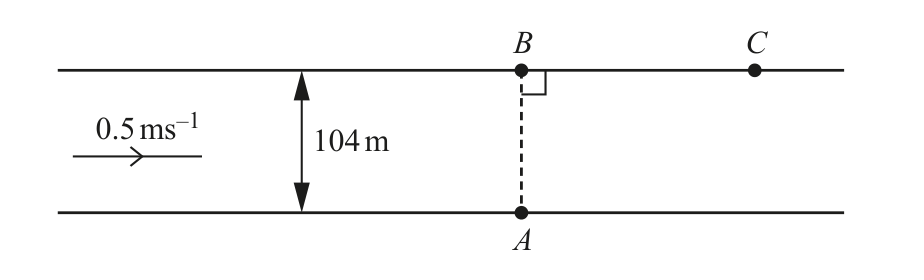
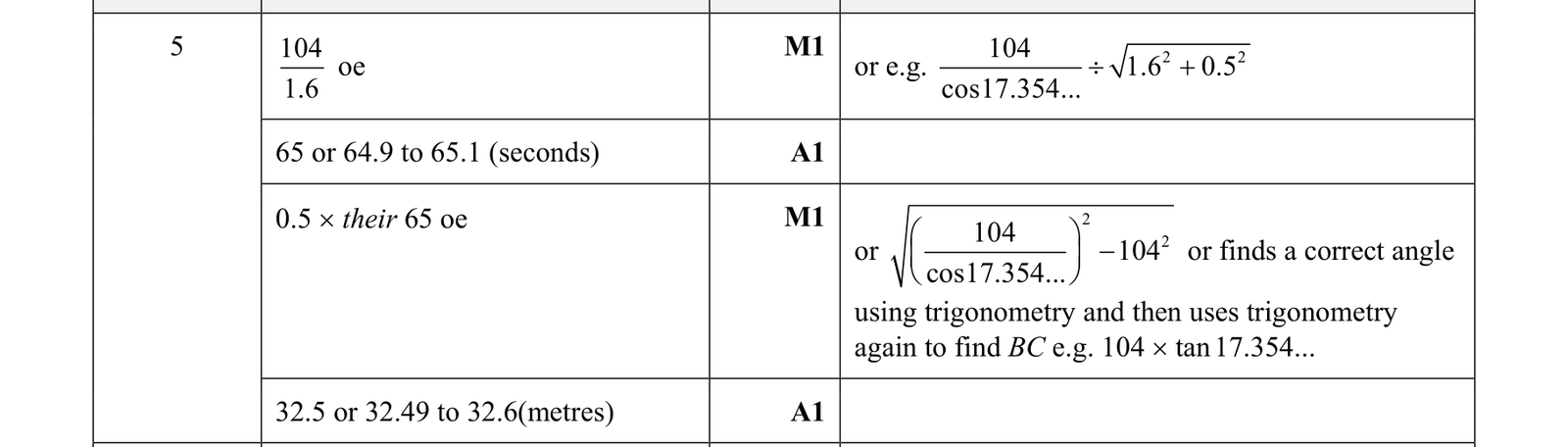
A river is \(104\) metres wide and the current flows at \(0.5\text{ m s}^{-1}\) parallel to its banks. A woman can swim at \(1.6\text{ m s}^{-1}\) in still water. She swims from point \(A\) and aims for point \(B\), which is directly opposite, but she is carried downstream to point \(C\). Calculate the time it takes the woman to swim across the river and the distance downstream, \(BC\), that she travels.
0606 P11 - Jun 2018 - Q8 - 8 marks
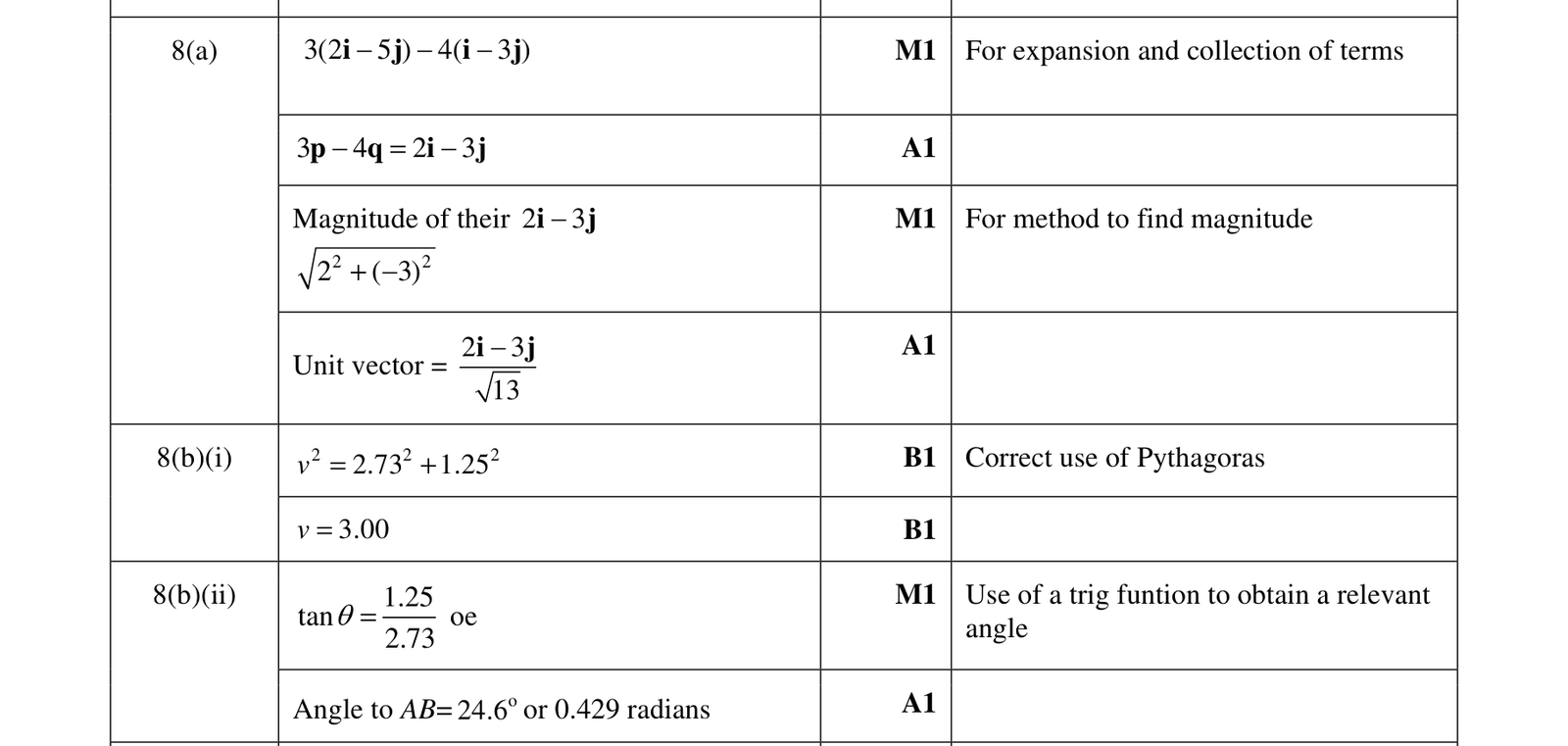
(a) Given that \(\mathbf p=2\mathbf i-5\mathbf j\) and \(\mathbf q=\mathbf i-3\mathbf j\), find the unit vector in the direction of \(3\mathbf p-4\mathbf q\).
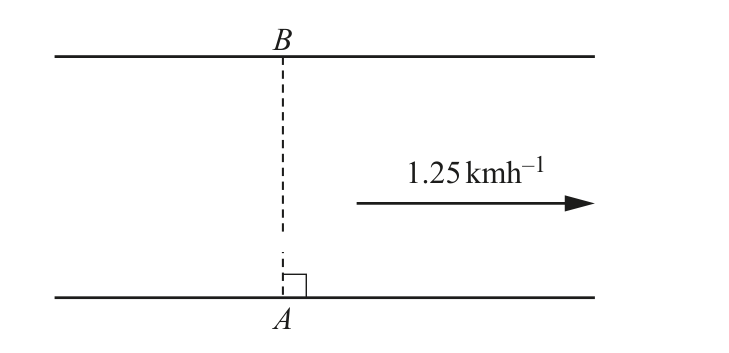
(b) A river flows between parallel banks at a speed of \(1.25\text{ km h}^{-1}\). A boy standing at point \(A\) on one bank sends a toy boat across the river to his father standing directly opposite at point \(B\). The toy boat, which can travel at \(v\text{ km h}^{-1}\) in still water, crosses the river with resultant speed \(2.73\text{ km h}^{-1}\) along the line \(AB\).
(i) Calculate the value of \(v\).
(ii) The direction in which the boy points the boat makes an angle \(\theta\) with the line \(AB\). Find the value of \(\theta\).
0606 P13 - Jun 2018 - Q8 - 8 marks
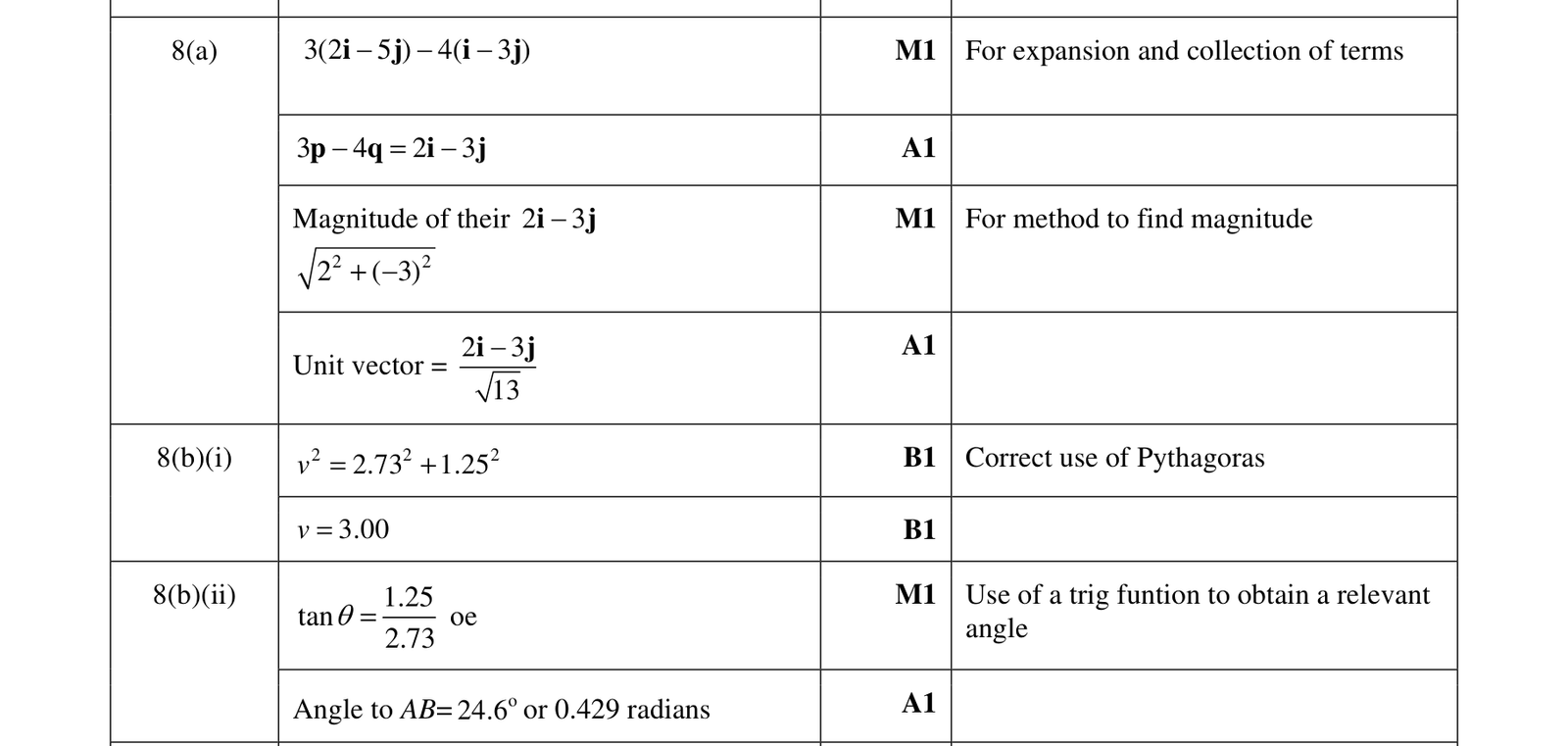
(a) Given that \(\mathbf p=2\mathbf i-5\mathbf j\) and \(\mathbf q=\mathbf i-3\mathbf j\), find the unit vector in the direction of \(3\mathbf p-4\mathbf q\).
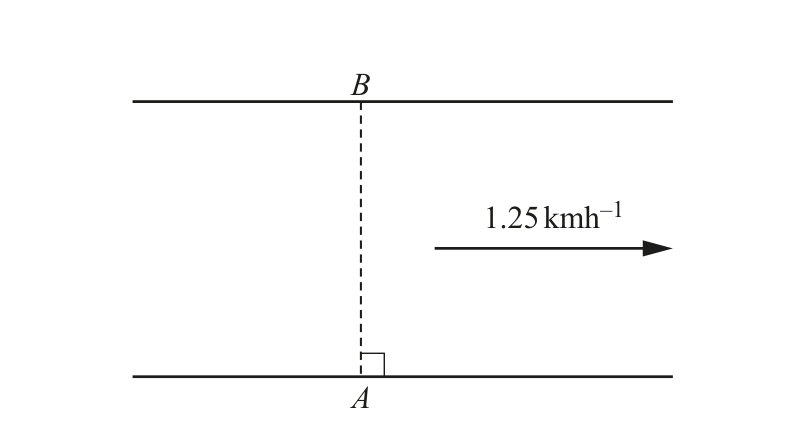
(b) A river flows between parallel banks at a speed of \(1.25\text{ km h}^{-1}\). A boy standing at point \(A\) on one bank sends a toy boat across the river to his father standing directly opposite at point \(B\). The toy boat, which can travel at \(v\text{ km h}^{-1}\) in still water, crosses the river with resultant speed \(2.73\text{ km h}^{-1}\) along the line \(AB\).
(i) Calculate the value of \(v\).
(ii) The direction in which the boy points the boat makes an angle \(\theta\) with the line \(AB\). Find the value of \(\theta\).
0606 P11 - Nov 2018 - Q10 - 9 marks
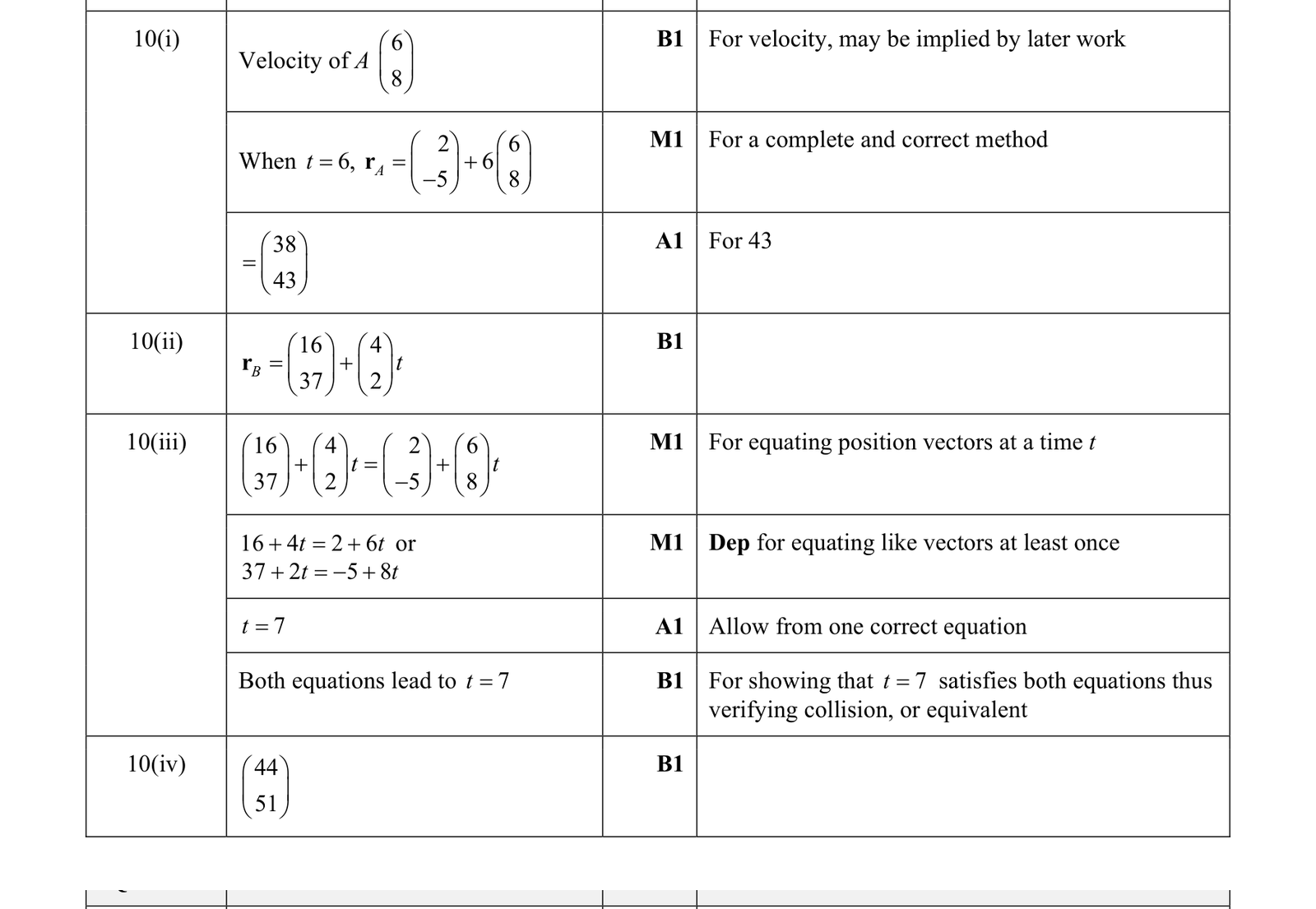
Particle \(A\) is at the point with position vector \(\begin{pmatrix}2\\-5\end{pmatrix}\) at time \(t=0\) and moves with a speed of \(10\text{ m s}^{-1}\) in the same direction as \(\begin{pmatrix}3\\4\end{pmatrix}\).
(i) Given that \(A\) is at the point with position vector \(\begin{pmatrix}38\\a\end{pmatrix}\) when \(t=6\) s, find the value of \(a\).
Particle \(B\) is at the point with position vector \(\begin{pmatrix}16\\37\end{pmatrix}\) at time \(t=0\) and moves with velocity \(\begin{pmatrix}4\\2\end{pmatrix}\text{ m s}^{-1}\).
(ii) Write down, in terms of \(t\), the position vector of \(B\) at time \(t\) seconds.
(iii) Verify that particles \(A\) and \(B\) collide.
(iv) Write down the position vector of the point of collision.
0606 P22 - Nov 2018 - Q12 - 6 marks
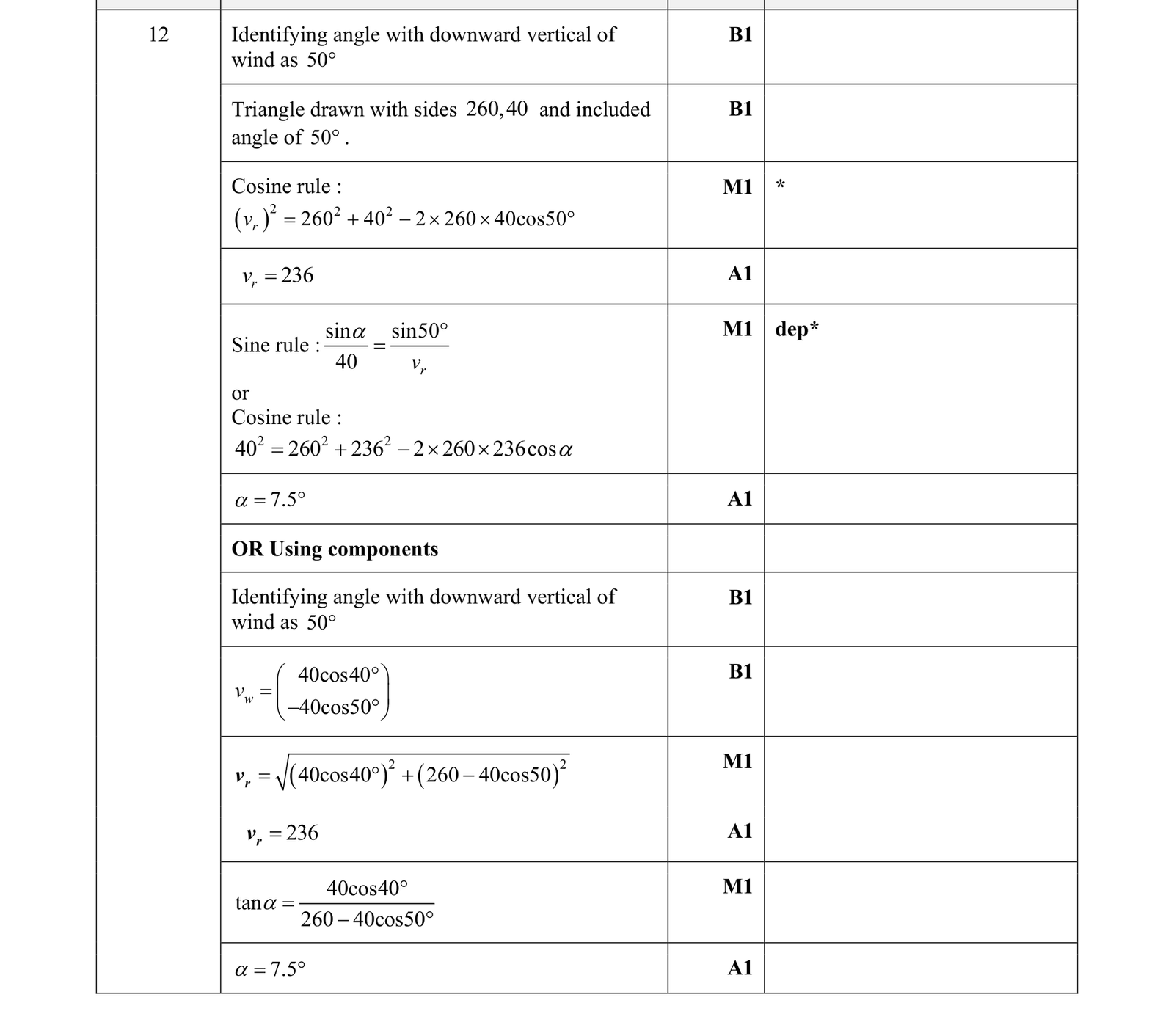
A plane that can travel at \(260\text{ km/h}\) in still air heads due North. A wind with speed \(40\text{ km/h}\) from a bearing of \(310^\circ\) blows the plane off course.
Find the resultant speed of the plane and its direction as a bearing correct to \(1\) decimal place.
0606 P12 - Nov 2017 - Q8 - 10 marks
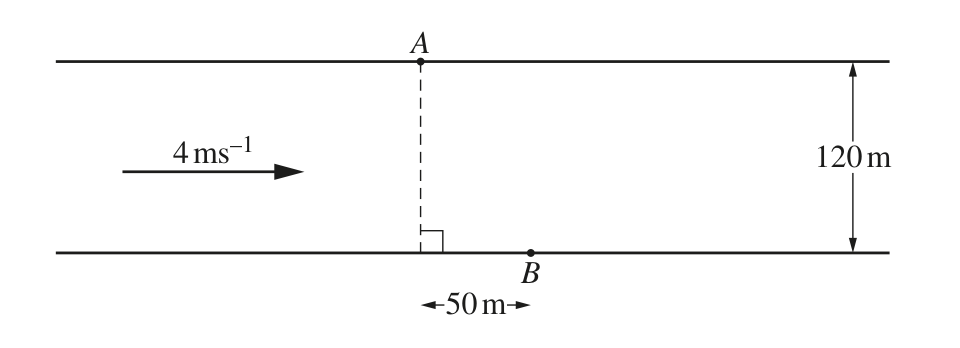
The diagram shows a river which is \(120\) m wide and is flowing at \(4\text{ m s}^{-1}\). Points \(A\) and \(B\) are on opposite sides of the river such that \(B\) is \(50\) m downstream from \(A\). A man needs to cross the river from \(A\) to \(B\) in a boat which can travel at \(5\text{ m s}^{-1}\) in still water.
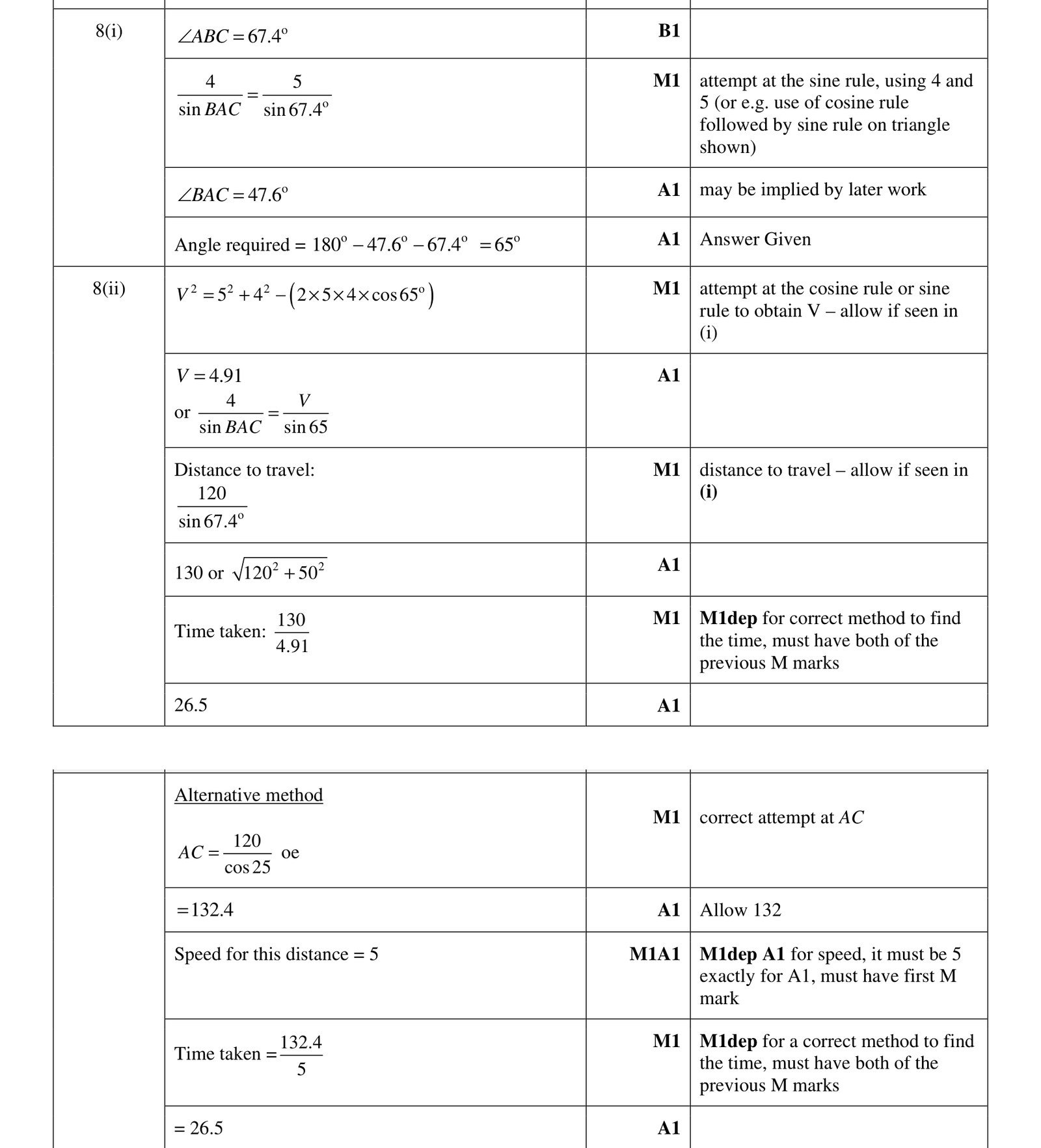
(i) Show that the man must point his boat upstream at an angle of approximately \(65^\circ\) to the bank.
(ii) Find the time the man takes to cross the river from \(A\) to \(B\).
0606 P21 - Nov 2017 - Q10 - 9 marks
In this question \(\mathbf i\) is a unit vector due east and \(\mathbf j\) is a unit vector due north. Units of length and velocity are metres and metres per second respectively.
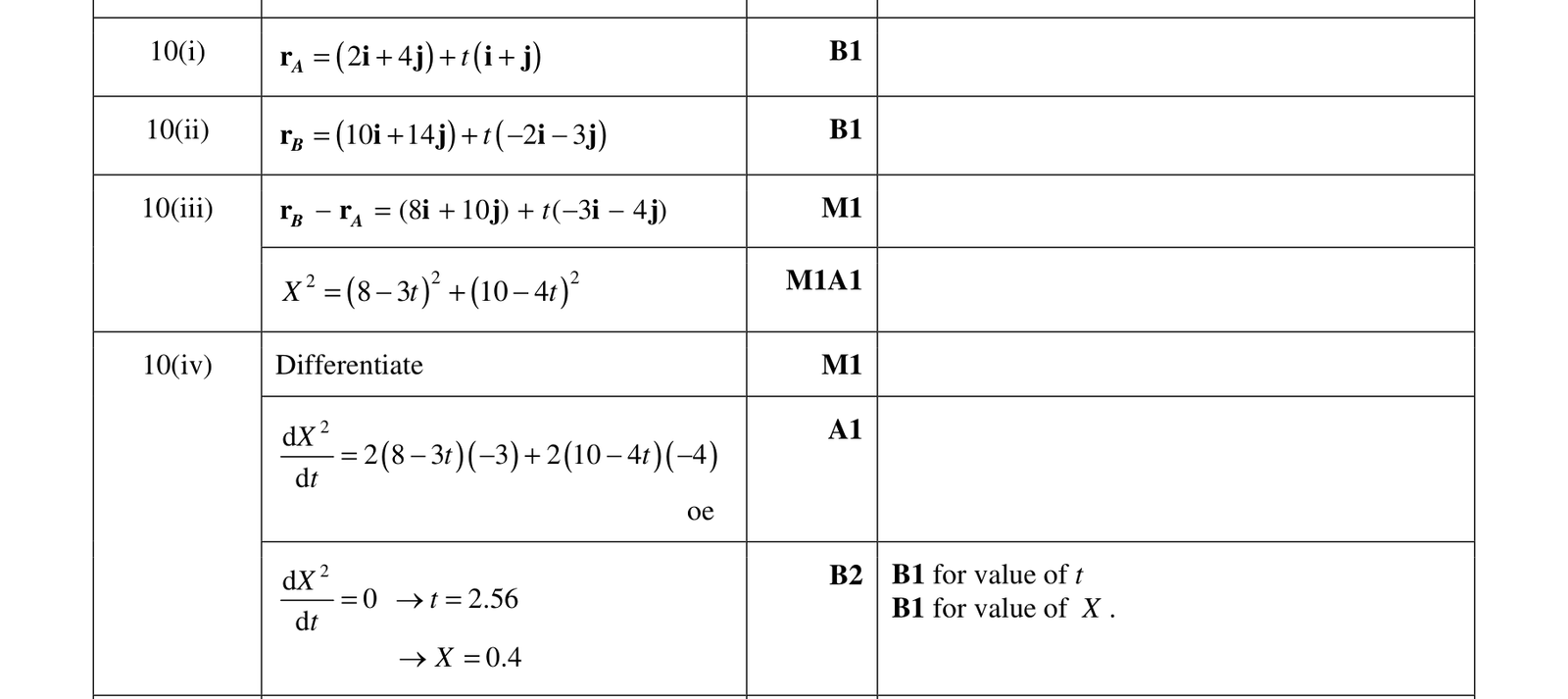
The initial position vectors of particles \(A\) and \(B\), relative to a fixed point \(O\), are \(2\mathbf i+4\mathbf j\) and \(10\mathbf i+14\mathbf j\) respectively. Particles \(A\) and \(B\) start moving at the same time. \(A\) moves with constant velocity \(\mathbf i+\mathbf j\) and \(B\) moves with constant velocity \(-2\mathbf i-3\mathbf j\). Find
(i) the position vector of \(A\) after \(t\) seconds,
(ii) the position vector of \(B\) after \(t\) seconds.
It is given that \(X\) is the distance between \(A\) and \(B\) after \(t\) seconds.
(iii) Show that \(X^2=(8-3t)^2+(10-4t)^2\).
(iv) Find the value of \(t\) for which \((8-3t)^2+(10-4t)^2\) has a stationary value and the corresponding value of \(X\).
0606 P23 - Nov 2017 - Q8 - 8 marks
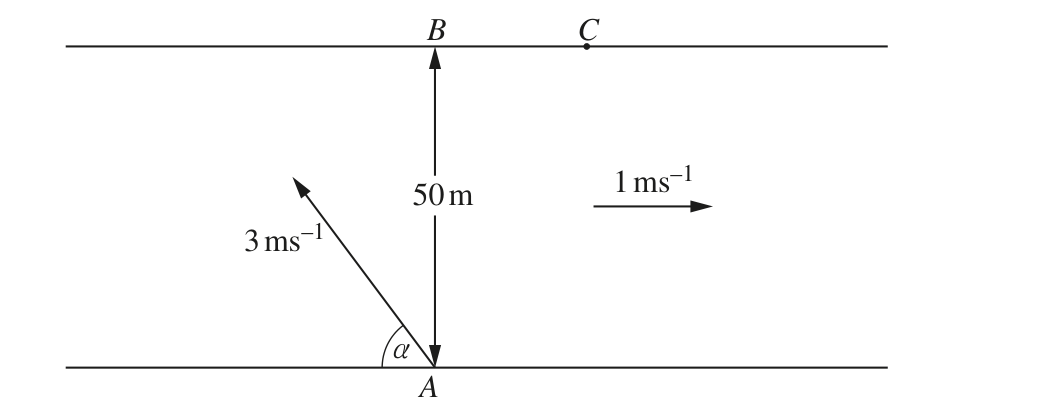
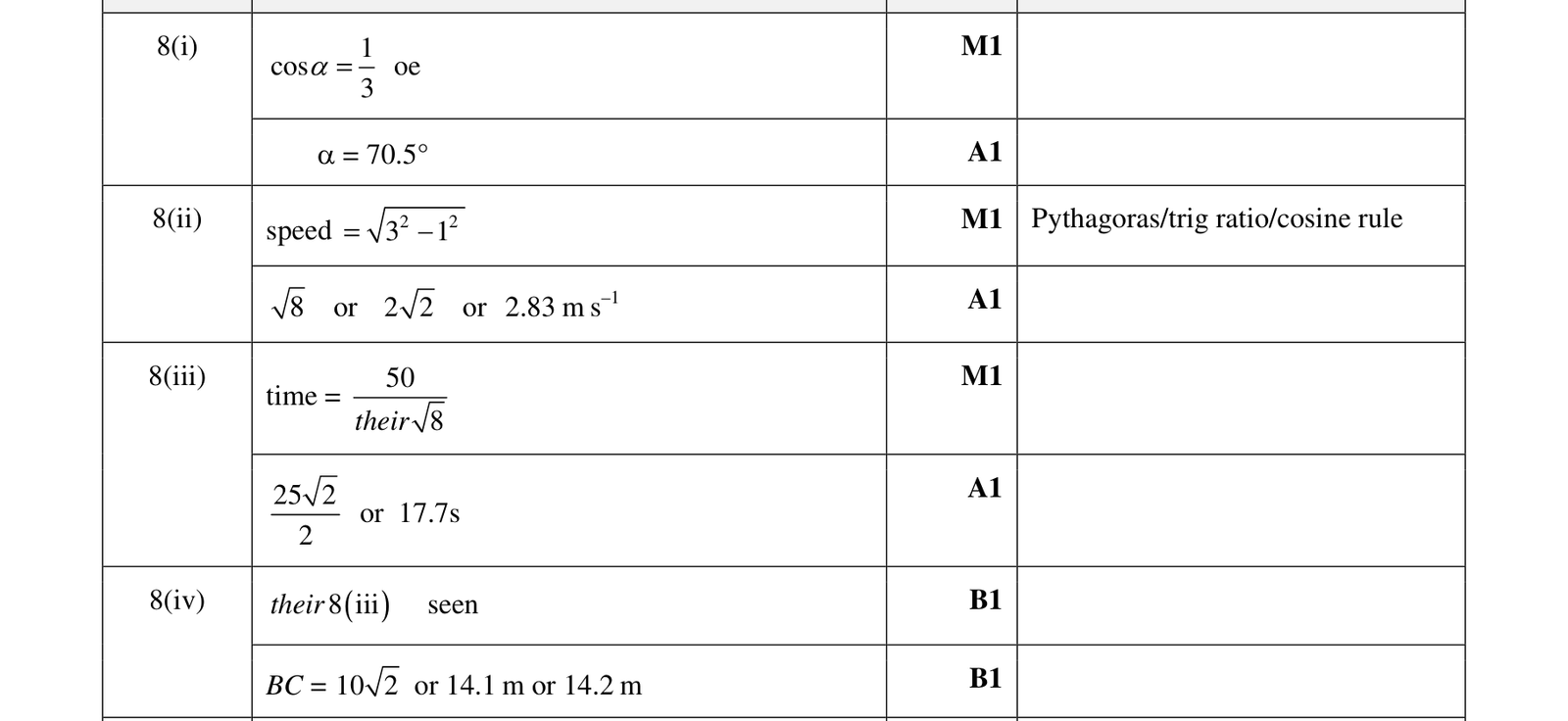
A man can row a boat at \(3\text{ m s}^{-1}\) in still water. He wants to cross a river from \(A\) to \(B\), where \(AB\) is perpendicular to both banks. The river is \(50\text{ m}\) wide and flows at \(1\text{ m s}^{-1}\). The man points his boat at an angle \(\alpha^\circ\) to the bank.
(i) Find \(\alpha\).
(ii) Find the resultant speed of the boat from \(A\) to \(B\).
(iii) Find the time taken to travel from \(A\) to \(B\).
On another occasion the man points the boat in the same direction, but the river speed is \(1.8\text{ m s}^{-1}\), so he lands at \(C\).
(iv) State the time taken to travel from \(A\) to \(C\), and hence find \(BC\).
9231 P23 - Jun 2017 - Q1 - 5 marks
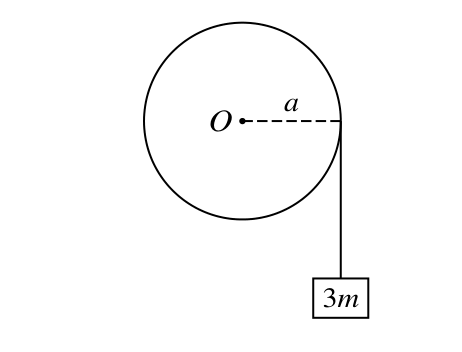
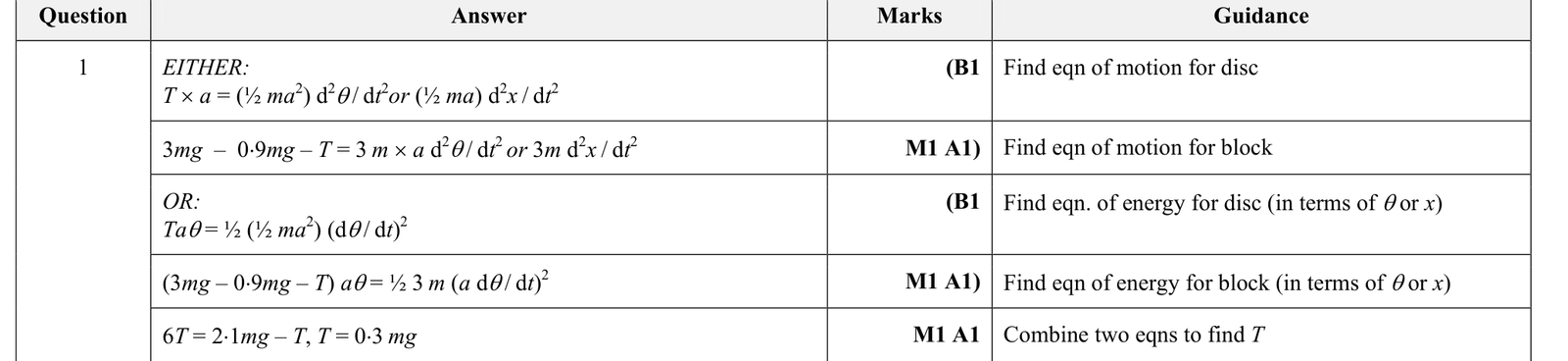
A uniform disc with centre \(O\), mass \(m\) and radius \(a\) is free to rotate without resistance in a vertical plane about a horizontal axis through \(O\). One end of a light inextensible string is attached to the rim of the disc and wrapped around the rim. The other end of the string is attached to a block of mass \(3 m\) (see diagram). The system is released from rest with the block hanging vertically. While the block is in motion, it experiences a constant vertical resisting force of magnitude 0.9 mg . Find the tension in the string in terms of \(m\) and \(g\).
9231 P21 - Nov 2018 - Q3 - 9 marks
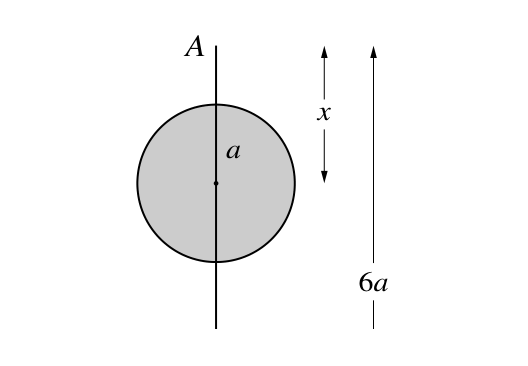
A uniform disc, of radius \(a\) and mass \(2 M\), is attached to a thin uniform rod \(A B\) of length \(6 a\) and mass \(M\). The rod lies along a diameter of the disc, so that the centre of the disc is a distance \(x\) from \(A\) (see diagram).
(i) Find the moment of inertia of the object, consisting of disc and rod, about a fixed horizontal axis \(l\) through \(A\) and perpendicular to the plane of the disc.
The object is free to rotate about the axis \(l\). The object is held with \(A B\) horizontal and is released from rest. When \(A B\) makes an angle \(\theta\) with the vertical, where \(\cos \theta=\frac{3}{5}\), the angular speed of the object is \(\sqrt{ }\left(\frac{2 g}{5 a}\right)\).
(ii) Find the possible values of \(x\).

9231 P22 - Nov 2018 - Q5 - 11 marks
An object is formed from a uniform circular disc, of radius \(2 a\) and mass \(3 M\), and a uniform \(\operatorname{rod} A B\), of length \(3 a\) and mass \(k M\), where \(k\) is a constant. The centre of the disc is \(O\). The end \(B\) of the rod is rigidly joined to a point on the circumference of the disc so that \(O B A\) is a straight line. The fixed horizontal axis \(l\) is in the plane of the object, passes through \(A\) and is perpendicular to \(A B\).
(i) Show that the moment of inertia of the object about the axis \(l\) is \(3 M a^{2}(26+k)\).
The object is free to rotate about \(l\).
(ii) Show that small oscillations of the object about \(l\) are approximately simple harmonic. Given that the period of these oscillations is \(4 \pi \sqrt{ }\left(\frac{a}{g}\right)\), find the value of \(k\).

9231 P21 - Jun 2017 - Q4 - 10 marks
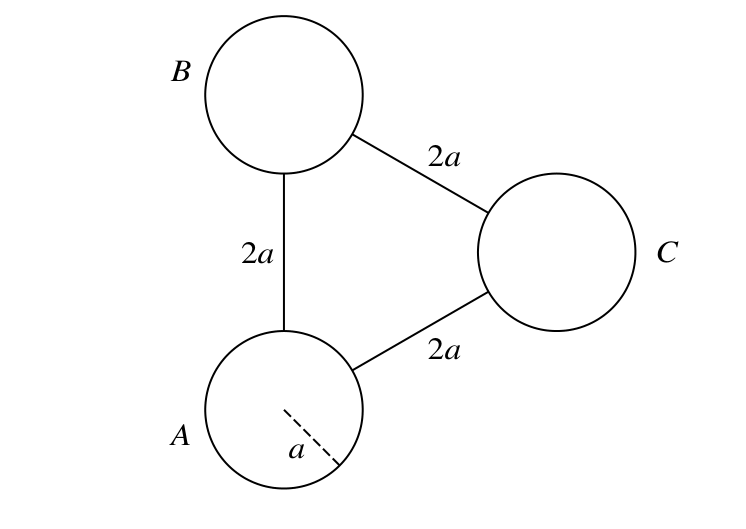
Three identical uniform discs, \(A, B\) and \(C\), each have mass \(m\) and radius \(a\). They are joined together by uniform rods, each of which has mass \(\frac{1}{3} m\) and length \(2 a\). The discs lie in the same plane and their centres form the vertices of an equilateral triangle of side \(4 a\). Each rod has one end rigidly attached to the circumference of a disc and the other end rigidly attached to the circumference of an adjacent disc, so that the rod lies along the line joining the centres of the two discs (see diagram).
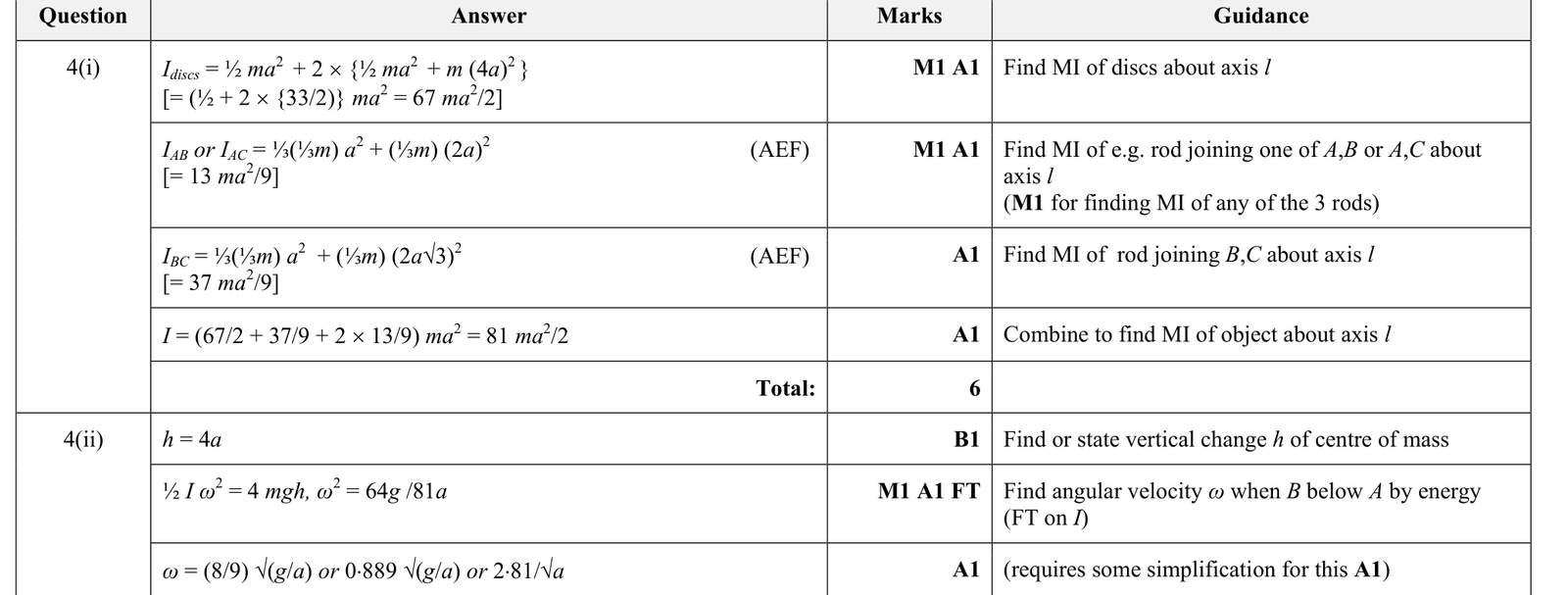
(i) Find the moment of inertia of this object about an axis \(l\), which is perpendicular to the plane of the object and through the centre of disc \(A\).
The object is free to rotate about the horizontal axis \(l\). It is released from rest in the position shown, with the centre of disc \(B\) vertically above the centre of \(\operatorname{disc} A\).
(ii) Write down the change in the vertical position of the centre of mass of the object when the centre of disc \(B\) is vertically below the centre of disc \(A\). Hence find the angular velocity of the object when the centre of disc \(B\) is vertically below the centre of disc \(A\).
9231 P21 - Nov 2017 - Q5 - 12 marks
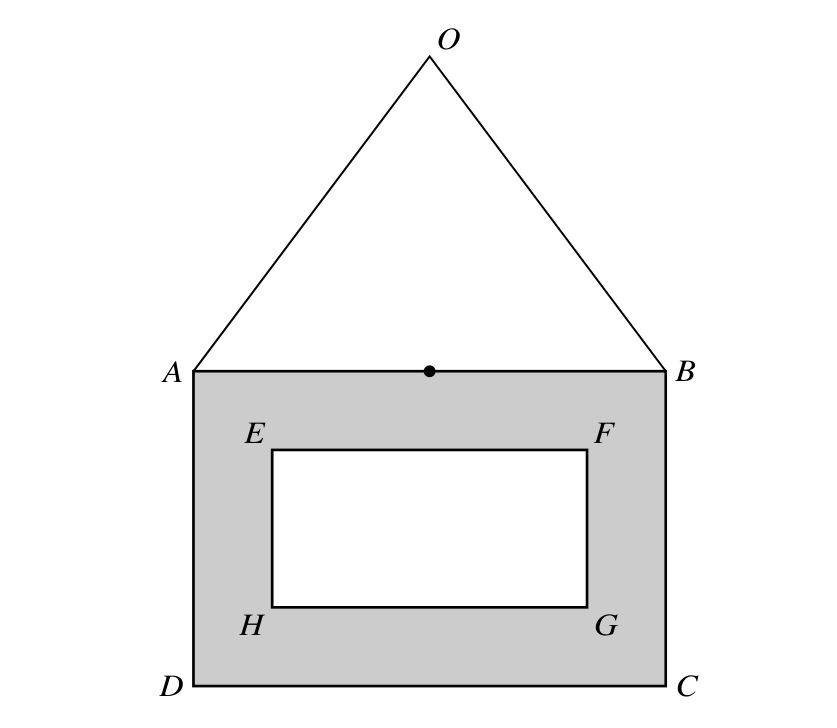
A uniform picture frame of mass \(m\) is made by removing a rectangular lamina \(E F G H\) in which \(E F=4 a\) and \(F G=2 a\) from a larger rectangular lamina \(A B C D\) in which \(A B=6 a\) and \(B C=4 a\). The side \(E F\) is parallel to the side \(A B\). The point of intersection of the diagonals \(A C\) and \(B D\) coincides with the point of intersection of the diagonals \(E G\) and \(F H\). One end of a light inextensible string of length \(10 a\) is attached to \(A\) and the other end is attached to \(B\). The frame is suspended from the mid-point \(O\) of the string. A small object of mass \(\frac{11}{12} m\) is fixed to the mid-point of \(A B\) (see diagram).
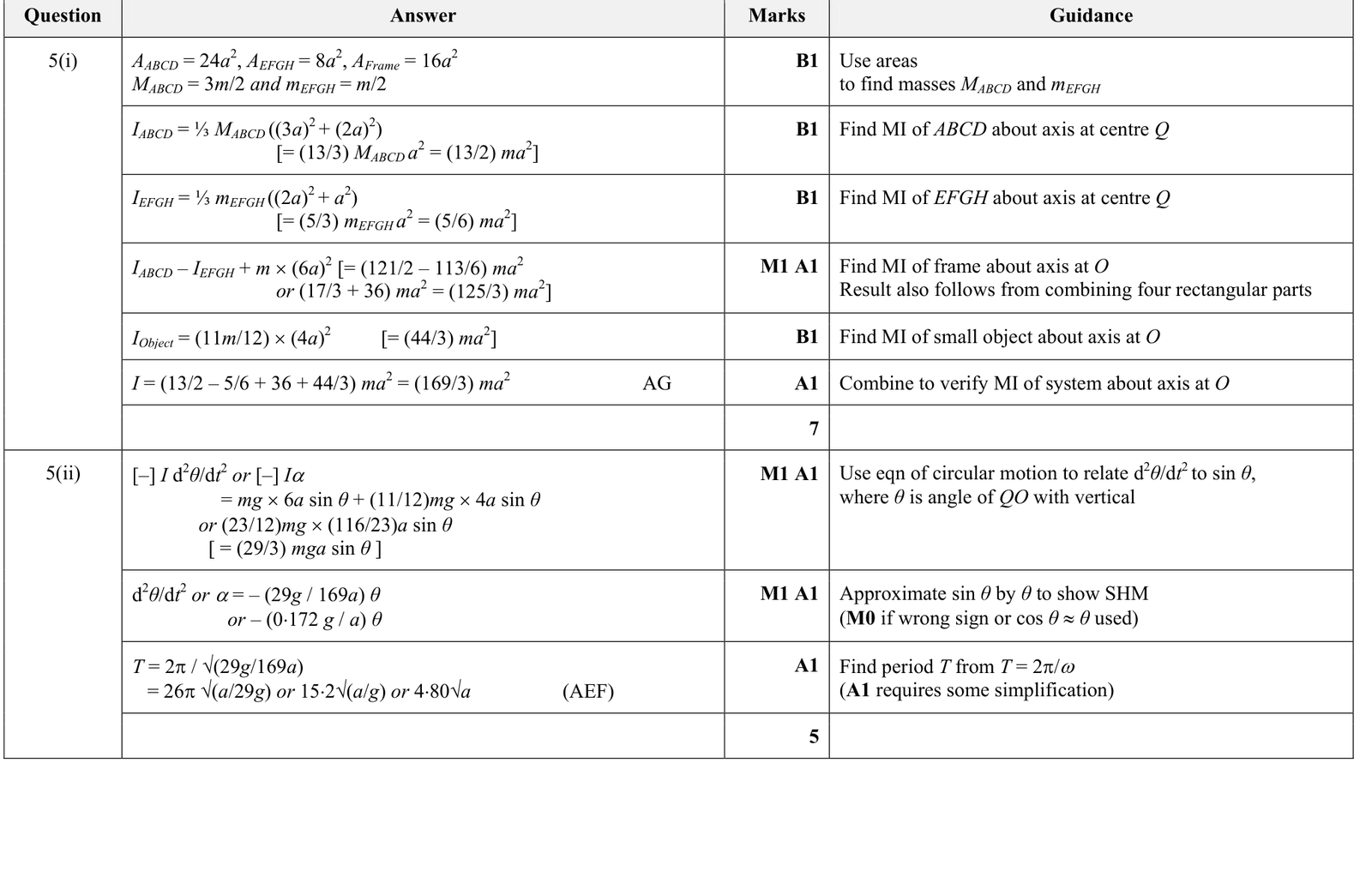
(i) Show that the moment of inertia of the system, consisting of frame and small object, about an axis through \(O\) perpendicular to the plane of the frame, is \(\frac{169}{3} m a^{2}\).
(ii) Show that small oscillations of the system about this axis are approximately simple harmonic and state their period.
9231 P21 - Jun 2018 - Q5 - 12 marks
Axis \(l\)
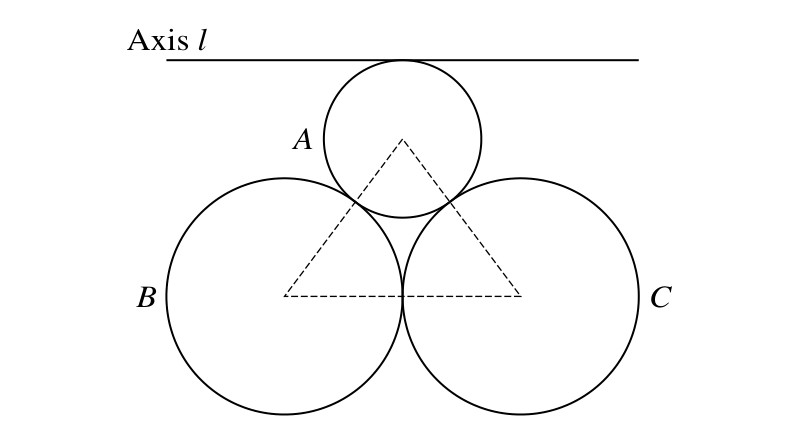
Three thin uniform rings \(A, B\) and \(C\) are joined together, so that each ring is in contact with each of the other two rings. Ring \(A\) has radius \(2 a\) and mass \(3 M\); rings \(B\) and \(C\) each have radius \(3 a\) and mass \(2 M\). The rings lie in the same plane and the centres of the rings are at the vertices of an isosceles triangle. The object consisting of the three rings is free to rotate about the horizontal axis \(l\) which is tangential to ring \(A\), in the plane of the object and perpendicular to the line of symmetry of the object (see diagram).
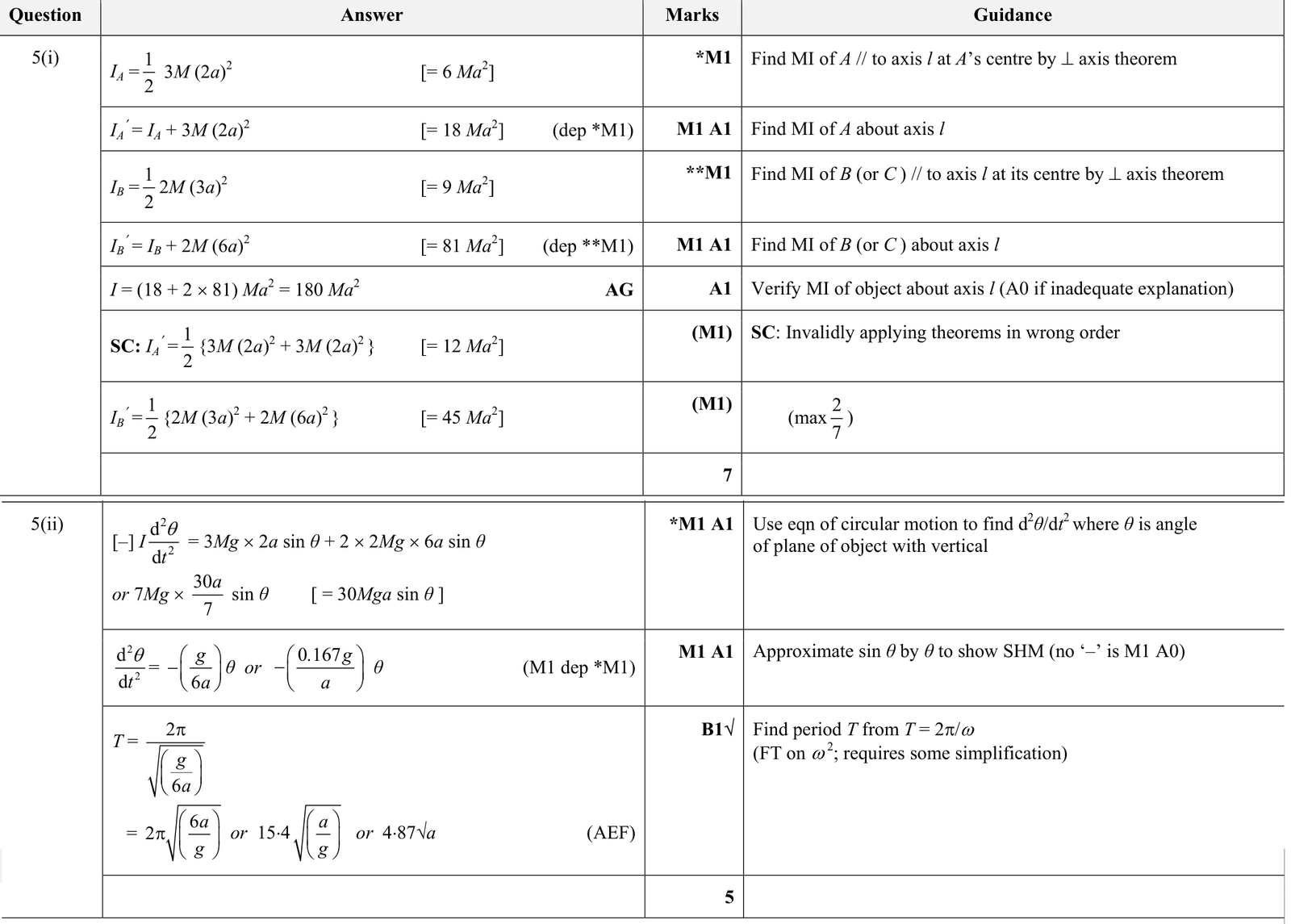
(i) Show that the moment of inertia of the object about the axis \(l\) is \(180 M a^{2}\).
(ii) Show that small oscillations of the object about the axis \(l\) are approximately simple harmonic, and state the period.
9231 P23 - Jun 2018 - Q11E - 14 marks
Question 11 EITHER alternative.
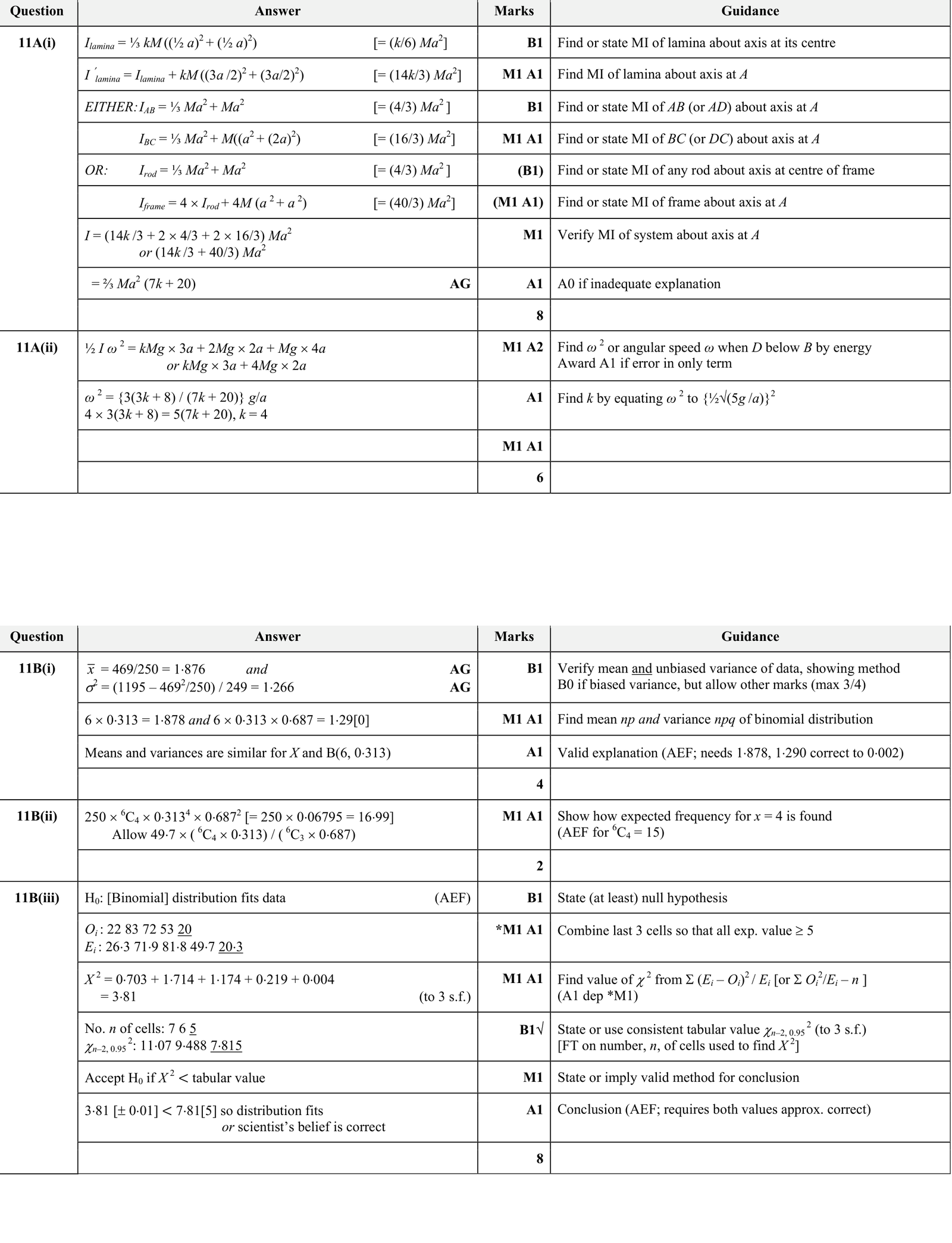
An object is formed from a square frame \(A B C D\) with a square lamina attached in one corner of the frame. The frame consists of four identical thin rods, each of mass \(M\) and length \(2a\). The lamina has mass \(kM\) and edges of length \(a\). It has one vertex at \(C\) and adjacent sides in contact with \(C B\) and \(C D\).
(i) Show that the moment of inertia of the object about an axis \(l\) through \(A\) perpendicular to the plane of the object is
\[\frac23Ma^2(7k+20).\]
The object is released from rest with the edge \(AB\) horizontal and \(D\) vertically above \(A\). The object rotates freely about the fixed axis \(l\). The angular speed of the object is \(\frac12\sqrt{\frac{5g}{a}}\) when \(D\) is first vertically below \(A\).
(ii) Find the value of \(k\).
9231 P31 - Nov 2025 - Q5 - 9 marks
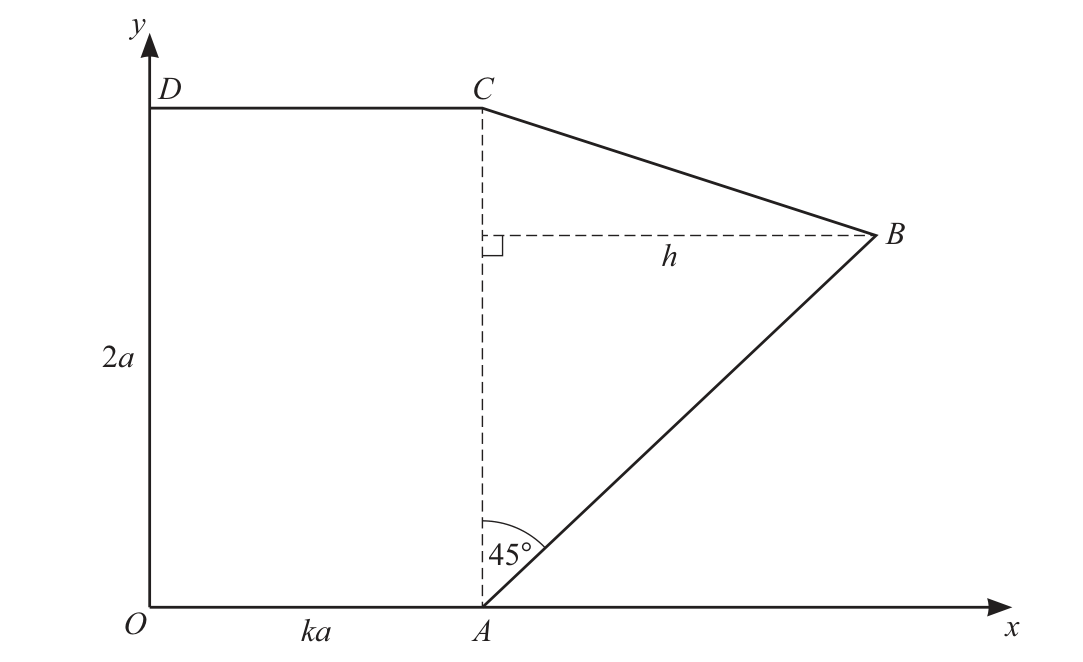
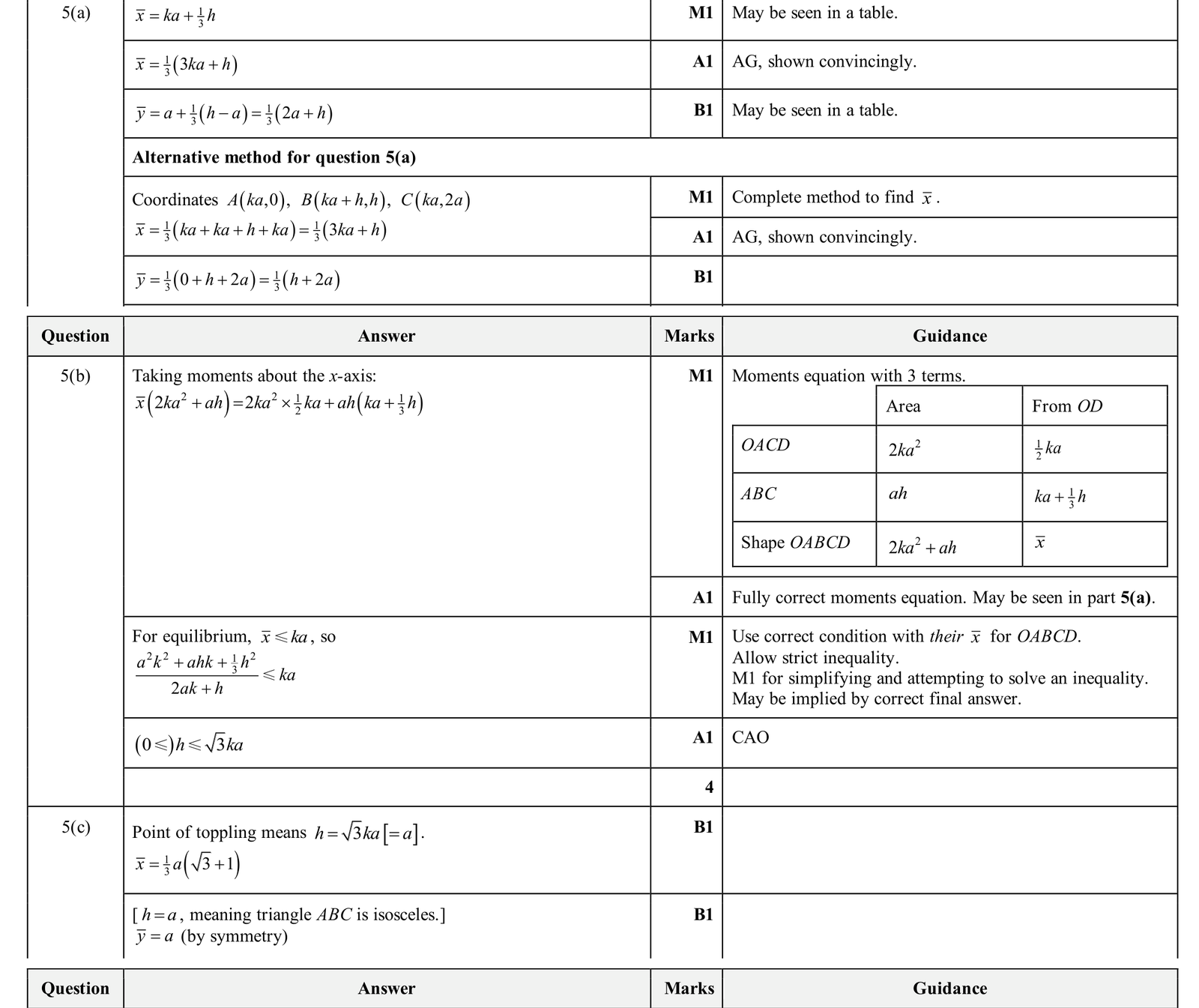
A uniform lamina \(O A B C D\) consists of a rectangle \(O A C D\) and a triangle \(A B C\). The length of \(O A\) is \(k a\), the length of \(O D\) is \(2 a\), the height of triangle \(A B C\) is \(h\) and angle \(C A B\) is \(45^{\circ}\) (see diagram). Relative to axes through \(O\), parallel and perpendicular to \(O A\) as shown, the centre of mass of triangle \(A B C\) is \((\bar{x}, \bar{y})\). (a) Show that \(\bar{x}\) is \(\frac{1}{3}(3 k a+h)\), and find an expression for \(\bar{y}\).
The lamina \(O A B C D\) is placed vertically on its edge \(O A\) on a horizontal plane. (b) Find, in terms of \(a\) and \(k\), the set of values of \(h\) for which the lamina is in equilibrium.
It is now given that \(k=\frac{\sqrt{3}}{3}\) and that the lamina is on the point of toppling. (c) Find, in terms of \(a\), the coordinates of the centre of mass of the triangle \(A B C\).