Past Exam Questions
← Back9231 P32 - Nov 2025 - Q3 - 6 marks
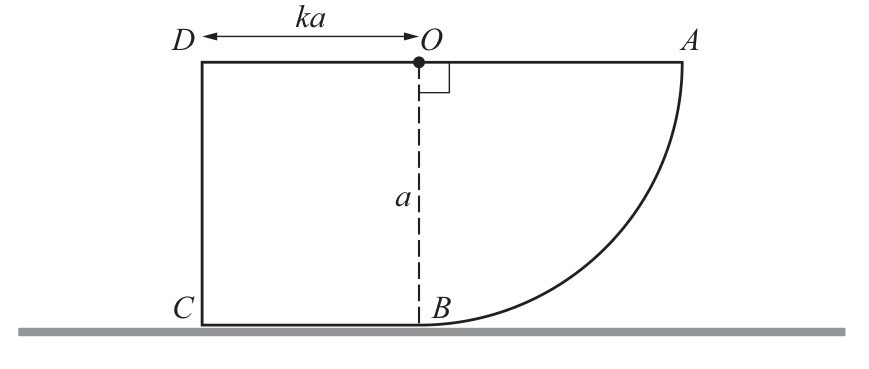
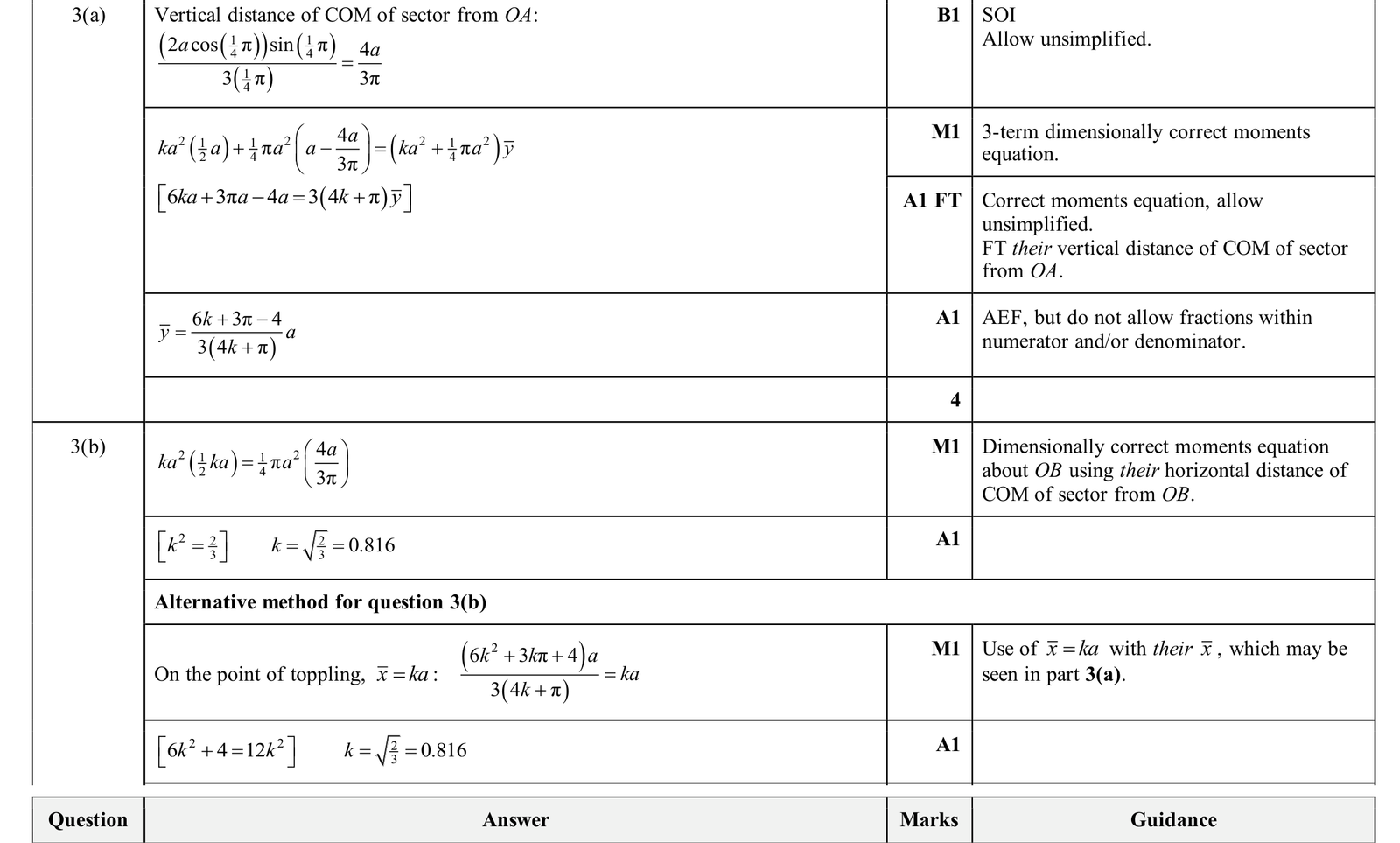
A uniform lamina \(O A B C D\) is in the form of a rectangle, \(O B C D\), joined along the edge \(O B\) to a quarter circle \(O A B\). The length of \(D O\) is \(k a\) and the length of \(O B\) is \(a\). The lamina rests in a vertical plane with its edge \(C B\) on a horizontal surface (see diagram). (a) Find, in terms of \(k, a\) and \(\pi\), an expression for the distance of the centre of mass above the horizontal surface. [You may use without proof the result for the centre of mass of a circular sector in the list of formulae (MF19).]
The lamina is on the point of toppling about \(B\). (b) Find the value of \(k\).
9231 P34 - Nov 2025 - Q3 - 7 marks
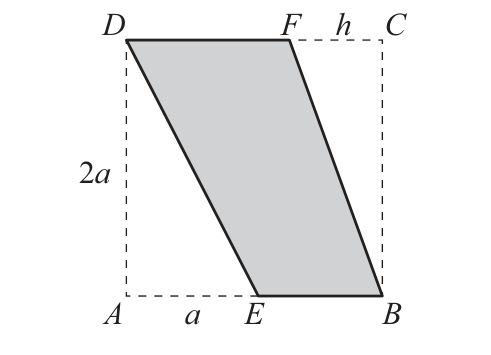
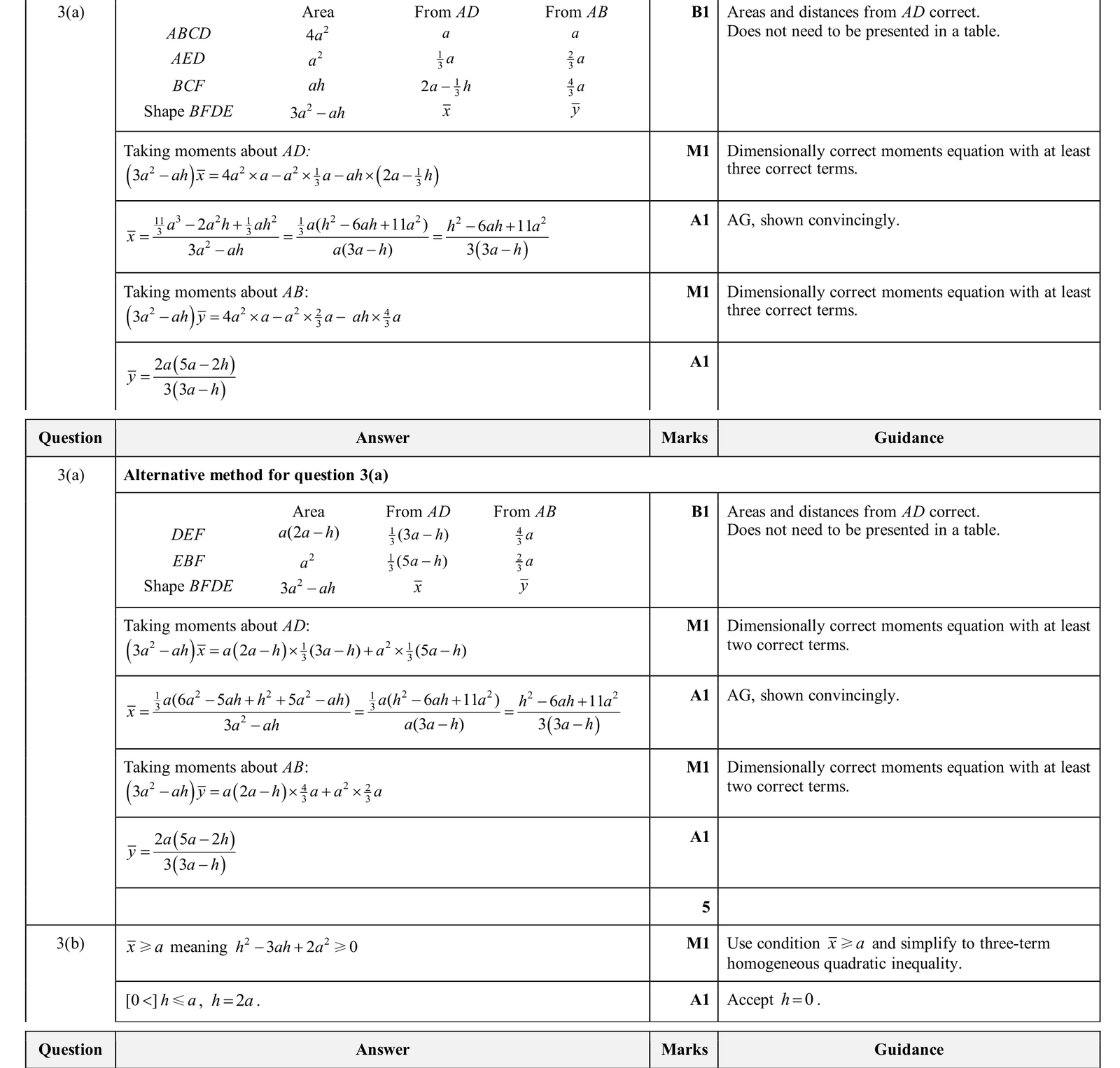
The lamina \(B F D E\) is obtained by removing triangles \(A E D\) and \(B C F\) from a uniform square lamina \(A B C D\) of side \(2 a\). The length of side \(A E\) is \(a\) and the length of side \(F C\) is \(h\) (see diagram). The centre of mass of \(B F D E\) is at a distance \(\bar{x}\) from \(A D\), and at a distance \(\bar{y}\) from \(A B\). (a) Show that \(\bar{x}=\frac{h^{2}-6 a h+11 a^{2}}{3(3 a-h)}\) and find a corresponding expression for \(\bar{y}\).
(b) The lamina \(B F D E\) is placed vertically on its edge \(E B\) on a smooth horizontal surface.
Find, in terms of \(a\), the set of possible values of \(h\) for which the lamina remains in equilibrium.
9231 P33 - Jun 2025 - Q4 - 4 marks
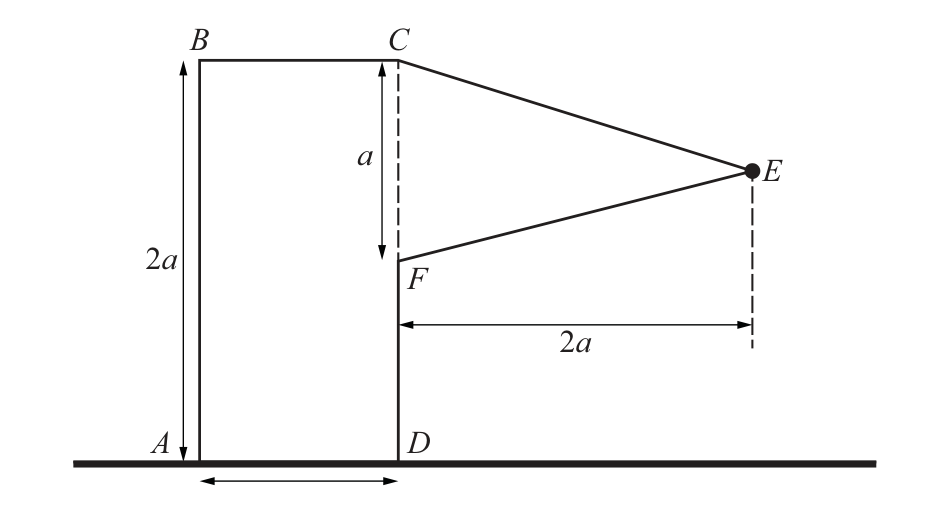
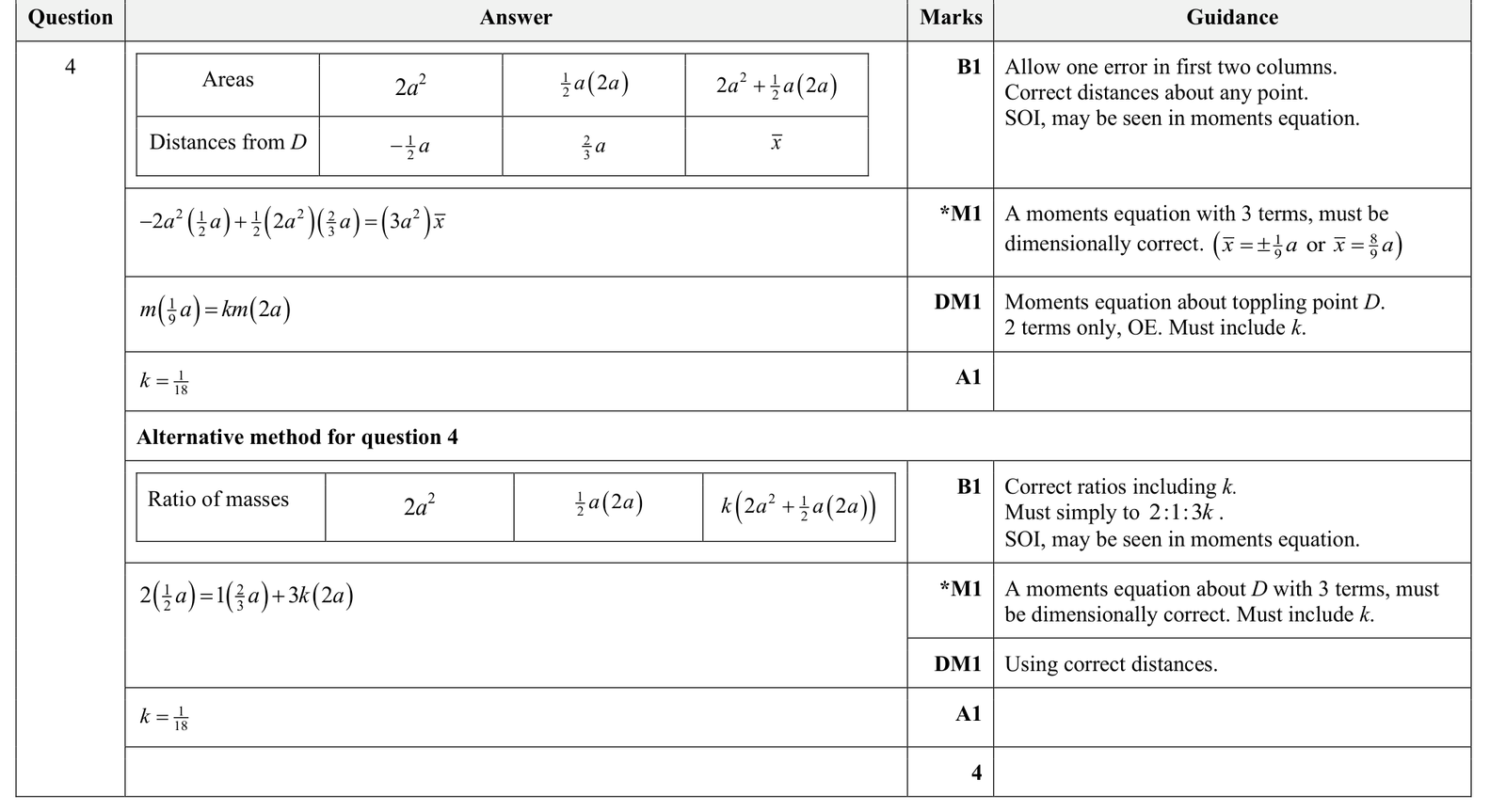
An object consists of a uniform lamina with a particle attached. The lamina \(ABCEFD\), of mass \(m\), is formed from a rectangle \(ABCD\) and an isosceles triangle \(CEF\), where \(F\) is the midpoint of \(CD\). The rectangle has sides \(AB=2a\) and \(AD=a\). The triangle has base \(a\) and height \(2a\). A particle of mass \(km\) is attached at \(E\). The object rests with edge \(AD\) on horizontal ground and is on the point of toppling about \(D\). Find \(k\).
9231 P34 - Jun 2025 - Q5 - 8 marks
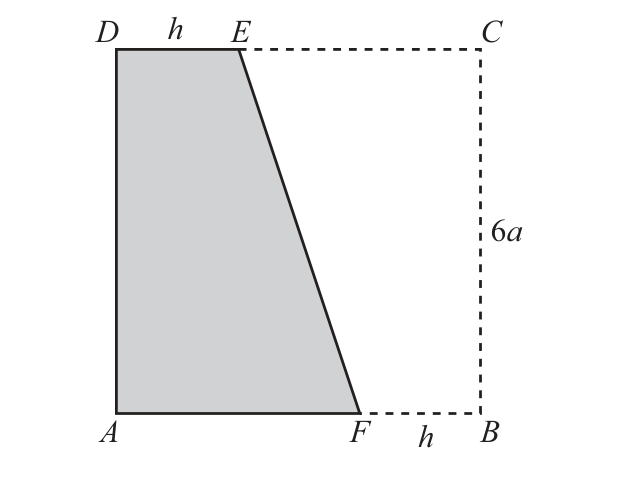
\(ABCD\) is a uniform square lamina of side \(6a\). Points \(E\) and \(F\) are on \(DC\) and \(AB\), respectively, and are such that \(DE=FB=h\). The quadrilateral \(BCEF\) is removed from the square lamina.
(a) Show that the distance of the centre of mass of the resulting lamina \(AFED\) from \(AD\) is \(\dfrac{h^2-6ah+36a^2}{18a}\), and find a corresponding expression for the distance of the centre of mass from \(AB\).
When the lamina \(AFED\) is suspended from the point \(D\), the edge \(DA\) makes an angle \(\theta\) with the downward vertical, where \(\tan\theta=\dfrac{7}{15}\).
(b) Find, in terms of \(a\), the two possible values of \(h\).

9231 P33 - Jun 2024 - Q5 - 7 marks
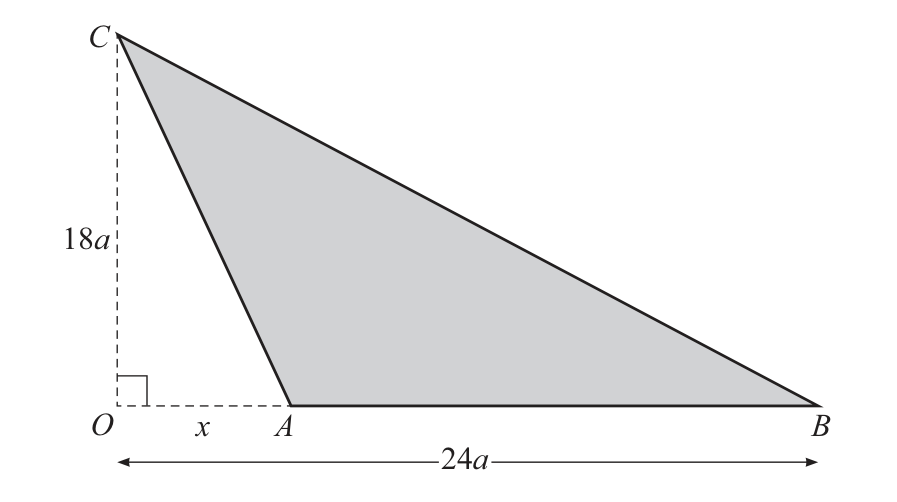
A uniform lamina is in the form of a triangle \(OBC\), with \(OC=18a\), \(OB=24a\), and \(\angle COB=90^\circ\). The point \(A\) on \(OB\) is such that \(OA=x\). The triangle \(OAC\) is removed from the lamina.
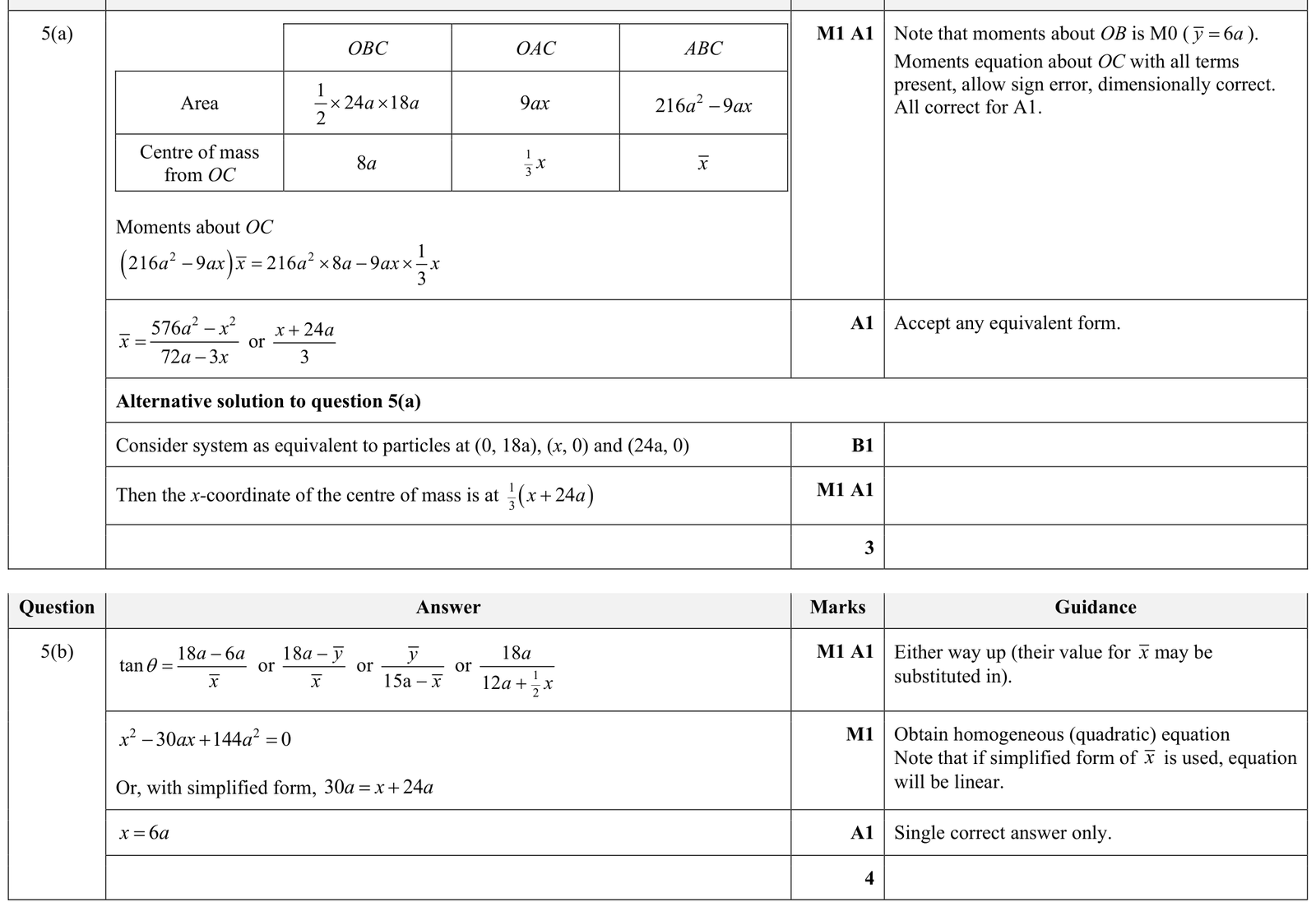
(a) Find, in terms of \(a\) and \(x\), the distance of the centre of mass of the remaining object \(ABC\) from \(OC\).
The object \(ABC\) is suspended from \(C\). In its equilibrium position, the side \(AB\) makes an angle \(\theta\) with the vertical, where \(\tan\theta=\dfrac65\).
(b) Find \(x\) in terms of \(a\).
9231 P32 - Nov 2023 - Q3 - 7 marks
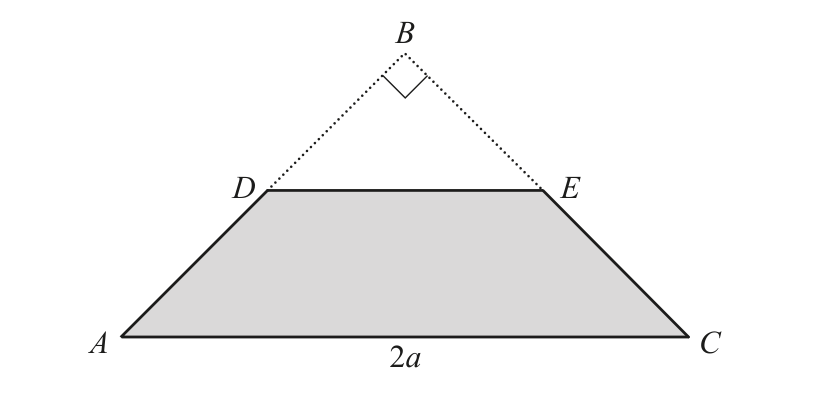
A uniform lamina is in the form of an isosceles triangle \(ABC\), in which \(AC=2a\) and \(\angle ABC=90^\circ\). The point \(D\) on \(AB\) is such that the ratio \(DB:AB=1:k\). The point \(E\) on \(CB\) is such that \(DE\) is parallel to \(AC\). The triangle \(DBE\) is removed from the lamina.
(a) Find, in terms of \(k\), the distance of the centre of mass of the remaining lamina \(ADEC\) from the midpoint of \(AC\).
When the lamina \(ADEC\) is freely suspended from the vertex \(A\), the edge \(AC\) makes an angle \(\theta\) with the downward vertical, where \(\tan\theta=\dfrac5{18}\).
(b) Find the value of \(k\).

9231 P33 - Jun 2023 - Q3 - 7 marks
A uniform lamina is in the form of a triangle \(A B C\), with \(A C=8 a, B C=6 a\) and angle \(A C B=90^{\circ}\). The point \(D\) on \(A C\) is such that \(A D=3 a\). The point \(E\) on \(C B\) is such that \(C E=x\) (see diagram). The triangle \(C D E\) is removed from the lamina.
(a) Find, in terms of \(a\) and \(x\), the distance of the centre of mass of the remaining object \(A D E B\) from \(A C\).
The object \(A D E B\) is on the point of toppling about the point \(E\) when the object is in the vertical plane with its edge \(E B\) on a smooth horizontal surface.
(b) Find \(x\) in terms of \(a\).

9231 P33 - Jun 2022 - Q1 - 4 marks
A uniform lamina \(O A B C\) is a trapezium whose vertices can be represented by coordinates in the \(x-y\) plane. The coordinates of the vertices are \(O(0,0), A(15,0), B(9,4)\) and \(C(3,4)\).
Find the \(x\)-coordinate of the centre of mass of the lamina.

9231 P32 - Nov 2022 - Q2 - 6 marks
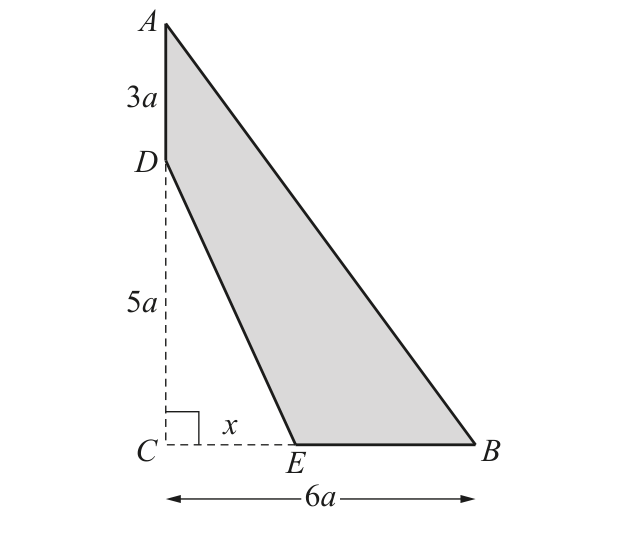
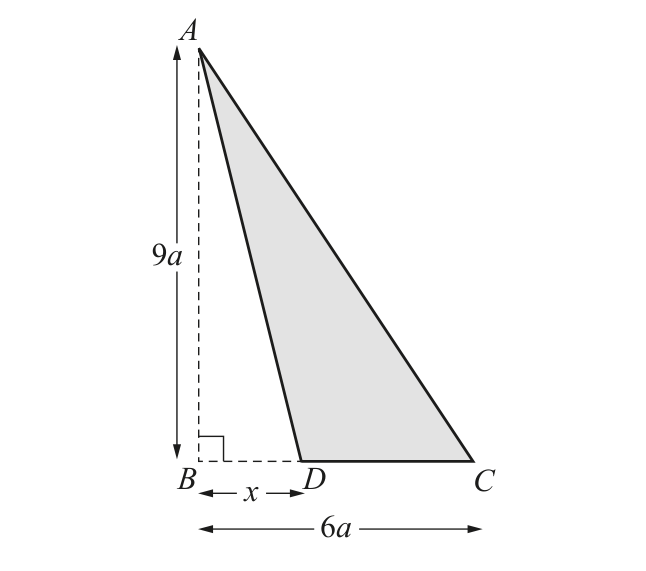
A uniform lamina is in the form of a triangle \(A B C\) in which angle \(B\) is a right angle, \(A B=9 a\) and \(B C=6 a\). The point \(D\) is on \(B C\) such that \(B D=x\) (see diagram). The region \(A B D\) is removed from the lamina. The resulting shape \(A D C\) is placed with the edge \(D C\) on a horizontal surface and the plane \(A D C\) is vertical.
Find the set of values of \(x\), in terms of \(a\), for which the shape is in equilibrium.

9231 P33 - Jun 2021 - Q1 - 3 marks
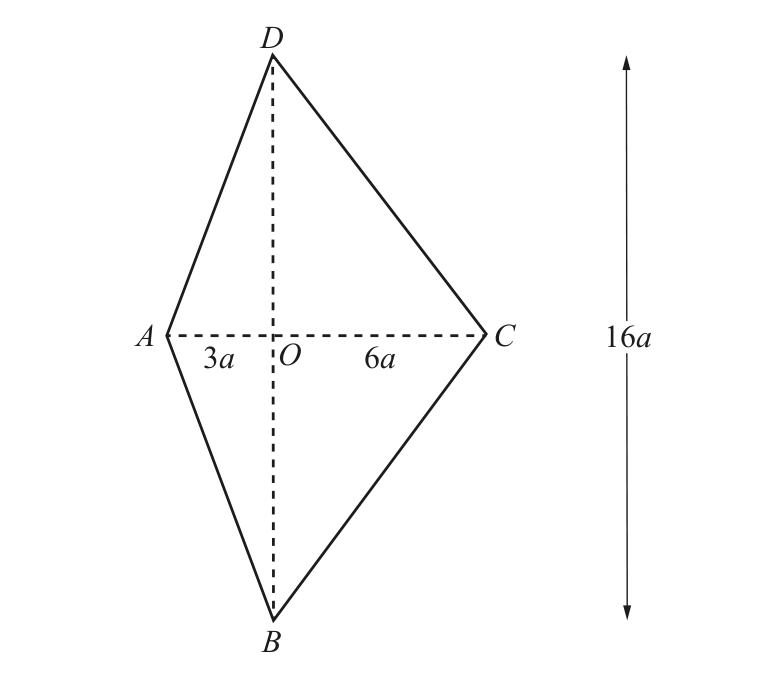
A uniform lamina \(A B C D\) consists of two isosceles triangles \(A B D\) and \(B C D\). The diagonals of \(A B C D\) meet at the point \(O\). The length of \(A O\) is \(3 a\), the length of \(O C\) is \(6 a\) and the length of \(B D\) is \(16 a\) (see diagram).
Find the distance of the centre of mass of the lamina from \(D B\).

9231 P31 - Nov 2021 - Q4 - 8 marks
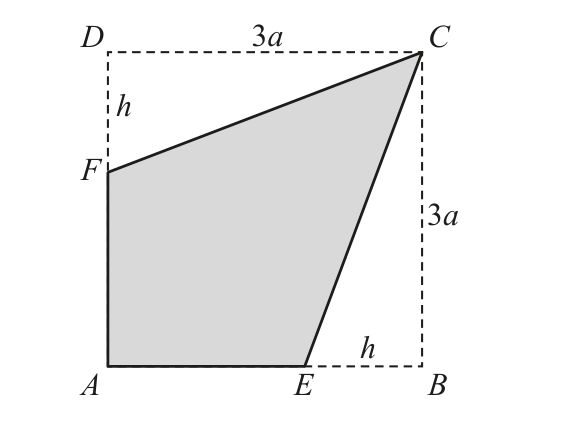
A uniform lamina \(A E C F\) is formed by removing two identical triangles \(B C E\) and \(C D F\) from a square lamina \(A B C D\). The square has side \(3 a\) and \(E B=D F=h\) (see diagram).
(a) Find the distance of the centre of mass of the lamina \(A E C F\) from \(A D\) and from \(A B\), giving your answers in terms of \(a\) and \(h\).
The lamina \(A E C F\) is placed vertically on its edge \(A E\) on a horizontal plane.
(b) Find, in terms of \(a\), the set of values of \(h\) for which the lamina remains in equilibrium.

9231 P31 - Jun 2020 - Q4 - 7 marks
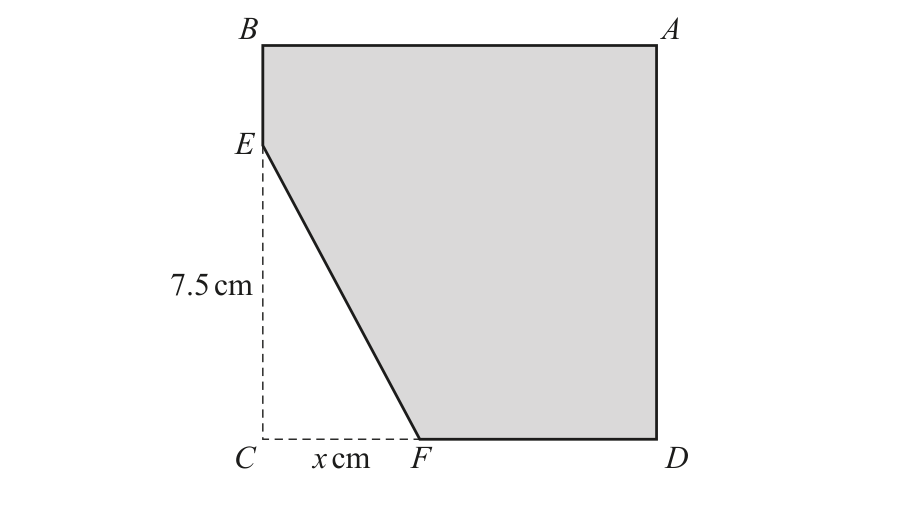
A uniform square lamina \(A B C D\) has sides of length 10 cm . The point \(E\) is on \(B C\) with \(E C=7.5 \mathrm{~cm}\), and the point \(F\) is on \(D C\) with \(C F=x \mathrm{~cm}\). The triangle \(E F C\) is removed from \(A B C D\) (see diagram). The centre of mass of the resulting shape \(A B E F D\) is a distance \(\bar{x} \mathrm{~cm}\) from \(C B\) and a distance \(\bar{y} \mathrm{~cm}\) from \(C D\).
(a) Show that \(\bar{x}=\frac{400-x^{2}}{80-3 x}\) and find a corresponding expression for \(\bar{y}\).
The shape \(A B E F D\) is in equilibrium in a vertical plane with the edge \(D F\) resting on a smooth horizontal surface.
(b) Find the greatest possible value of \(x\), giving your answer in the form \(a+b \sqrt{2}\), where \(a\) and \(b\) are constants to be determined.

9231 P21 - Nov 2019 - Q5 - 12 marks
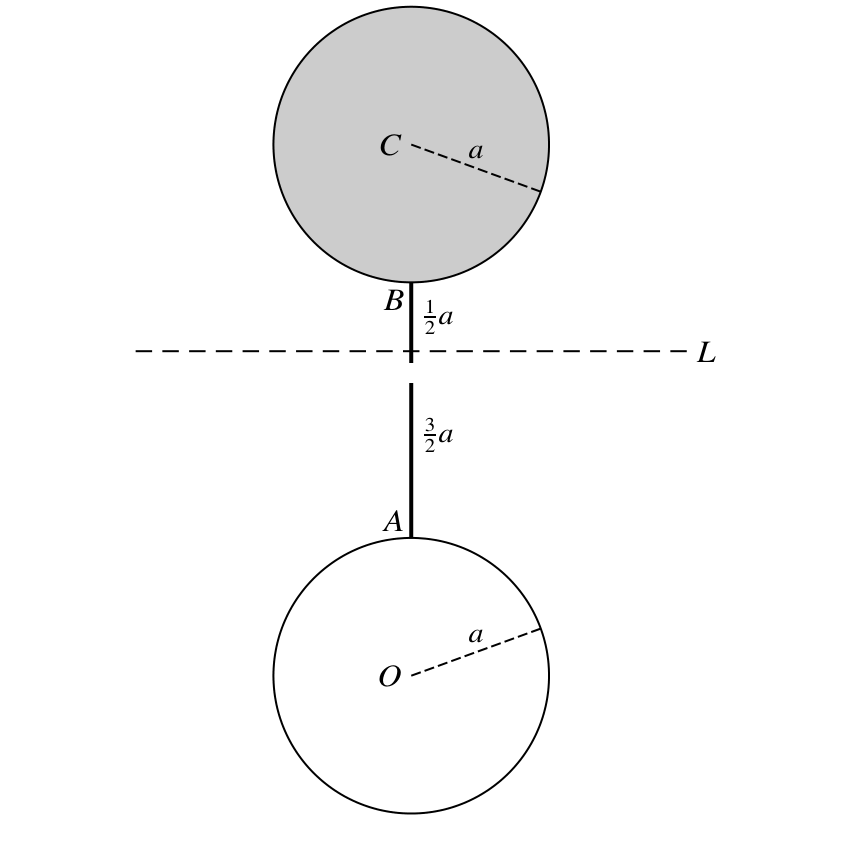
A thin uniform \(\operatorname{rod} A B\) has mass \(\lambda M\) and length \(2 a\). The end \(A\) of the rod is rigidly attached to the surface of a uniform hollow sphere (spherical shell) with centre \(O\), mass \(3 M\) and radius \(a\). The end \(B\) of the rod is rigidly attached to the surface of a uniform solid sphere with centre \(C\), mass \(5 M\) and radius \(a\). The rod lies along the line joining the centres of the spheres, so that \(C B A O\) is a straight line. The horizontal axis \(L\) is perpendicular to the rod and passes through the point of the rod that is a distance \(\frac{1}{2} a\) from \(B\) (see diagram). The object consisting of the rod and the two spheres can rotate freely about \(L\).
(i) Show that the moment of inertia of the object about \(L\) is \(\left(\frac{408+7 \lambda}{12}\right) M a^{2}\).
The period of small oscillations of the object about \(L\) is \(5 \pi \sqrt{ }\left(\frac{2 a}{g}\right)\).
(ii) Find the value of \(\lambda\).

9231 P23 - Jun 2019 - Q4 - 11 marks
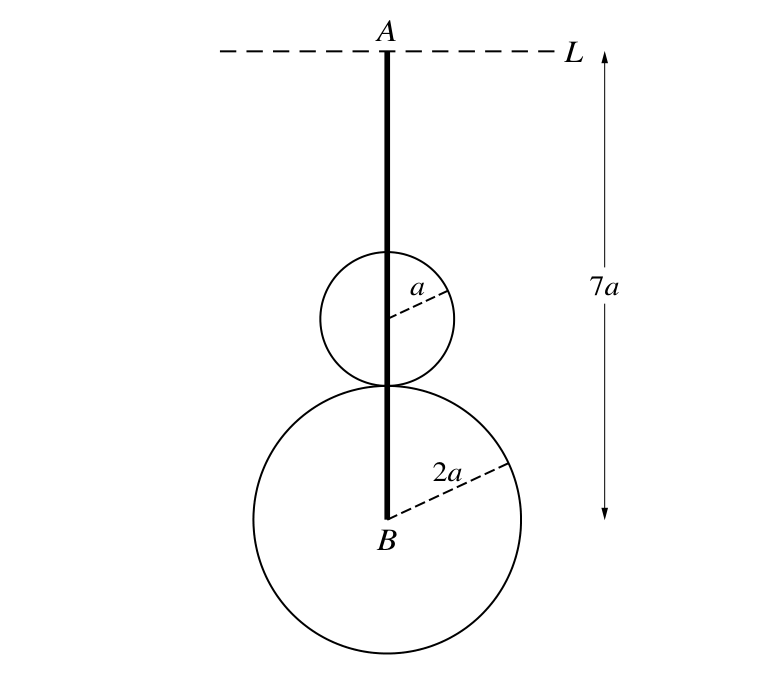
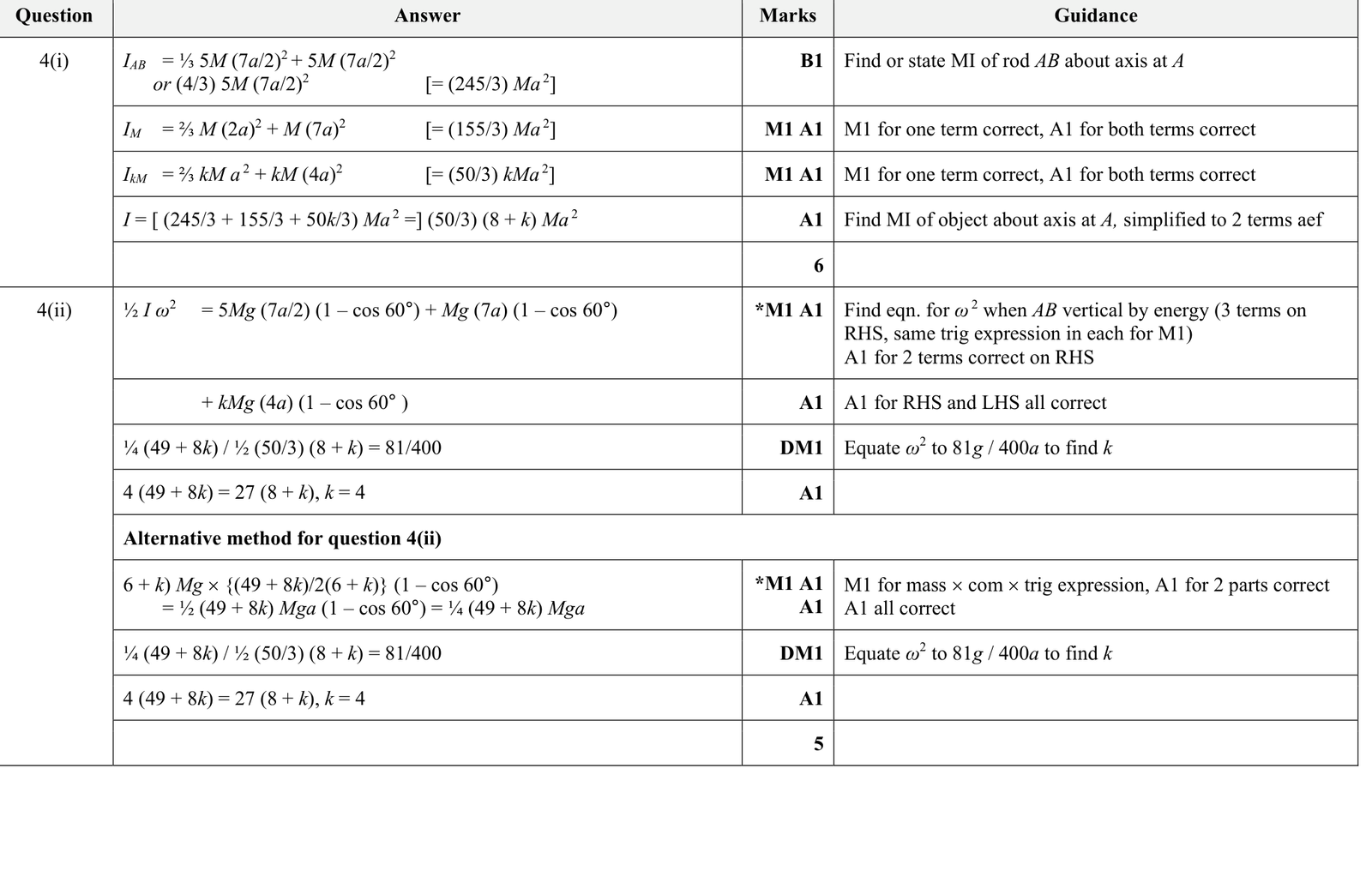
An object consists of two hollow spheres which touch each other, together with a thin uniform \(\operatorname{rod} A B\). The rod passes through small holes in the surfaces of the spheres. The rod is fixed to the spheres so that it passes through the centre of the smaller sphere. The end \(B\) of the rod is at the centre of the larger sphere. The larger sphere has radius \(2 a\) and mass \(M\), the smaller sphere has radius \(a\) and mass \(k M\), and the rod has length \(7 a\) and mass \(5 M\). A fixed horizontal axis \(L\) passes through \(A\) and is perpendicular to \(A B\) (see diagram).
(i) Find the moment of inertia of the object, consisting of the rod and two spheres, about \(L\).
The object is pivoted at \(A\) so that it can rotate freely about \(L\). The object is released from rest with the rod making an angle of \(60^{\circ}\) to the downward vertical. The greatest angular speed attained by the object in the subsequent motion is \(\frac{9}{20} \sqrt{ }\left(\frac{g}{a}\right)\).
(ii) Find the value of \(k\).
9231 P21 - Jun 2019 - Q5 - 12 marks
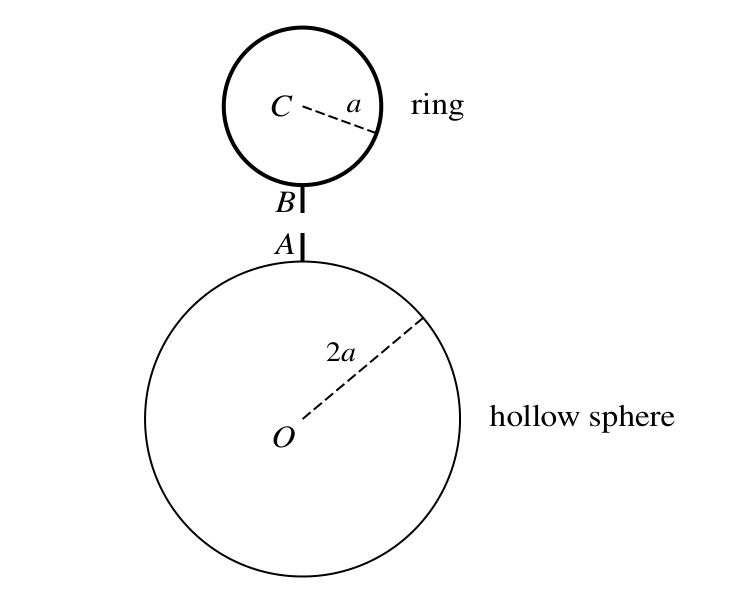
A thin uniform \(\operatorname{rod} A B\) has mass \(k M\) and length \(2 a\). The end \(A\) of the rod is rigidly attached to the surface of a uniform hollow sphere with centre \(O\), mass \(k M\) and radius \(2 a\). The end \(B\) of the rod is rigidly attached to the circumference of a uniform ring with centre \(C\), mass \(M\) and radius \(a\). The points \(C, B, A, O\) lie in a straight line. The horizontal axis \(L\) passes through the mid-point of the rod and is perpendicular to the rod and in the plane of the ring (see diagram). The object consisting of the rod, the ring and the hollow sphere can rotate freely about \(L\).
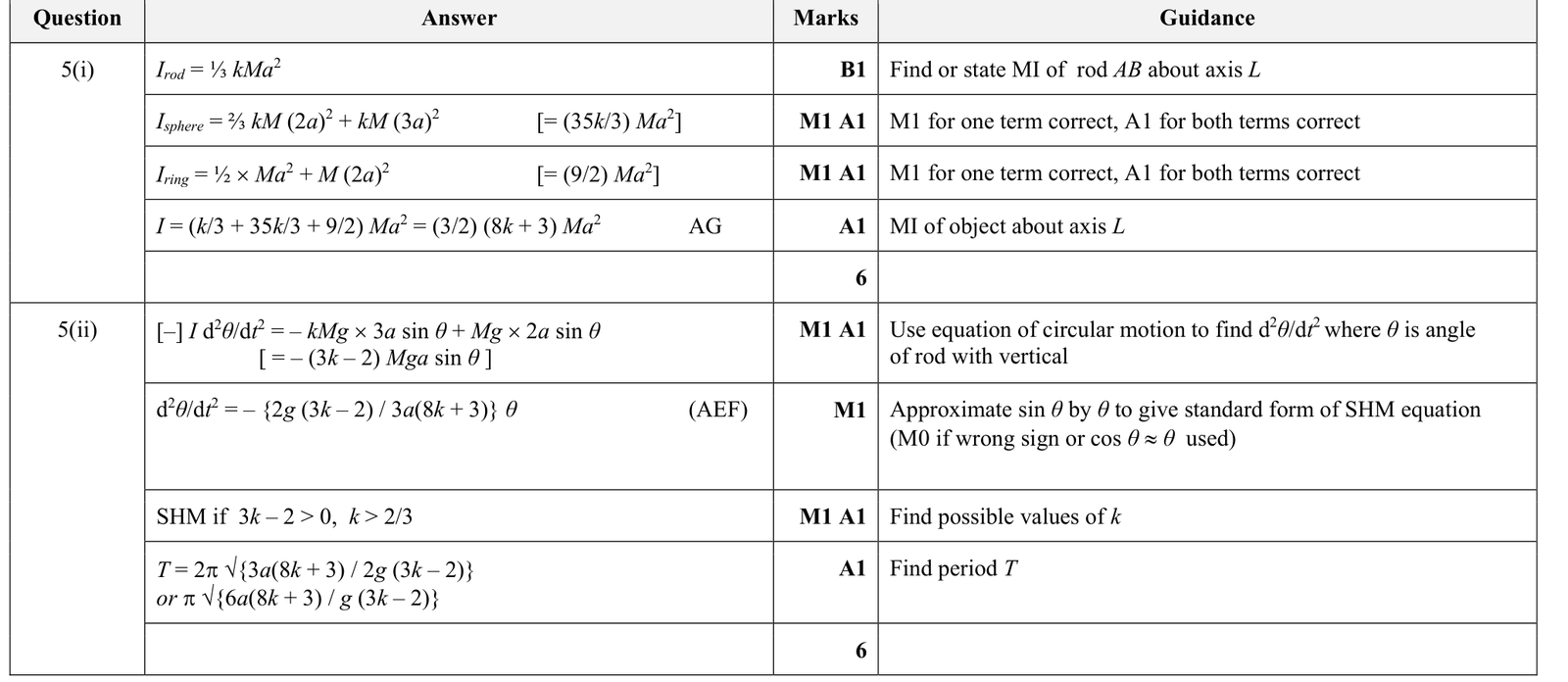
(i) Show that the moment of inertia of the object about \(L\) is \(\frac{3}{2}(8 k+3) M a^{2}\).
The object performs small oscillations about \(L\), with the ring above the sphere as shown in the diagram.
(ii) Find the set of possible values of \(k\) and the period of these oscillations in terms of \(k\).
9231 P23 - Jun 2017 - Q11E - 12 marks
Question 11 EITHER alternative.
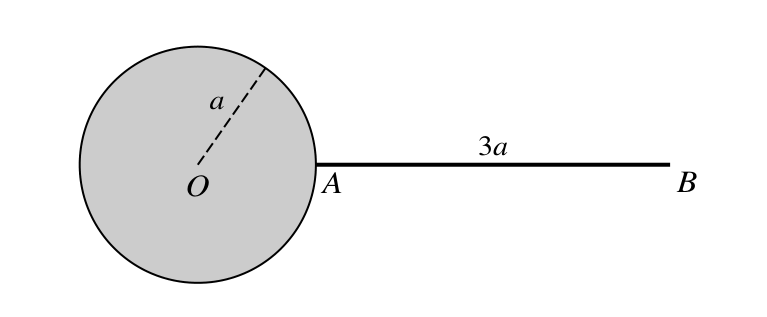
The diagram shows a uniform thin \(\operatorname{rod} A B\) of length \(3 a\) and mass \(8 m\). The end \(A\) is rigidly attached to the surface of a sphere with centre \(O\) and radius \(a\). The rod is perpendicular to the surface of the sphere. The sphere consists of two parts: an inner uniform solid sphere of mass \(\frac{3}{2} m\) and radius \(a\) surrounded by a thin uniform spherical shell of mass \(m\) and also of radius \(a\). The horizontal axis \(l\) is perpendicular to the rod and passes through the point \(C\) on the rod where \(A C=a\).
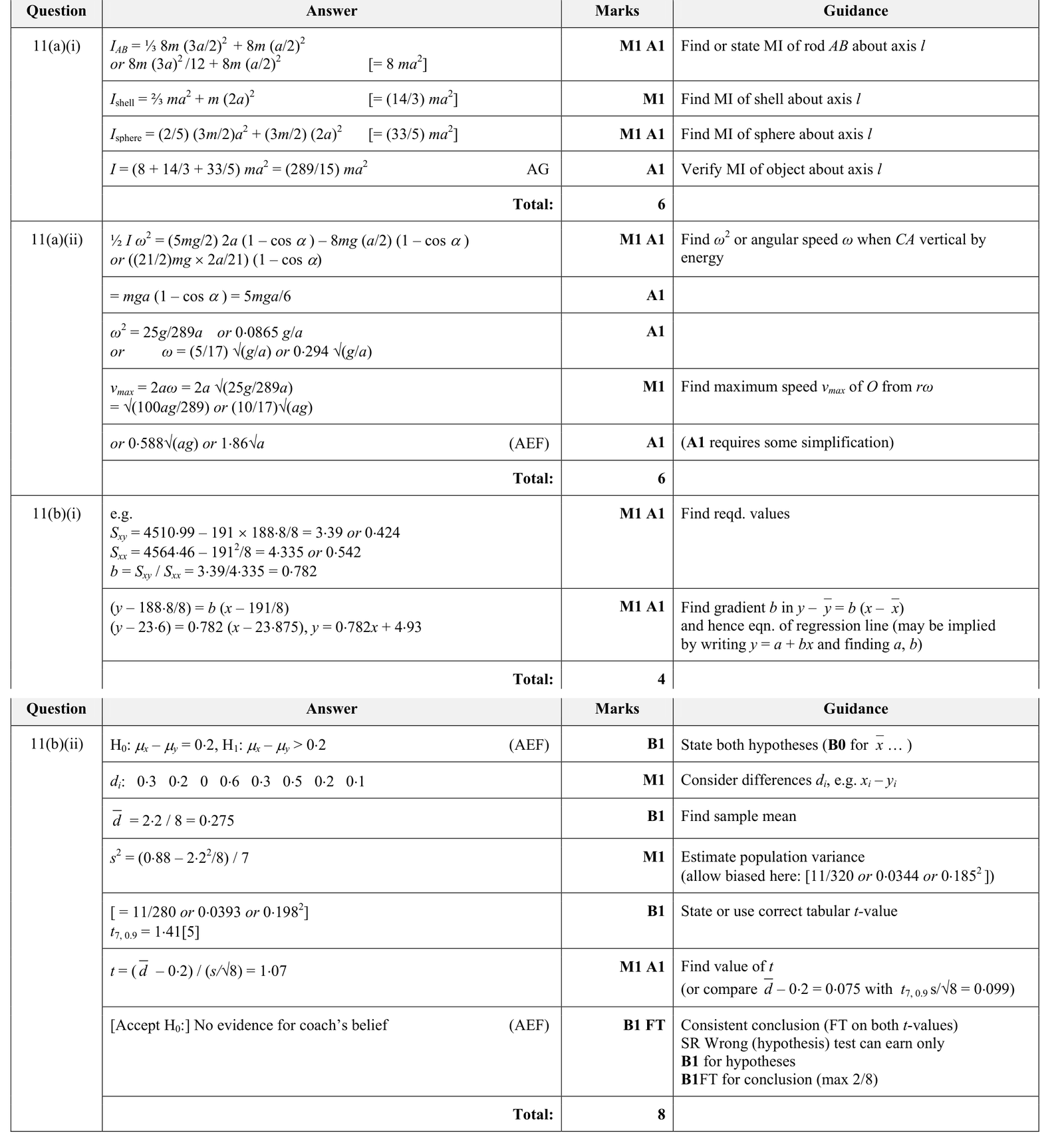
(i) Show that the moment of inertia of the object, consisting of rod, shell and inner sphere, about the axis \(l\) is \(\frac{289}{15} m a^{2}\).
The object is free to rotate about the axis \(l\). The object is held so that \(C A\) makes an angle \(\alpha\) with the downward vertical and is released from rest.
(ii) Given that \(\cos \alpha=\frac{1}{6}\), find the greatest speed achieved by the centre of the sphere in the subsequent motion.
9231 P31 - Jun 2025 - Q4 - 7 marks
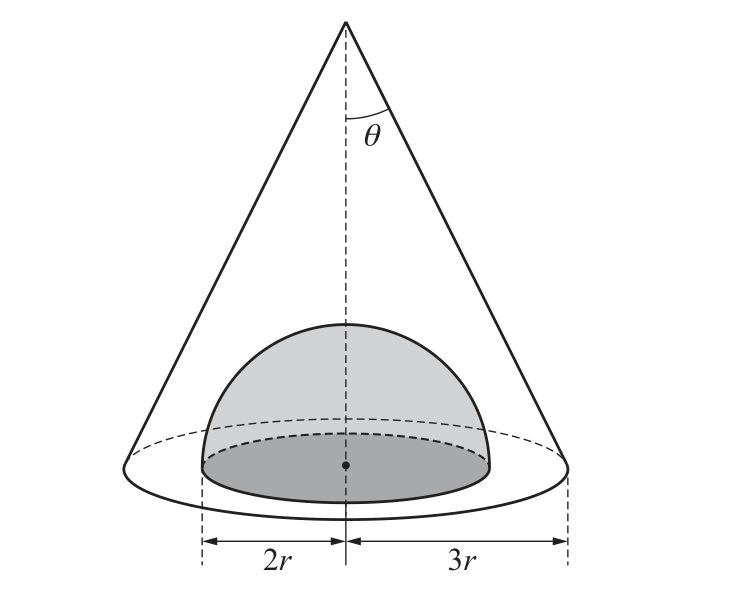
An object is formed by removing a solid hemisphere of radius \(2r\) from a uniform solid cone of radius \(3r\) and semi-vertical angle \(\theta\), where \(\tan\theta=\frac12\). The axes of symmetry coincide, and the cone and hemisphere have their bases in the same plane.
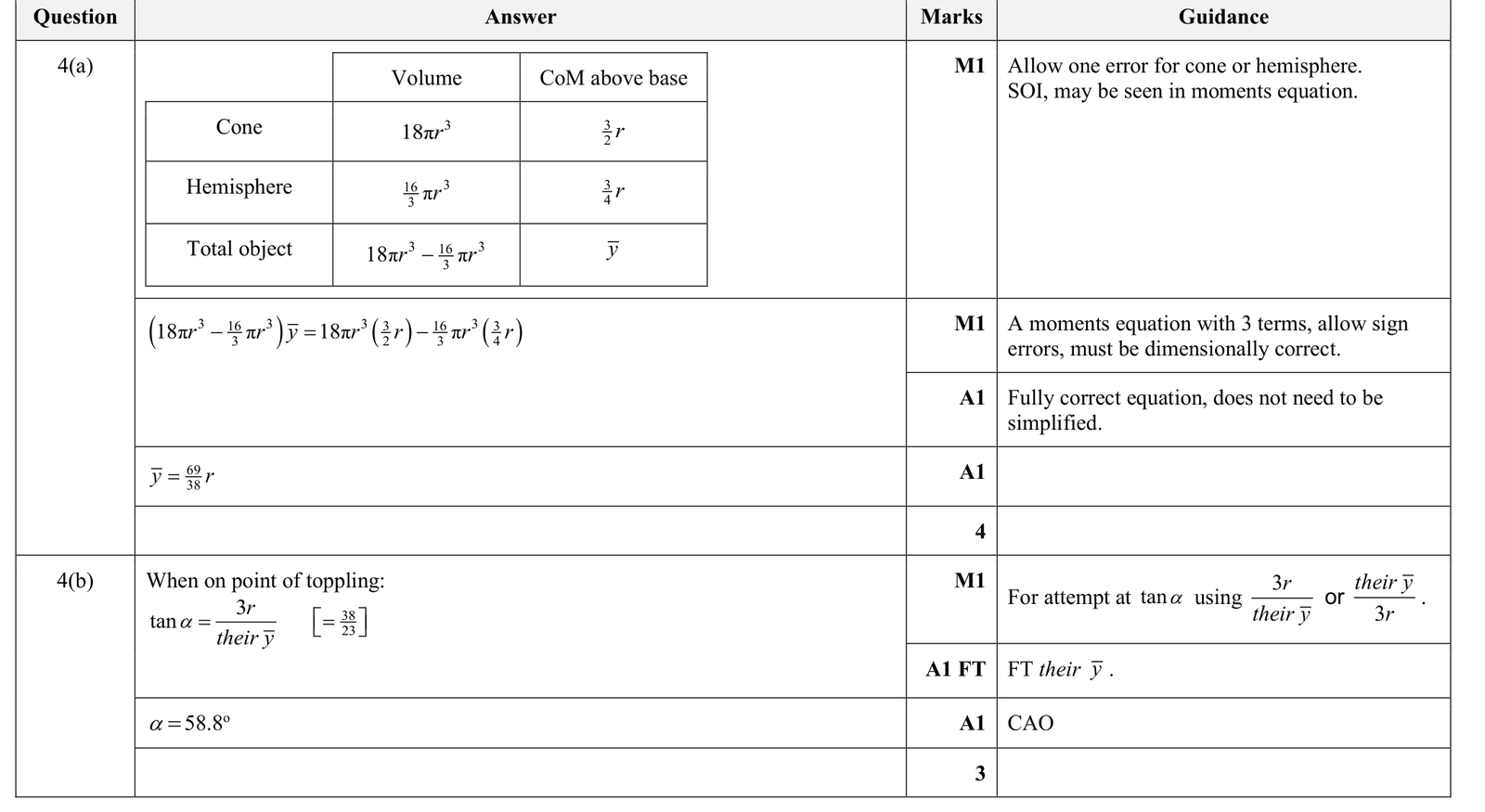
(a) Find, in terms of \(r\), the distance of the centre of mass of the object from its base.
(b) The object is placed with its circular base on a rough plane inclined at angle \(\alpha\). The object is on the point of toppling. Find \(\alpha\).
9231 P31 - Nov 2024 - Q4 - 7 marks
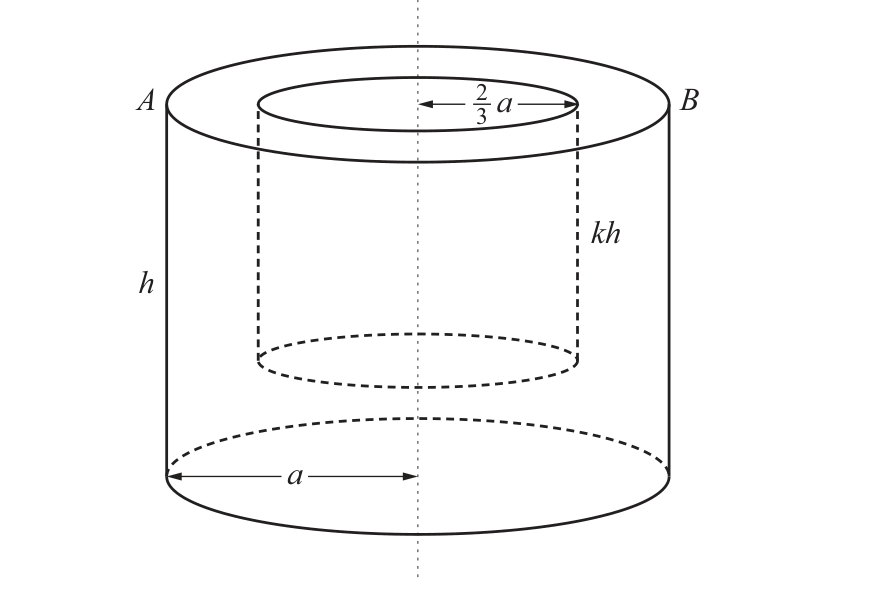
An object is formed by removing a cylinder of radius \(\dfrac23a\) and height \(kh\), where \(0\lt k\lt1\), from a uniform solid cylinder of radius \(a\) and height \(h\). The vertical axes of symmetry of the two cylinders coincide, and the upper faces are in the same plane.
The points \(A\) and \(B\) are opposite ends of a diameter of the upper face of the object.
(a) Find, in terms of \(h\) and \(k\), the distance of the centre of mass of the object from \(AB\).
When the object is suspended from \(A\), the angle between \(AB\) and the vertical is \(\theta\), where \(\tan\theta=\dfrac32\).
(b) Given that \(h=\dfrac83a\), find the possible values of \(k\).

9231 P31 - Jun 2023 - Q4 - 8 marks
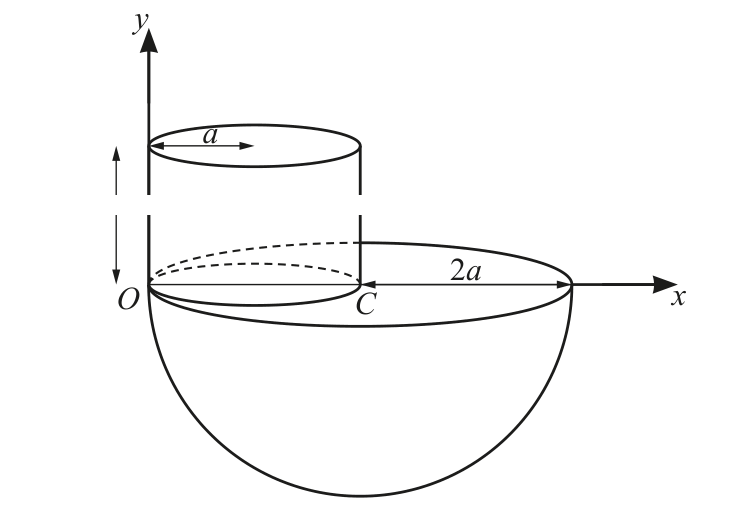
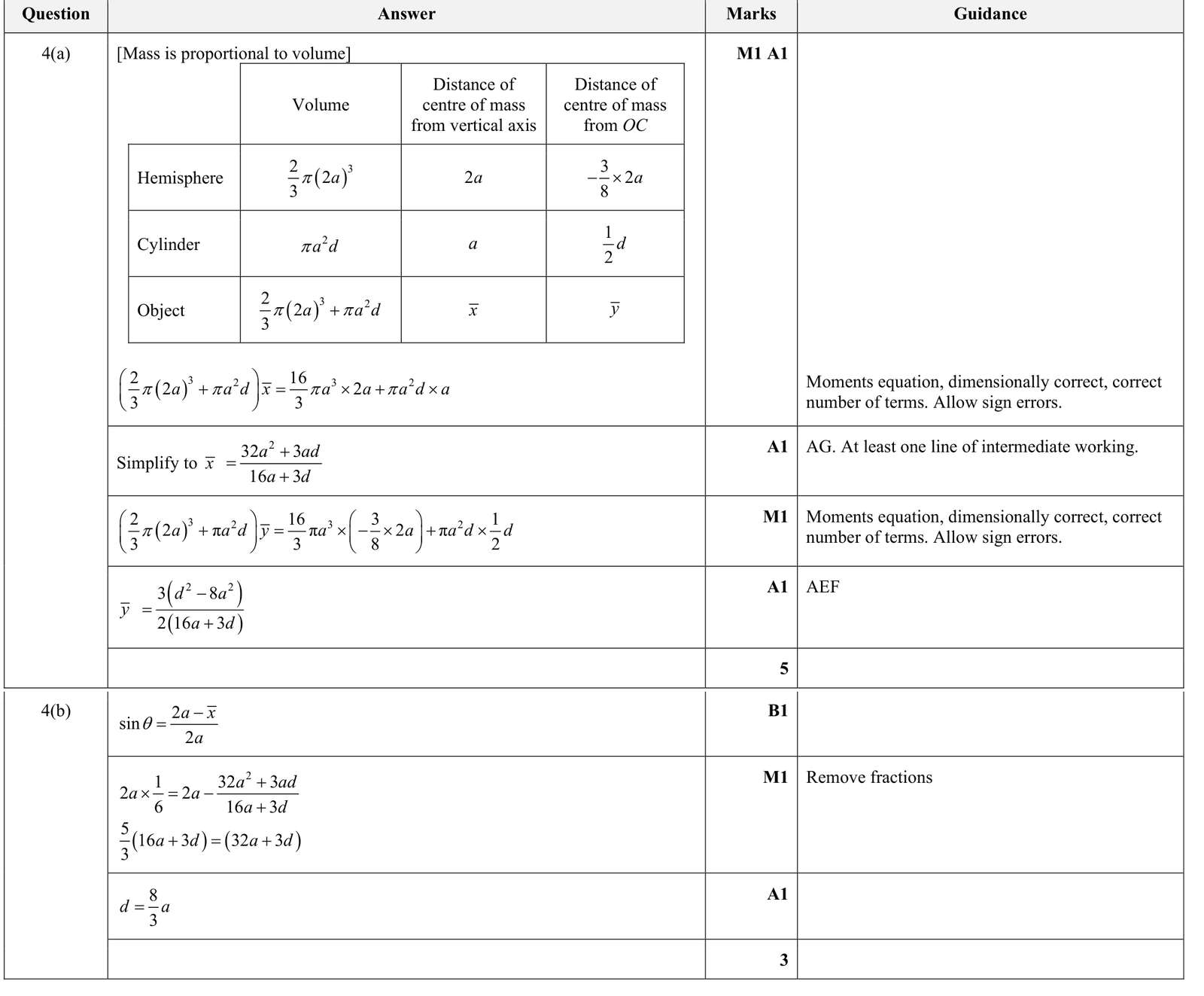
An object is formed from a solid hemisphere, of radius \(2 a\), and a solid cylinder, of radius \(a\) and height \(d\). The hemisphere and the cylinder are made of the same material. The cylinder is attached to the plane face of the hemisphere. The line \(O C\) forms a diameter of the base of the cylinder, where \(C\) is the centre of the plane face of the hemisphere and \(O\) is common to both circumferences (see diagram). Relative to axes through \(O\), parallel and perpendicular to \(O C\) as shown, the centre of mass of the object is \((\bar{x}, \bar{y})\).
(a) Show that \(\bar{x}=\frac{32 a^{2}+3 a d}{16 a+3 d}\) and find an expression, in terms of \(a\) and \(d\), for \(\bar{y}\).
The object is placed on a rough plane which is inclined to the horizontal at an angle \(\theta\) where \(\sin \theta=\frac{1}{6}\). The object is in equilibrium with \(C O\) horizontal, where \(C O\) lies in a vertical plane through a line of greatest slope.
(b) Find \(d\) in terms of \(a\).
9231 P31 - Jun 2022 - Q4 - 8 marks
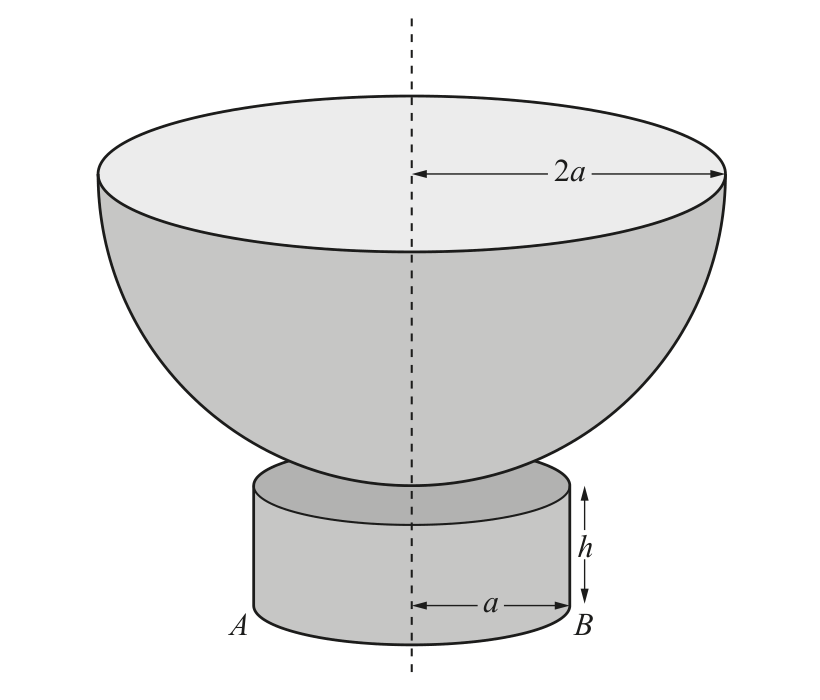
An object is composed of a hemispherical shell of radius \(2 a\) attached to a closed hollow circular cylinder of height \(h\) and base radius \(a\). The hemispherical shell and the hollow cylinder are made of the same uniform material. The axes of symmetry of the shell and the cylinder coincide. \(A B\) is a diameter of the lower end of the cylinder (see diagram).
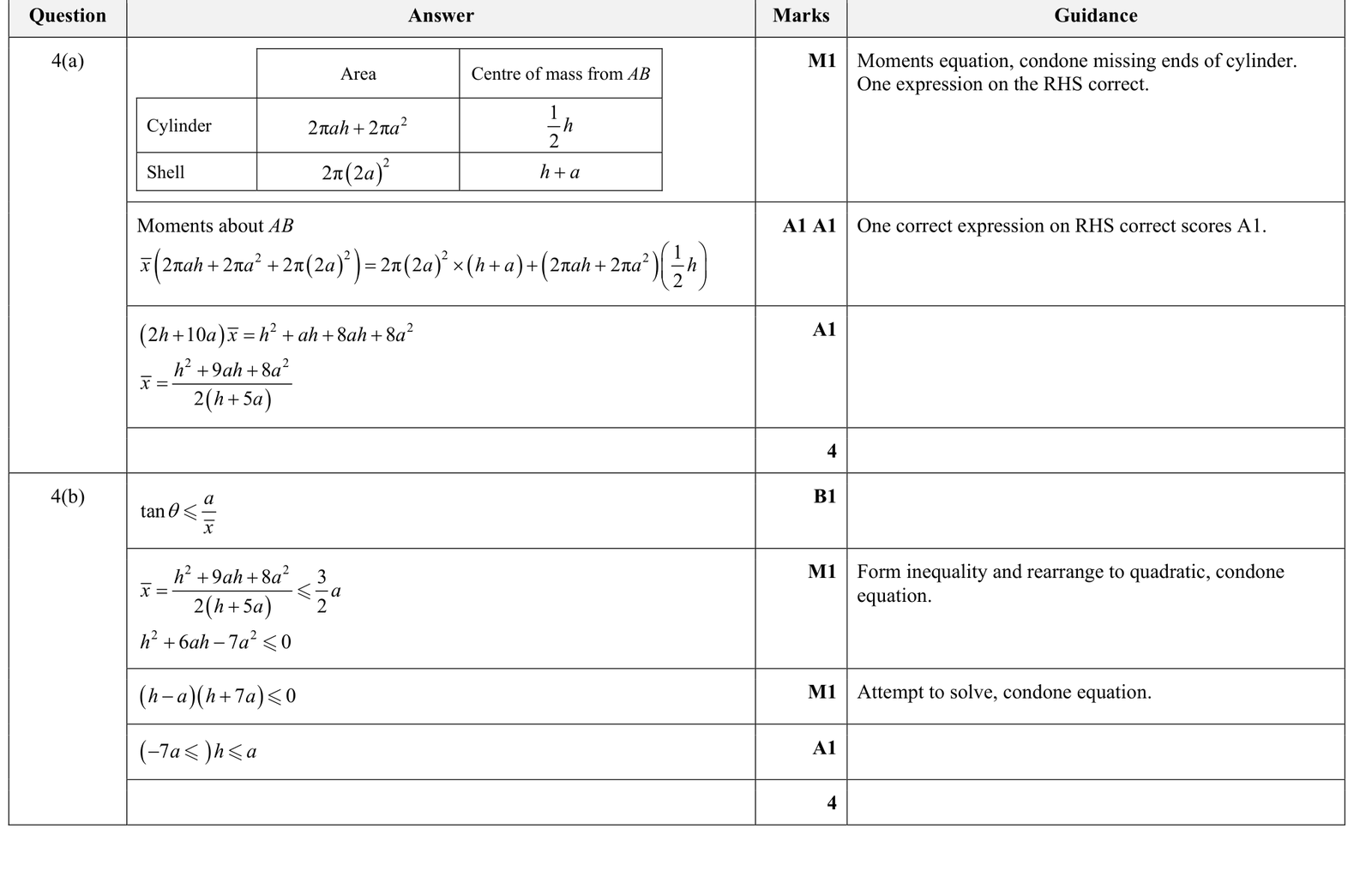
(a) Find, in terms of \(a\) and \(h\), an expression for the distance of the centre of mass of the object from \(A B\).
The object is placed on a rough plane which is inclined to the horizontal at an angle \(\theta\), where \(\tan \theta=\frac{2}{3}\). The object is in equilibrium with \(A B\) in contact with the plane and lying along a line of greatest slope of the plane.
(b) Find the set of possible values of \(h\), in terms of \(a\).