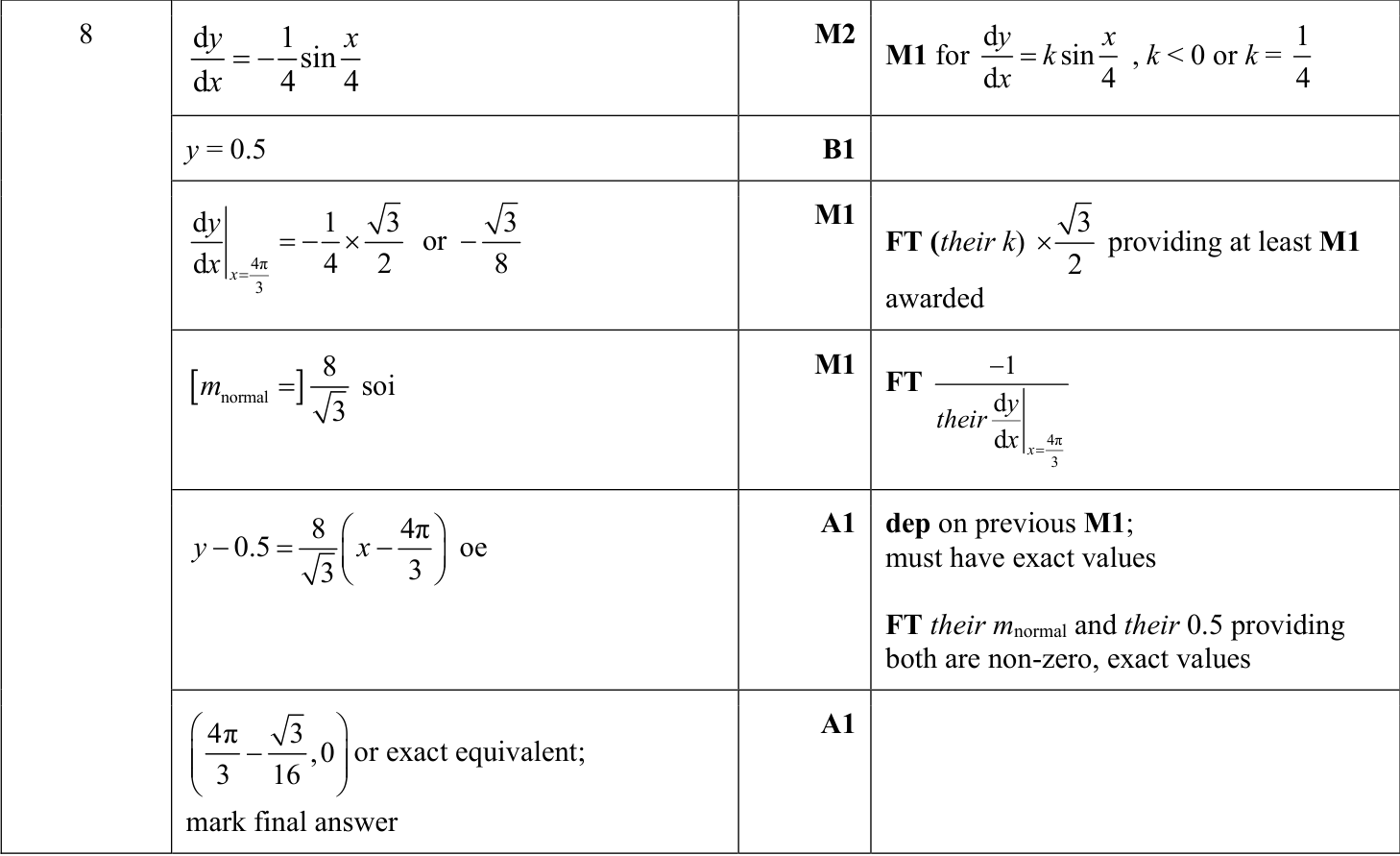
Answer: \(\displaystyle P\left(\frac{4\pi}{3}-\frac{\sqrt3}{16},0\right)\).
For a trigonometric graph, identify the amplitude, midline and period first, then use these to locate the key points of the sketch.
The point on the curve has
\(x=\frac{4\pi}{3}.\)
So
\(y=\cos\left(\frac14\cdot\frac{4\pi}{3}\right) =\cos\frac{\pi}{3} =\frac12.\)
Thus the point on the curve is
\(\left(\frac{4\pi}{3},\frac12\right).\)
Differentiate \(y=\cos\frac{x}{4}\):
\(\frac{dy}{dx}=-\frac14\sin\frac{x}{4}.\)
At \(x=\frac{4\pi}{3}\),
\(\frac{dy}{dx}=-\frac14\sin\frac{\pi}{3} =-\frac{\sqrt3}{8}.\)
This is the gradient of the tangent. Therefore the gradient of the normal is
\(\frac{8}{\sqrt3}.\)
The equation of the normal is
\(y-\frac12=\frac{8}{\sqrt3}\left(x-\frac{4\pi}{3}\right).\)
At the \(x\)-axis, \(y=0\). Substitute this:
\(-\frac12=\frac{8}{\sqrt3}\left(x-\frac{4\pi}{3}\right).\)
So
\(x-\frac{4\pi}{3}=-\frac{\sqrt3}{16}.\)
Hence
\(x=\frac{4\pi}{3}-\frac{\sqrt3}{16}.\)
Therefore
\(P\left(\frac{4\pi}{3}-\frac{\sqrt3}{16},0\right).\)