Answer: \(\boxed{k=2}\) or \(\boxed{k=\dfrac{4}{17}}\), depending on the direction of limiting friction at the wall.
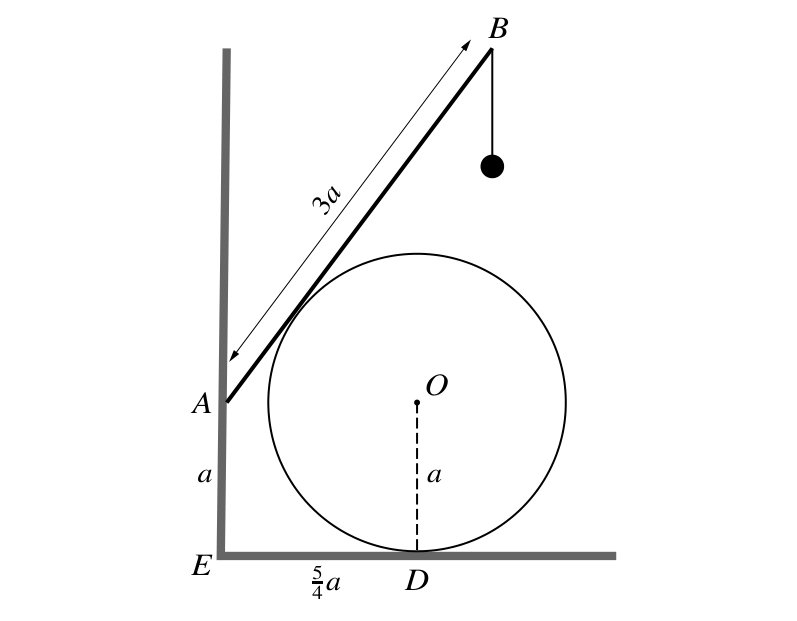
Let \(P\) be the point where the rod touches the disc, and let \(\theta\) be the angle made by the rod with the horizontal.
Since the rod is tangent to the smooth disc, \(OP\) is perpendicular to the rod. From the geometry of triangle \(AOP\),
\[AO=\frac54a,\qquad OP=a.\]
So
\[AP=\sqrt{\left(\frac54a\right)^2-a^2}=\frac34a.\]
Hence
\[\sin\theta=\frac45,\qquad \cos\theta=\frac35.\]
Let \(R_P\) be the reaction from the disc, and let \(R_A\) be the normal reaction from the wall at \(A\). Resolving horizontally gives
\[R_A=R_P\sin\theta=\frac45R_P.\]
Take friction at \(A\) to be positive downwards and call it \(F_A\). Resolving vertically gives
\[F_A+(k+1)W=R_P\cos\theta=\frac35R_P.\]
Now take moments about \(A\). The reaction \(R_P\) has moment arm \(AP=\frac34a\). The weights of the rod and the particle act vertically, so their perpendicular distances from \(A\) are horizontal distances along the rod:
\[R_P\left(\frac34a\right)-kW(3a\cos\theta)=W\left(\frac32a\cos\theta\right).\]
Using \(\cos\theta=\frac35\), this becomes
\[R_P\left(\frac34a\right)-kW\left(\frac95a\right)=W\left(\frac9{10}a\right).\]
Multiplying by \(20/a\),
\[15R_P-36kW=18W.\]
Because the system is in limiting equilibrium,
\[|F_A|=\frac18R_A=\frac18\cdot\frac45R_P=\frac1{10}R_P.\]
Case 1: friction acts downwards. Then \(F_A=\frac1{10}R_P\). The vertical equation gives
\[\frac1{10}R_P+(k+1)W=\frac35R_P,\]
so
\[(k+1)W=\frac12R_P.\]
Thus \(R_P=2(k+1)W\). Substitute this into the moment equation:
\[15\{2(k+1)W\}-36kW=18W.\]
So
\[30k+30-36k=18,\]
which gives
\[k=2.\]
Case 2: friction acts upwards. Then \(F_A=-\frac1{10}R_P\). The vertical equation gives
\[-\frac1{10}R_P+(k+1)W=\frac35R_P,\]
so
\[(k+1)W=\frac7{10}R_P.\]
Thus \(R_P=\frac{10}{7}(k+1)W\). Substitute this into the moment equation:
\[15\left\{\frac{10}{7}(k+1)W\right\}-36kW=18W.\]
Multiplying by \(7\) gives
\[150(k+1)-252k=126.\]
Hence
\[24=102k,\]
so
\[k=\frac4{17}.\]
Therefore the limiting-equilibrium values are \(\boxed{k=2}\) and \(\boxed{k=\frac4{17}}\).