Answer: \(\boxed{T=W}\), \(\boxed{\mu=\dfrac13}\), \(\boxed{R_A=\dfrac{\sqrt{13}}2W}\), and \(\boxed{\lambda=\dfrac83W}\).
Since \(\sin\theta=\frac35\), we have
\[\cos\theta=\frac45.\]
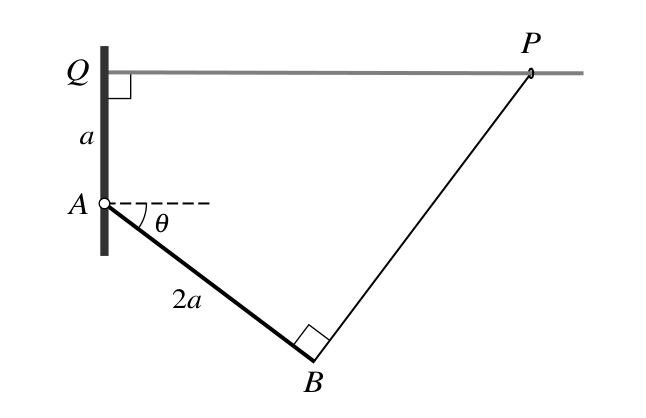
(i) Take moments about the hinge \(A\) for the rod.
The weight of the rod is \(\frac52W\) and acts at the midpoint of the rod, a distance \(a\) from \(A\). Its perpendicular moment arm is \(a\cos\theta\).
The tension \(T\) acts at \(B\) at right angles to the rod, so its moment about \(A\) is \(T(2a)\).
Hence
\[T(2a)=\frac52W(a\cos\theta).\]
Substitute \(\cos\theta=\frac45\):
\[2aT=\frac52W\cdot a\cdot\frac45=2aW.\]
Therefore
\[\boxed{T=W}.\]
(ii) Now consider the ring \(P\). Since the system is in limiting equilibrium, the friction is \(F=\mu R\).
The horizontal component of the tension is
\[T\sin\theta=W\cdot\frac35=\frac35W.\]
The normal reaction from the wire is the weight of the ring plus the vertical component of the tension:
\[R=W+T\cos\theta=W+W\cdot\frac45=\frac95W.\]
Therefore
\[\mu R=\frac35W.\]
So
\[\mu\cdot\frac95W=\frac35W.\]
Cancel \(W\):
\[\mu=\frac{3/5}{9/5}=\frac13.\]
Thus
\[\boxed{\mu=\frac13}.\]
(iii) For the rod, resolve the force at the hinge into horizontal and vertical components.
The horizontal component balances the horizontal component of the tension:
\[X=T\sin\theta=W\cdot\frac35=\frac35W.\]
The vertical component balances the weight of the rod after allowing for the vertical component of tension:
\[Y=\frac52W-T\cos\theta=\frac52W-W\cdot\frac45.\]
So
\[Y=\frac{25}{10}W-\frac{8}{10}W=\frac{17}{10}W.\]
The resultant force at the hinge has magnitude
\[R_A=\sqrt{X^2+Y^2}.\]
Hence
\[R_A=\sqrt{\left(\frac35W\right)^2+\left(\frac{17}{10}W\right)^2}.\]
Therefore
\[R_A=W\sqrt{\frac{9}{25}+\frac{289}{100}}=W\sqrt{\frac{36+289}{100}}.\]
So
\[R_A=\frac{\sqrt{325}}{10}W=\frac{5\sqrt{13}}{10}W=\boxed{\frac{\sqrt{13}}{2}W}.\]
(iv) The string has natural length \(2a\).
From the geometry of the diagram, the length of the string is
\[PB=\frac{a+2a\sin\theta}{\cos\theta}.\]
Using \(\sin\theta=\frac35\) and \(\cos\theta=\frac45\),
\[PB=\frac{a+2a(3/5)}{4/5}=\frac{a+6a/5}{4/5}=\frac{11a/5}{4/5}=\frac{11a}{4}.\]
So the extension is
\[x=\frac{11a}{4}-2a=\frac{3a}{4}.\]
By Hooke's law,
\[T=\frac{\lambda x}{2a}.\]
Since \(T=W\),
\[W=\frac{\lambda(3a/4)}{2a}=\frac{3\lambda}{8}.\]
Therefore
\[\lambda=\boxed{\frac83W}.\]