9231 P31 - Jun 2021 - Q4 - 7 marks
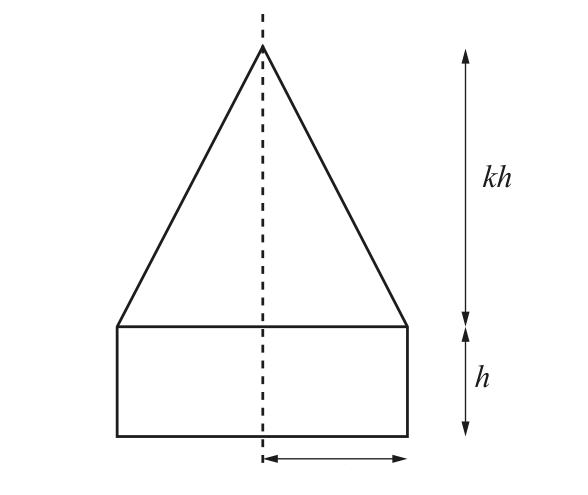
A uniform solid circular cone has vertical height \(k h\) and radius \(r\). A uniform solid cylinder has height \(h\) and radius \(r\). The base of the cone is joined to one of the circular faces of the cylinder so that the axes of symmetry of the two solids coincide (see diagram, which shows a cross-section). The cone and the cylinder are made of the same material.
(a) Show that the distance of the centre of mass of the combined solid from the base of the cylinder
\(\text { is } \frac{h\left(k^{2}+4 k+6\right)}{4(3+k)} .\)
The solid is placed on a plane that is inclined to the horizontal at an angle \(\theta\). The base of the cylinder is in contact with the plane. The plane is sufficiently rough to prevent sliding. It is given that \(3 h=2 r\) and that the solid is on the point of toppling when \(\tan \theta=\frac{4}{3}\).
(b) Find the value of \(k\).