Past Exam Questions
← Back0606 P12 - Mar 2024 - Q8 - 7 marks
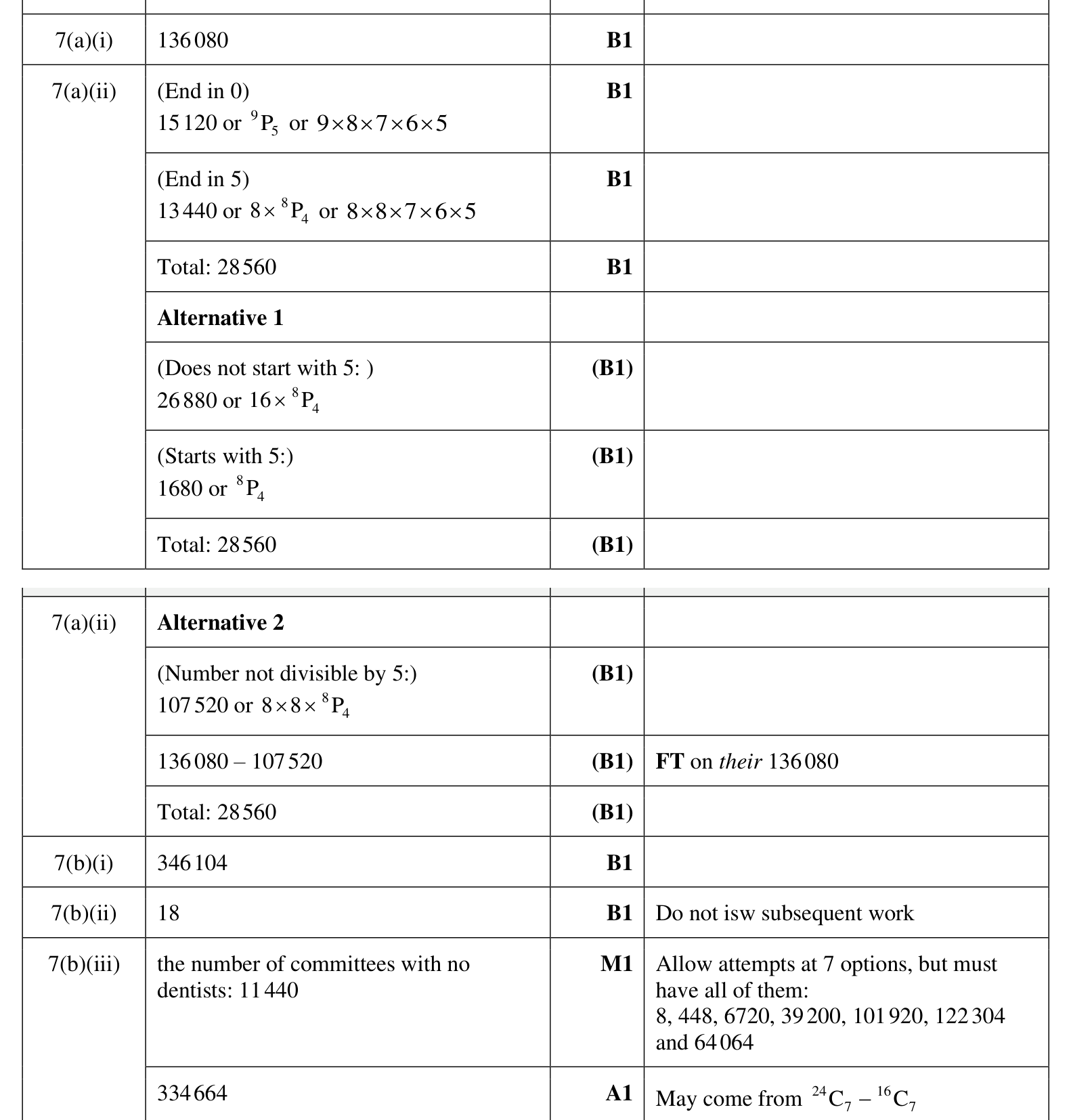
(a) A 5-digit number is to be formed using 5 different numbers selected from \(1,2,3,4,5,6,7,8\) and 9 . No digit may be used more than once in any 5 -digit number. (i) Find how many 5-digit numbers can be formed.
(ii) Find how many of these 5-digit numbers are greater than 50000 and even.
(b) A team of 9 people is to be chosen from 6 doctors, 4 dentists and 2 nurses. Find how many possible teams include at least 2 doctors, at least 2 dentists and at least 2 nurses.
0606 P12 - Mar 2023 - Q7 - 6 marks
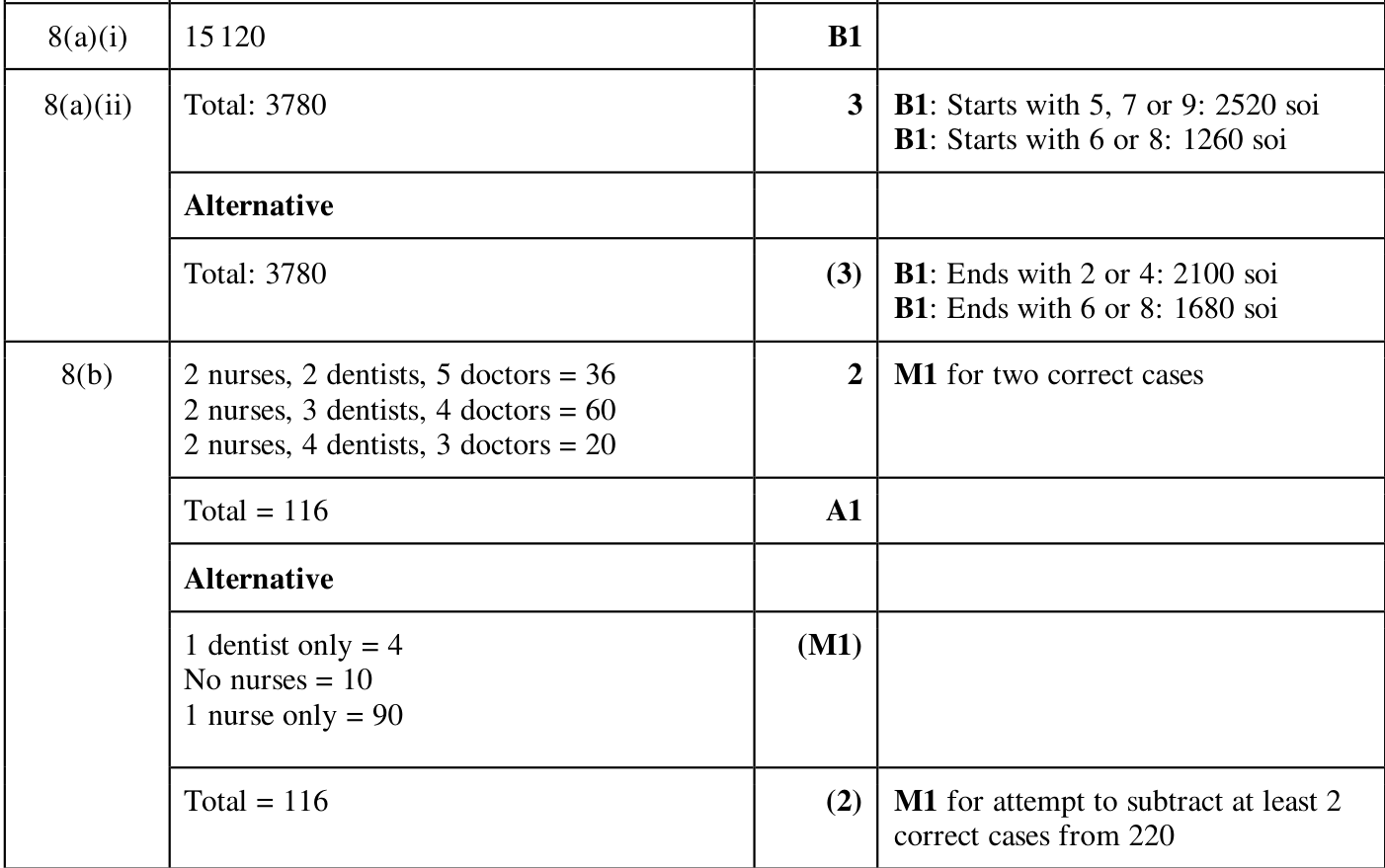
(a) A 5-character password is to be formed from the following 13 characters.
| Letters | A | B | C | D | E |
|---|---|---|---|---|---|
| Numbers | 9 | 8 | 7 | 6 | 5 |
| Symbols | * | # | ! |
No character may be used more than once in any password.
(i) Find the number of possible passwords that can be formed.
(ii) Find the number of possible passwords that contain at least one symbol.
(b) Given that
\(16\binom n{12}=(n-10)\binom{n+1}{11},\)
find the value of \(n\).
0606 P11 - Nov 2023 - Q5 - 7 marks
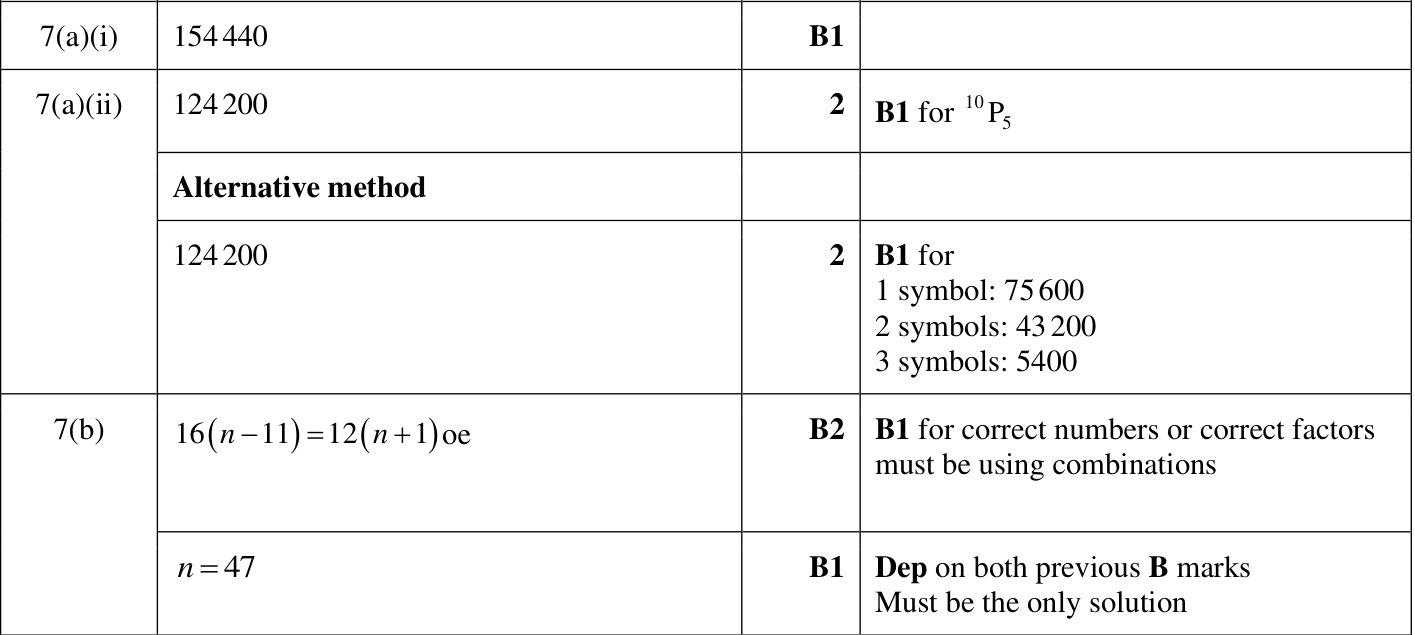
(a) A 4-digit code is made using digits chosen from \(0,1,2,\ldots,9\). No digit may be repeated, but the code may begin with 0.
Find the number of possible codes if
(i) there are no other restrictions,
(ii) the code is odd,
(iii) the code is greater than 1000.
(b) A team of 9 people is chosen from a group of 15 people. Four members of one family are in the group. The family members must not be separated: either all four are chosen or none of them is chosen.
Find the number of possible teams.
0606 P22 - Mar 2021 - Q8 - 9 marks
A photographer takes 12 different photographs. There are 3 of sunsets, 4 of oceans, and 5 of mountains.
(a) The photographs are arranged in a line on a wall.
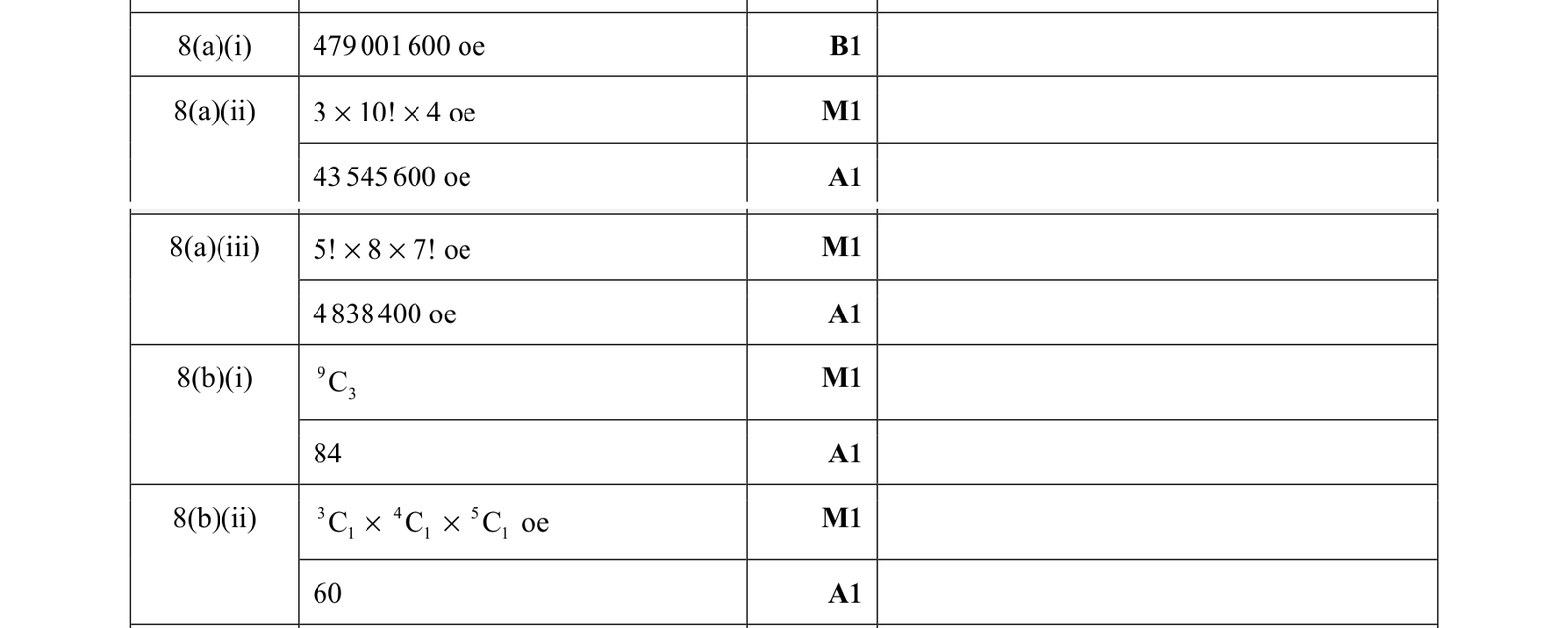
(i) How many possible arrangements are there if there are no restrictions?
(ii) How many possible arrangements are there if the first photograph is of a sunset and the last photograph is of an ocean?
(iii) How many possible arrangements are there if all the photographs of mountains are next to each other?
(b) Three of the photographs are to be selected for a competition.
(i) Find the number of different possible selections if no photograph of a sunset is chosen.
(ii) Find the number of different possible selections if one photograph of each type, sunset, ocean and mountain, is chosen.
0606 P12 - Jun 2020 - Q4 - 10 marks
(a) The digits \(1,2,3,5,7,8\) are used to make 5-digit numbers. Each digit can be used at most once in each number.
(i) How many different numbers can be made?
(ii) How many of these numbers are not divisible by 5?
(iii) How many of these numbers are even and greater than \(30000\)?
(b) Given that
\({}^nC_3=6\,{}^nC_2,\)
find the constant \(n\).

0606 P23 - Nov 2020 - Q6 - 6 marks
A 4-digit code is formed using 4 different numbers chosen from \(1,2,3,\ldots,9\).
(a) Find the number of different codes that can be formed with no restrictions.
(b) Find the number of different codes that can be formed using only prime numbers.
(c) Find the number of different codes that can be formed if the first two numbers are even and the last two numbers are odd.
(d) Find the number of different codes that can be formed if the code is an even number.

0606 P22 - Mar 2019 - Q1 - 3 marks
A band can play 25 different pieces of music. From these pieces of music, 8 are to be selected for a concert.
(i) Find the number of different ways this can be done.
The 8 pieces of music are then arranged in order.
(ii) Find the number of different arrangements possible.
The band has 15 members. Three members are chosen at random to be the treasurer, secretary and agent.
(iii) Find the number of ways in which this can be done.

0606 P22 - Jun 2018 - Q5 - 7 marks
(a) Four parts in a play are to be given to four of the girls chosen from the seven girls in a drama class. Find the number of different ways in which this can be done.
(b) Three singers are chosen at random from a group of \(5\) Chinese, \(4\) Indian and \(2\) British singers. Find the number of different ways in which this can be done if
(i) no Chinese singer is chosen,
(ii) one singer of each nationality is chosen,
(iii) the three singers chosen are all of the same nationality.

0606 P21 - Nov 2025 - Q3 - 5 marks
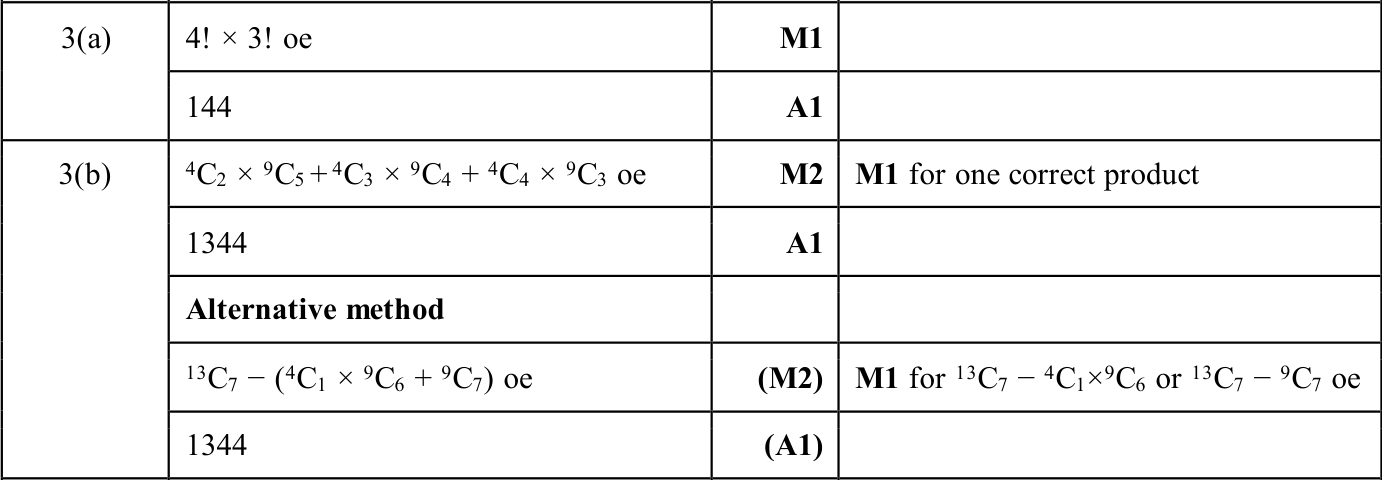
(a) 3 men and 3 women are standing in a line. The 3 men are standing next to each other. Find how many different arrangements are possible.
(b) In the 13-letter word MULTIBRANCHED, there are 4 vowels, U, I, A and E. 7 different letters are selected from these 13 letters. Find how many different selections are possible if the selection includes at least 2 vowels.
0606 P11 - Jun 2025 - Q12 - 4 marks
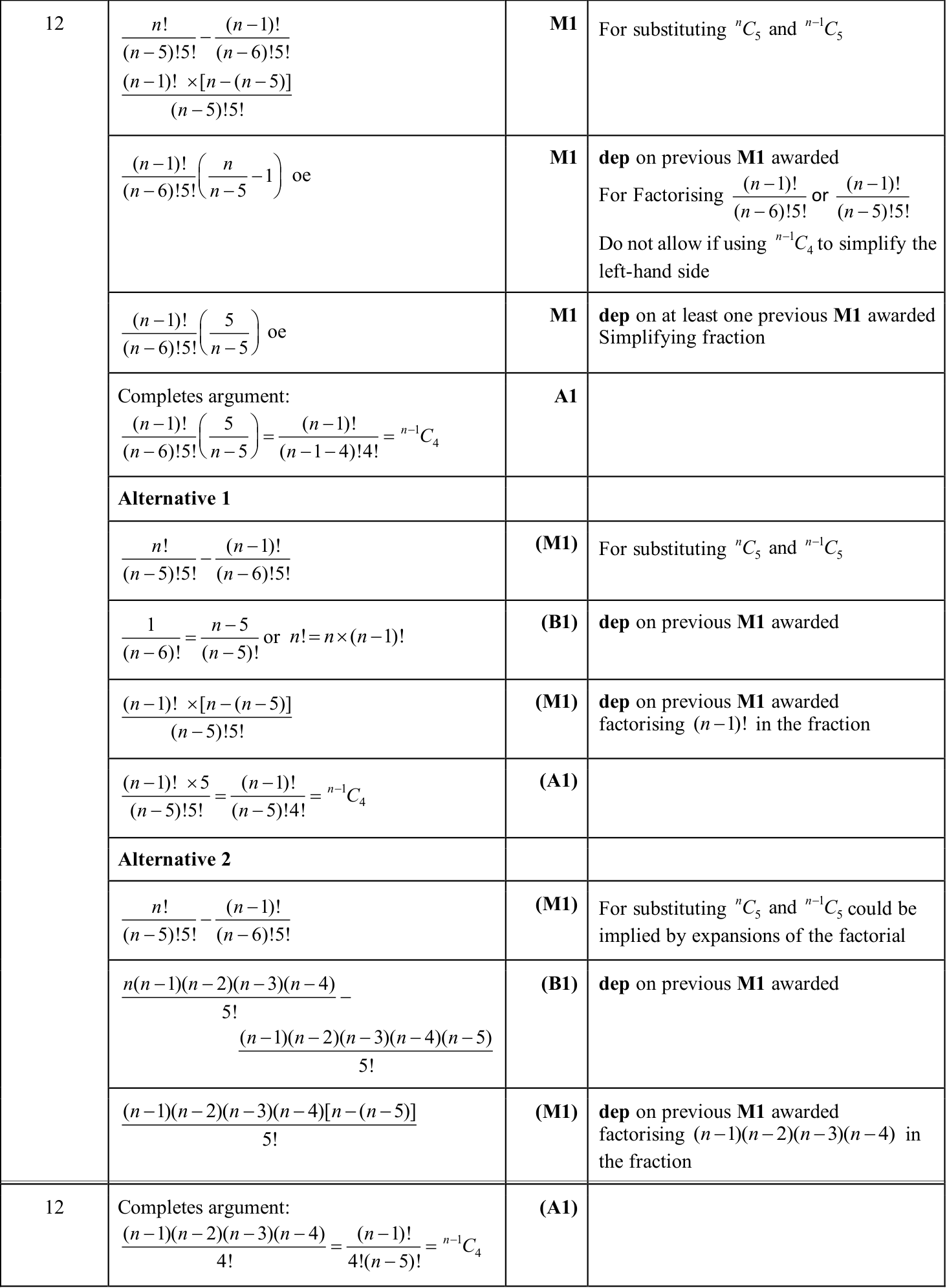
In this question \(n\geqslant6\).
Use an algebraic method to show that \({}^{n}\mathrm{C}_5-{}^{n-1}\mathrm{C}_5\) can be written as \({}^{n-1}\mathrm{C}_4\).
0606 P21 - Jun 2025 - Q3 - 5 marks
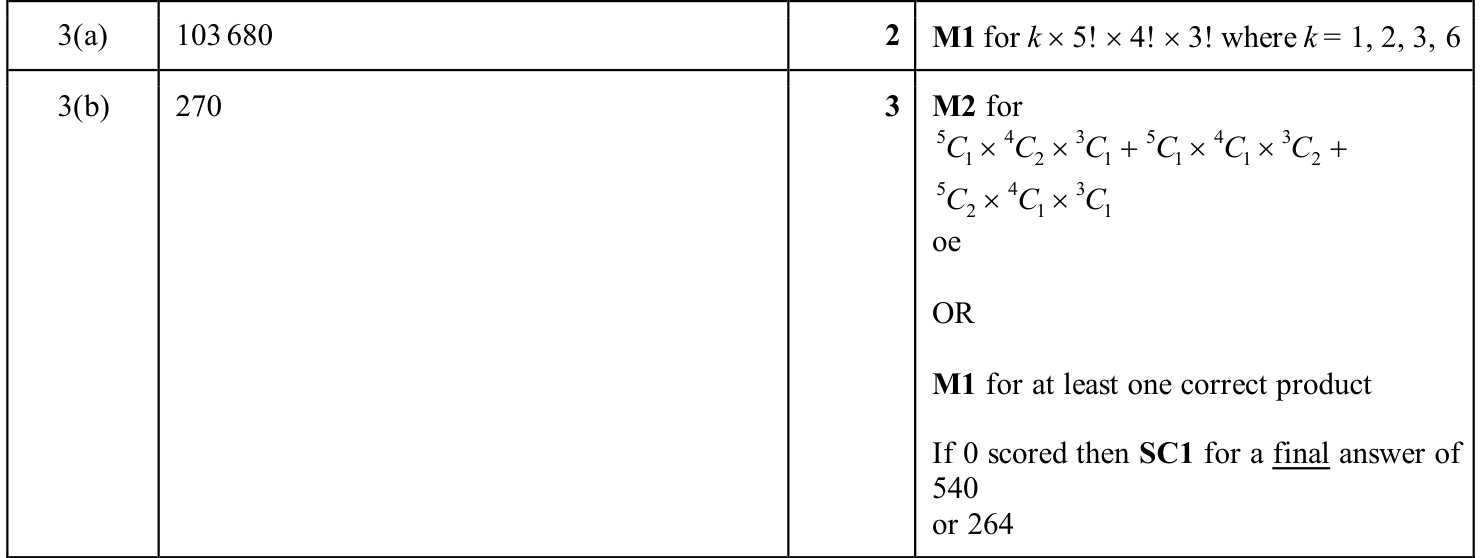
A sports club has the following members. 5 runners, 4 swimmers, 3 gymnasts (a) These members stand in a straight line.
Find the number of ways that this can be done when all the runners stand together, all the swimmers stand together and all the gymnasts stand together.
(b) Four of these members are selected for an event.
Find the number of ways that this can be done when at least one runner, at least one swimmer and at least one gymnast must be selected.
0606 P22 - Mar 2025 - Q4 - 7 marks
(a) A team of 10 players is to be chosen from 15 players.
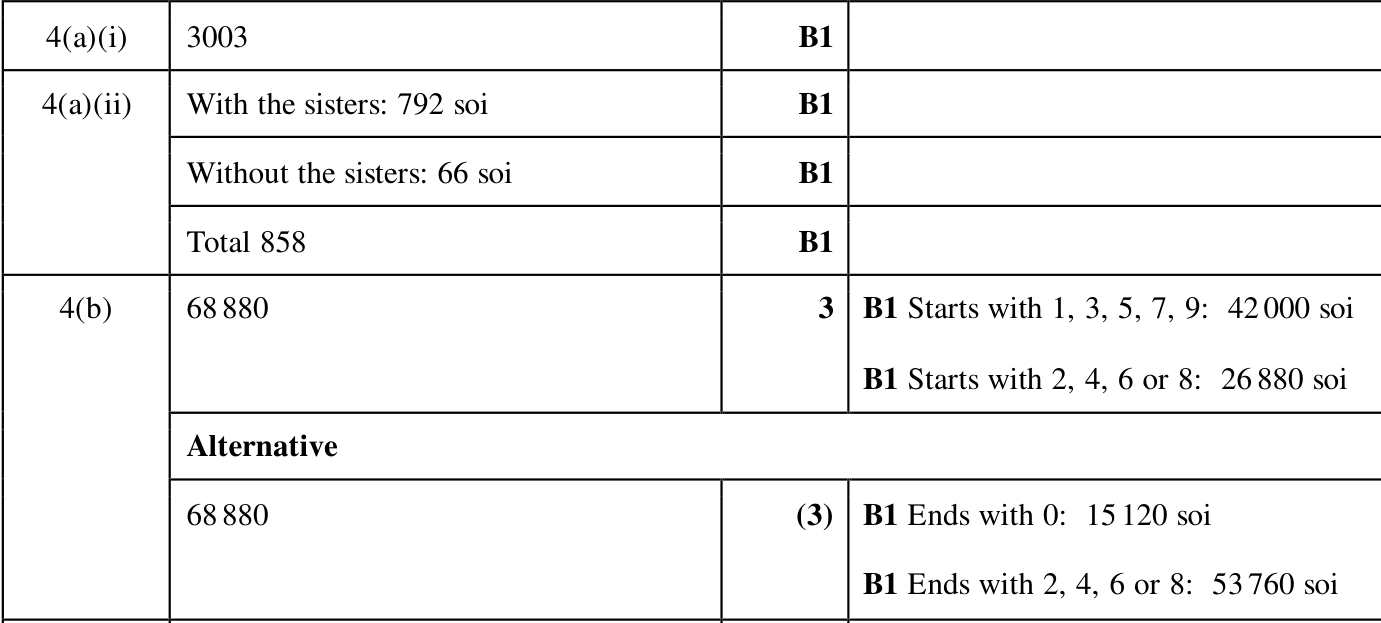
(i) Find the number of different teams that can be chosen if there are no restrictions.
The 15 players include 3 sisters who must not be separated.
(ii) Find the number of different teams that can be chosen.
(b) A 6-digit number is to be formed using the digits \(0,1,2,3,4,5,6,7,8\) and \(9\). The 6-digit number cannot start with \(0\) and all six digits must be different.
Find how many 6-digit numbers can be formed if the 6-digit number is even.
0606 P21 - Nov 2024 - Q10 - 6 marks
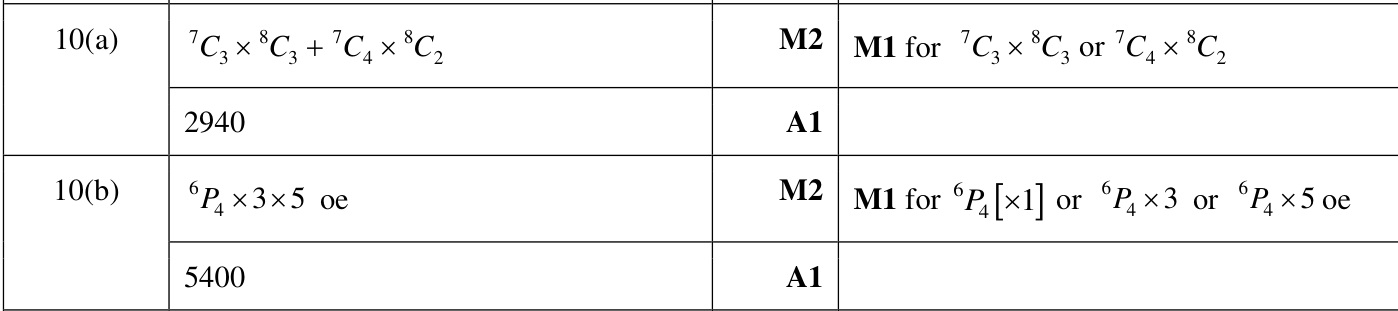
(a) A class contains 7 girls and 8 boys. A group of 6 is selected from the class. The group must contain at least 3 girls and at least 2 boys. Find the number of different groups that can be selected.
(b) A 5-character code is to be formed from the following characters.
| Letters | A | B | C | D | E | F |
|---|---|---|---|---|---|---|
| Numbers | 1 | 2 | 3 |
No character may be used more than once in any code. The characters may be arranged in any order.
Find the number of different codes that can be formed using 4 letters and 1 number.
0606 P22 - Nov 2024 - Q7 - 8 marks
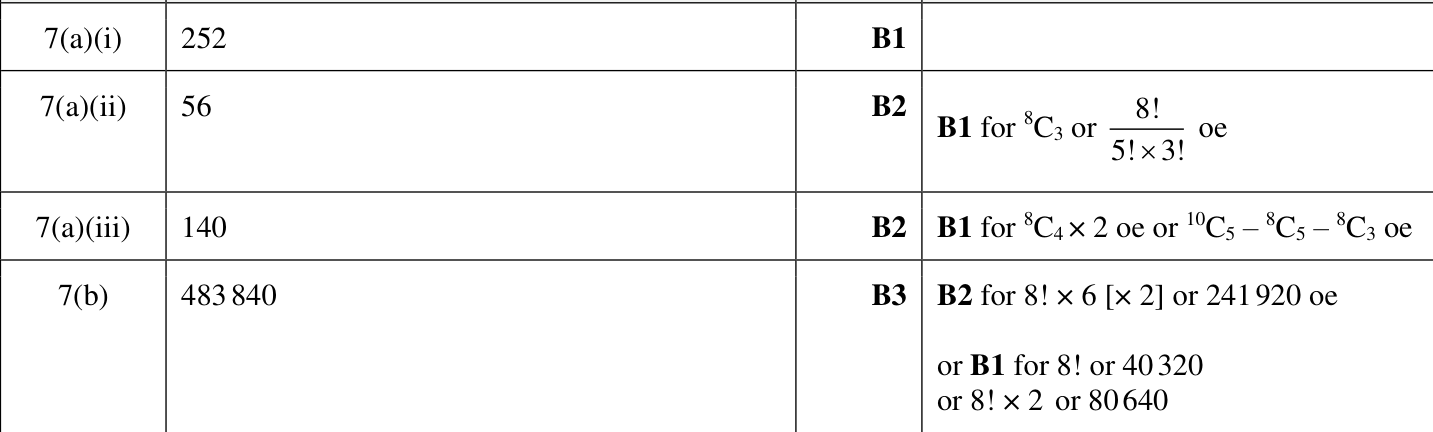
A class of 10 students includes Abby and Ben. (a) A group of 5 students is to be selected from the class. Find the number of possible groups in the following cases. (i) There are no restrictions.
(ii) The group includes both Abby and Ben.
(iii) The group includes either Abby or Ben, but not both.
(b) All 10 students are arranged in a line. How many arrangements are possible if there are exactly three students between Abby and Ben?
0606 P12 - Jun 2024 - Q4 - 6 marks
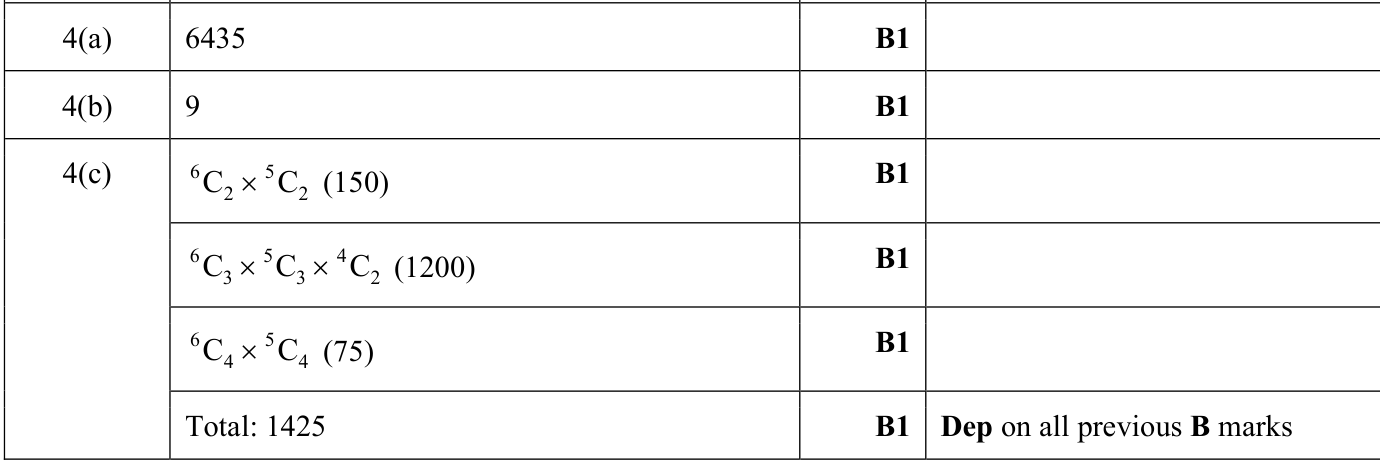
A team of 8 people is to be formed from 6 teachers, 5 doctors and 4 police officers. (a) Find the number of teams that can be formed. (b) Find the number of teams that can be formed without any teachers. (c) Find the number of teams that can be formed with the same number of doctors as teachers.
0606 P13 - Jun 2024 - Q7 - 7 marks
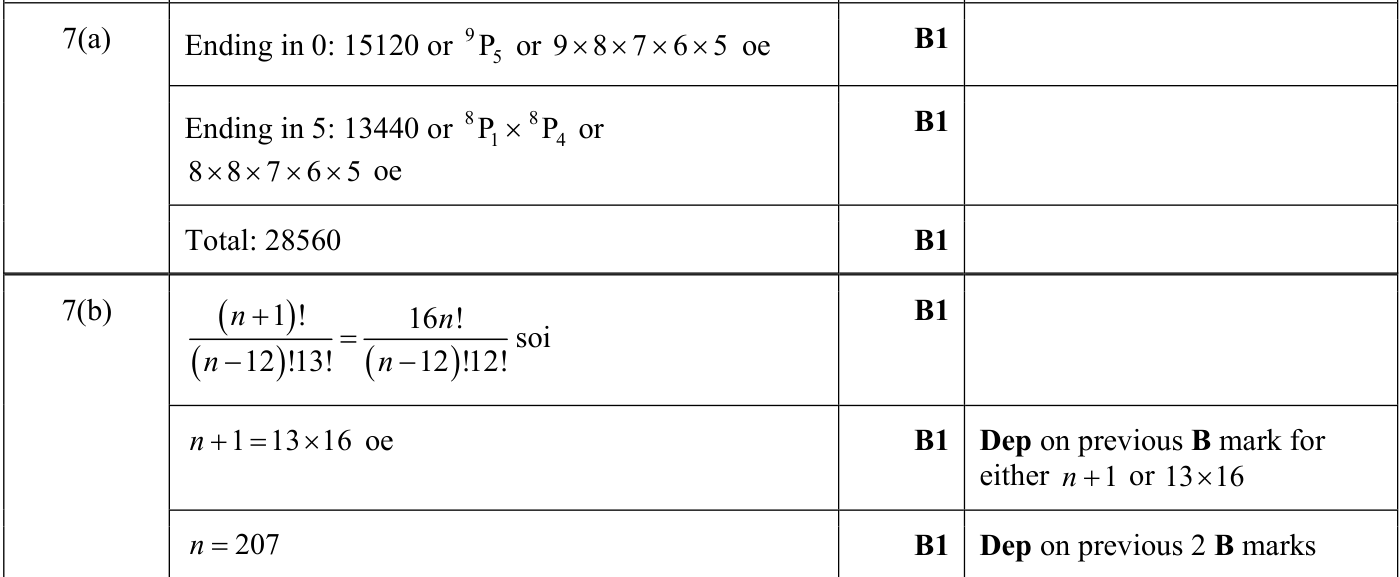
(a) A 6-digit number is to be formed using the digits \(0,1,2,3,4,5,6,7,8,9\). The 6-digit number cannot start with 0 . Each digit can be used at most once in any 6-digit number. Find how many of these 6 -digit numbers are divisible by 5 . (b) The number of combinations of \((n+1)\) objects taken 13 at a time is equal to 16 times the number of combinations of \(n\) objects taken 12 at a time. Find the value of \(n\).
0606 P11 - Jun 2023 - Q7 - 7 marks
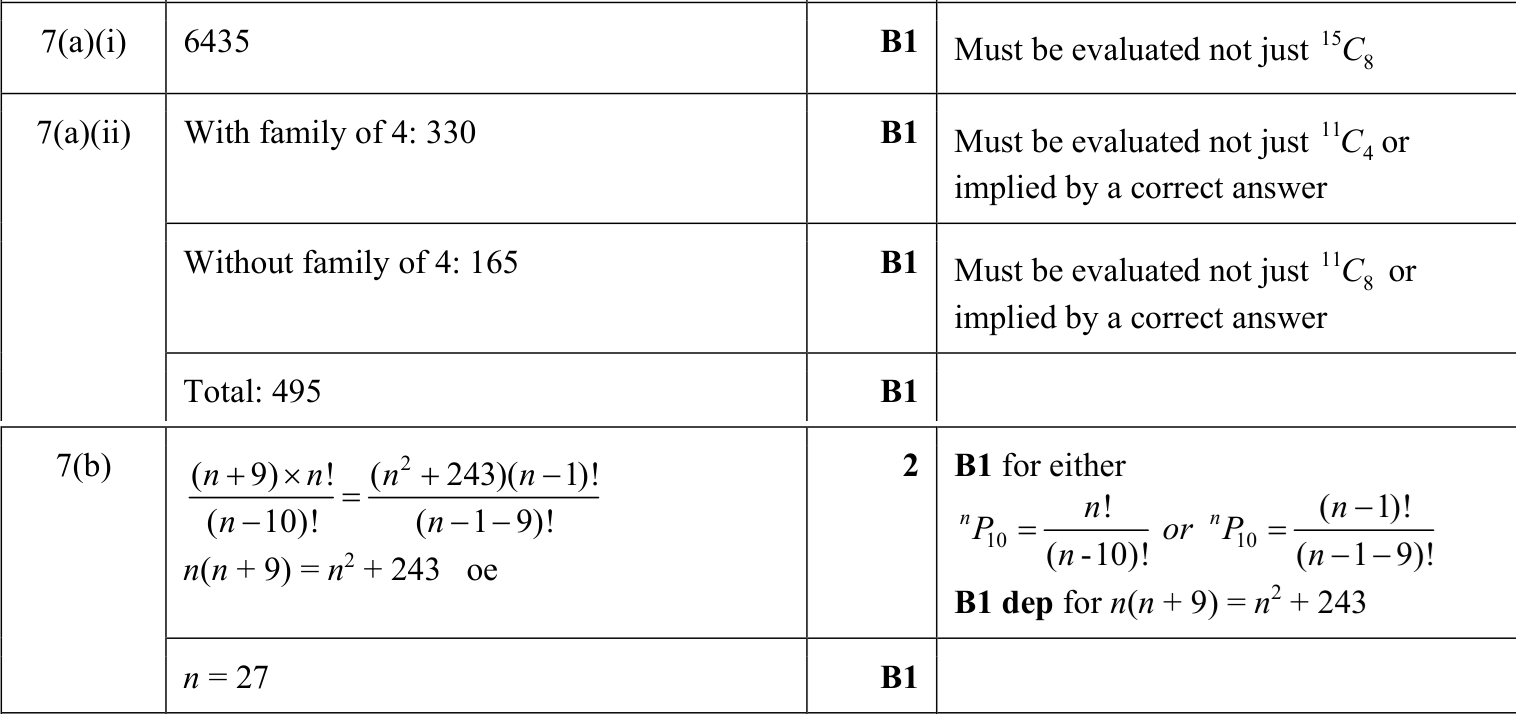
(a) A team of 8 people is to be chosen from a group of 15 people.
(i) Find the number of possible teams.
(ii) Four members of the group are from the same family. The team must include either all four family members or none of them. Find the number of possible teams.
(b) Given that
\(\displaystyle (n+9)\times{}^nP_{10}=(n^2+243)\times{}^{n-1}P_9,\)
find the value of \(n\).
0606 P12 - Jun 2023 - Q7 - 8 marks
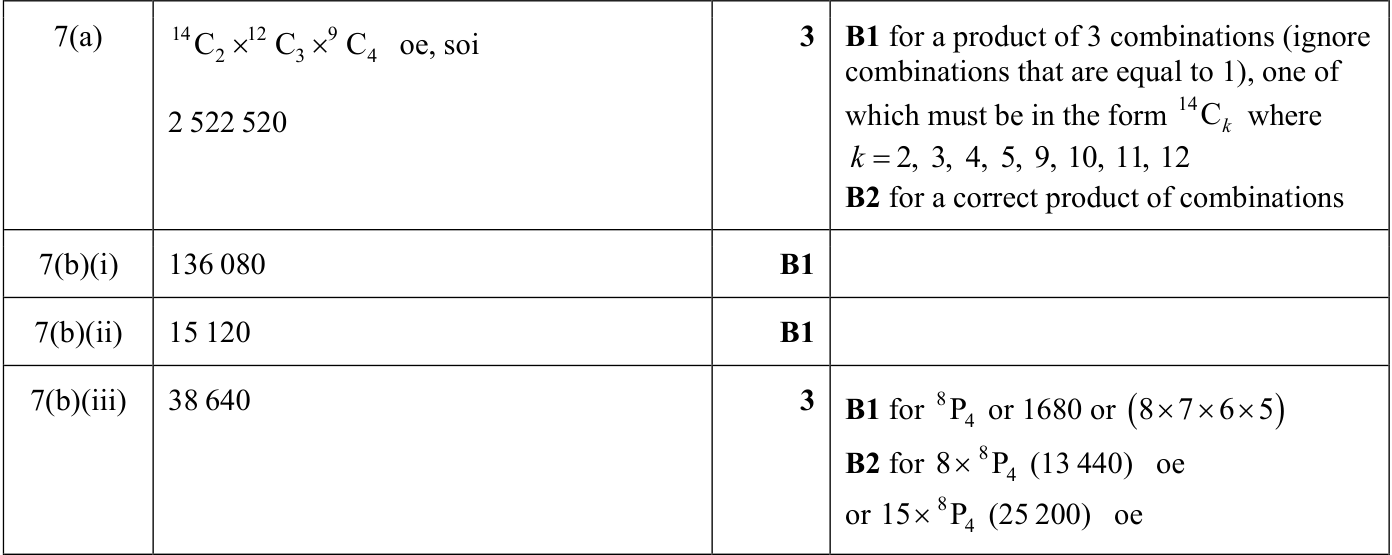
(a) Find the number of ways in which 14 people can be put into 4 groups containing 2, 3, 4 and 5 people.
(b) 6-digit numbers are to be formed using the digits \(0,1,2,3,4,5,6,7,8,9\). Each digit may be used only once in any 6-digit number. A 6-digit number must not start with 0. Find how many 6-digit numbers can be formed if
(i) there are no further restrictions,
(ii) the 6-digit number is divisible by 10,
(iii) the 6-digit number is greater than 500 000 and even.
0606 P23 - Jun 2023 - Q5 - 10 marks
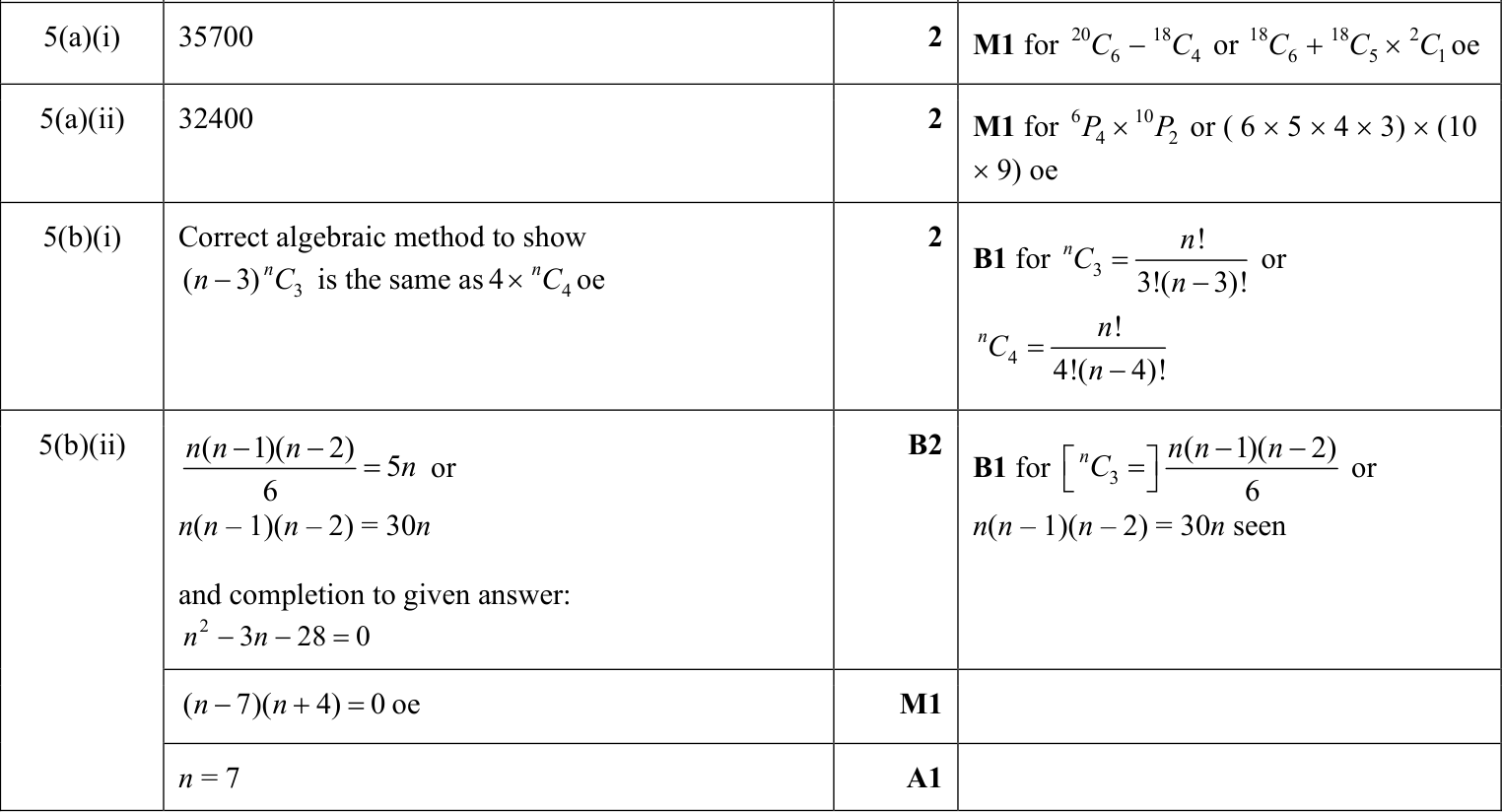
(a)(i) A gardening group has 20 members. A committee of 6 members is to be selected. Two of the members, Ann and Bo, belong to the group, but at most one of them can be on the committee. Find the number of different committees that can be selected.
(a)(ii) A gate passcode has 6 characters. The characters are chosen from the letters and digits shown below, and no character is repeated.
| Letters | G | A | R | D | E | N | ||||
|---|---|---|---|---|---|---|---|---|---|---|
| Digits | 0 | 1 | 2 | 3 | 4 | 5 | 6 | 7 | 8 | 9 |
Find the number of passcodes that consist of 4 letters followed by 2 digits.
(b)(i) Given that \(n\geq4\), show that
\((n-3)\binom n3=4\binom n4.\)
(b)(ii) Given that
\(\binom n3=5n,\qquad n\gt 3,\)
show that \(n^2-3n-28=0\), and hence find \(n\).
0606 P12 - Nov 2023 - Q7 - 8 marks
(a) A 6-digit number is to be formed using the digits \(0,1,2,3,4,5,6,7,8,9\). Each digit can be used only once in any 6-digit number. A 6-digit number cannot start with 0.
(i) Find how many 6-digit numbers can be formed.
(ii) Find how many of these 6-digit numbers are divisible by 5.
(b) A committee of 7 people is to be chosen from 6 doctors, 10 nurses and 8 dentists.
(i) Find the number of committees that can be chosen.
(ii) Find the number of committees that can be chosen if all the doctors have to be on the committee.
(iii) Find the number of committees that can be chosen if there has to be at least one dentist on the committee.