Browsing as Guest. Progress, bookmarks and attempts are disabled.
Log in to track your work.
9709 P32 - Nov 2022 - Q5
1924
(a) Solve the equation \(z^2 - 6iz - 12 = 0\), giving the answers in the form \(x + iy\), where \(x\) and \(y\) are real and exact.
(b) On a sketch of an Argand diagram with origin \(O\), show points \(A\) and \(B\) representing the roots of the equation in part (a).
(c) Find the exact modulus and argument of each root.
(d) Hence show that the triangle \(OAB\) is equilateral.
Solution
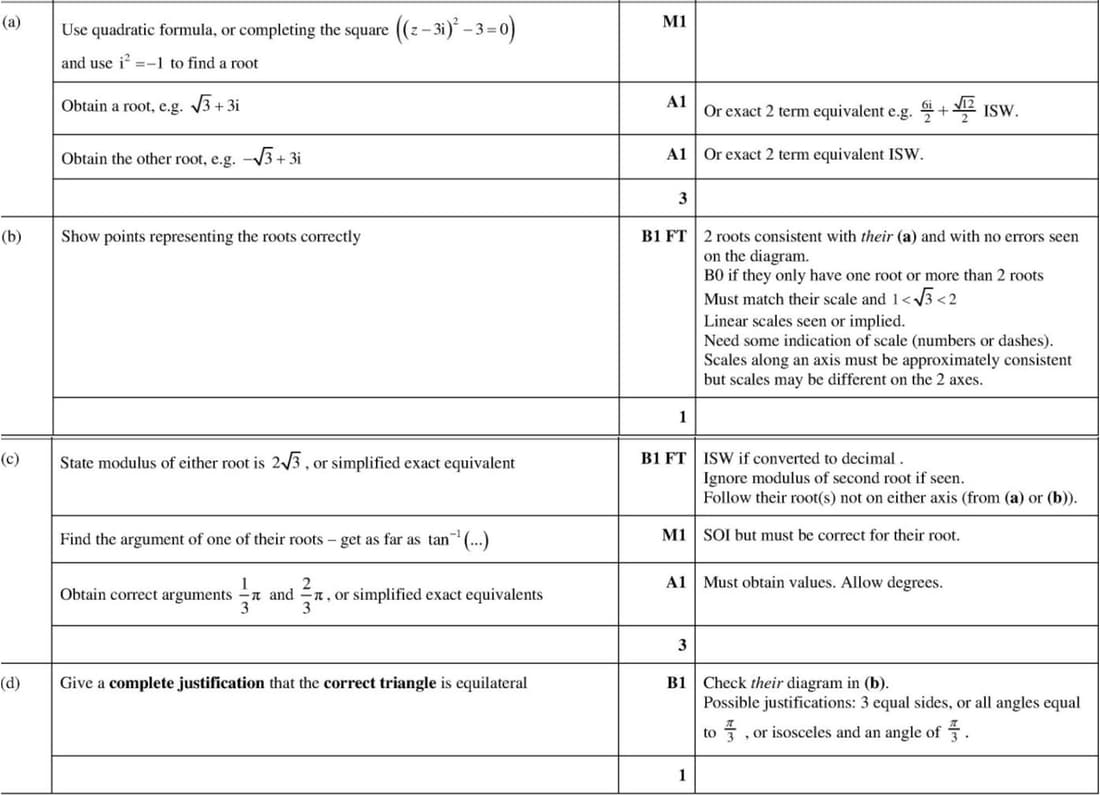
(a) To solve the equation \(z^2 - 6iz - 12 = 0\), use the quadratic formula or complete the square. Completing the square gives \((z - 3i)^2 - 3 = 0\). Solving for \(z\), we find the roots \(z = \sqrt{3} + 3i\) and \(z = -\sqrt{3} + 3i\).
(b) On the Argand diagram, plot the points \(A(\sqrt{3}, 3)\) and \(B(-\sqrt{3}, 3)\) to represent the roots.
(c) The modulus of each root is \(\sqrt{(\sqrt{3})^2 + 3^2} = \sqrt{3 + 9} = \sqrt{12} = 2\sqrt{3}\). The argument of \(\sqrt{3} + 3i\) is \(\arctan\left(\frac{3}{\sqrt{3}}\right) = \frac{\pi}{3}\), and the argument of \(-\sqrt{3} + 3i\) is \(\pi - \frac{\pi}{3} = \frac{2\pi}{3}\).
(d) To show that triangle \(OAB\) is equilateral, note that the distances \(OA\), \(OB\), and \(AB\) are all equal to \(2\sqrt{3}\), and the angles between them are all \(\frac{\pi}{3}\), confirming that \(OAB\) is equilateral.