Browsing as Guest. Progress, bookmarks and attempts are disabled.
Log in to track your work.
June 2022 p33 q5
1927
The complex number 3 - i is denoted by u.
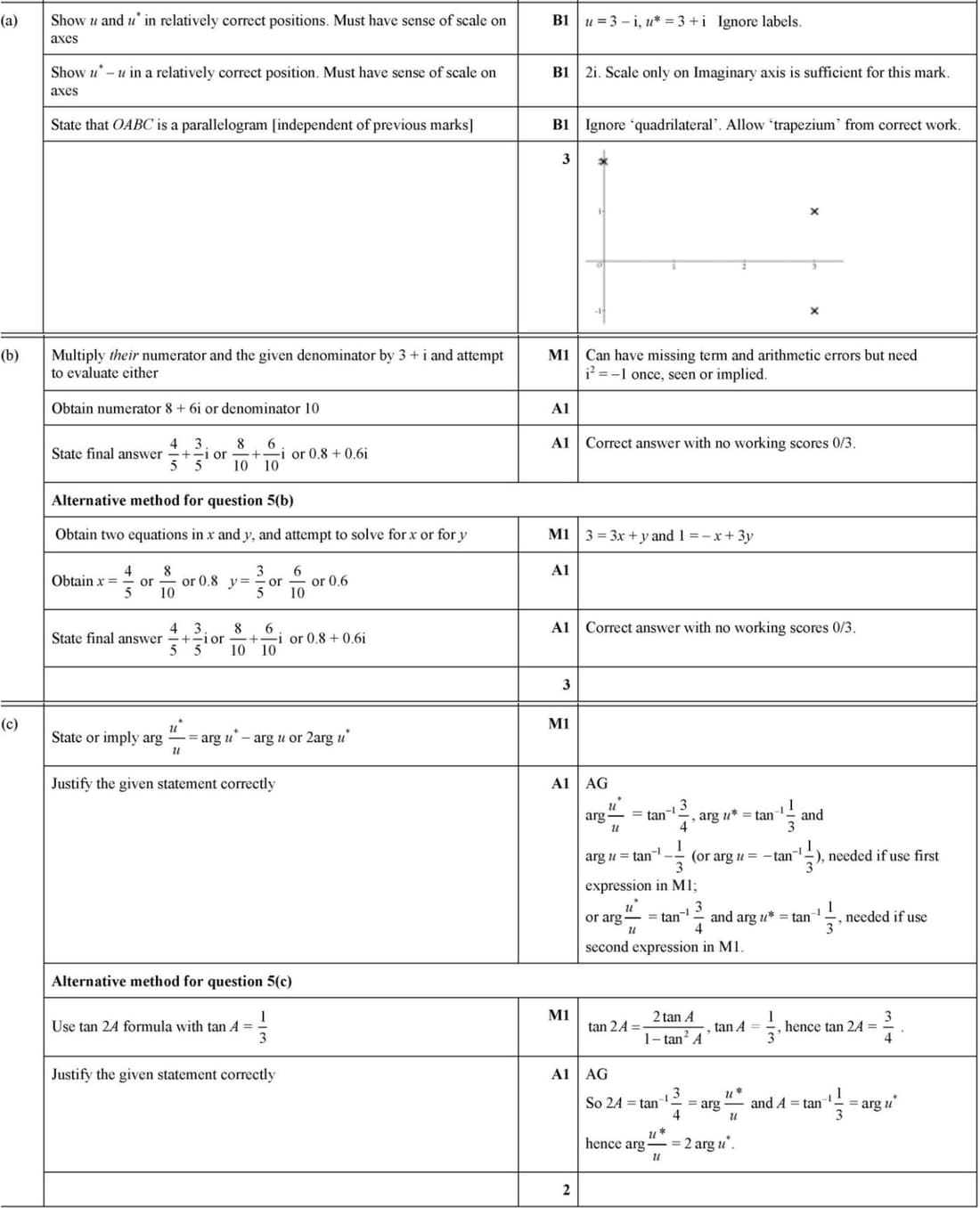
(a) Show, on an Argand diagram with origin O, the points A, B and C representing the complex numbers u, u^* and u^* - u respectively. State the type of quadrilateral formed by the points O, A, B and C.
(b) Express \(\frac{u^*}{u}\) in the form \(x + iy\), where \(x\) and \(y\) are real.
(c) By considering the argument of \(\frac{u^*}{u}\), or otherwise, prove that \(\arctan\left(\frac{3}{4}\right) = 2 \arctan\left(\frac{1}{3}\right)\).
Solution
(a) On the Argand diagram, point A represents \(u = 3 - i\), point B represents \(u^* = 3 + i\), and point C represents \(u^* - u = 2i\). The quadrilateral OABC is a parallelogram because opposite sides are equal and parallel.
(b) To express \(\frac{u^*}{u}\), calculate \(\frac{3+i}{3-i}\). Multiply numerator and denominator by the conjugate of the denominator: \(\frac{(3+i)(3+i)}{(3-i)(3+i)} = \frac{9 + 6i + i^2}{9 + 1} = \frac{8 + 6i}{10} = 0.8 + 0.6i\).
(c) The argument of \(\frac{u^*}{u}\) is \(\arg(u^*) - \arg(u) = \arctan\left(\frac{1}{3}\right) - (-\arctan\left(\frac{1}{3}\right)) = 2 \arctan\left(\frac{1}{3}\right)\). Thus, \(\arctan\left(\frac{3}{4}\right) = 2 \arctan\left(\frac{1}{3}\right)\).