Past Exam Questions
← Back0606 P23 - Nov 2018 - Q7 - 7 marks
A squad of \(20\) boys, which includes \(2\) sets of twins, is available for selection for a cricket team of \(11\) players.
Calculate the number of different teams that can be selected if
(i) there are no restrictions,
(ii) both sets of twins are selected,
(iii) one set of twins is selected but neither twin from the other set is selected,
(iv) exactly one twin from each set of twins is selected.

0606 P21 - Jun 2017 - Q8 - 7 marks
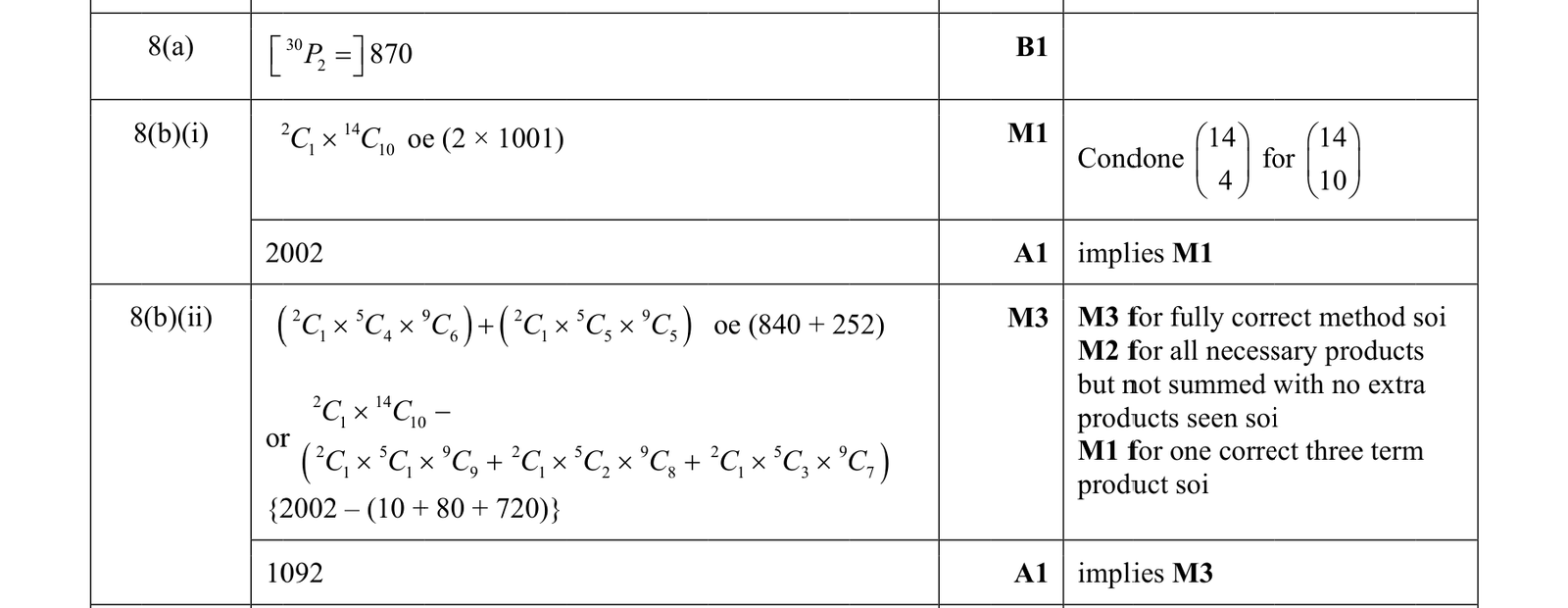
(a) A football club has \(30\) players. In how many different ways can a captain and a vice-captain be selected at random from these players?
(b) A team of \(11\) teachers is to be chosen from \(2\) mathematics teachers, \(5\) computing teachers and \(9\) science teachers. Find the number of different teams that can be chosen if
(i) the team must have exactly \(1\) mathematics teacher,
(ii) the team must have exactly \(1\) mathematics teacher and at least \(4\) computing teachers.
0606 P23 - Jun 2017 - Q5 - 6 marks
(a) How many \(5\)-digit numbers are there that have \(5\) different digits and are divisible by \(5\)?
(b) A committee of \(8\) people is to be selected from \(9\) men and \(5\) women. Find the number of different committees that can be selected if the committee must have at least \(4\) women.

0606 P11 - Nov 2017 - Q8 - 12 marks
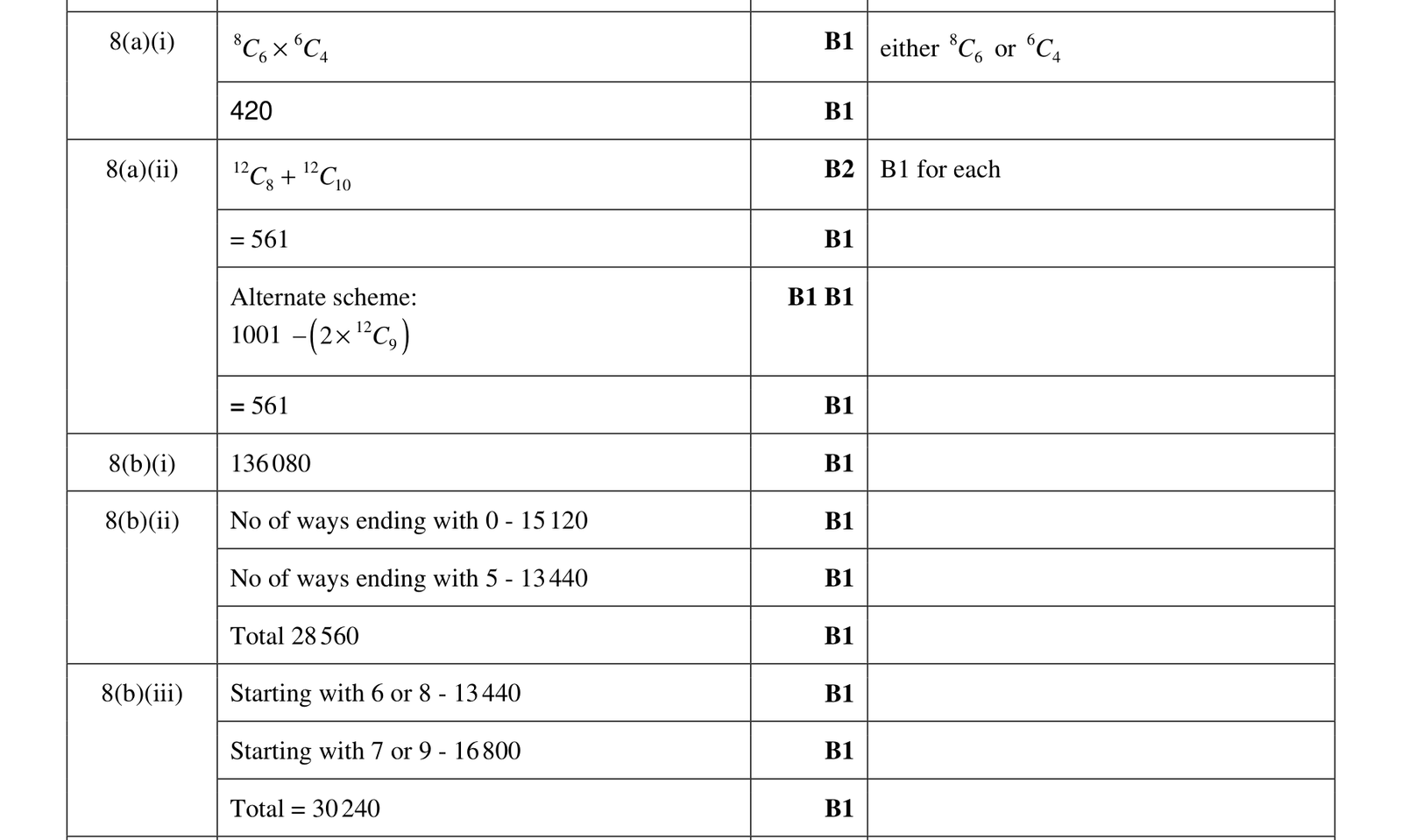
(a) Ten people are to be chosen, to receive concert tickets, from a group of 8 men and 6 women.
(i) Find the number of different ways the 10 people can be chosen if 6 of them are men and 4 of them are women.
The group of 8 men and 6 women contains a man and his wife.
(ii) Find the number of different ways the 10 people can be chosen if both the man and his wife are chosen or neither of them is chosen.
(b) Freddie has forgotten the 6-digit code that he uses to lock his briefcase. He knows that he did not repeat any digit and that he did not start his code with a zero.
(i) Find the number of different 6-digit numbers he could have chosen.
Freddie also remembers that his 6-digit code is divisible by 5.
(ii) Find the number of different 6-digit numbers he could have chosen.
Freddie decides to choose a new 6-digit code for his briefcase once he has opened it. He plans to have the 6-digit number divisible by 2 and greater than 600000, again with no repetitions of digits.
(iii) Find the number of different 6-digit numbers he can choose.
0606 P13 - Nov 2017 - Q9 - 9 marks
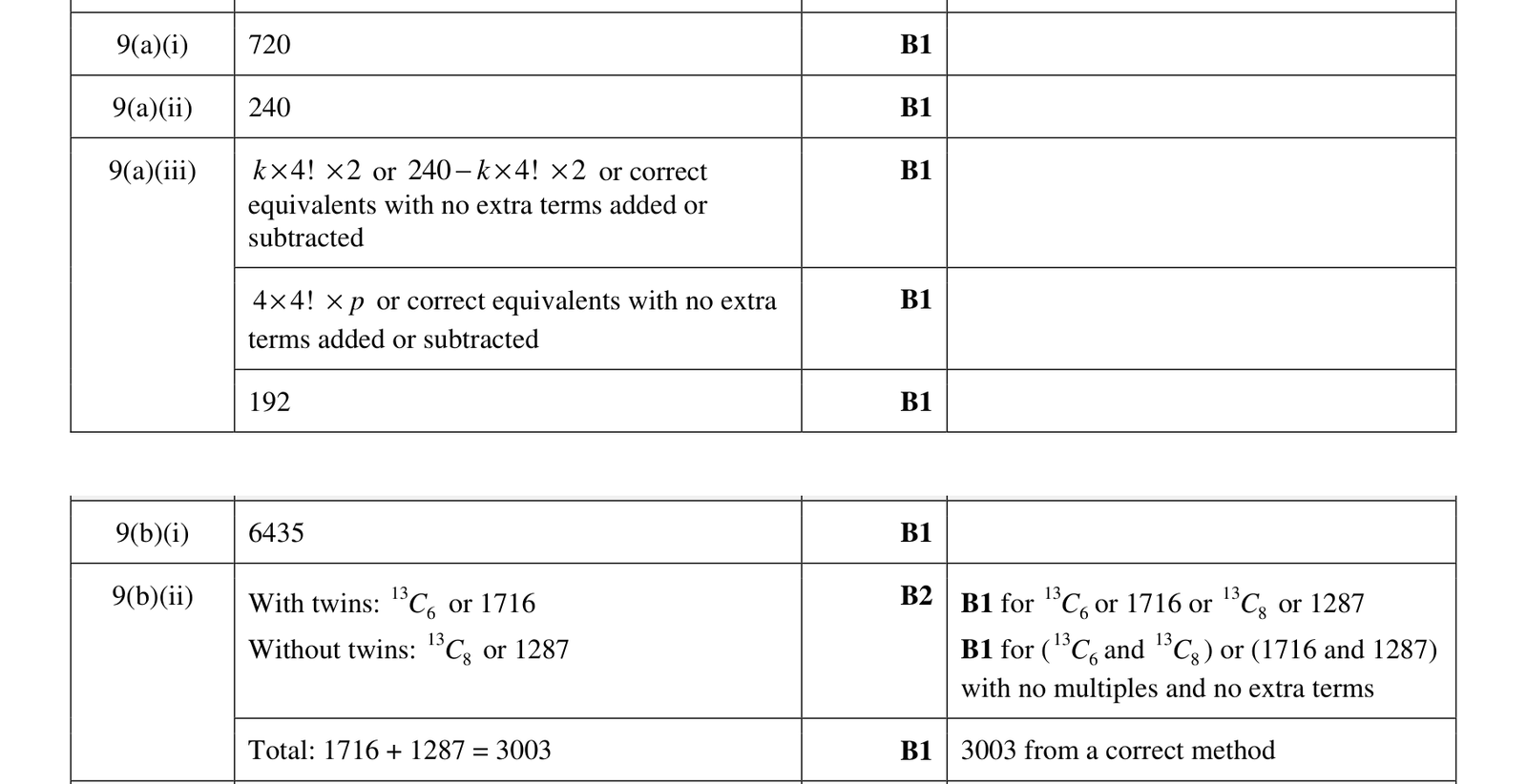
(a) A 6-digit number is formed using each of the digits \(1\), \(3\), \(5\), \(6\), \(8\), and \(9\) once and only once. Find the number of different 6-digit numbers that can be formed if
(i) there are no restrictions,
(ii) the number is even,
(iii) the number is even and greater than \(300000\).
(b) Ruby has \(15\) friends. She decides to invite \(8\) of them to a party. Find the number of ways in which she can do this if
(i) there are no restrictions,
(ii) two of the \(15\) friends are twins who must not be separated.
0606 P22 - Nov 2017 - Q5 - 7 marks
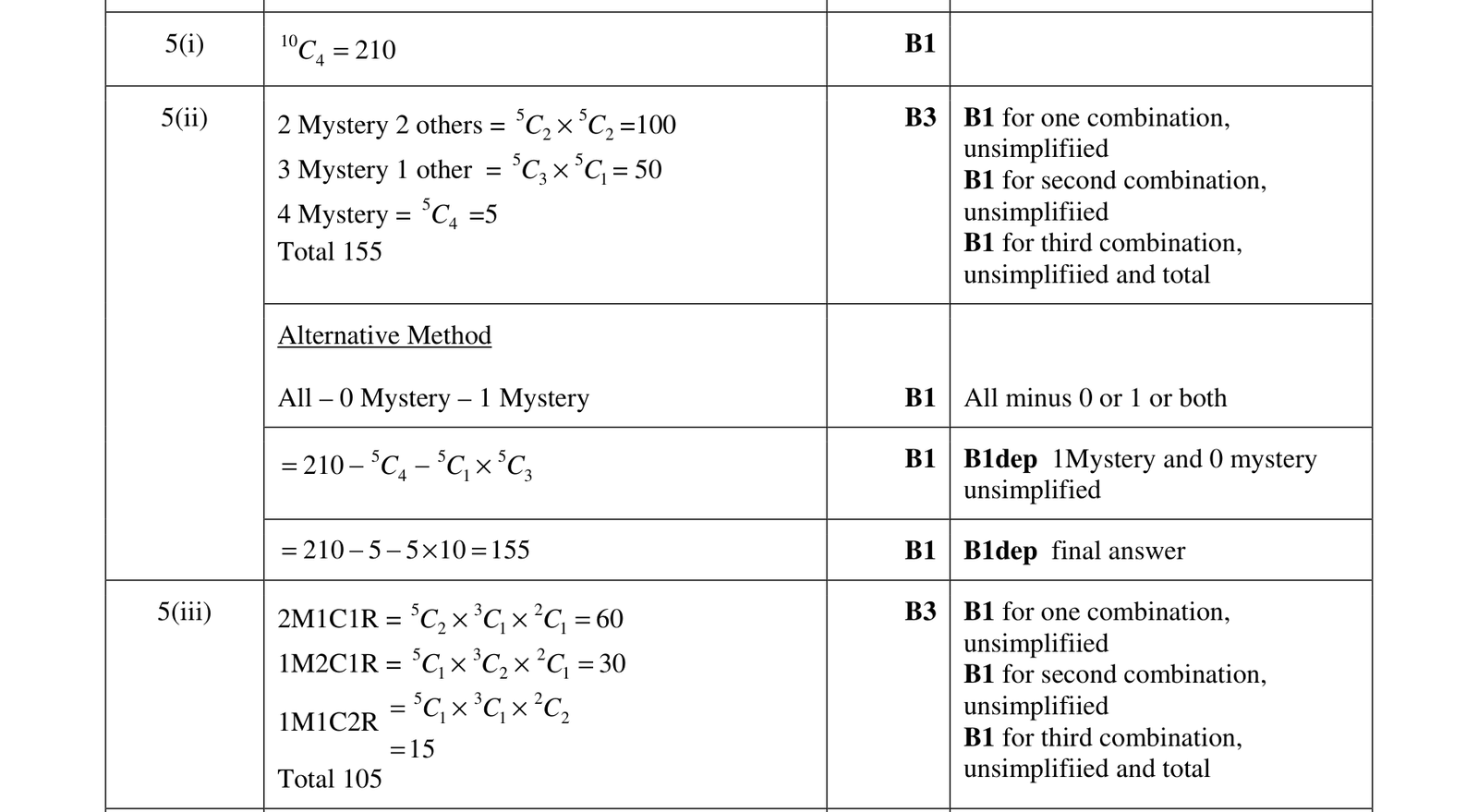
Naomi is going on holiday and intends to read \(4\) books during her time away. She selects these books from \(5\) mystery, \(3\) crime, and \(2\) romance books. Find the number of ways in which she can make her selection in each of the following cases.
(i) There are no restrictions.
(ii) She selects at least \(2\) mystery books.
(iii) She selects at least \(1\) book of each type.
9709 P23 - Nov 2023 - Q4
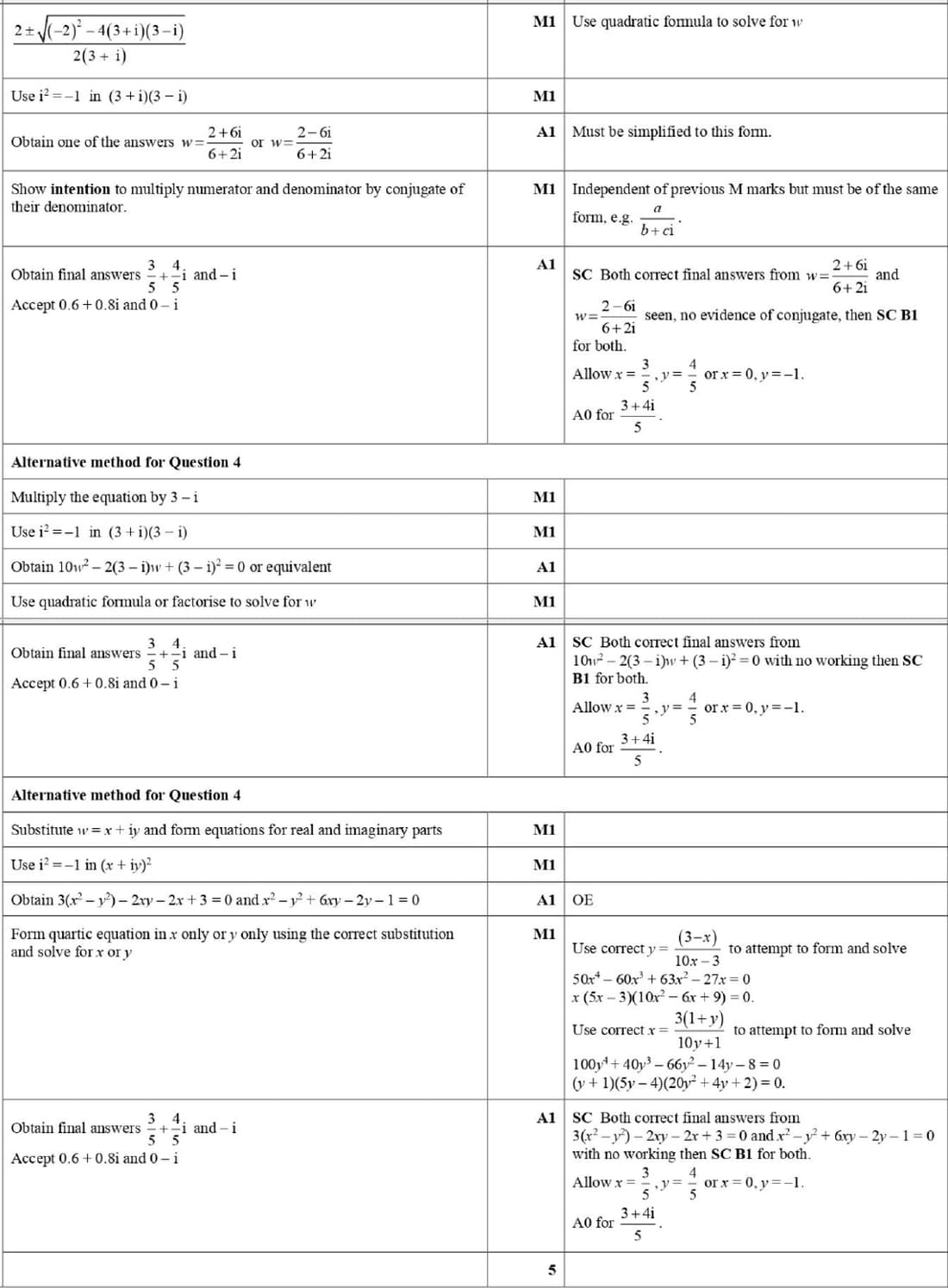
Solve the quadratic equation \((3+i)w^2 - 2w + 3 - i = 0\), giving your answers in the form \(x + iy\), where \(x\) and \(y\) are real.
9709 P32 - Jun 2023 - Q3
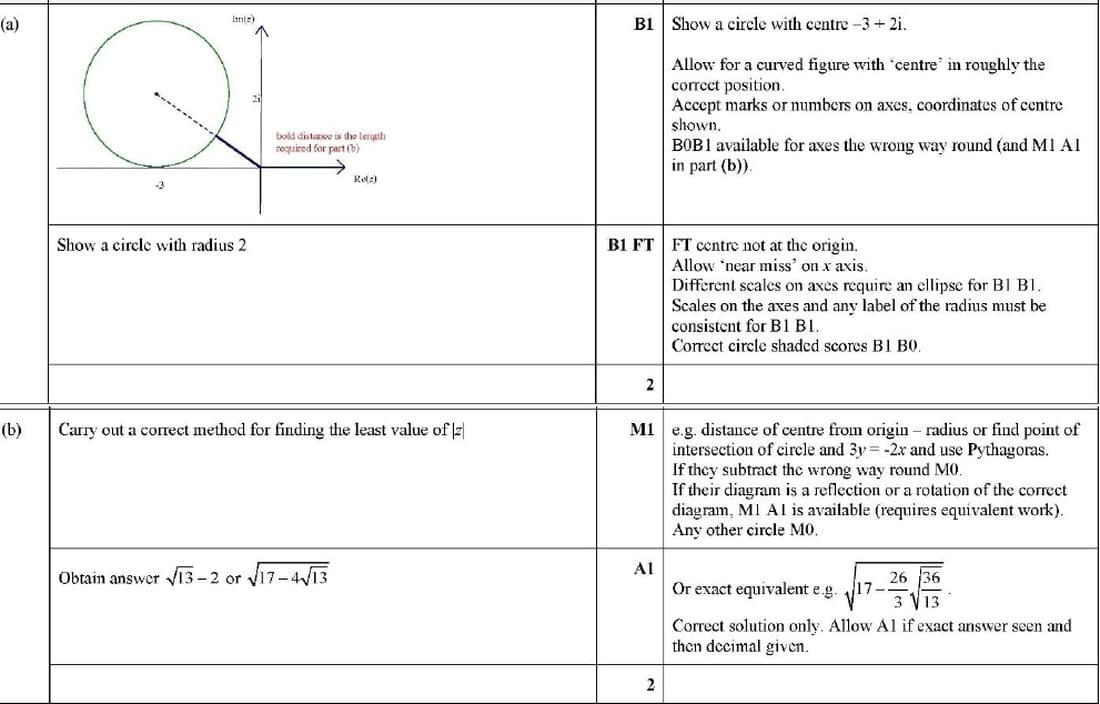
(a) On an Argand diagram, sketch the locus of points representing complex numbers \(z\) satisfying \(|z + 3 - 2i| = 2\).
(b) Find the least value of \(|z|\) for points on this locus, giving your answer in an exact form.
9709 P3 - Nov 2007 - Q8
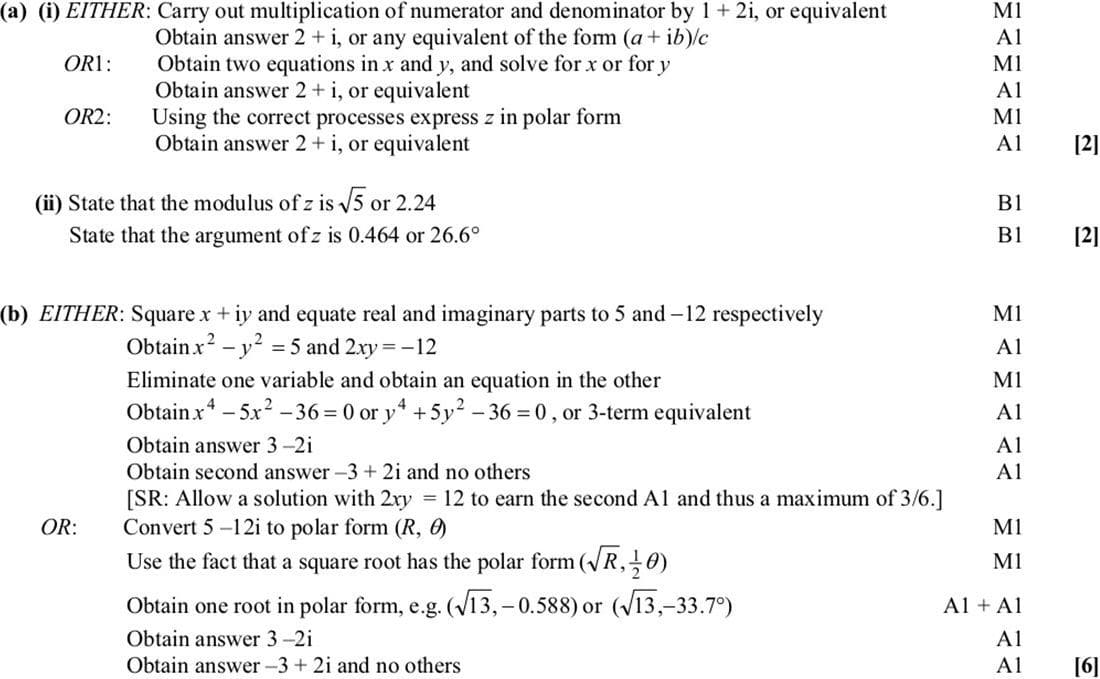
(a) The complex number z is given by \(z = \frac{4 - 3i}{1 - 2i}\).
(i) Express \(z\) in the form \(x + iy\), where \(x\) and \(y\) are real.
(ii) Find the modulus and argument of \(z\).
(b) Find the two square roots of the complex number \(5 - 12i\), giving your answers in the form \(x + iy\), where \(x\) and \(y\) are real.
9709 P3 - Jun 2007 - Q8
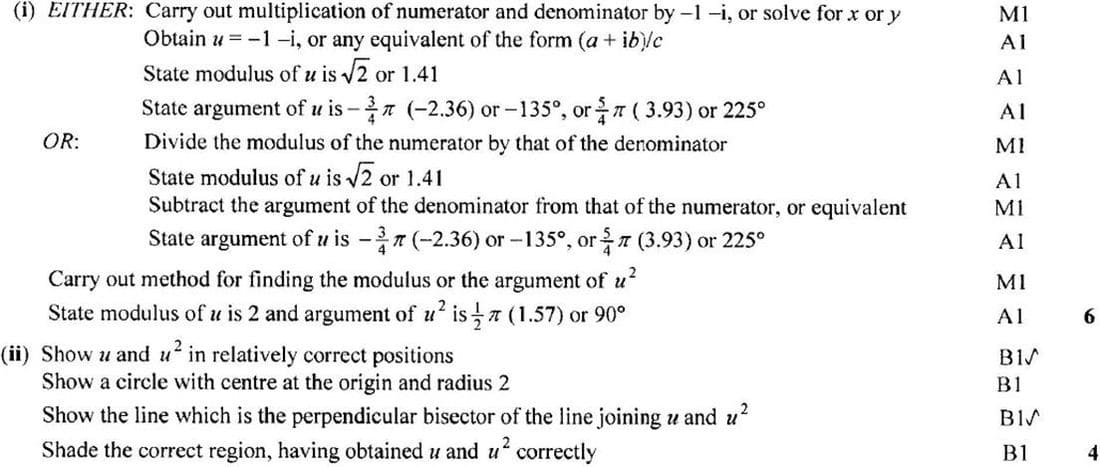
The complex number \(\frac{2}{-1+i}\) is denoted by \(u\).
(i) Find the modulus and argument of \(u\) and \(u^2\).
(ii) Sketch an Argand diagram showing the points representing the complex numbers \(u\) and \(u^2\). Shade the region whose points represent the complex numbers \(z\) which satisfy both the inequalities \(|z| < 2\) and \(|z-u^2| < |z-u|\).
9709 P3 - Nov 2006 - Q9
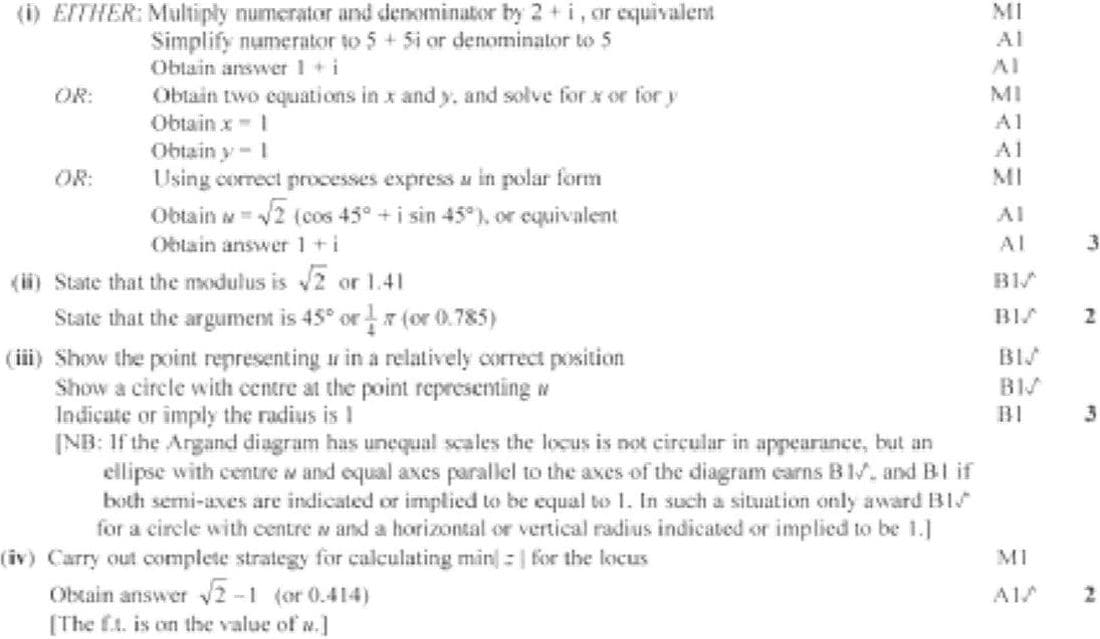
The complex number u is given by
\(u = \frac{3+i}{2-i}\).
- Express u in the form x + iy, where x and y are real. [3]
- Find the modulus and argument of u. [2]
- Sketch an Argand diagram showing the point representing the complex number u. Show on the same diagram the locus of the point representing the complex number z such that \(|z-u| = 1\). [3]
- Using your diagram, calculate the least value of \(|z|\) for points on this locus. [2]
9709 P3 - Jun 2006 - Q7
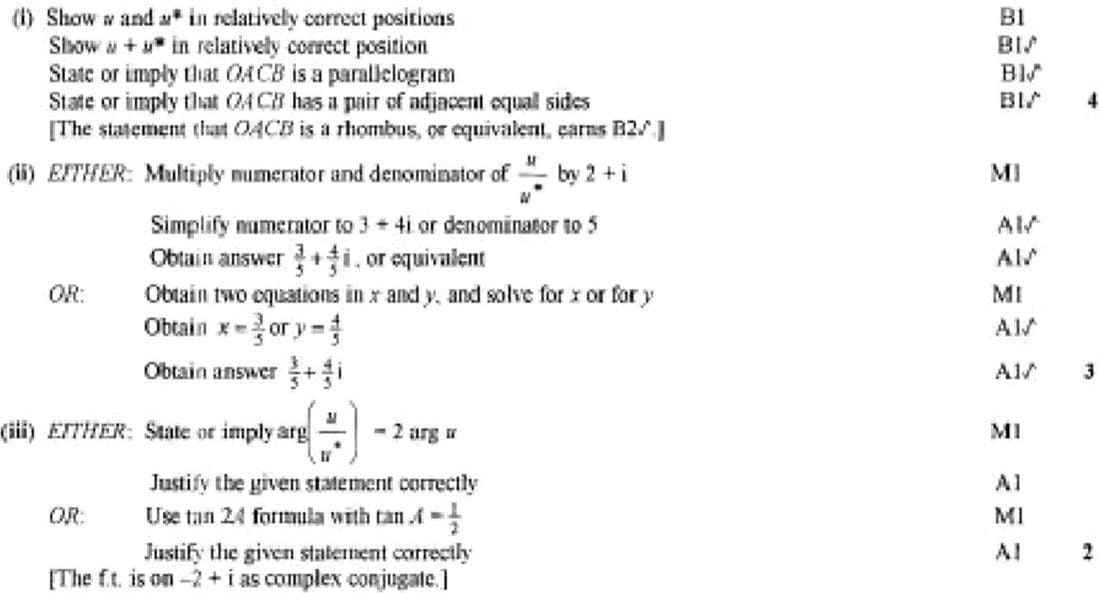
The complex number 2 + i is denoted by u. Its complex conjugate is denoted by u*.
(i) Show, on a sketch of an Argand diagram with origin O, the points A, B and C representing the complex numbers u, u* and u + u* respectively. Describe in geometrical terms the relationship between the four points O, A, B and C. [4]
(ii) Express \(\frac{u}{u^*}\) in the form \(x + iy\), where x and y are real. [3]
(iii) By considering the argument of \(\frac{u}{u^*}\), or otherwise, prove that \(\arctan\left(\frac{4}{3}\right) = 2 \arctan\left(\frac{1}{2}\right)\). [2]
9709 P3 - Nov 2005 - Q7
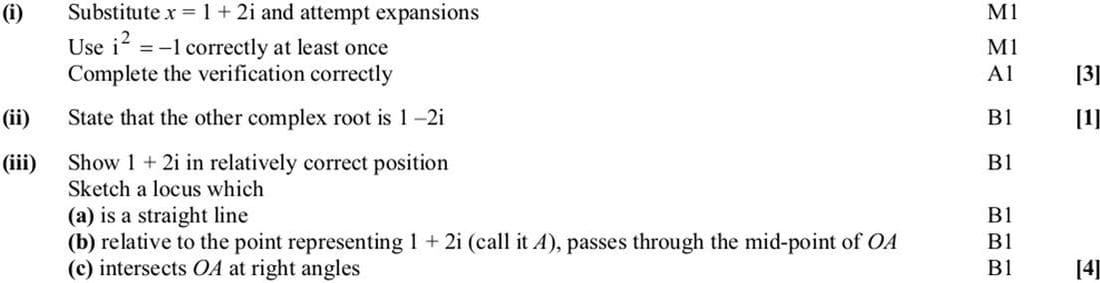
The equation \(2x^3 + x^2 + 25 = 0\) has one real root and two complex roots.
- Verify that \(1 + 2i\) is one of the complex roots.
- Write down the other complex root of the equation.
- Sketch an Argand diagram showing the point representing the complex number \(1 + 2i\). Show on the same diagram the set of points representing the complex numbers \(z\) which satisfy \(|z| = |z - 1 - 2i|\).
9709 P3 - Jun 2005 - Q3
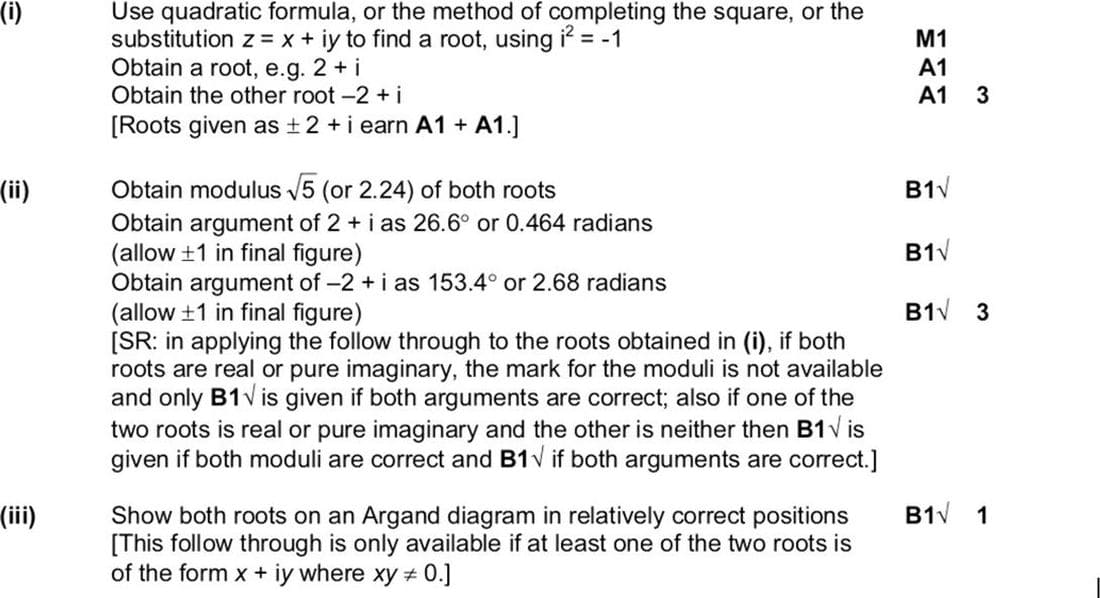
(i) Solve the equation \(z^2 - 2iz - 5 = 0\), giving your answers in the form \(x + iy\) where \(x\) and \(y\) are real.
(ii) Find the modulus and argument of each root.
(iii) Sketch an Argand diagram showing the points representing the roots.
9709 P3 - Nov 2004 - Q6
The complex numbers 1 + 3i and 4 + 2i are denoted by u and v respectively.
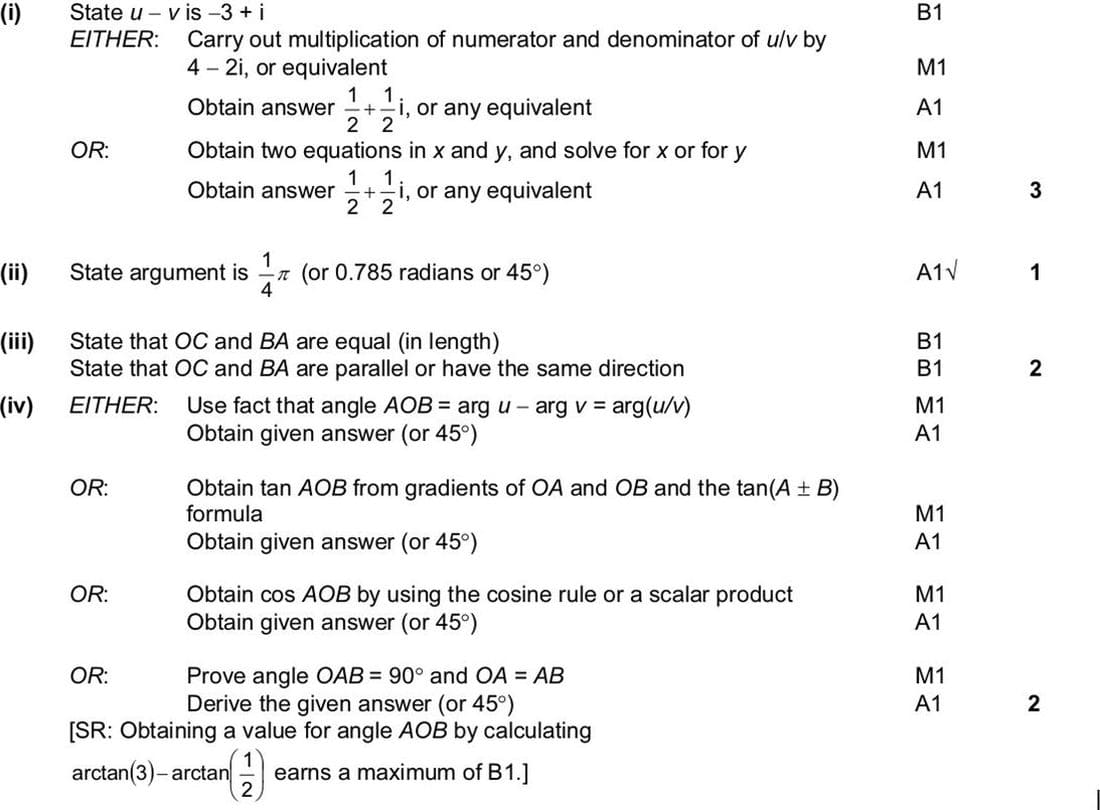
- Find, in the form x + iy, where x and y are real, the complex numbers u - v and \(\frac{u}{v}\).
- State the argument of \(\frac{u}{v}\).
In an Argand diagram, with origin O, the points A, B and C represent the numbers u, v and u - v respectively.
- State fully the geometrical relationship between OC and BA.
- Prove that angle AOB = \(\frac{1}{4} \pi\) radians.
9709 P3 - Jun 2004 - Q8
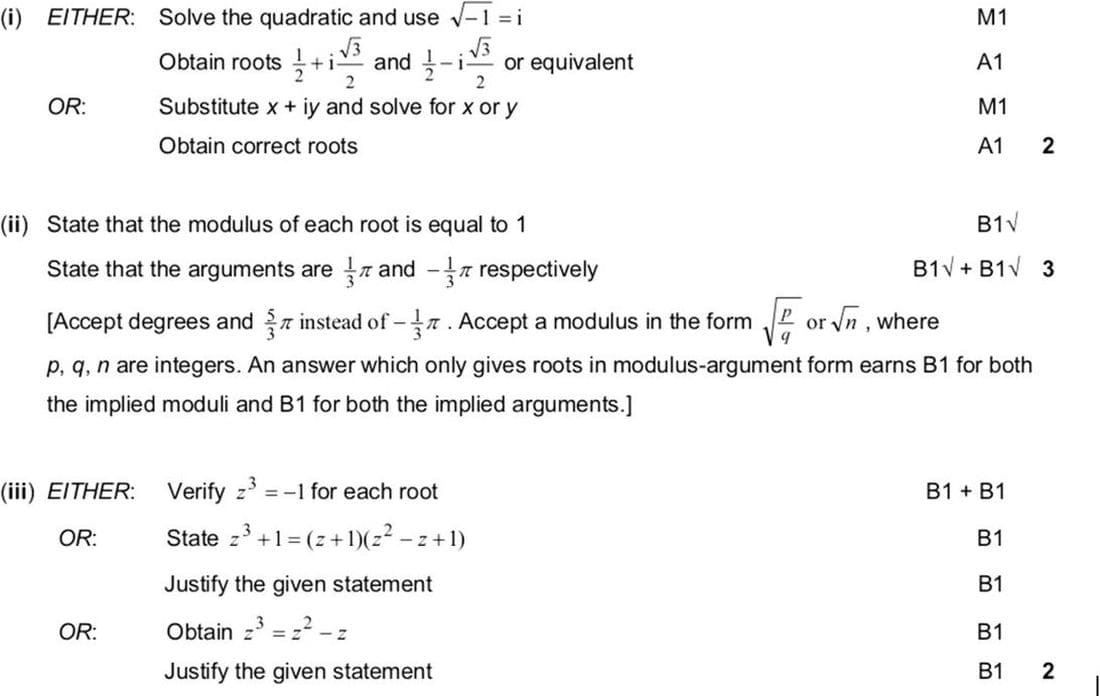
(i) Find the roots of the equation \(z^2 - z + 1 = 0\), giving your answers in the form \(x + iy\), where \(x\) and \(y\) are real.
(ii) Obtain the modulus and argument of each root.
(iii) Show that each root also satisfies the equation \(z^3 = -1\).
9709 P3 - Nov 2003 - Q7
The complex number u is given by \(u = \frac{7 + 4i}{3 - 2i}\).
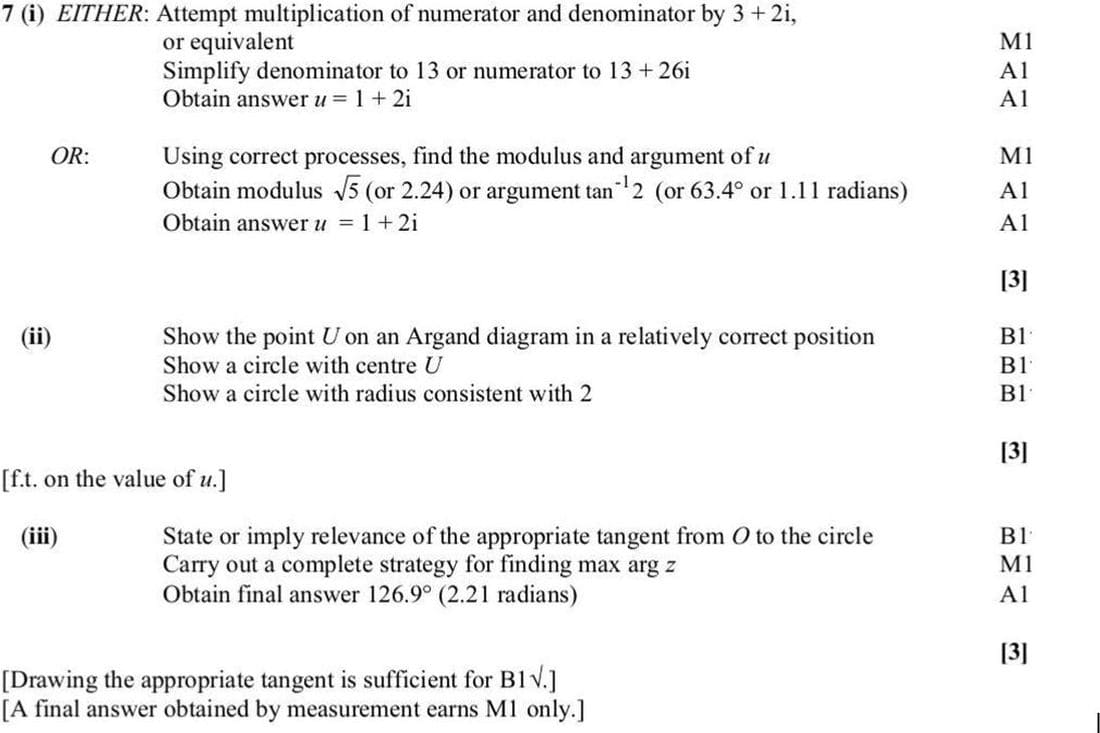
- Express u in the form \(x + iy\), where x and y are real.
- Sketch an Argand diagram showing the point representing the complex number u. Show on the same diagram the locus of the complex number z such that \(|z - u| = 2\).
- Find the greatest value of \(\arg z\) for points on this locus.
9709 P3 - Jun 2003 - Q5
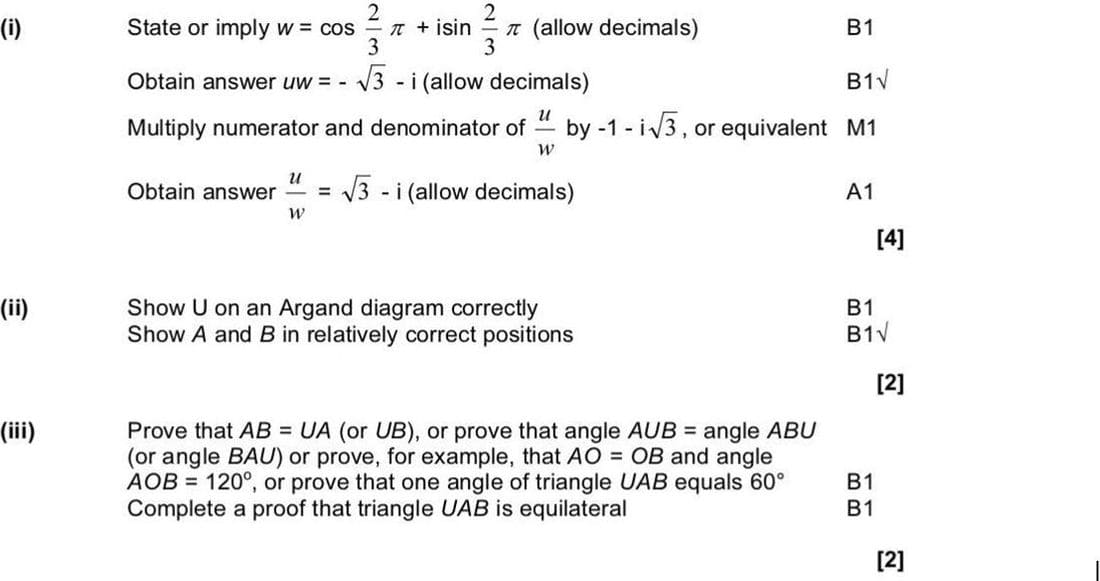
The complex number 2i is denoted by u. The complex number with modulus 1 and argument \(\frac{2}{3} \pi\) is denoted by w.
(i) Find in the form x + iy, where x and y are real, the complex numbers w, uw and \(\frac{u}{w}\).
(ii) Sketch an Argand diagram showing the points U, A and B representing the complex numbers u, uw and \(\frac{u}{w}\) respectively.
(iii) Prove that triangle UAB is equilateral.
9709 P31 - Jun 2023 - Q10
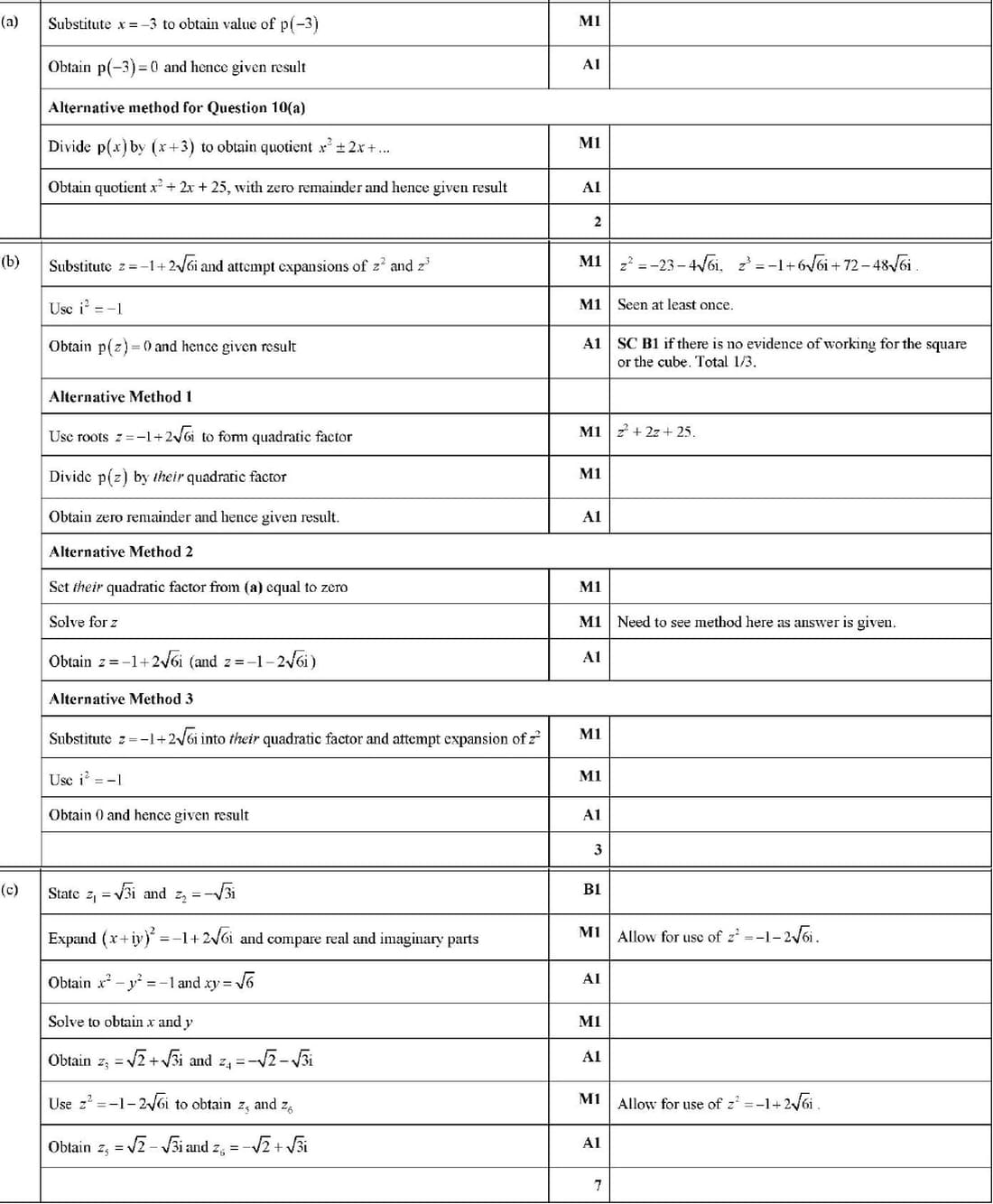
The polynomial \(x^3 + 5x^2 + 31x + 75\) is denoted by \(p(x)\).
(a) Show that \((x + 3)\) is a factor of \(p(x)\).
(b) Show that \(z = -1 + 2\sqrt{6}i\) is a root of \(p(z) = 0\).
(c) Hence find the complex numbers \(z\) which are roots of \(p(z^2) = 0\).
9709 P3 - Nov 2002 - Q8
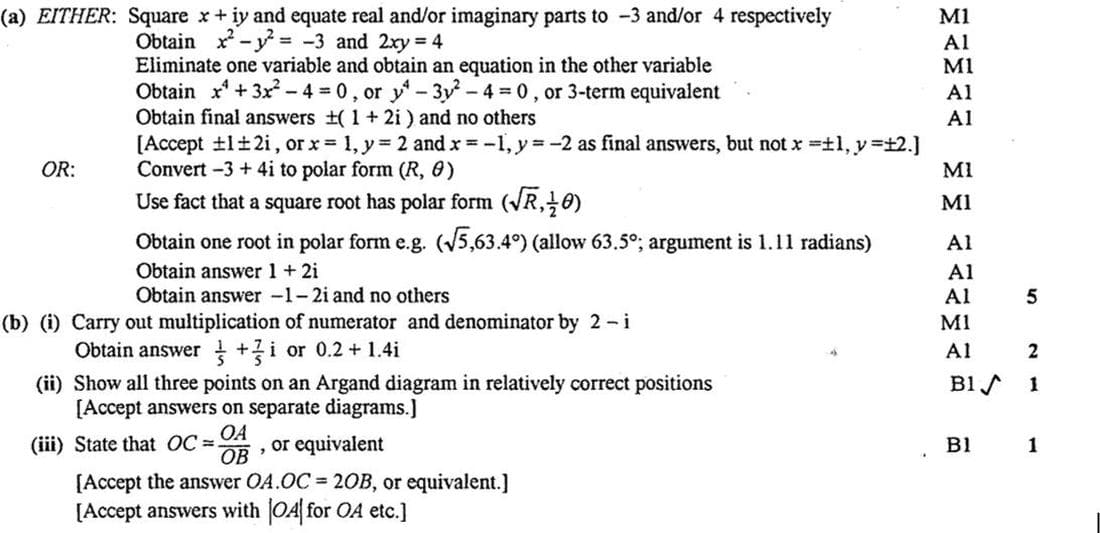
(a) Find the two square roots of the complex number \(-3 + 4i\), giving your answers in the form \(x + iy\), where \(x\) and \(y\) are real.
(b) The complex number \(z\) is given by
\(z = \frac{-1 + 3i}{2 + i}.\)
- Express \(z\) in the form \(x + iy\), where \(x\) and \(y\) are real.
- Show on a sketch of an Argand diagram, with origin \(O\), the points \(A\), \(B\) and \(C\) representing the complex numbers \(-1 + 3i\), \(2 + i\) and \(z\) respectively.
- State an equation relating the lengths \(OA\), \(OB\) and \(OC\).