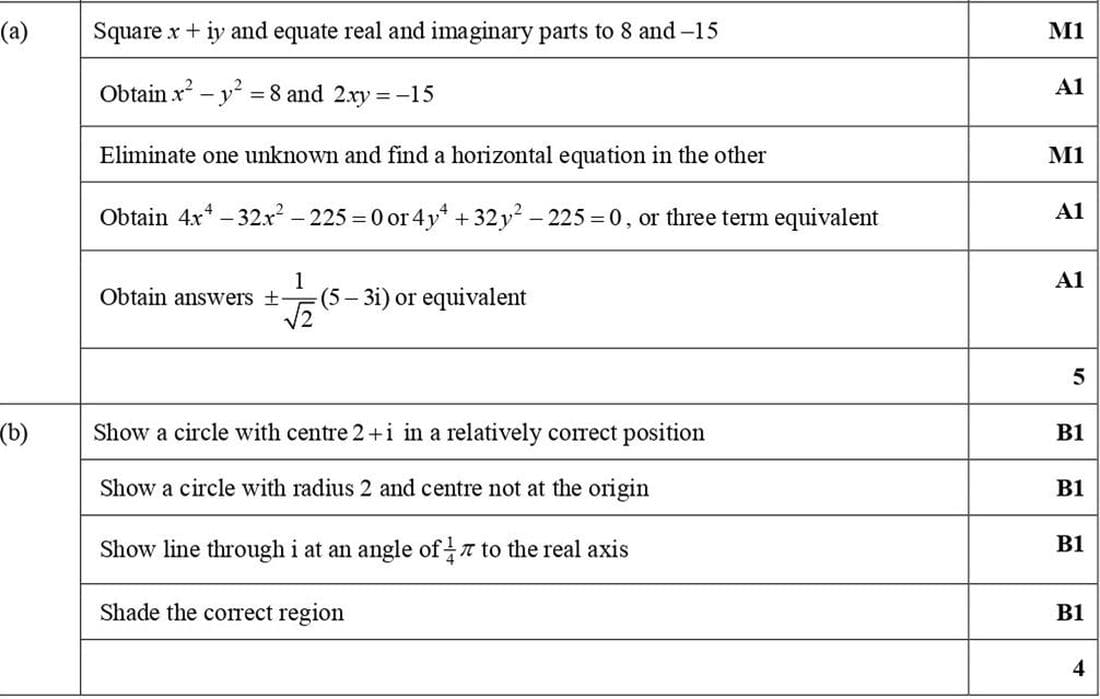
(a) Let the square root of \(u\) be \(x + iy\). Then, \((x + iy)^2 = 8 - 15i\).
Expanding, we have \(x^2 - y^2 + 2xyi = 8 - 15i\).
Equating real and imaginary parts gives:
\(x^2 - y^2 = 8\)
\(2xy = -15\)
From \(2xy = -15\), we have \(xy = -\frac{15}{2}\).
Substitute \(y = -\frac{15}{2x}\) into \(x^2 - y^2 = 8\):
\(x^2 - \left(-\frac{15}{2x}\right)^2 = 8\)
\(x^2 - \frac{225}{4x^2} = 8\)
Multiply through by \(4x^2\):
\(4x^4 - 225 = 32x^2\)
\(4x^4 - 32x^2 - 225 = 0\)
Let \(z = x^2\), then:
\(4z^2 - 32z - 225 = 0\)
Solving this quadratic equation gives \(z = \frac{25}{4}\) or \(z = -9\).
Since \(z = x^2\), \(x^2 = \frac{25}{4}\), so \(x = \pm\frac{5}{2}\).
Substitute back to find \(y\):
\(y = -\frac{15}{2x} = \mp\frac{3}{2}\).
Thus, the square roots are \(\pm \frac{1}{\sqrt{2}}(5 - 3i)\).
(b) The inequality \(|z - 2 - i| \leq 2\) represents a circle centered at \(2+i\) with radius 2.
The inequality \(0 \leq \arg(z - i) \leq \frac{1}{4}\pi\) represents the region within an angle \(\frac{1}{4}\pi\) from the positive real axis.
Shade the intersection of these regions on the Argand diagram.