9709 P33 - Nov 2016 - Q7
1971
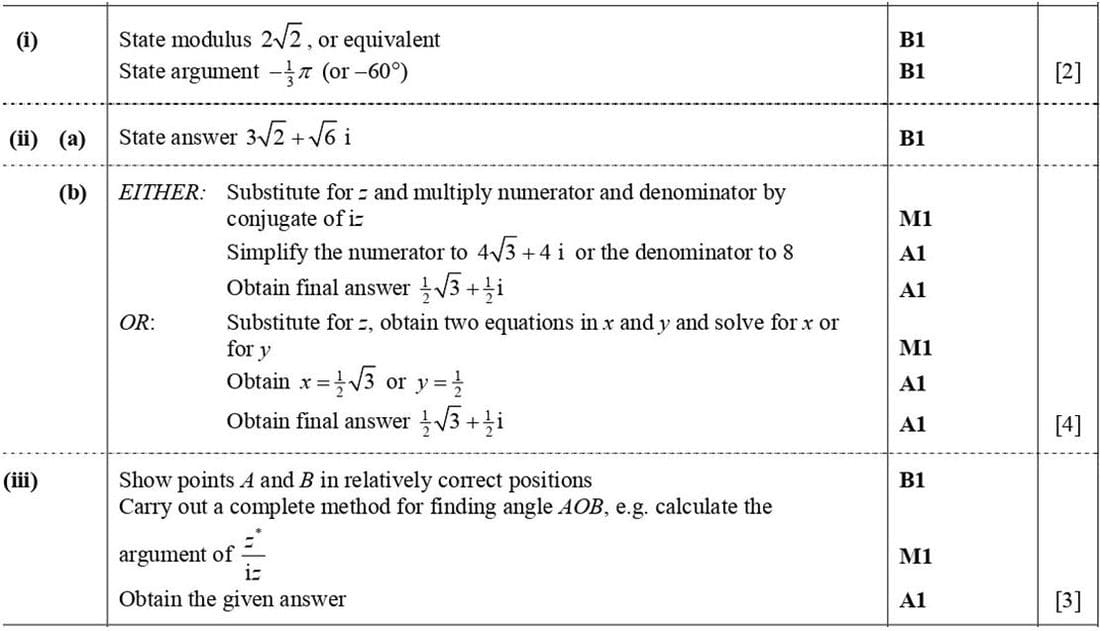
The complex number \(z\) is defined by \(z = (\sqrt{2}) - (\sqrt{6})i\). The complex conjugate of \(z\) is denoted by \(z^*\).
- Find the modulus and argument of \(z\).
- Express each of the following in the form \(x + iy\), where \(x\) and \(y\) are real and exact:
- \(z + 2z^*\);
- \(\frac{z^*}{iz}\).
- On a sketch of an Argand diagram with origin \(O\), show the points \(A\) and \(B\) representing the complex numbers \(z^*\) and \(iz\) respectively. Prove that angle \(AOB\) is equal to \(\frac{1}{6}\pi\).