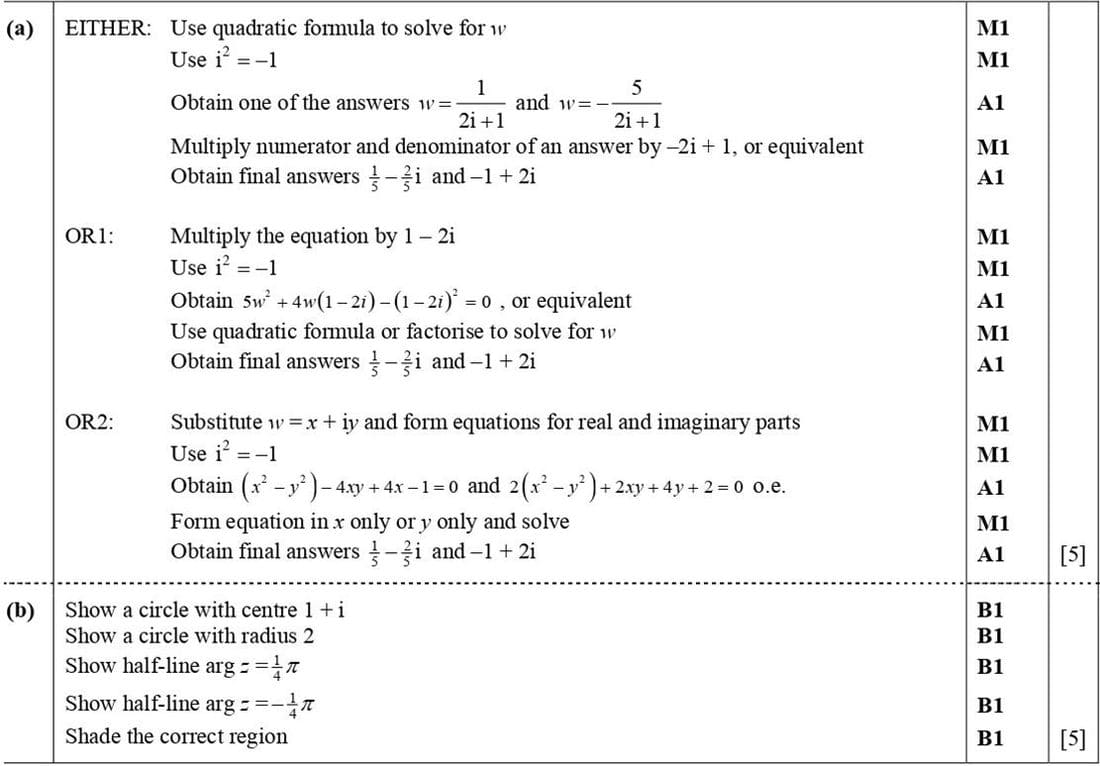
(a) To solve the equation \((1 + 2i)w^2 + 4w - (1 - 2i) = 0\), we can use the quadratic formula \(w = \frac{-b \pm \sqrt{b^2 - 4ac}}{2a}\), where \(a = 1 + 2i\), \(b = 4\), and \(c = -(1 - 2i)\).
First, calculate the discriminant: \(b^2 - 4ac = 16 - 4(1 + 2i)(-1 + 2i)\).
Simplify \((1 + 2i)(-1 + 2i) = -1 + 2i - 2i - 4 = -5\).
Thus, \(b^2 - 4ac = 16 + 20 = 36\).
Now, apply the quadratic formula: \(w = \frac{-4 \pm \sqrt{36}}{2(1 + 2i)}\).
\(w = \frac{-4 \pm 6}{2 + 4i}\).
Calculate \(w = \frac{2}{2 + 4i}\) and \(w = \frac{-10}{2 + 4i}\).
Multiply numerator and denominator by the conjugate \(2 - 4i\):
\(w = \frac{2(2 - 4i)}{(2 + 4i)(2 - 4i)} = \frac{4 - 8i}{4 + 16} = \frac{4 - 8i}{20} = \frac{1}{5} - \frac{2}{5}i\).
\(w = \frac{-10(2 - 4i)}{20} = \frac{-20 + 40i}{20} = -1 + 2i\).
(b) On the Argand diagram, draw a circle centered at \(1 + i\) with radius \(2\). The region is bounded by the circle and the lines \(\arg z = -\frac{\pi}{4}\) and \(\arg z = \frac{\pi}{4}\), forming a sector.