Past Exam Questions
← Back0606 P13 - Nov 2023 - Q5 - 10 marks
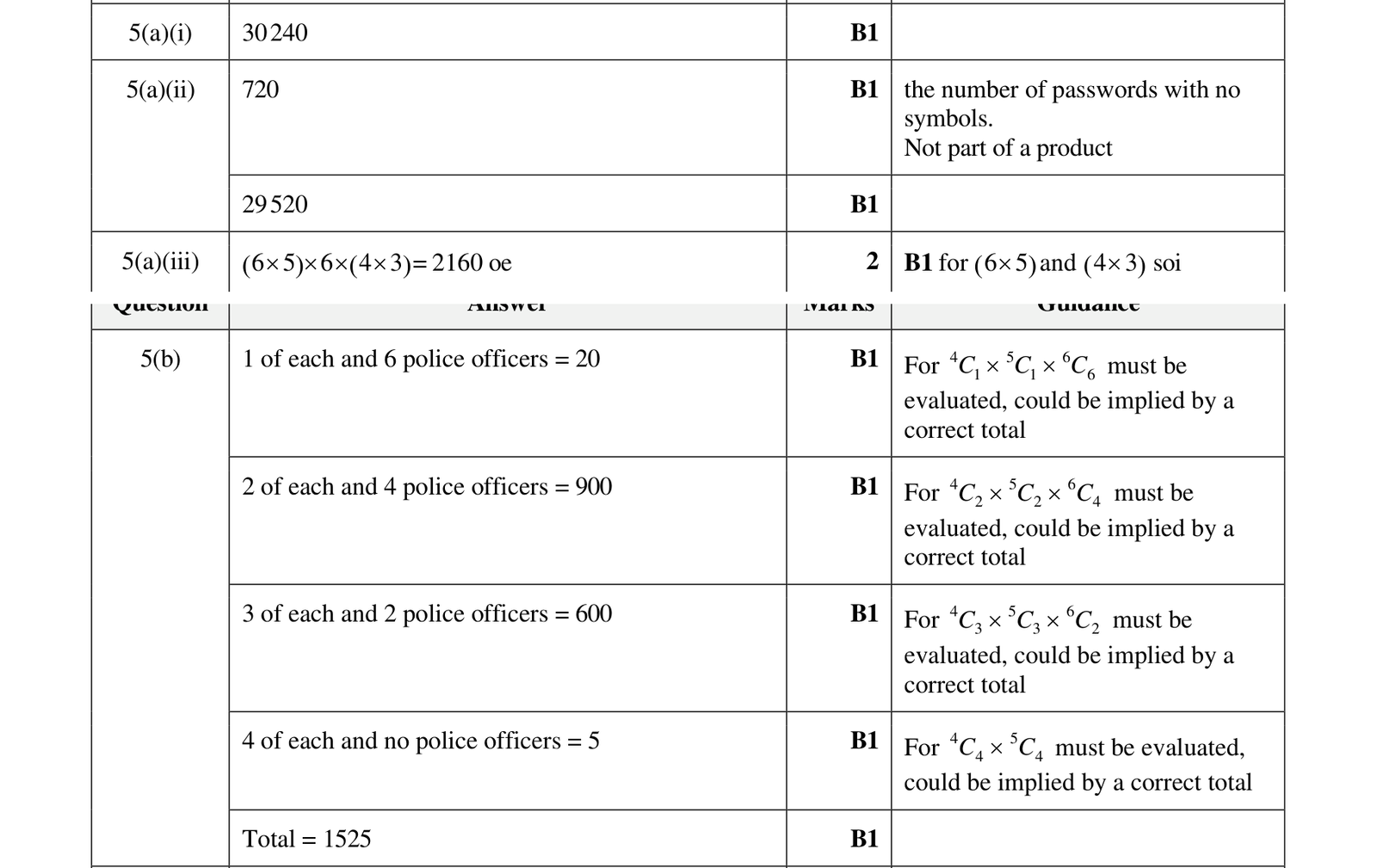
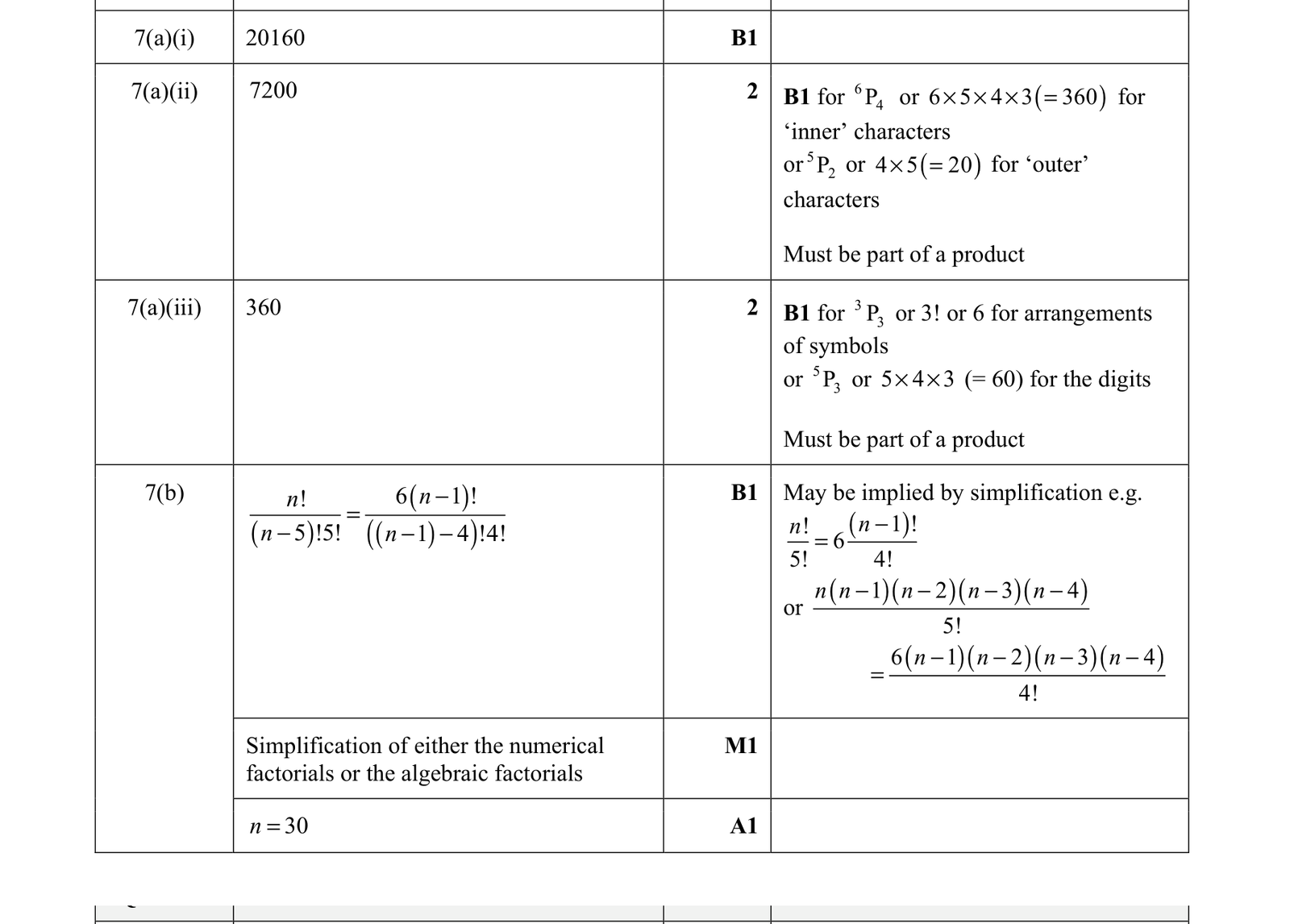
(a) A 5-character password is to be formed from the following 10 characters.
Letters: \(A,\ B,\ C,\ X,\ Y,\ Z\)
Symbols: *, $, #, &
No character can be used more than once in any 5-character password.
(i) Find the number of passwords that can be formed.
(ii) Find the number of passwords that can be formed if the password has to contain at least one symbol.
(iii) Find the number of passwords that can be formed if the password has to start with two letters and end with two symbols.
(b) A team of 8 people is to be chosen from 5 doctors, 4 teachers and 6 police officers. Find how many possible teams have the same number of doctors as teachers.
0606 P12 - Jun 2022 - Q8 - 7 marks
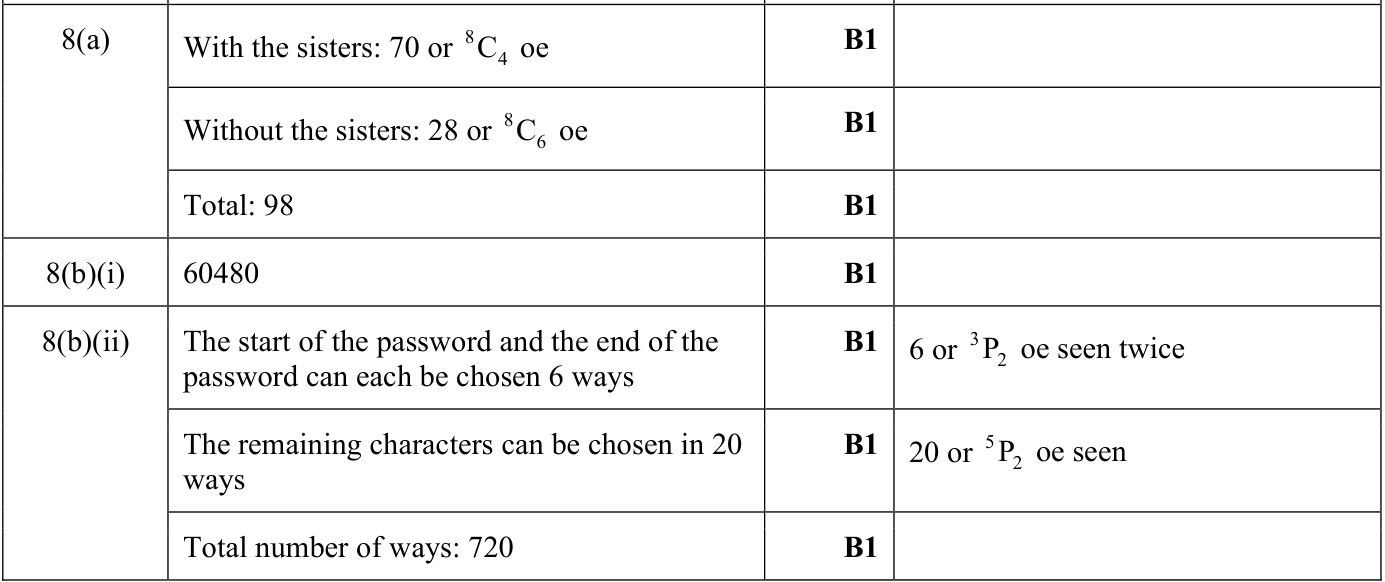
(a) A team of \(6\) people is to be chosen from \(10\) people. Two of the people are sisters who must not be separated. Find the number of different teams that can be formed.
(b) A \(6\)-character password is to be chosen from the following characters.
Digits: \(2,4,8\). Letters: \(x,y,z\). Symbols: \(*,#,!\).
No character may be used more than once in any password. Find the number of different passwords that may be chosen if
(i) there are no other restrictions,
(ii) the password starts with two letters and ends with two digits.
0606 P13 - Jun 2022 - Q8 - 10 marks
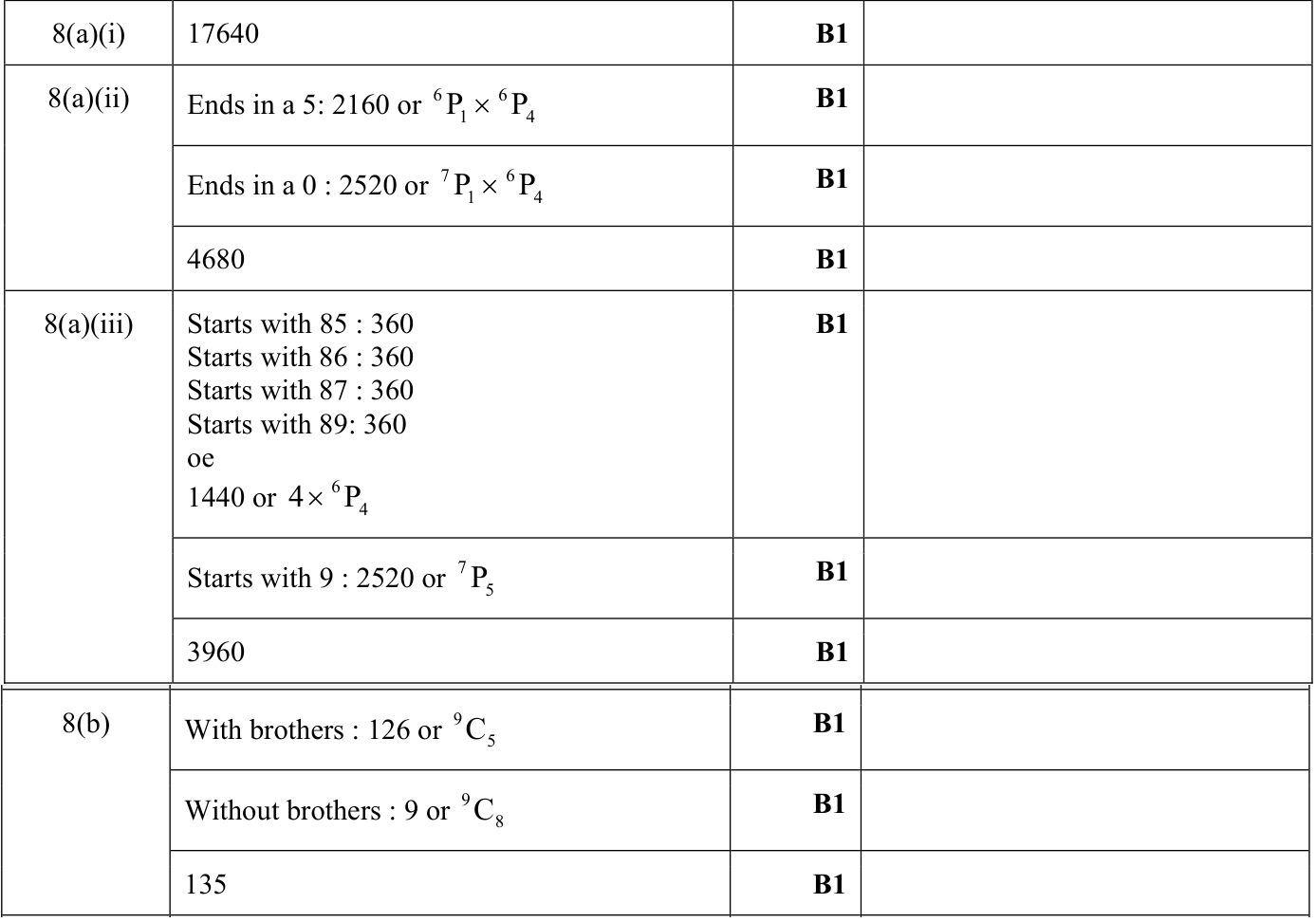
(a) A \(6\)-digit number is formed from the digits \(0,1,2,5,6,7,8,9\). A number cannot start with \(0\) and each digit can be used at most once in any \(6\)-digit number.
(i) Find how many \(6\)-digit numbers can be formed if there are no further restrictions.
(ii) Find how many of these \(6\)-digit numbers are divisible by \(5\).
(iii) Find how many of these \(6\)-digit numbers are greater than \(850000\).
(b) A team of \(8\) people is to be chosen from \(12\) people. Three of the people are brothers who must not be separated. Find the number of different teams that can be chosen.
0606 P21 - Jun 2022 - Q6 - 14 marks
(a) A 5-digit number is to be formed using digits selected from 0, 1, 2, 3, 4, 5 and 6. No digit may be used more than once and the number may not start with 0.
(i) How many such 5-digit numbers can be formed?
(ii) How many of the numbers formed are even?
(b) A team of 7 people is to be selected from a group of 9 women and 6 men. Find the number of different teams that can be selected if the team must include at least one man.
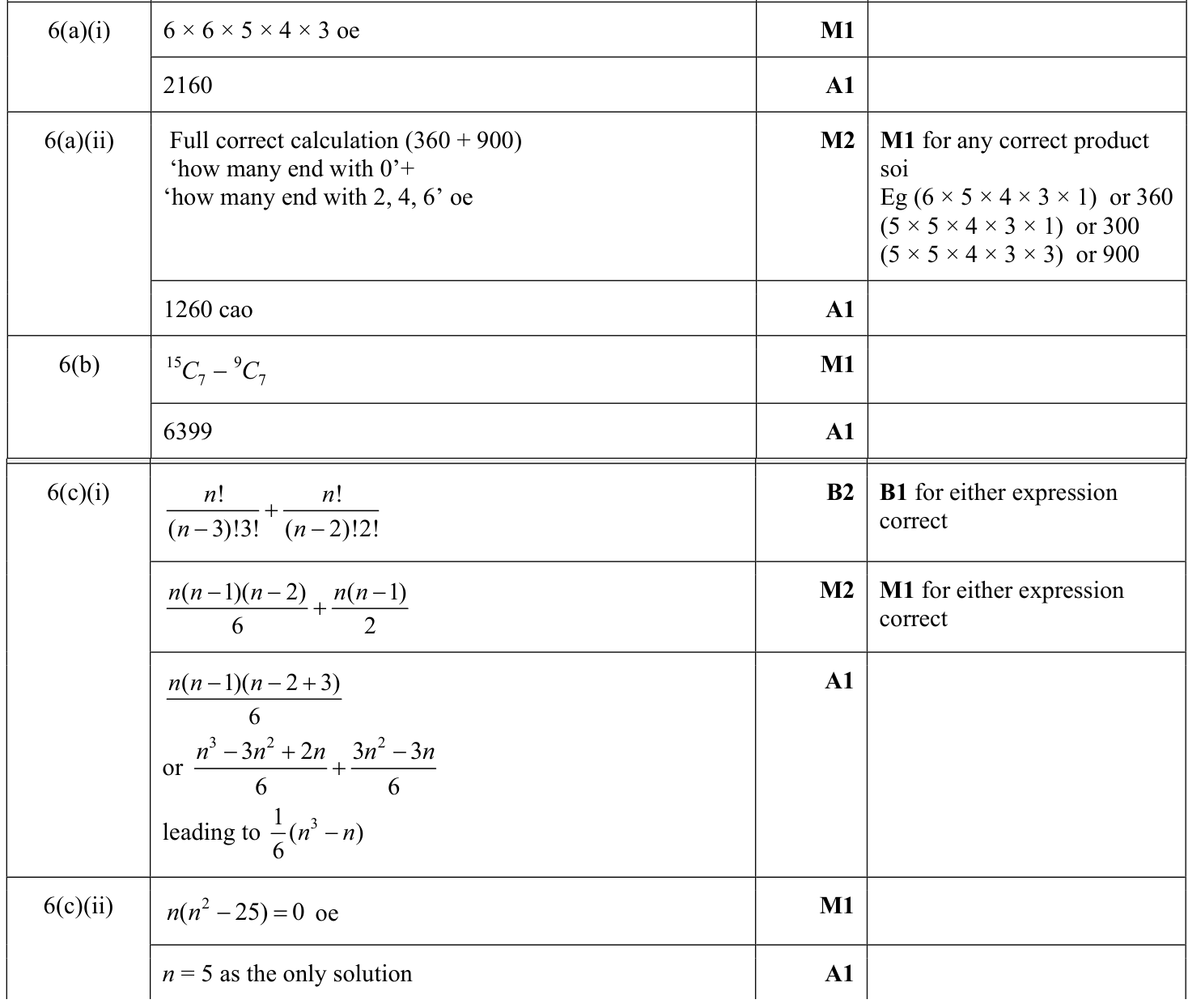
(c) (i) Show that \({}^nC_3+{}^nC_2=\frac{1}{6}(n^3-n)\), where \(n\ge 3\).
(ii) Hence solve the equation \({}^nC_3+{}^nC_2=4n\), where \(n\ge 3\).
0606 P11 - Nov 2022 - Q10 - 3 marks
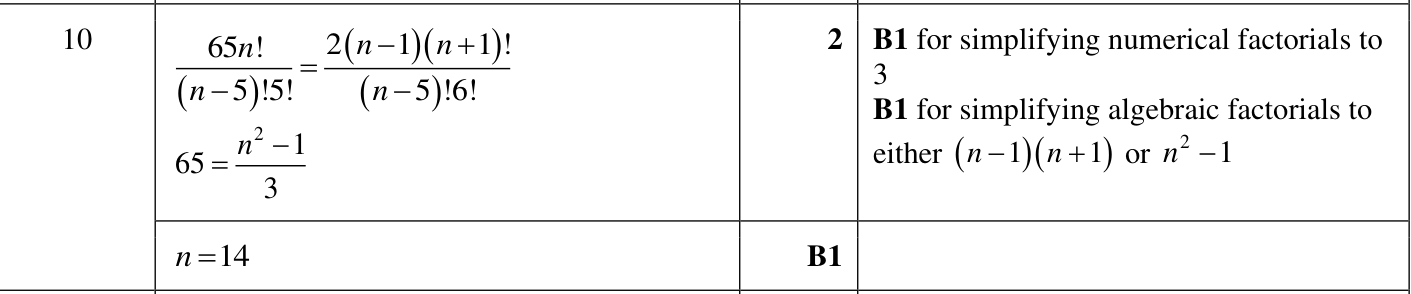
Given that
\(65\,{}^nC_5=2(n-1)\,{}^{n+1}C_6,\)
find the value of \(n\).
0606 P12 - Nov 2022 - Q6 - 3 marks
A group of \(15\) people includes \(3\) brothers. A team of \(6\) people is to be chosen from this group. The three brothers must not be separated. Find the number of possible teams that can be chosen.

0606 P23 - Nov 2022 - Q7 - 5 marks
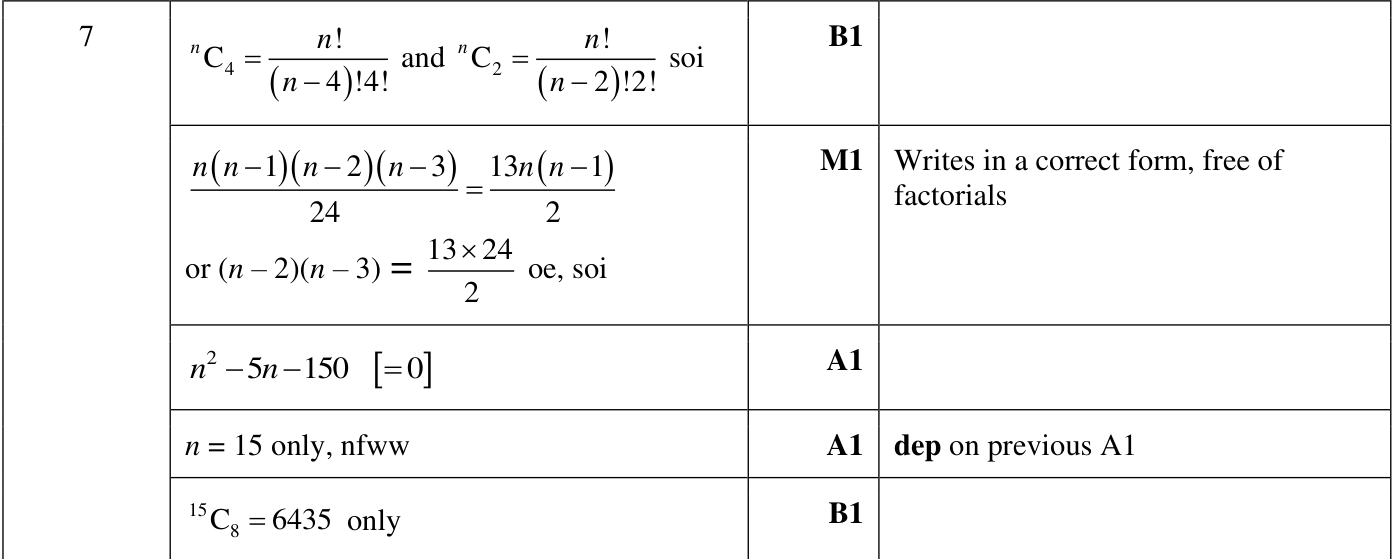
Given that
\({}^n C_4=13\,{}^n C_2,\)
find the value of \({}^n C_8\).
0606 P11 - Jun 2021 - Q6 - 9 marks
(a)
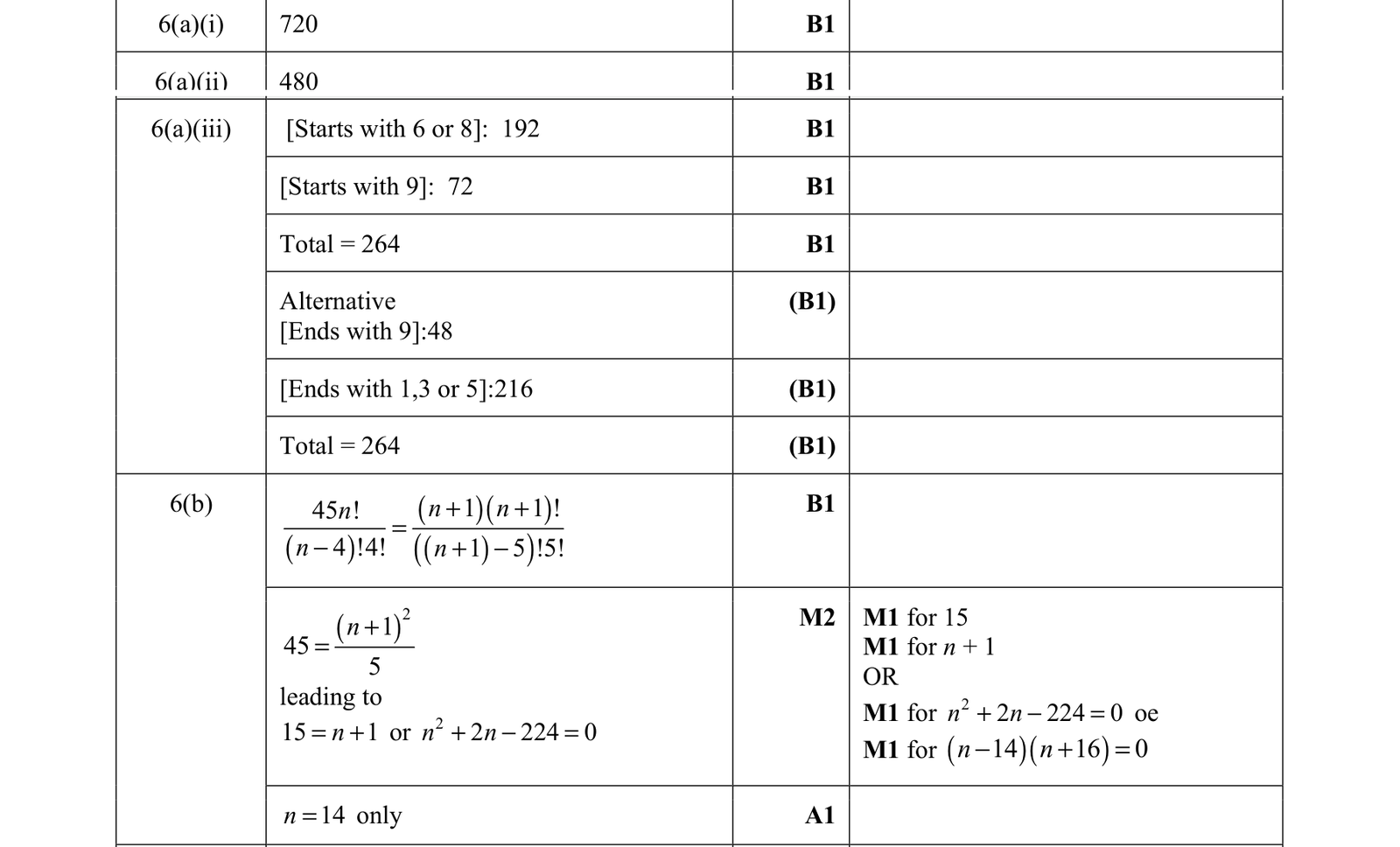
(i) Find how many different 5-digit numbers can be formed using the digits \(1,3,5,6,8\) and \(9\). No digit may be used more than once in any 5-digit number.
(ii) How many of these 5-digit numbers are odd?
(iii) How many of these 5-digit numbers are odd and greater than \(60000\)?
(b) Given that
\(45\binom n4=(n+1)\binom{n+1}{5},\)
find the value of \(n\).
0606 P12 - Jun 2021 - Q7 - 8 marks
Five digits, \(1,3,5,8,9\), and three symbols, \(*,\$, \#\), are used to form passwords.
A password has six characters and no character is repeated.
(a) Find the number of different passwords which can be formed if the password
(i) has no restrictions,
(ii) starts with a digit and finishes with a digit,
(iii) starts with the three symbols.
(b) The number of combinations of \(5\) objects chosen from \(n\) objects is six times the number of combinations of \(4\) objects chosen from \(n-1\) objects.
Find \(n\).
0606 P13 - Jun 2021 - Q7 - 8 marks
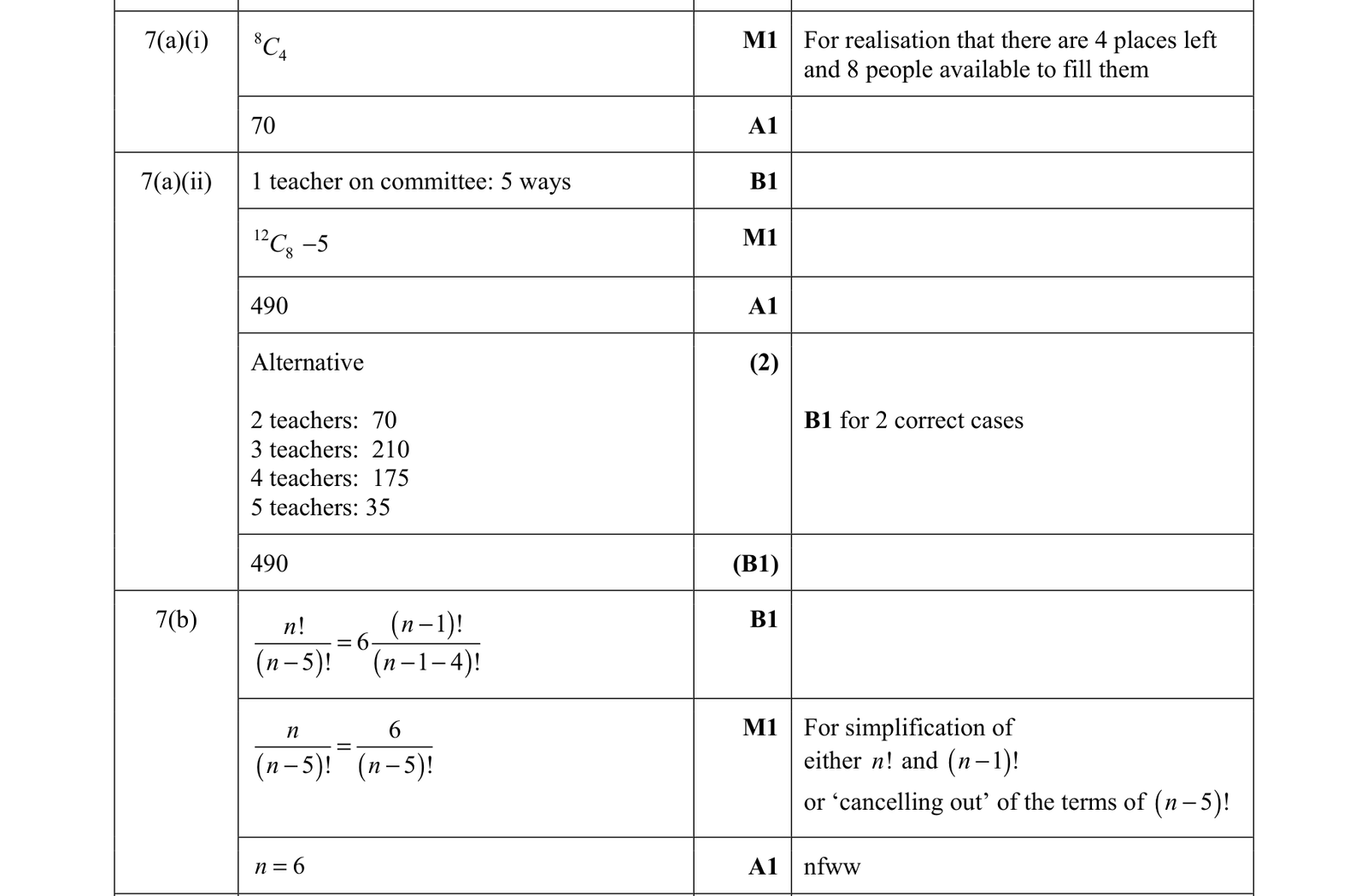
(a) A committee of \(8\) people is to be formed from \(5\) teachers, \(4\) doctors and \(3\) police officers. Find the number of different committees that could be chosen if
(i) all \(4\) doctors are on the committee,
(ii) there are at least \(2\) teachers on the committee.
(b) Given that
\({}^nP_5=6\,{}^{\,n-1}P_4,\)
find the value of \(n\).
0606 P12 - Nov 2021 - Q8 - 7 marks
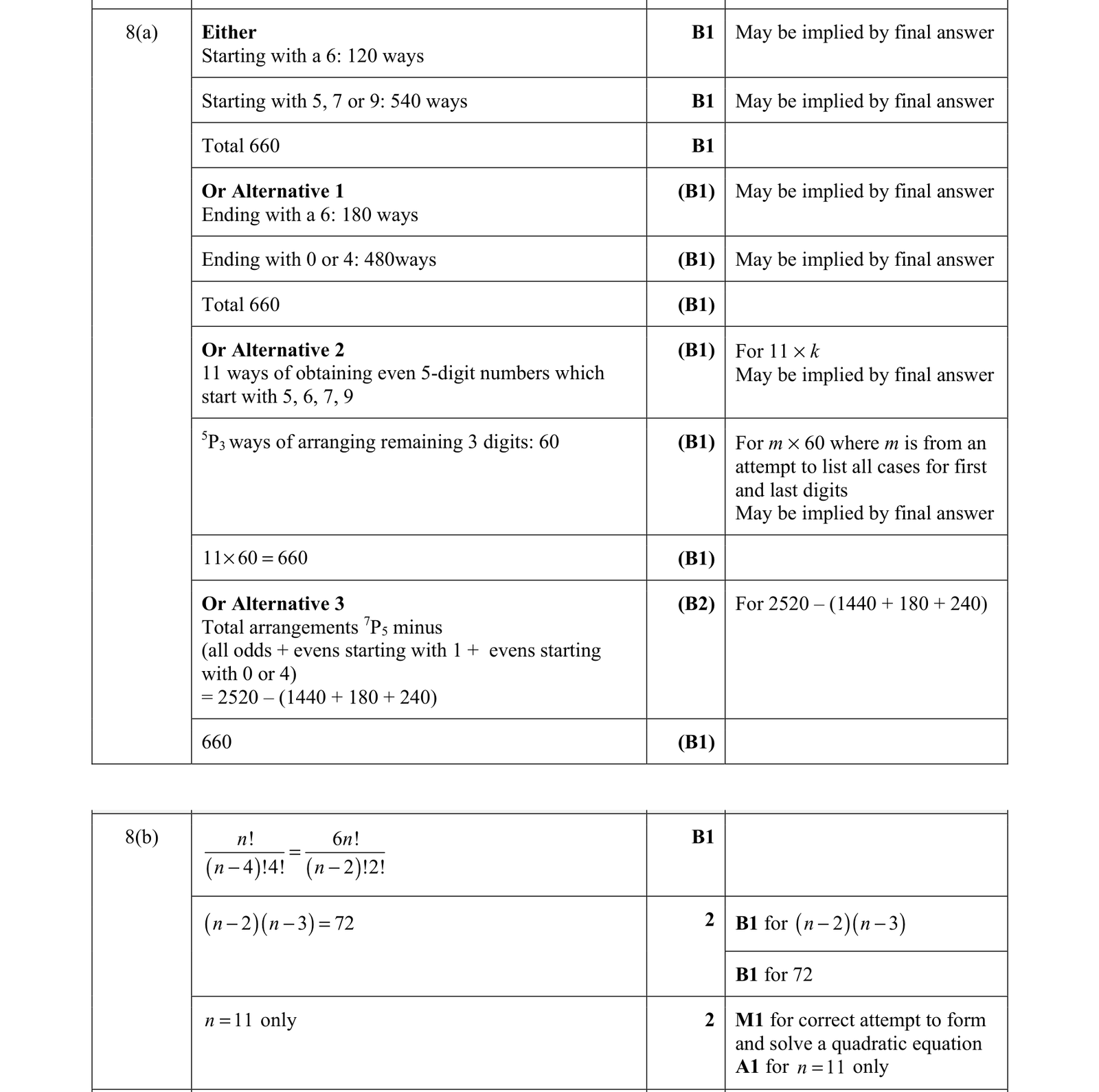
(a) Find how many different \(5\)-digit even numbers greater than \(50000\) can be formed using the digits \(0\), \(1\), \(4\), \(5\), \(6\), \(7\) and \(9\) if no digit is repeated in any number.
(b) Given that \(n\) is a positive integer and
\({}^nC_4=6{}^nC_2,\)
find the value of \(n\).
0606 P13 - Nov 2021 - Q6 - 7 marks
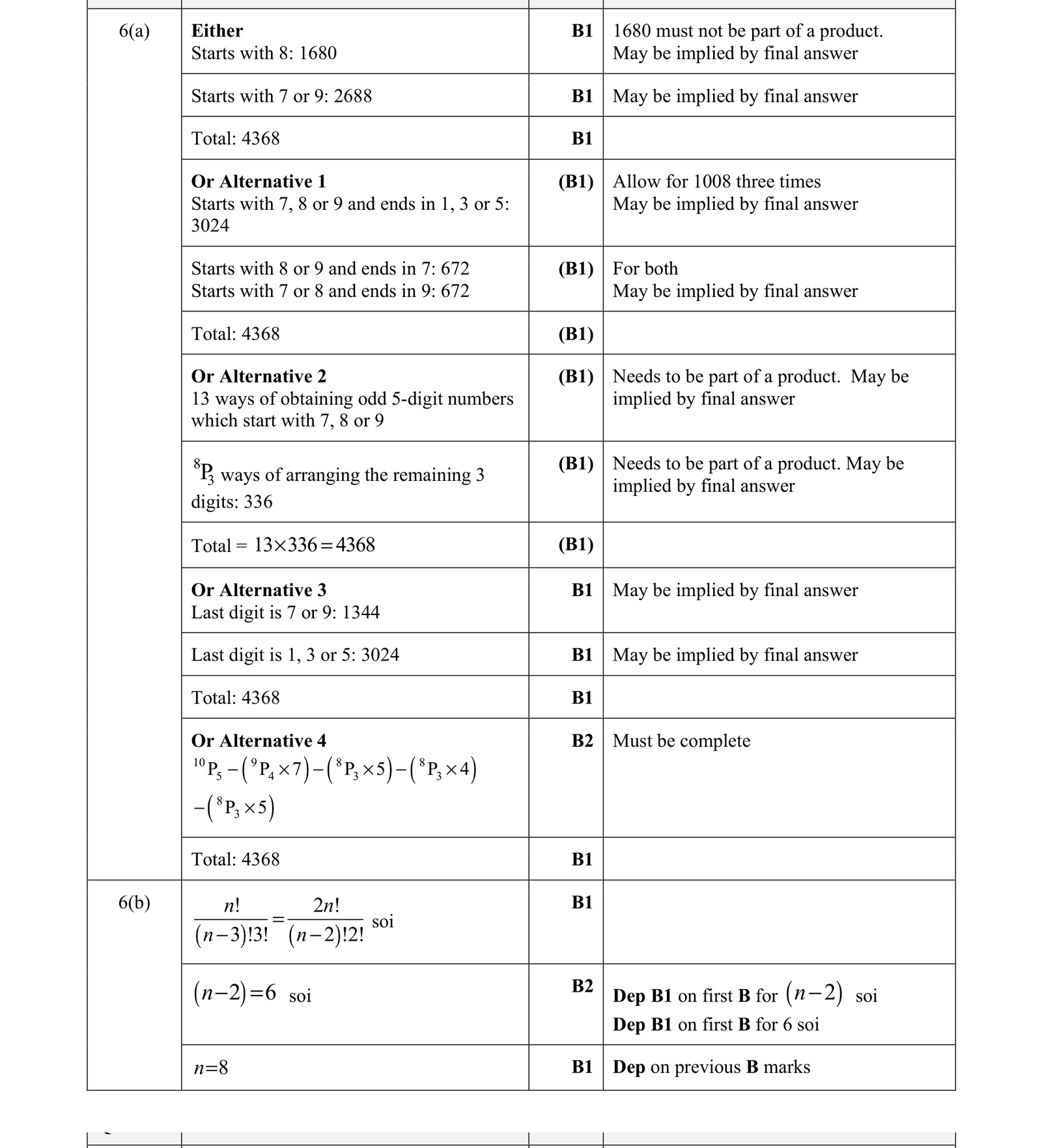
(a) A \(5\)-digit number is made using the digits \(0,1,2,3,4,5,6,7,8\) and \(9\). No digit may be used more than once in any \(5\)-digit number. Find how many such \(5\)-digit numbers are odd and greater than \(70000\).
(b) The number of combinations of \(n\) objects taken \(3\) at a time is \(2\) times the number of combinations of \(n\) objects taken \(2\) at a time. Find the value of \(n\).
0606 P21 - Nov 2021 - Q8 - 7 marks
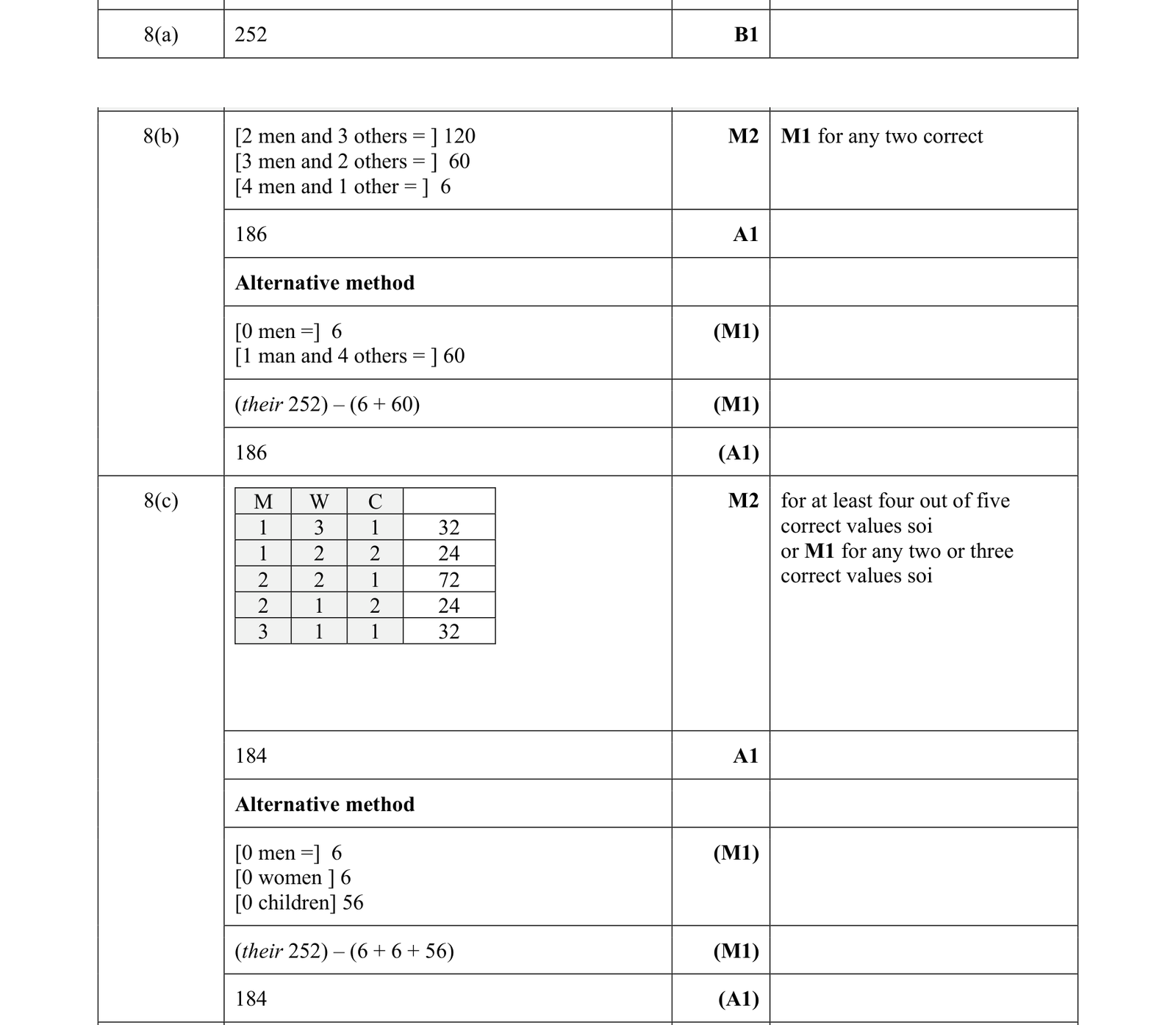
Marc chooses \(5\) people from \(4\) men, \(4\) women and \(2\) children.
Find the number of possible selections when:
(a) there are no restrictions,
(b) at least \(2\) men are chosen,
(c) at least \(1\) man, at least \(1\) woman and at least \(1\) child are chosen.
0606 P12 - Mar 2020 - Q9 - 10 marks
(a)(i) Find how many different 4-digit numbers can be formed using the digits \(2\), \(3\), \(5\), \(7\), \(8\) and \(9\), if each digit may be used only once in any number.
(a)(ii) How many of the numbers found in part (i) are divisible by 5?
(a)(iii) How many of the numbers found in part (i) are odd and greater than \(7000\)?
(b) The number of combinations of \(n\) items taken 3 at a time is \(92n\). Find the value of the constant \(n\).

0606 P21 - Jun 2020 - Q4 - 4 marks
(a) In an examination a candidate must select 2 questions from the 5 questions in section A and 4 questions from the 8 questions in section B. Find the number of ways in which this selection can be made.
(b) The 7 digits of the number 6378129 are arranged to give a different 7-digit number. Find the number of different 7-digit numbers that can be made in which the number is even.

0606 P23 - Jun 2020 - Q4 - 6 marks
(a)(i) Find how many different 5-digit numbers can be formed using five of the eight digits \(1,2,3,4,5,6,7,8\), if each digit can be used once only.
(ii) Find how many of these 5-digit numbers are greater than \(60000\).
(b) A team of 3 people is to be selected from 4 men and 5 women. Find the number of different teams that could be selected which include at least 2 women.

0606 P11 - Nov 2020 - Q5 - 8 marks
(a)(i) Find how many different 4-digit numbers can be formed using the digits \(1,3,4,6,7\) and \(9\). Each digit may be used once only in any 4-digit number.
(a)(ii) How many of these 4-digit numbers are even and greater than \(6000\)?
(b) A committee of \(5\) people is to be formed from \(6\) doctors, \(4\) dentists and \(3\) nurses. Find the number of different committees that could be formed if
(i) there are no restrictions,
(ii) the committee contains at least one doctor,
(iii) the committee contains all the nurses.

0606 P12 - Nov 2020 - Q8 - 8 marks
(a) Twelve people are to be divided into three groups containing \(3\), \(4\) and \(5\) people. Find the number of possible divisions.
(b) Four-digit numbers are to be formed using four of the digits \(2,3,7,8,9\), with no digit repeated.
(i) Find the total number of such four-digit numbers.
(ii) Find the number of such four-digit numbers which are even.
(iii) Find the number of such four-digit numbers which are greater than \(7000\) and odd.

0606 P11 - Nov 2019 - Q11 - 11 marks
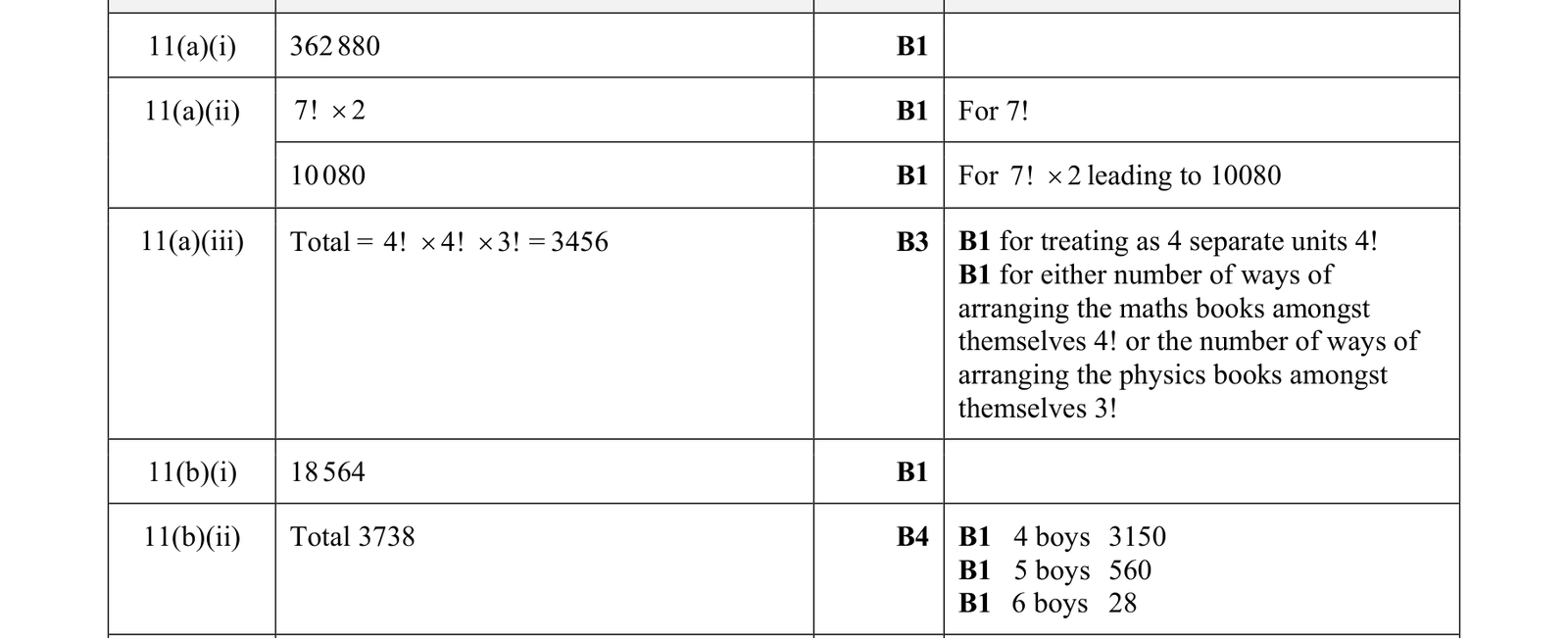
(a) Jess wants to arrange \(9\) different books on a shelf. There are \(4\) mathematics books, \(3\) physics books and \(2\) chemistry books. Find the number of different possible arrangements of the books if
(i) there are no restrictions,
(ii) a chemistry book is at each end of the shelf,
(iii) all the mathematics books are kept together and all the physics books are kept together.
(b) A quiz team of \(6\) children is to be chosen from a class of \(8\) boys and \(10\) girls. Find the number of ways of choosing the team if
(i) there are no restrictions,
(ii) there are more boys than girls in the team.
0606 P13 - Nov 2019 - Q7 - 10 marks
(a) A 5-digit code is to be chosen from the digits \(1,2,3,4,5,6,7,8\) and \(9\). Each digit may be used only once in any 5-digit code. Find the number of different 5-digit codes that may be chosen if
(i) there are no restrictions,
(ii) the code is divisible by \(5\),
(iii) the code is even and greater than \(70000\).
(b) A team of \(6\) people is to be chosen from \(8\) men and \(6\) women. Find the number of different teams that may be chosen if
(i) there are no restrictions,
(ii) there are no women in the team,
(iii) there are a husband and wife who must not be separated.