9709 P32 - Mar 2019 - Q7
1957
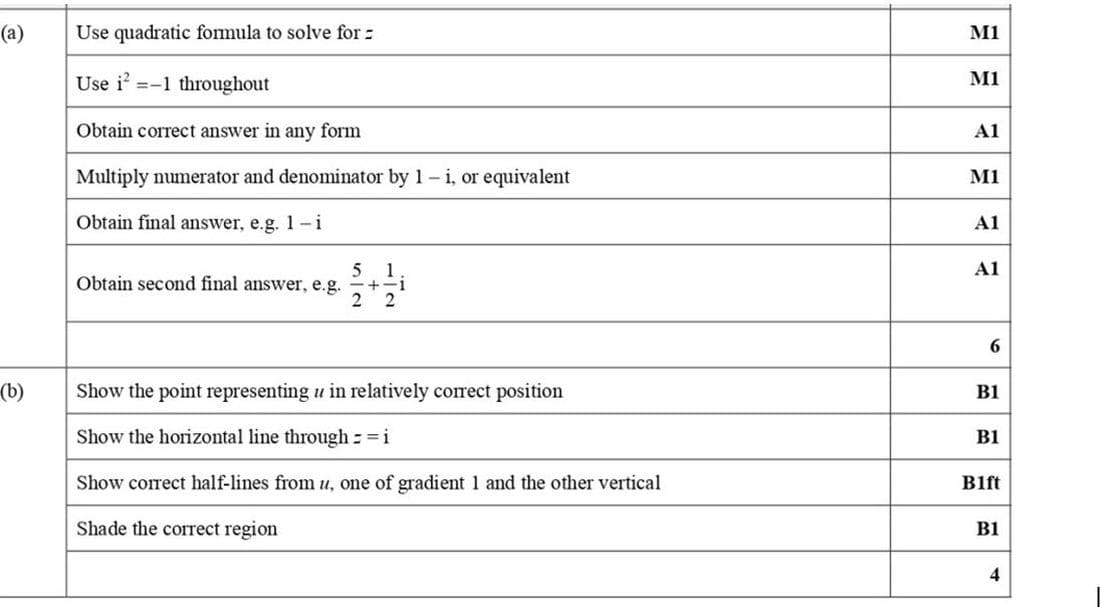
(a) Showing all working and without using a calculator, solve the equation
\((1 + i)z^2 - (4 + 3i)z + 5 + i = 0.\)
Give your answers in the form x + iy, where x and y are real.
(b) The complex number u is given by
\(u = -1 - i.\)
On a sketch of an Argand diagram show the point representing u. Shade the region whose points represent complex numbers satisfying the inequalities |z| < |z - 2i| and \(\frac{1}{4}\pi < \text{arg}(z - u) < \frac{1}{2}\pi\).