Browsing as Guest. Progress, bookmarks and attempts are disabled.
Log in to track your work.
9709 P32 - Nov 2023 - Q4
1950
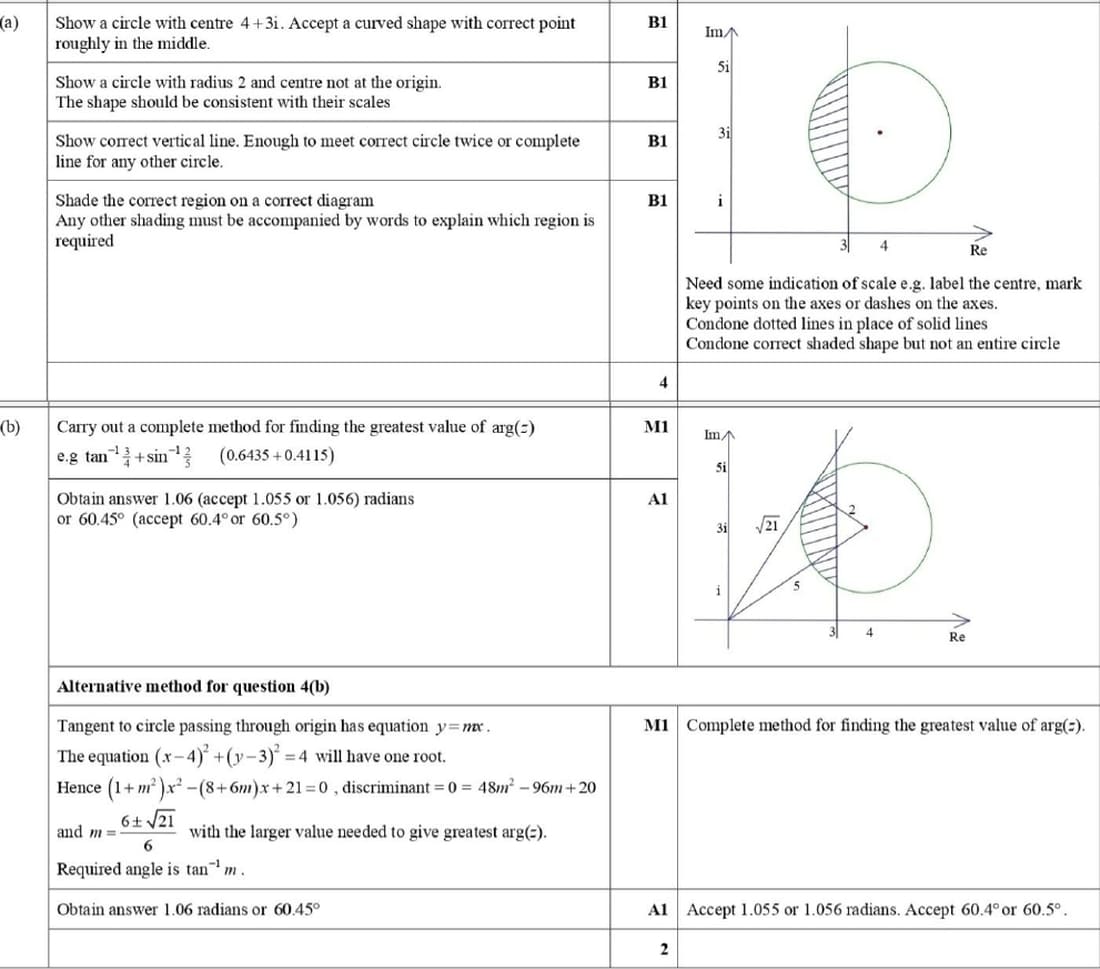
(a) On a sketch of an Argand diagram, shade the region whose points represent complex numbers \(z\) satisfying the inequalities \(|z - 4 - 3i| \leq 2\) and \(\text{Re} \, z \leq 3\).
(b) Find the greatest value of \(\arg z\) for points in this region.
Solution
(a) The inequality \(|z - 4 - 3i| \leq 2\) represents a circle centered at \((4, 3)\) with radius 2 on the Argand diagram. The inequality \(\text{Re} \, z \leq 3\) represents a vertical line at \(x = 3\). The region to be shaded is the intersection of the circle and the half-plane to the left of this line.
(b) To find the greatest value of \(\arg z\), consider the tangent to the circle from the origin. The equation of the circle is \((x - 4)^2 + (y - 3)^2 = 4\). The tangent line from the origin has the equation \(y = mx\). Solving for \(m\) using the condition that the line is tangent to the circle gives:
\((1 + m^2)x^2 - (8 + 6m)x + 21 = 0\)
The discriminant of this quadratic must be zero for tangency:
\(48m^2 - 96m + 20 = 0\)
Solving for \(m\), we find:
\(m = \frac{6 \pm \sqrt{21}}{6}\)
The larger value of \(m\) gives the greatest \(\arg z\). The required angle is \(\arctan m\).
Calculating this gives \(\arg z = 1.06\) radians or \(60.45^{\circ}\).