9709 P3 - Jun 2002 - Q9
1919
The complex number \(1 + i \sqrt{3}\) is denoted by \(u\).
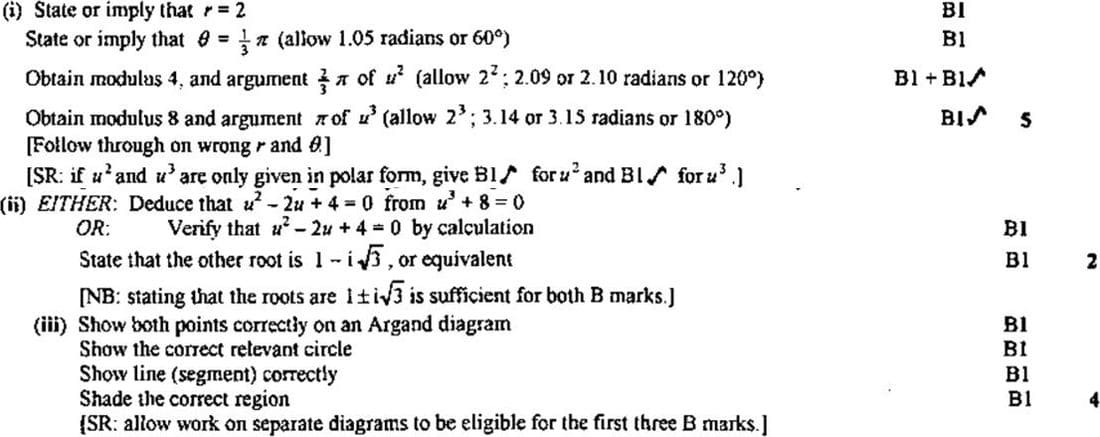
(i) Express \(u\) in the form \(r(\cos \theta + i \sin \theta)\), where \(r > 0\) and \(-\pi < \theta \leq \pi\). Hence, or otherwise, find the modulus and argument of \(u^2\) and \(u^3\).
(ii) Show that \(u\) is a root of the equation \(z^2 - 2z + 4 = 0\), and state the other root of this equation.
(iii) Sketch an Argand diagram showing the points representing the complex numbers \(i\) and \(u\). Shade the region whose points represent every complex number \(z\) satisfying both the inequalities \(|z-i| \leq 1\) and \(\arg z \geq \arg u\).