June 2022 p32 q10
1929
The complex number \(-1 + \sqrt{7}i\) is denoted by \(u\). It is given that \(u\) is a root of the equation
\(2x^3 + 3x^2 + 14x + k = 0,\)
where \(k\) is a real constant.
(a) Find the value of \(k\). [3]
(b) Find the other two roots of the equation. [4]
(c) On an Argand diagram, sketch the locus of points representing complex numbers \(z\) satisfying the equation \(|z - u| = 2\). [2]
(d) Determine the greatest value of \(\arg z\) for points on this locus, giving your answer in radians. [2]
Solution
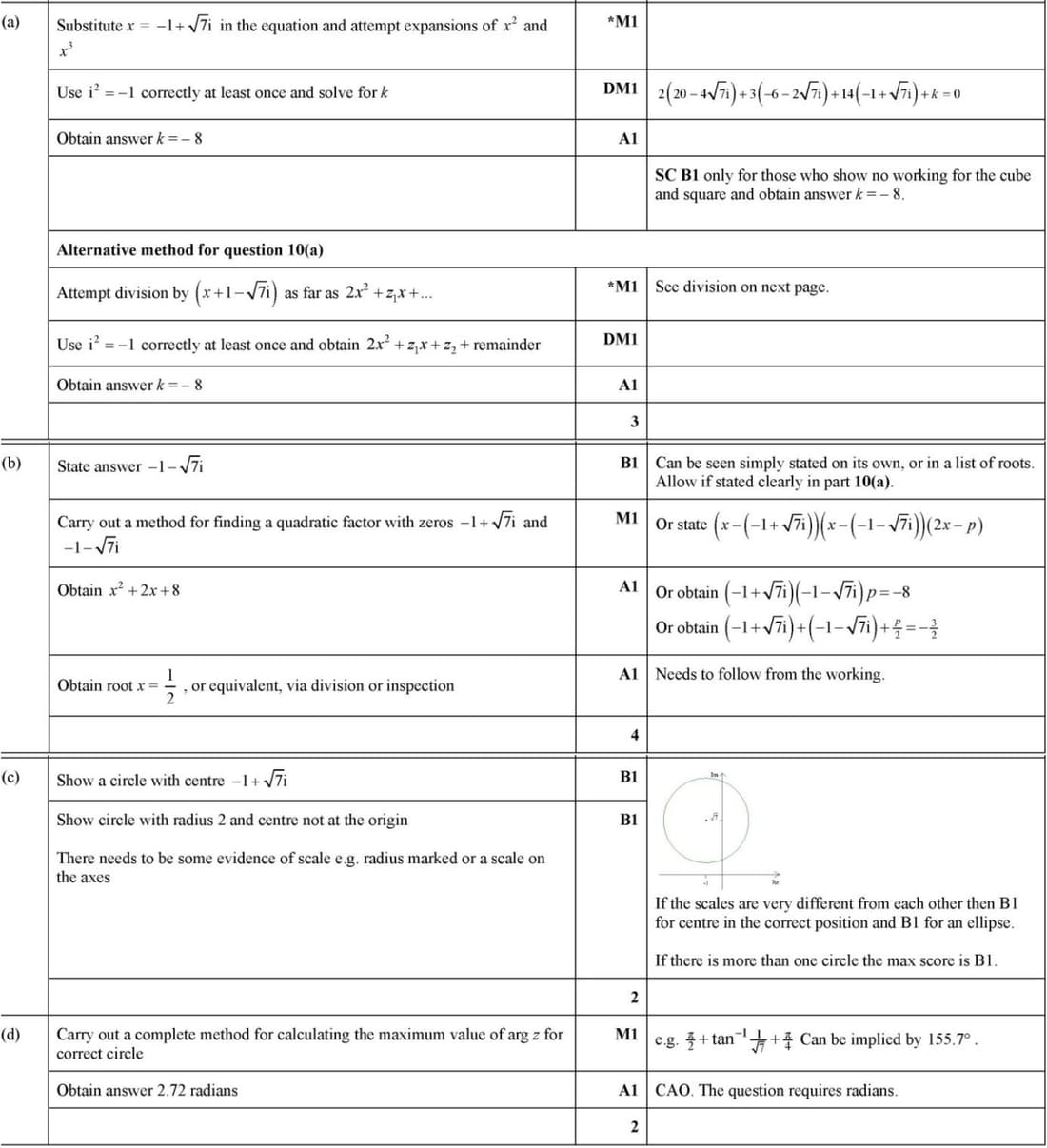
(a) Substitute \(x = -1 + \sqrt{7}i\) into the equation \(2x^3 + 3x^2 + 14x + k = 0\). Calculate \(x^2\) and \(x^3\) using \(i^2 = -1\):
\((-1 + \sqrt{7}i)^2 = -1 - 2\sqrt{7}i - 7 = -8 - 2\sqrt{7}i\)
\((-1 + \sqrt{7}i)^3 = (-1 + \sqrt{7}i)(-8 - 2\sqrt{7}i) = 20 - 4\sqrt{7}i\)
Substitute into the equation:
\(2(20 - 4\sqrt{7}i) + 3(-8 - 2\sqrt{7}i) + 14(-1 + \sqrt{7}i) + k = 0\)
Simplify to find \(k = -8\).
(b) The conjugate root is \(-1 - \sqrt{7}i\). Use these roots to find a quadratic factor:
\((x - (-1 + \sqrt{7}i))(x - (-1 - \sqrt{7}i)) = x^2 + 2x + 8\)
Divide the cubic by this quadratic to find the remaining root:
\(2x^3 + 3x^2 + 14x + 8 = (x^2 + 2x + 8)(2x - 1)\)
The remaining root is \(\frac{1}{2}\).
(c) The locus \(|z - u| = 2\) is a circle with center \(-1 + \sqrt{7}i\) and radius 2.
(d) The maximum value of \(\arg z\) is calculated using the geometry of the circle, resulting in 2.72 radians.
Log in to record attempts.