Learn the method, study an example, then explain your reasoning in an exam-style problem. Work on paper before opening the solution and compare each step with the marking guidance.
Tangents, normals and the zero-gradient case
Find tangent and normal equations at a point and handle a horizontal tangent correctly.
Notes
Before you start: differentiate a function and use point–slope line equations.
At a point \(P=(a,f(a))\) where f′(a) is finite, the tangent is
\[y-f(a)=f^{\prime}(a)(x-a).\]
Find both the point and the slope. A derivative value is not a line equation until it is paired with a point. For a finite nonzero tangent slope m, the normal has slope −1/m and passes through the same point.
If m=0, the tangent is horizontal, y=f(a), and the normal is vertical, x=a. Do not divide by zero or report a numerical infinite slope. The formula above assumes an ordinary finite derivative; a vertical tangent requires separate reasoning.
For a tangent parallel to a known line, equate f′(x) to that line's slope and solve for every permitted x. Substitute each x into the original function to obtain the points. A nonmonotonic derivative can give more than one point.
Recall later
A tangent of slope −3 has a normal of slope 1/3. A horizontal tangent has a vertical normal.
Common mistakes
Using f(a) as the slope instead of f′(a).
Using a reciprocal without changing its sign for a normal.
Losing a second parallel-tangent point or dividing by a zero tangent slope.
Three worked examples
Example 1
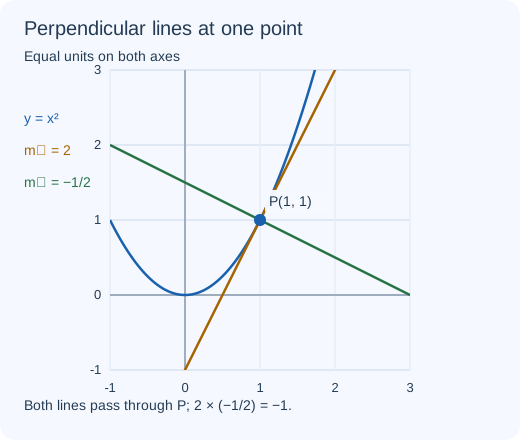
Find the tangent and normal to y=x² at x=1.
Show the reasoning
The point is (1,1) and y′=2x gives m=2. The tangent is \(y-1=2(x-1)\), or y=2x−1. The normal is \(y-1=-\tfrac12(x-1)\), or y=−x/2+3/2.
Example 2
Find the tangent and normal to y=x²+3 at x=0.
Show the reasoning
The point is (0,3), with gradient zero. The tangent is y=3 and the normal is x=0. The latter is a vertical line, not y=0.
Example 3
Find every point on y=x³−x whose tangent is parallel to y=2x+5.
Show the reasoning
Set 3x²−1=2, obtaining x=±1. Both ordinates are zero, so the points are (−1,0) and (1,0). Their tangents are y=2x+2 and y=2x−2 respectively.