9709 P12 - Jun 2023 - Q11
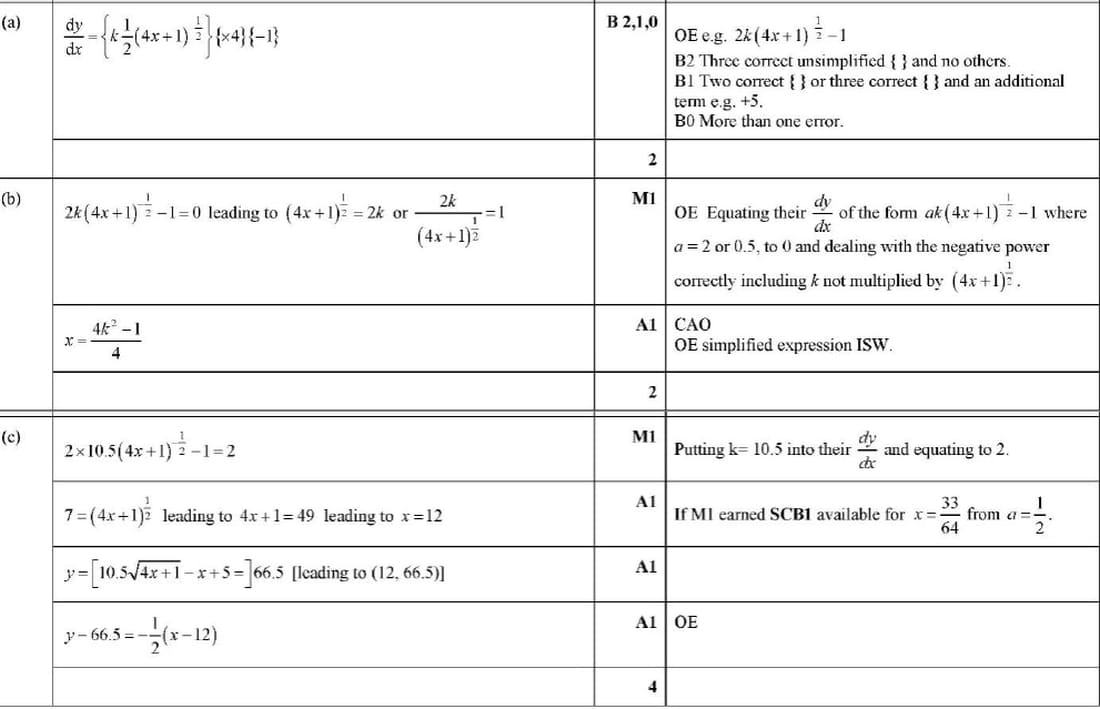
The equation of a curve is
\(y = k \sqrt{4x + 1} - x + 5\),
where \(k\) is a positive constant.
(a) Find \(\frac{dy}{dx}\).
(b) Find the \(x\)-coordinate of the stationary point in terms of \(k\).
(c) Given that \(k = 10.5\), find the equation of the normal to the curve at the point where the tangent to the curve makes an angle of \(\arctan(2)\) with the positive \(x\)-axis.
9709 P11 - Jun 2016 - Q8
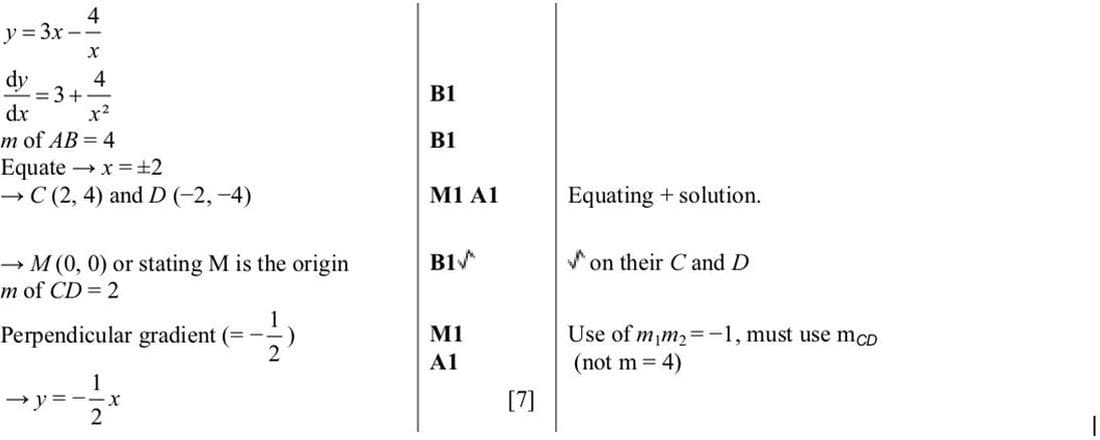
A curve has equation \(y = 3x - \frac{4}{x}\) and passes through the points \(A(1, -1)\) and \(B(4, 11)\). At each of the points \(C\) and \(D\) on the curve, the tangent is parallel to \(AB\). Find the equation of the perpendicular bisector of \(CD\).
9709 P11 - Jun 2014 - Q4
A curve has equation \(y = \frac{4}{(3x + 1)^2}\). Find the equation of the tangent to the curve at the point where the line \(x = -1\) intersects the curve.

9709 P13 - Nov 2013 - Q11
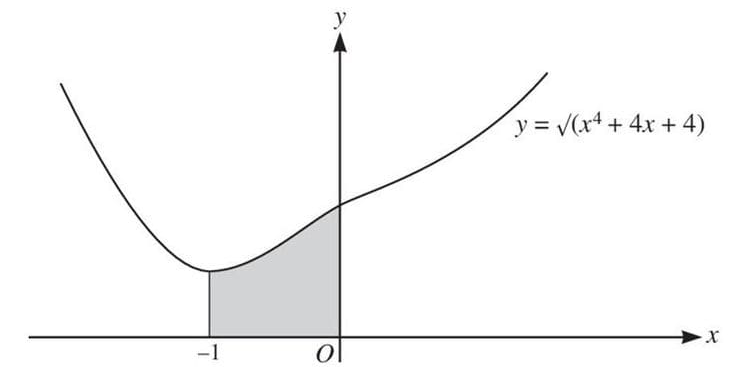
The diagram shows the curve \(y = \sqrt{x^4 + 4x + 4}\).
(i) Find the equation of the tangent to the curve at the point \((0, 2)\).
(ii) Show that the \(x\)-coordinates of the points of intersection of the line \(y = x + 2\) and the curve are given by the equation \((x + 2)^2 = x^4 + 4x + 4\). Hence find these \(x\)-coordinates.

9709 P11 - Nov 2012 - Q11
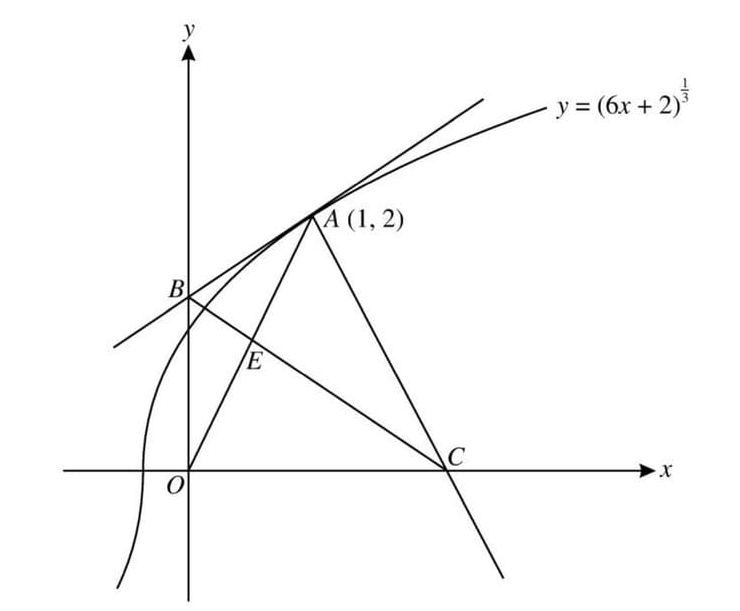
The diagram shows the curve \(y = (6x + 2)^{\frac{1}{3}}\) and the point \(A (1, 2)\) which lies on the curve. The tangent to the curve at \(A\) cuts the \(y\)-axis at \(B\) and the normal to the curve at \(A\) cuts the \(x\)-axis at \(C\).
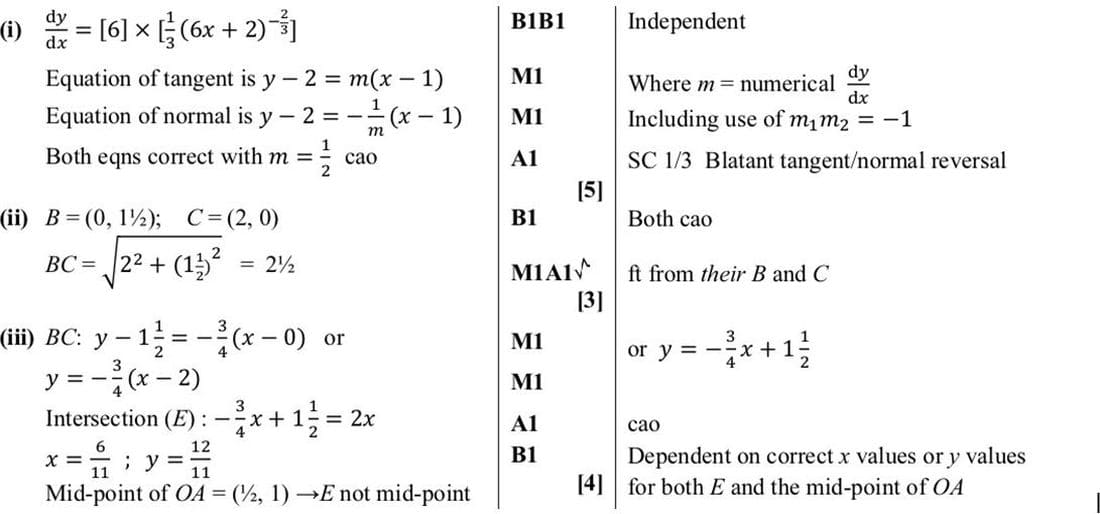
(i) Find the equation of the tangent \(AB\) and the equation of the normal \(AC\). [5]
(ii) Find the distance \(BC\). [3]
(iii) Find the coordinates of the point of intersection, \(E\), of \(OA\) and \(BC\), and determine whether \(E\) is the mid-point of \(OA\). [4]
9709 P13 - Jun 2012 - Q7
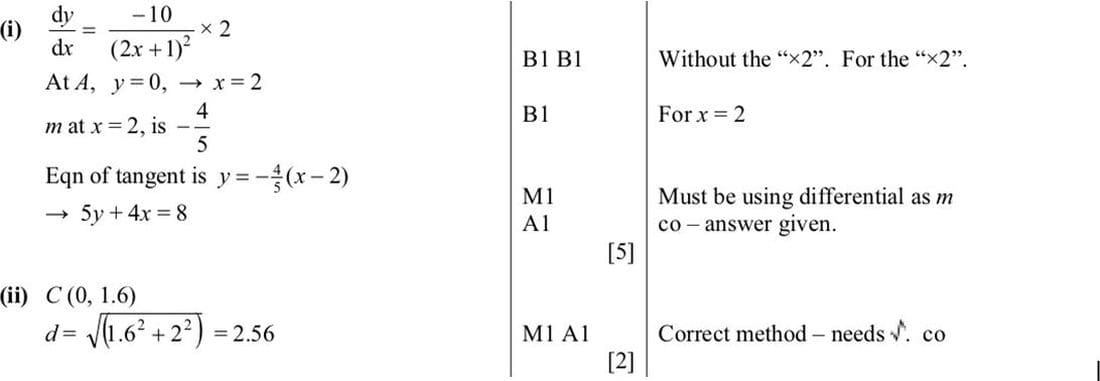
The curve \(y = \frac{10}{2x+1} - 2\) intersects the \(x\)-axis at \(A\). The tangent to the curve at \(A\) intersects the \(y\)-axis at \(C\).
(i) Show that the equation of \(AC\) is \(5y + 4x = 8\).
(ii) Find the distance \(AC\).
9709 P11 - Nov 2010 - Q10
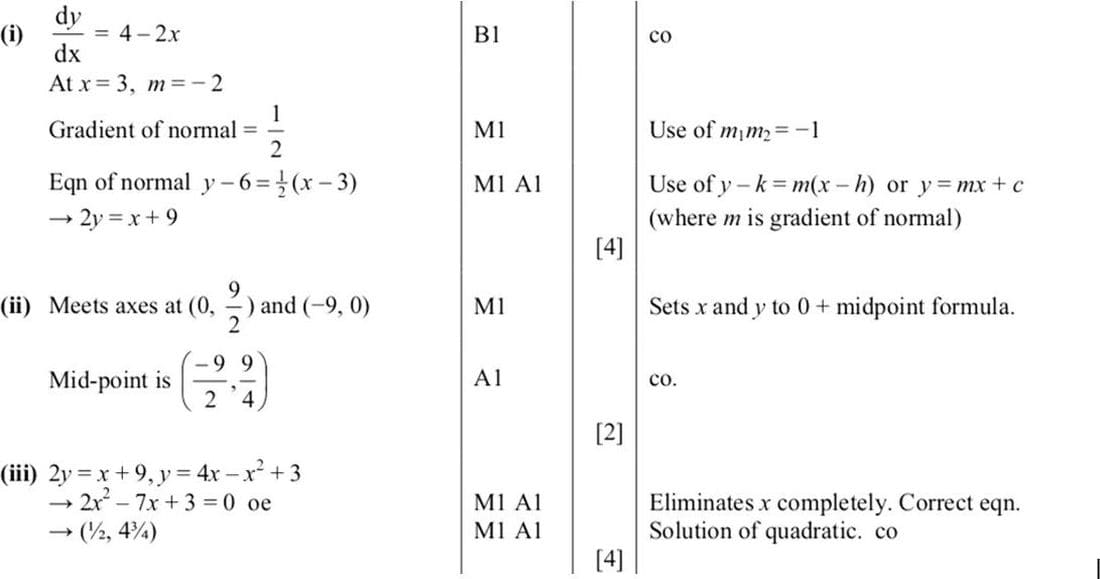
The equation of a curve is \(y = 3 + 4x - x^2\).
(i) Show that the equation of the normal to the curve at the point \((3, 6)\) is \(2y = x + 9\).
(ii) Given that the normal meets the coordinate axes at points \(A\) and \(B\), find the coordinates of the mid-point of \(AB\).
(iii) Find the coordinates of the point at which the normal meets the curve again.
9709 P11 - Jun 2010 - Q7
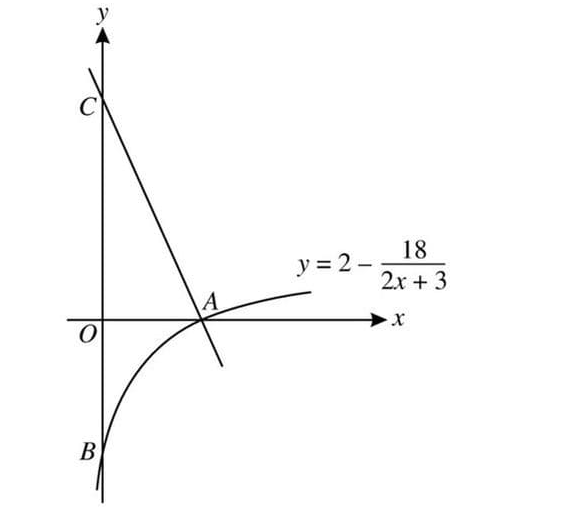
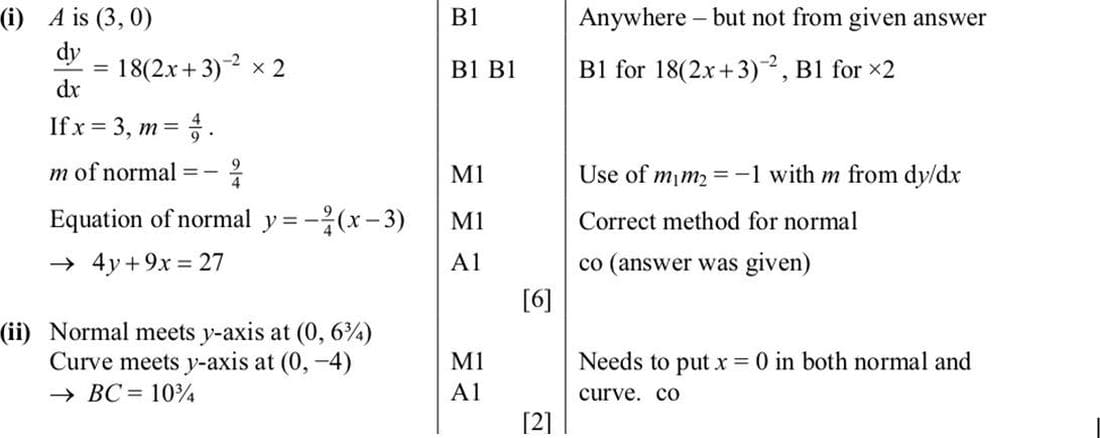
The diagram shows part of the curve \(y = 2 - \frac{18}{2x+3}\), which crosses the x-axis at \(A\) and the y-axis at \(B\). The normal to the curve at \(A\) crosses the y-axis at \(C\).
(i) Show that the equation of the line \(AC\) is \(9x + 4y = 27\).
(ii) Find the length of \(BC\).
9709 P1 - Nov 2008 - Q8
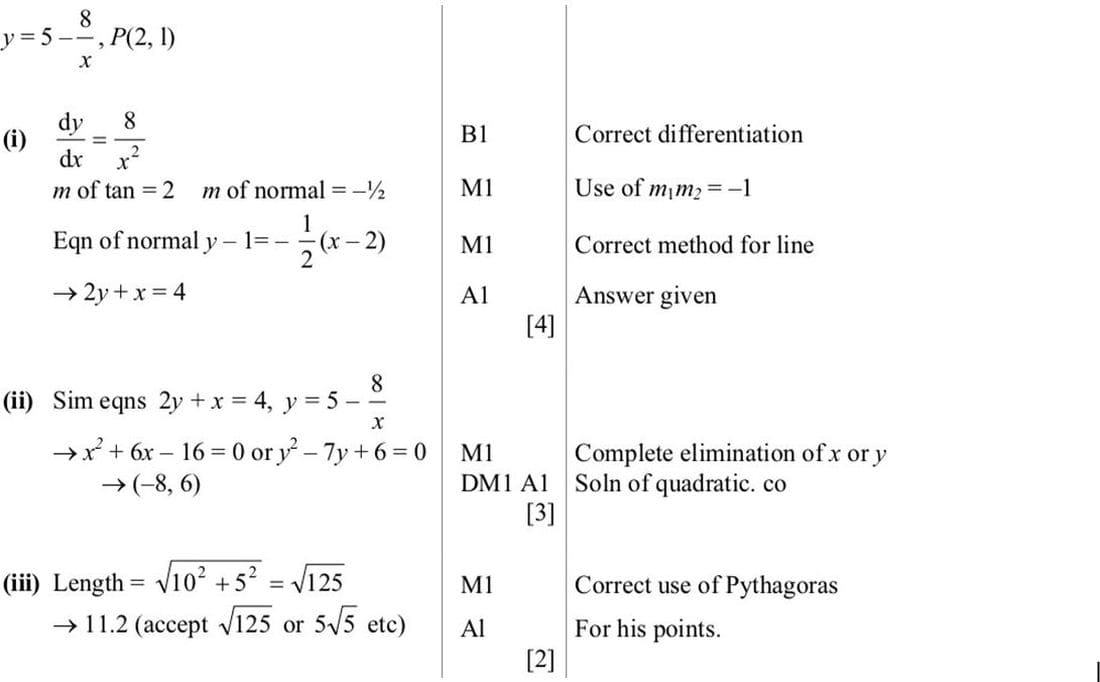
The equation of a curve is \(y = 5 - \frac{8}{x}\).
(i) Show that the equation of the normal to the curve at the point \(P(2, 1)\) is \(2y + x = 4\).
This normal meets the curve again at the point \(Q\).
(ii) Find the coordinates of \(Q\).
(iii) Find the length of \(PQ\).
9709 P1 - Jun 2007 - Q10
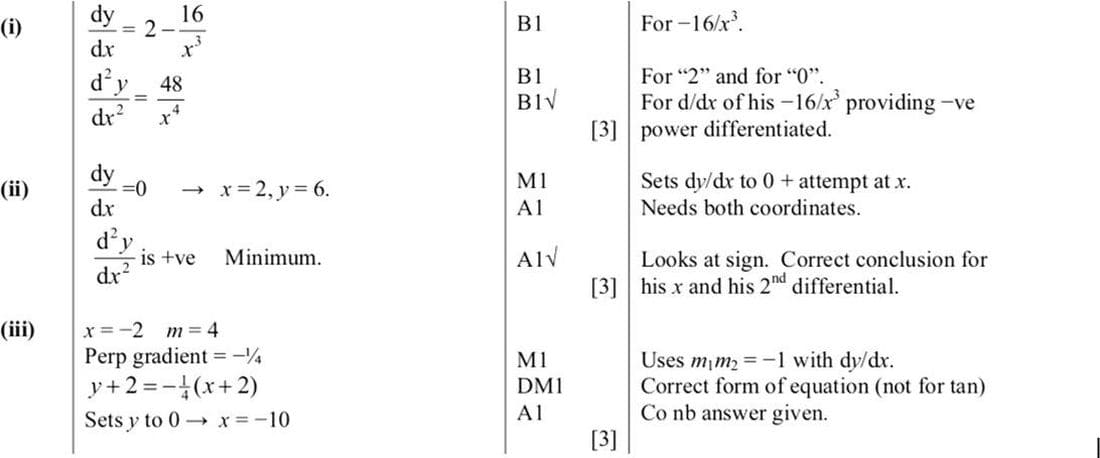
The equation of a curve is \(y = 2x + \frac{8}{x^2}\).
(i) Obtain expressions for \(\frac{dy}{dx}\) and \(\frac{d^2y}{dx^2}\).
(ii) Find the coordinates of the stationary point on the curve and determine the nature of the stationary point.
(iii) Show that the normal to the curve at the point \((-2, -2)\) intersects the x-axis at the point \((-10, 0)\).
9709 P1 - Jun 2005 - Q9
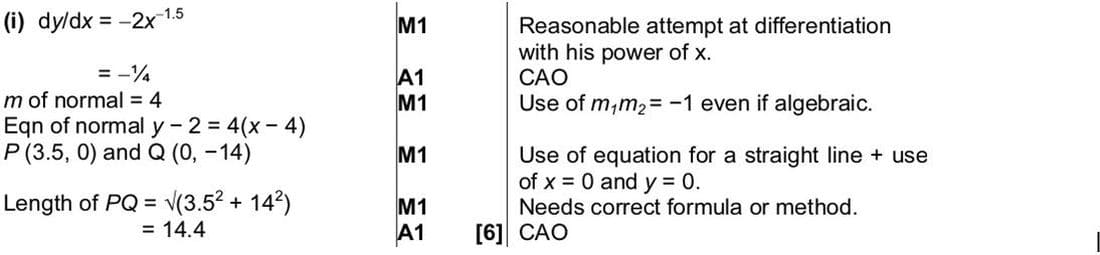
A curve has equation \(y = \frac{4}{\sqrt{x}}\).
The normal to the curve at the point \((4, 2)\) meets the \(x\)-axis at \(P\) and the \(y\)-axis at \(Q\). Find the length of \(PQ\), correct to 3 significant figures.
9709 P13 - Jun 2022 - Q11
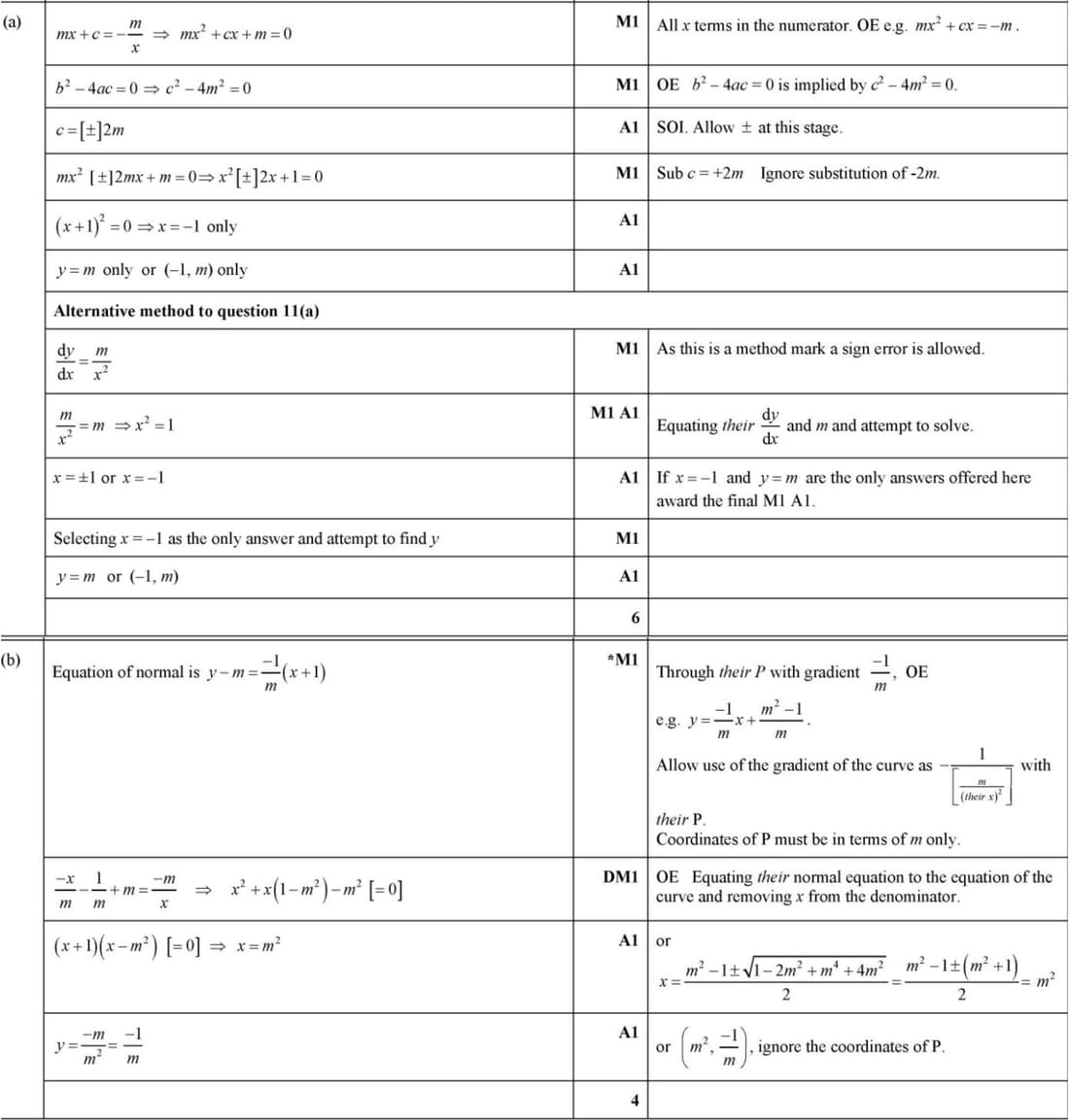
The point P lies on the line with equation \(y = mx + c\), where \(m\) and \(c\) are positive constants. A curve has equation \(y = -\frac{m}{x}\). There is a single point P on the curve such that the straight line is a tangent to the curve at P.
(a) Find the coordinates of P, giving the \(y\)-coordinate in terms of \(m\).
The normal to the curve at P intersects the curve again at the point Q.
(b) Find the coordinates of Q in terms of \(m\).
9709 P13 - Jun 2011 - Q9
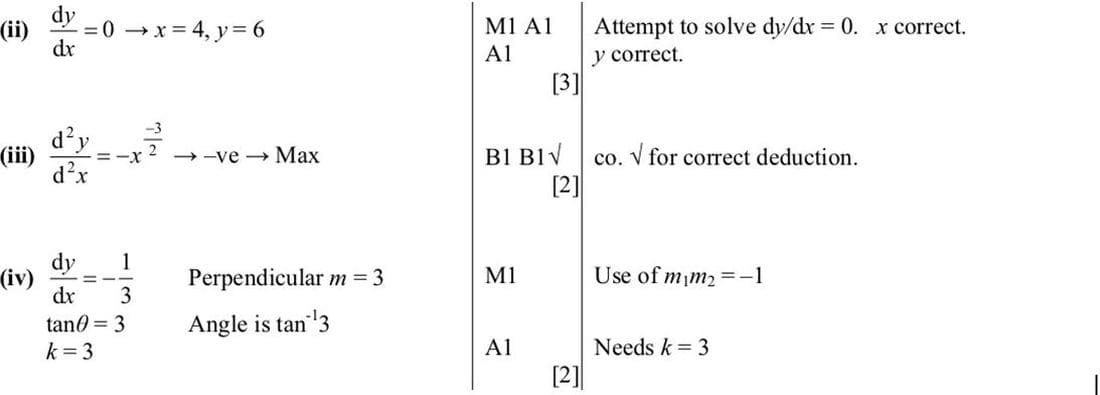
A curve is such that \(\frac{dy}{dx} = \frac{2}{\sqrt{x}} - 1\) and \(P(9, 5)\) is a point on the curve.
(ii) Find the coordinates of the stationary point on the curve. [3]
(iii) Find an expression for \(\frac{d^2y}{dx^2}\) and determine the nature of the stationary point. [2]
(iv) The normal to the curve at \(P\) makes an angle of \(\arctan k\) with the positive \(x\)-axis. Find the value of \(k\). [2]
9709 P12 - Jun 2011 - Q4
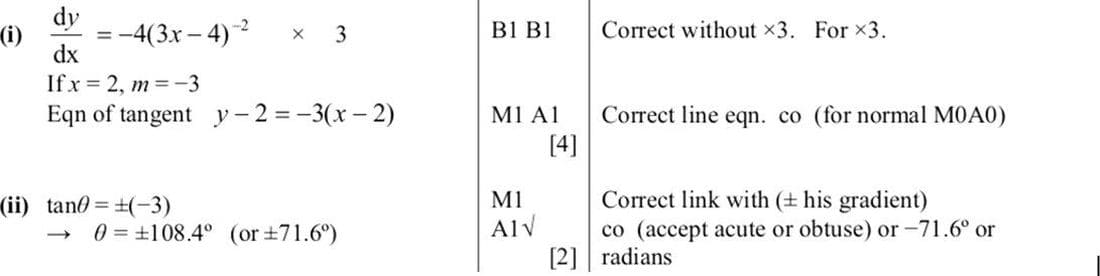
A curve has equation \(y = \frac{4}{3x-4}\) and \(P(2, 2)\) is a point on the curve.
(i) Find the equation of the tangent to the curve at \(P\).
(ii) Find the angle that this tangent makes with the \(x\)-axis.
9709 P12 - Nov 2009 - Q10
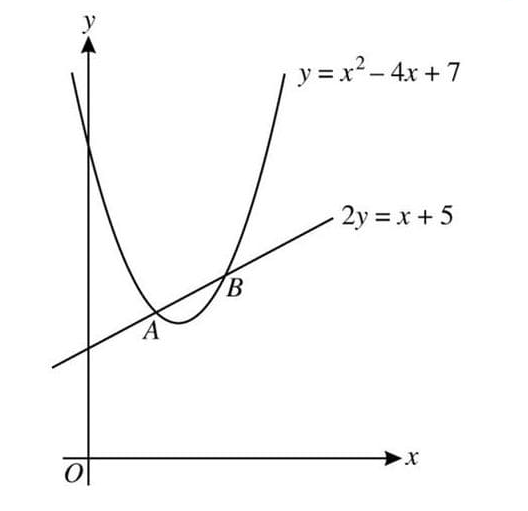
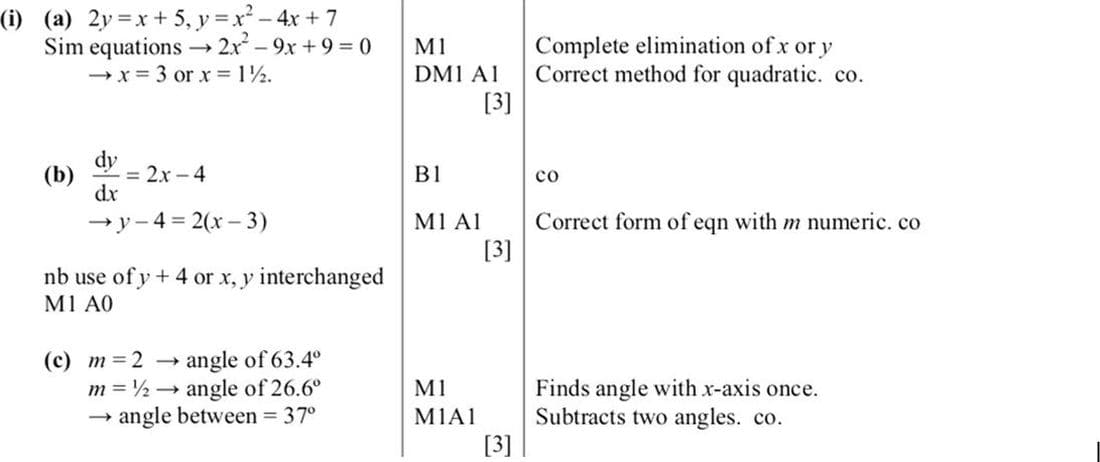
The diagram shows the line \(2y = x + 5\) and the curve \(y = x^2 - 4x + 7\), which intersect at the points \(A\) and \(B\). Find
(a) the \(x\)-coordinates of \(A\) and \(B\),
(b) the equation of the tangent to the curve at \(B\),
(c) the acute angle, in degrees correct to 1 decimal place, between this tangent and the line \(2y = x + 5\).
9709 P11 - Jun 2021 - Q11
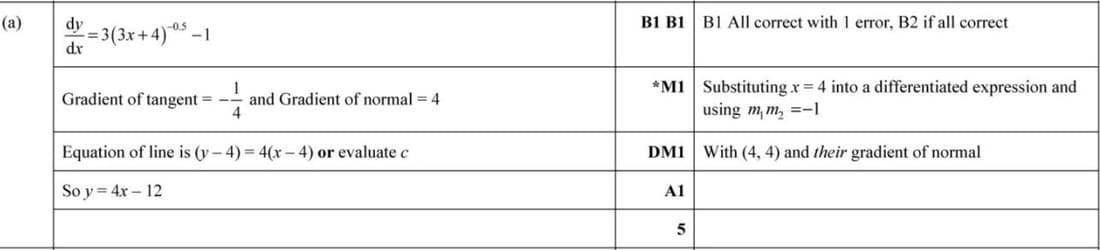
The equation of a curve is \(y = 2\sqrt{3x+4} - x\).
Find the equation of the normal to the curve at the point (4, 4), giving your answer in the form \(y = mx + c\).
9709 P12 - Mar 2019 - Q10
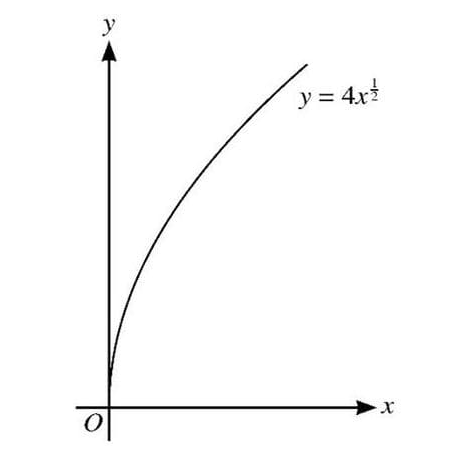
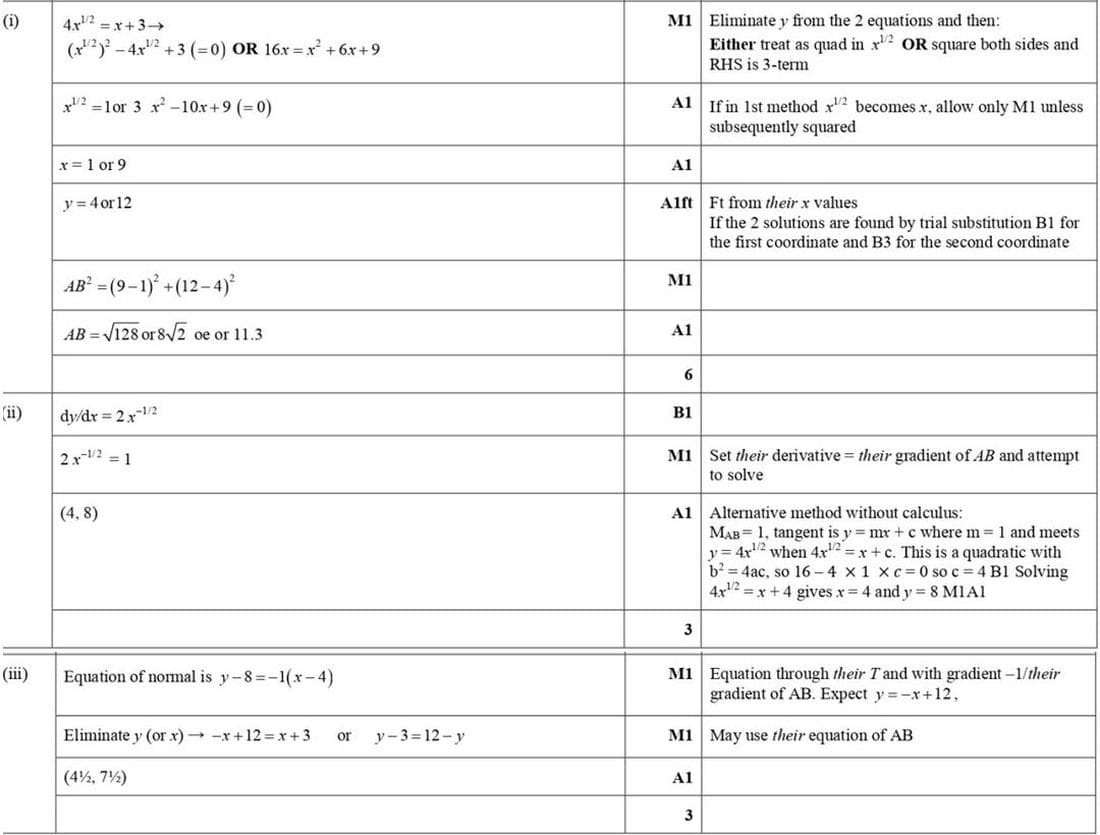
The diagram shows the curve with equation \(y = 4x^{\frac{1}{2}}\).
(i) The straight line with equation \(y = x + 3\) intersects the curve at points \(A\) and \(B\). Find the length of \(AB\).
(ii) The tangent to the curve at a point \(T\) is parallel to \(AB\). Find the coordinates of \(T\).
(iii) Find the coordinates of the point of intersection of the normal to the curve at \(T\) with the line \(AB\).
9709 P13 - Nov 2017 - Q11
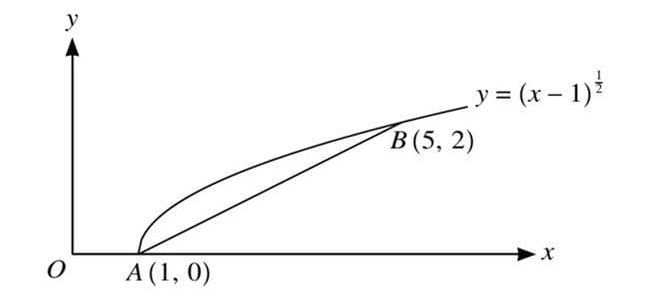
The diagram shows the curve \(y = (x - 1)^{\frac{1}{2}}\) and points \(A(1, 0)\) and \(B(5, 2)\) lying on the curve.
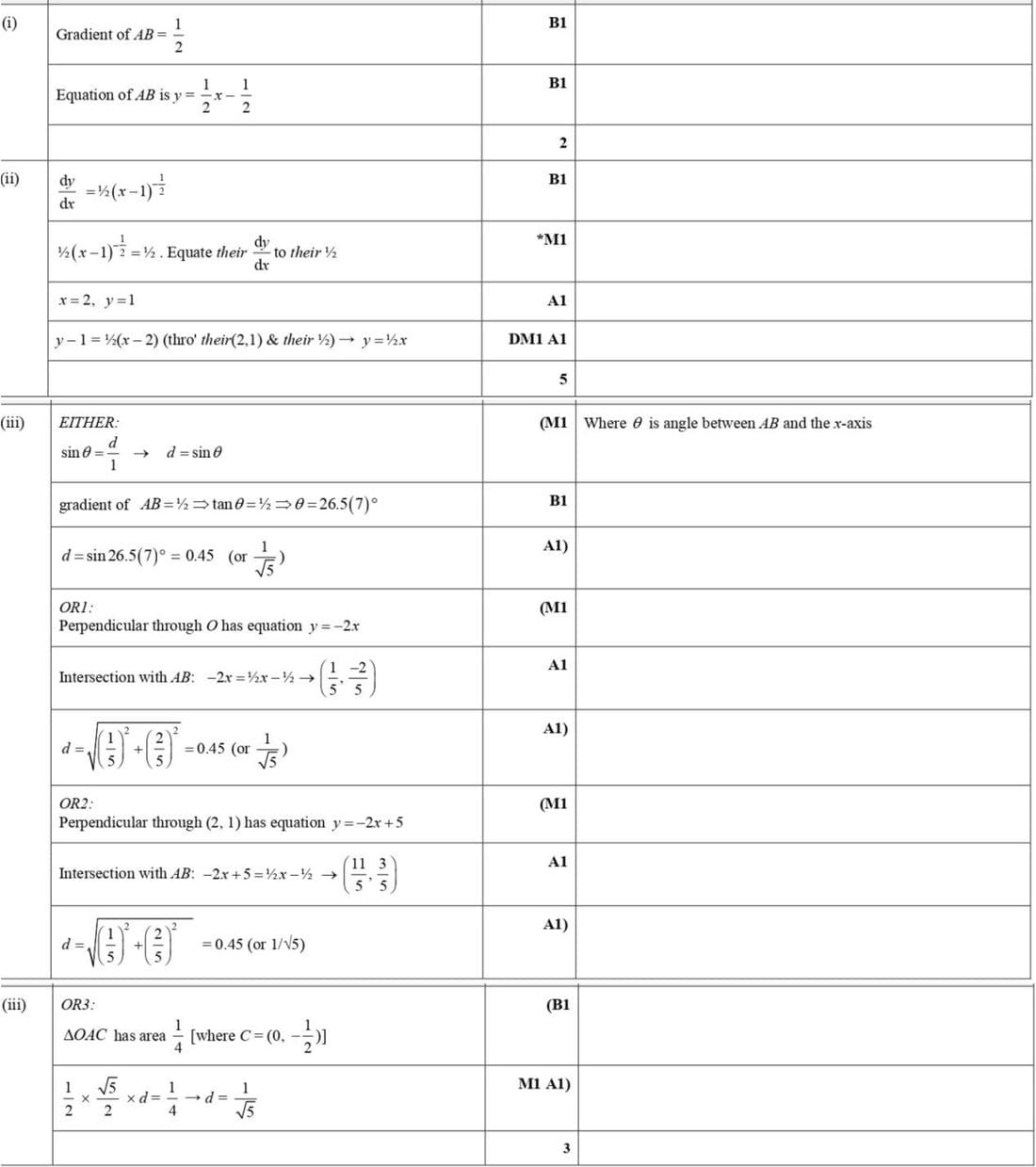
(i) Find the equation of the line \(AB\), giving your answer in the form \(y = mx + c\).
(ii) Find, showing all necessary working, the equation of the tangent to the curve which is parallel to \(AB\).
(iii) Find the perpendicular distance between the line \(AB\) and the tangent parallel to \(AB\). Give your answer correct to 2 decimal places.
9709 P11 - Nov 2017 - Q1
A curve has equation \(y = 2x^{\frac{3}{2}} - 3x - 4x^{\frac{1}{2}} + 4\). Find the equation of the tangent to the curve at the point (4, 0).

9709 P13 - Jun 2017 - Q6
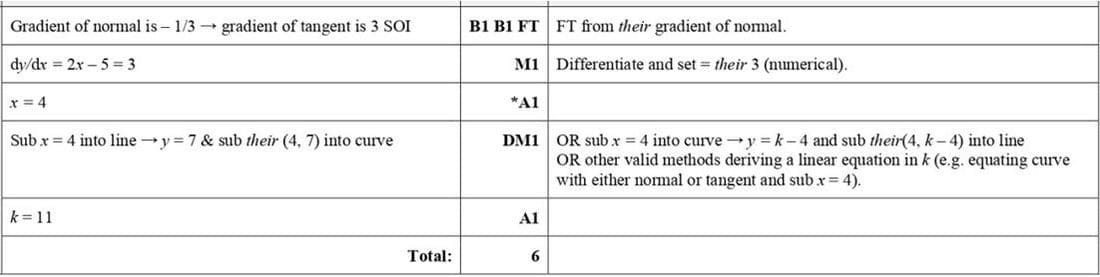
\(The line 3y + x = 25 is a normal to the curve y = x^2 - 5x + k. Find the value of the constant k.\)
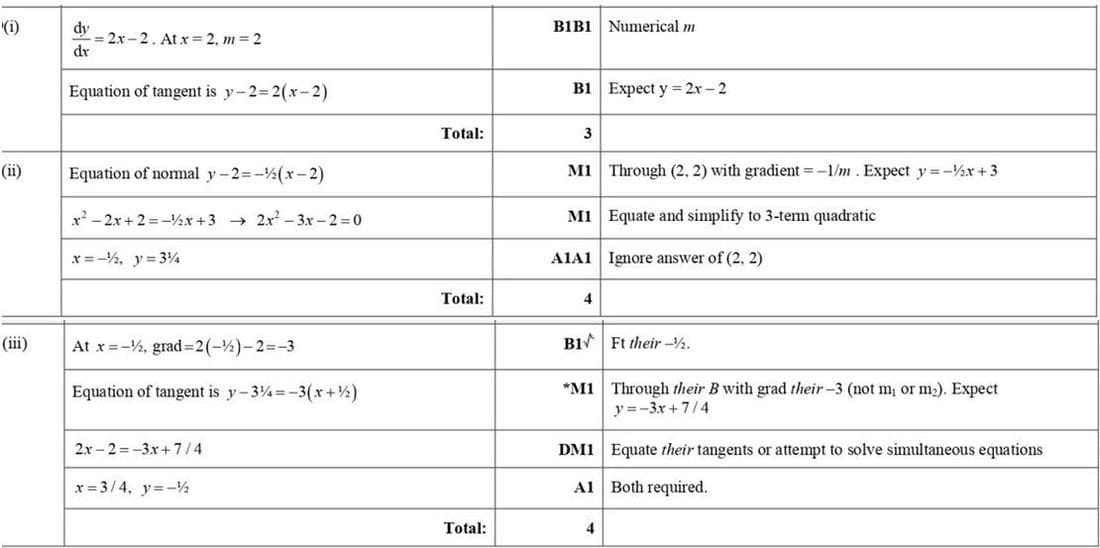
9709 P12 - Mar 2017 - Q9
The point A (2, 2) lies on the curve \(y = x^2 - 2x + 2\).
(i) Find the equation of the tangent to the curve at A.
The normal to the curve at A intersects the curve again at B.
(ii) Find the coordinates of B.
The tangents at A and B intersect each other at C.
(iii) Find the coordinates of C.
9709 P11 - Nov 2016 - Q11
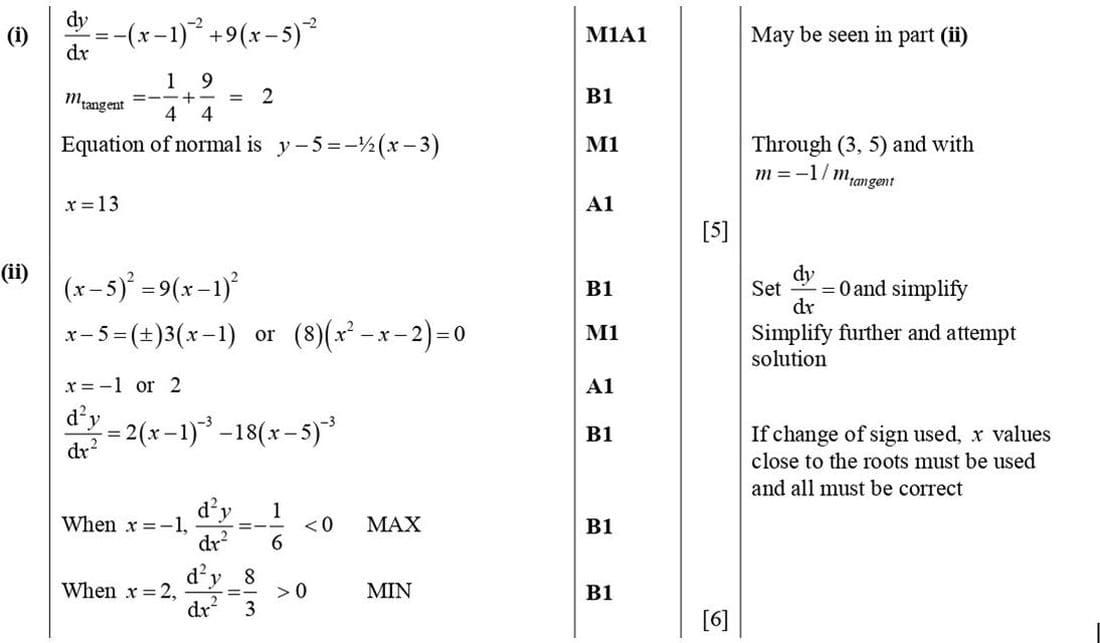
The point \(P(3, 5)\) lies on the curve \(y = \frac{1}{x-1} - \frac{9}{x-5}\).
(i) Find the \(x\)-coordinate of the point where the normal to the curve at \(P\) intersects the \(x\)-axis.
(ii) Find the \(x\)-coordinate of each of the stationary points on the curve and determine the nature of each stationary point, justifying your answers.