Learn the method, study an example, then explain your reasoning in an exam-style problem. Work on paper before opening the solution and compare each step with the marking guidance.
Optimisation on a feasible domain
Build a one-variable model, reject inadmissible stationary values and justify a global optimum.
Notes
Before you start: eliminate a variable from a constraint, differentiate, and interpret derivative signs.
Define the variables and state a feasible domain from the geometry or context.
Use the constraint to write the objective as a function of one variable.
Find stationary candidates and retain only those inside the feasible domain.
Classify candidates, compare appropriate boundary values or limits, and justify the optimum on the whole domain.
Give the requested dimensions or quantity with units, retaining exact values before rounding.
A negative second derivative at a stationary point proves a local maximum; it does not by itself prove a global maximum on an arbitrary domain. A complete derivative-sign argument, a suitable comparison with endpoints/limits, or an algebraic bound can establish the global result.
Geometric dimensions are usually positive. A root that gives a negative side, a zero-volume object or a dimension beyond the sheet is not admissible. On an open domain, boundary limits help compare values without pretending the boundary objects are feasible.
Recall later
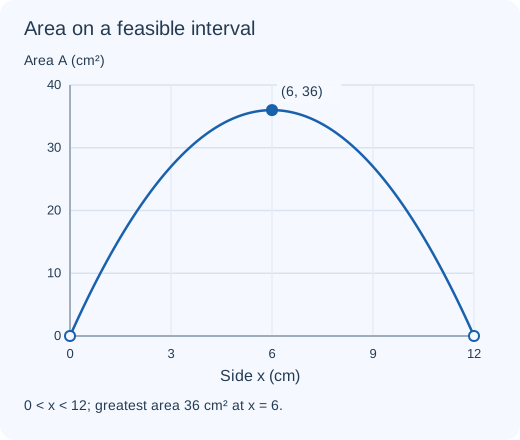
For A=x(12−x), \(A=36-(x-6)^2\le36\). Equality occurs at the feasible value x=6, so the bound proves the global maximum directly.
Common mistakes
Solving the stationary equation without stating or checking a feasible domain.
Using only a local second-derivative test to claim a global optimum.
Giving an optimal input but omitting the requested output, other dimension or units.
Three worked examples
Example 1
A rectangle has perimeter 24 cm. Find its greatest area and dimensions.
Show the reasoning
If the sides are x and y, x+y=12, so A=x(12−x), with 0<x<12. A′=12−2x vanishes at x=6. It is positive before 6 and negative afterwards, giving the global maximum 36 cm² at a 6 cm by 6 cm square.
Example 2
Find the least value of f(x)=x+9/x for x>0.
Show the reasoning
\(f^{\prime}=1-9/x^2=(x-3)(x+3)/x^2\). The only positive stationary input is 3. The derivative is negative on (0,3) and positive on (3,∞), proving the global minimum f(3)=6. The negative root is outside the domain.
Example 3
An open-top cylinder has volume 8π cm³. Minimise the area of its base and curved surface.
Show the reasoning
With r>0, the height is h=8/r² and the area is \(A=\pi r^2+16\pi/r\). Its derivative is \(2\pi(r^3-8)/r^2\), negative for 0<r<2 and positive for r>2. Hence the global minimum occurs at r=2 cm, h=2 cm, with A=12π cm².