Past Exam Questions
← Back0606 P12 - Mar 2024 - Q4 - 11 marks
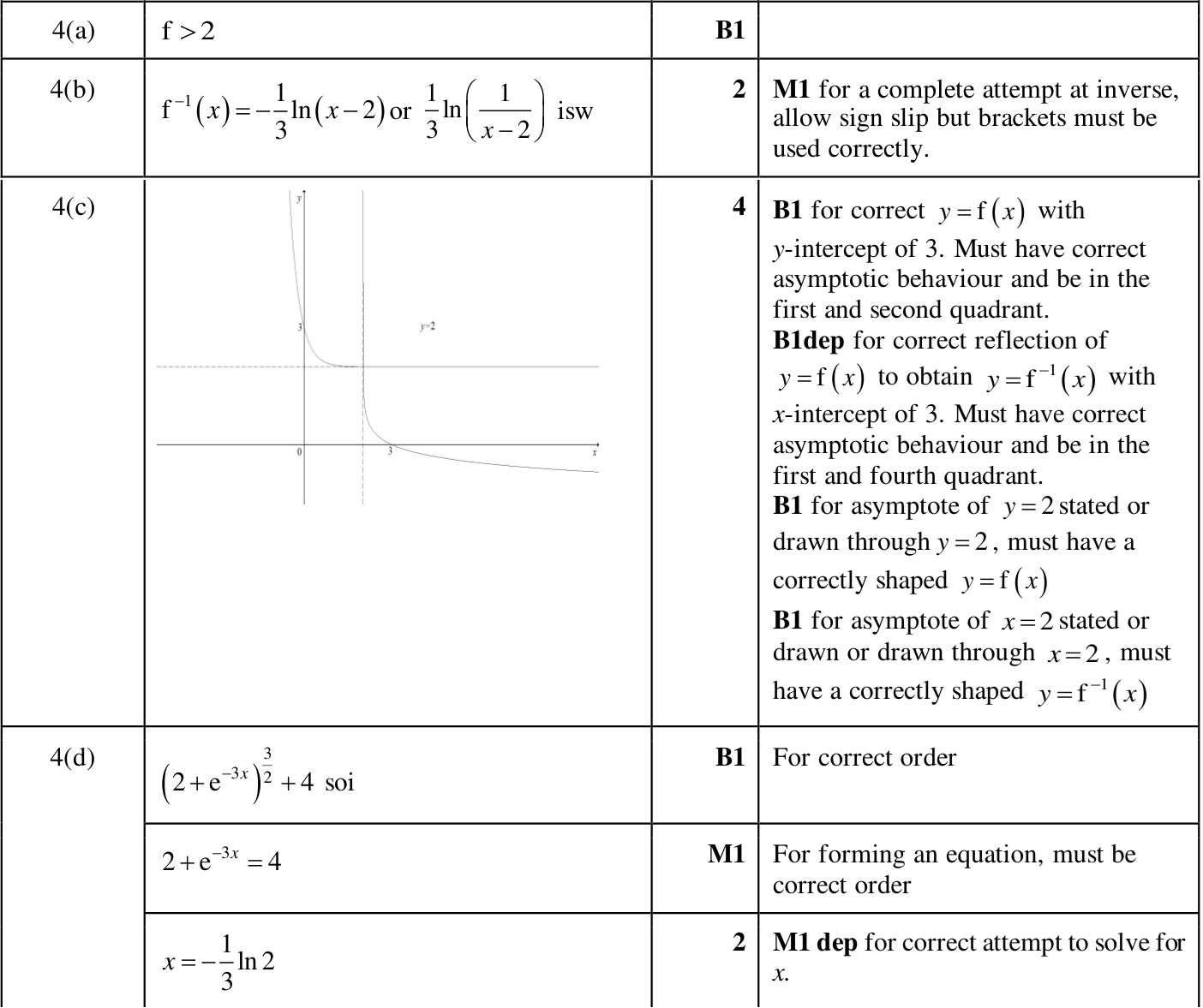
A function f is such that \(\mathrm{f}(x)=2+\mathrm{e}^{-3 x}, \quad x \in \mathbb{R}\). (a) Write down the range of f .
(b) Find an expression for \(\mathrm{f}^{-1}\).
(c) On the axes, sketch the graphs of \(y=\mathrm{f}(x)\) and \(y=\mathrm{f}^{-1}(x)\), stating the coordinates of the points where the curves meet the coordinate axes. State the equations of any asymptotes. Label your curves.
A function g is such that \(\mathrm{g}(x)=x^{\frac{3}{2}}+4, \quad x \geqslant 0\). (d) Find the exact solution of the equation \(\mathrm{gf}(x)=12\).
0606 P21 - Jun 2023 - Q8 - 11 marks
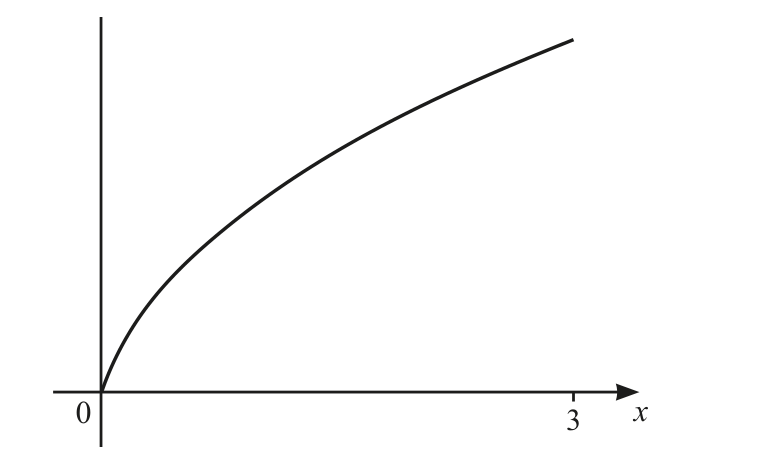
(a) The diagram shows the graph of \(y=f(x)\), where \(f\) is defined by
\(f(x)=\frac{3x}{\sqrt{5x+1}}\quad\text{for }0\leq x\leq3.\)
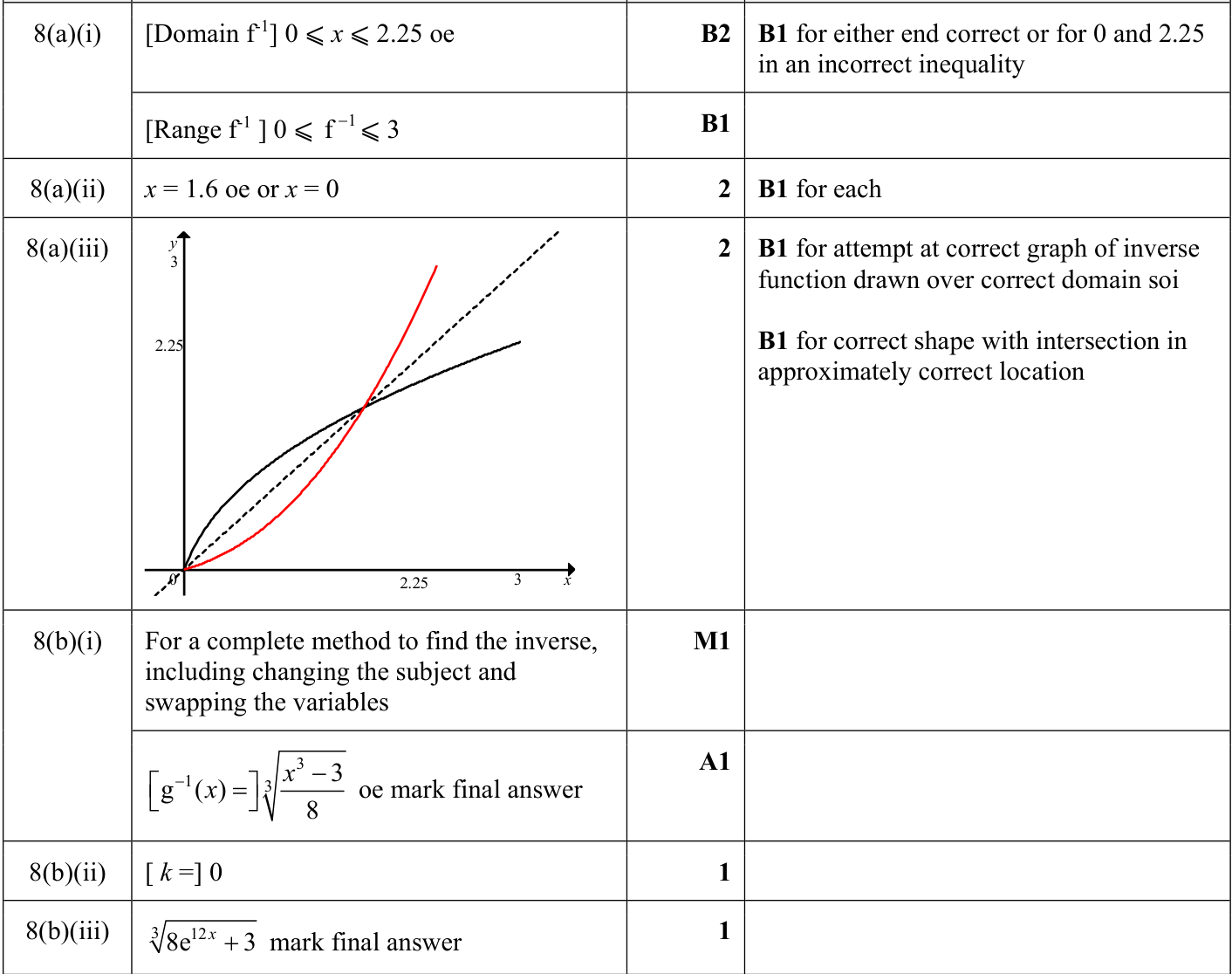
(i) Given that \(f\) is a one-one function, find the domain and range of \(f^{-1}\).
(ii) Solve the equation \(f(x)=x\).
(iii) Sketch the graph of \(y=f^{-1}(x)\).
(b) The functions \(g\) and \(h\) are defined by
\(g(x)=\sqrt[3]{8x^3+3}\quad\text{for }x\geq1, \qquad h(x)=e^{4x}\quad\text{for }x\geq k.\)
(i) Find an expression for \(g^{-1}(x)\).
(ii) State the least value of the constant \(k\) such that \(gh(x)\) can be formed.
(iii) Find and simplify an expression for \(gh(x)\).
0606 P23 - Jun 2023 - Q8 - 14 marks
The functions \(f\) and \(g\) are defined by
\(f(x)=\operatorname{sec} x,\qquad \frac{\pi}{2}\lt x\lt \frac{3\pi}{2},\)
and
\(g(x)=3(x^2-1),\qquad x\in\mathbb R.\)
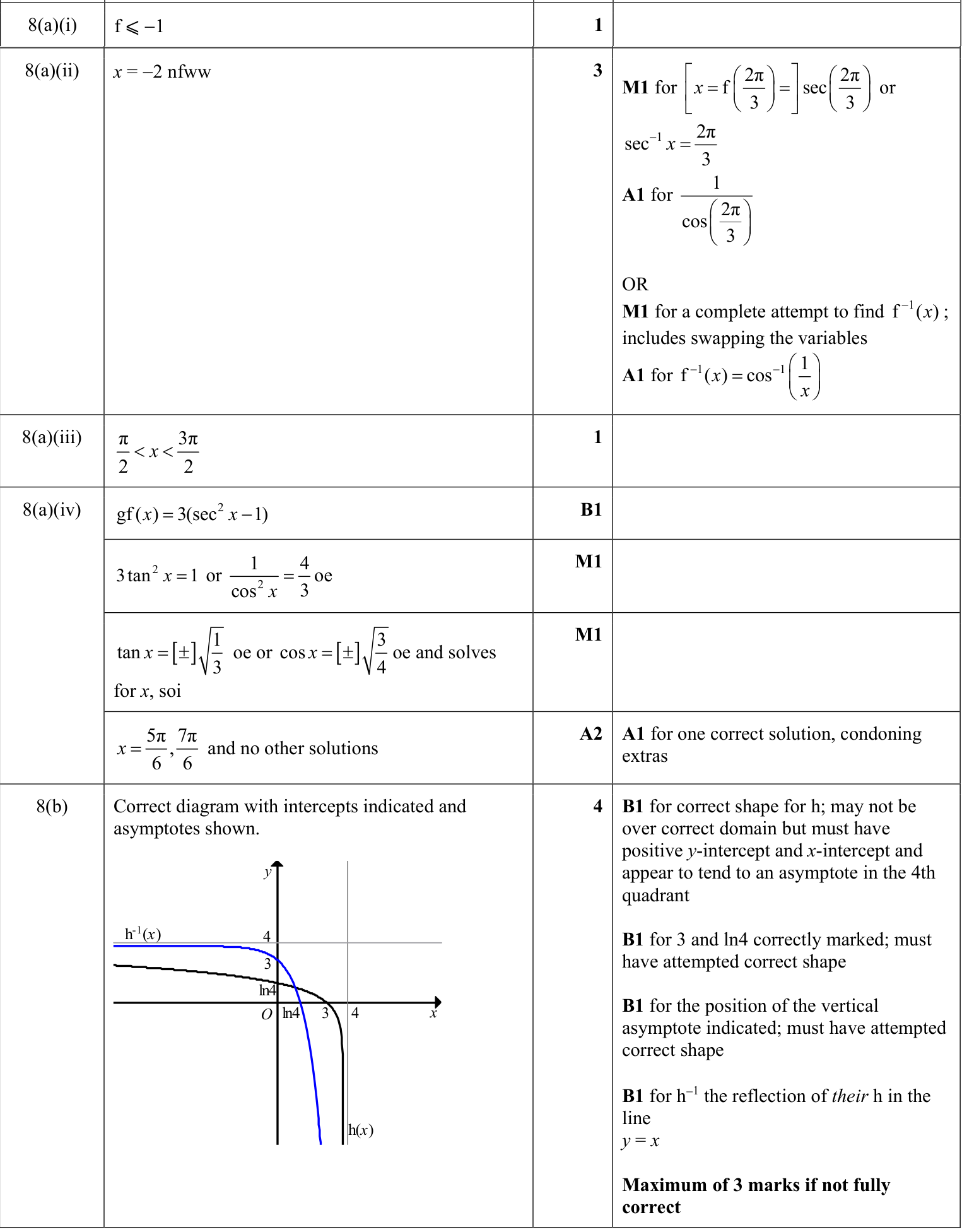
(a)(i) State the range of \(f\).
(a)(ii) Solve \(f^{-1}(x)=\frac{2\pi}{3}\).
(a)(iii) Given that \(gf\) exists, state the domain of \(gf\).
(a)(iv) Solve \(gf(x)=1\).
(b) The function \(h\) is defined by
\(h(x)=\ln(4-x),\qquad x\lt 4.\)
Sketch, on the same diagram, the graphs of \(y=h(x)\) and \(y=h^{-1}(x)\), showing clearly any asymptotes and any intersections with the axes.
0606 P12 - Nov 2023 - Q8 - 9 marks
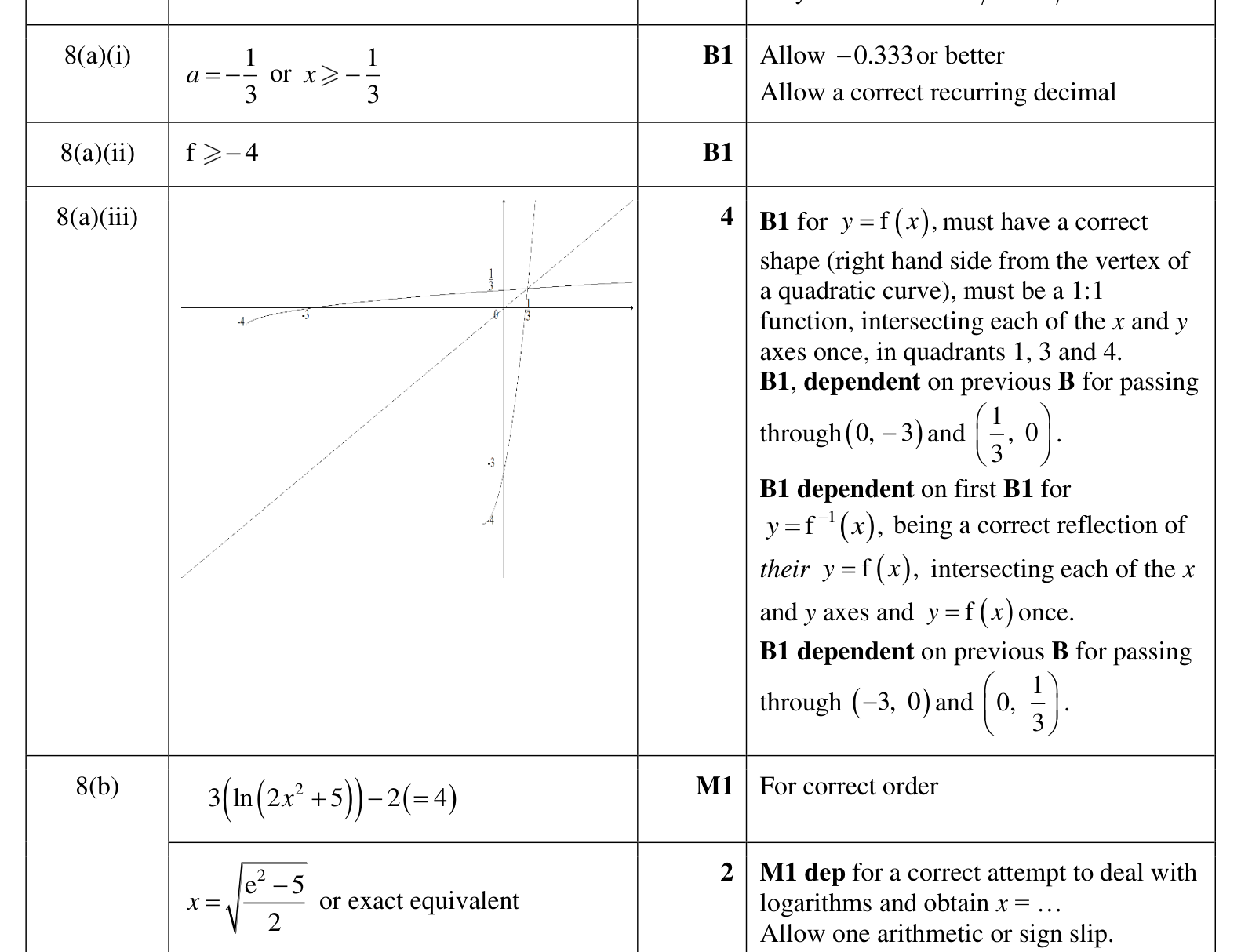
(a) It is given that \(f:x\mapsto(3x+1)^2-4\), for \(x\geq a\), and that \(f^{-1}\) exists.
(i) Find the least possible value of \(a\).
(ii) Using this value of \(a\), write down the range of \(f\).
(iii) Using this value of \(a\), sketch the graphs of \(y=f(x)\) and \(y=f^{-1}(x)\), stating the intercepts with the coordinate axes.
(b) It is given that \(g(x)=\ln(2x^2+5)\), for \(x\geq0\), and \(h(x)=3x-2\), for \(x\geq0\).
Solve the equation \(hg(x)=4\), giving your answer in exact form.
0606 P12 - Mar 2022 - Q9 - 12 marks
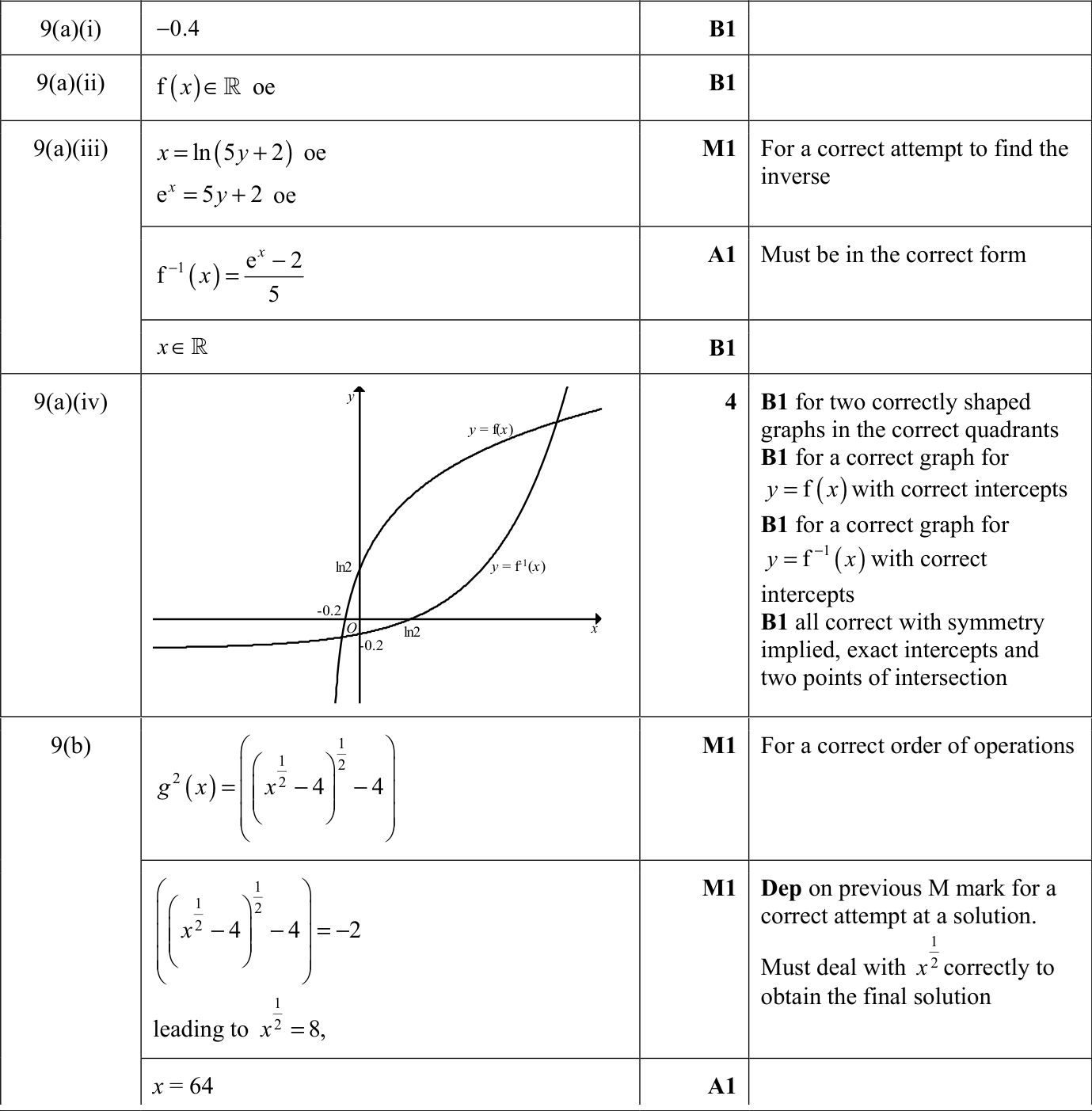
(a) The function \(f\) is such that \(f(x)=\ln(5x+2)\), for \(x\gt a\), where \(a\) is as small as possible.
(i) Write down the value of \(a\).
(ii) Hence find the range of \(f\).
(iii) Find \(f^{-1}(x)\), stating its domain.
(iv) Sketch the graphs of \(y=f(x)\) and \(y=f^{-1}(x)\), stating the exact values of the intercepts of the curves with the coordinate axes.
(b) The function \(g\) is such that \(g:x\mapsto x^{1/2}-4\), for \(x\gt 0\). Solve the equation \(g^2(x)=-2\).
0606 P22 - Mar 2023 - Q8 - 13 marks
The function \(f\) is defined for \(x\geq0\) by
\(f(x)=5-2\mathrm e^{-x}.\)
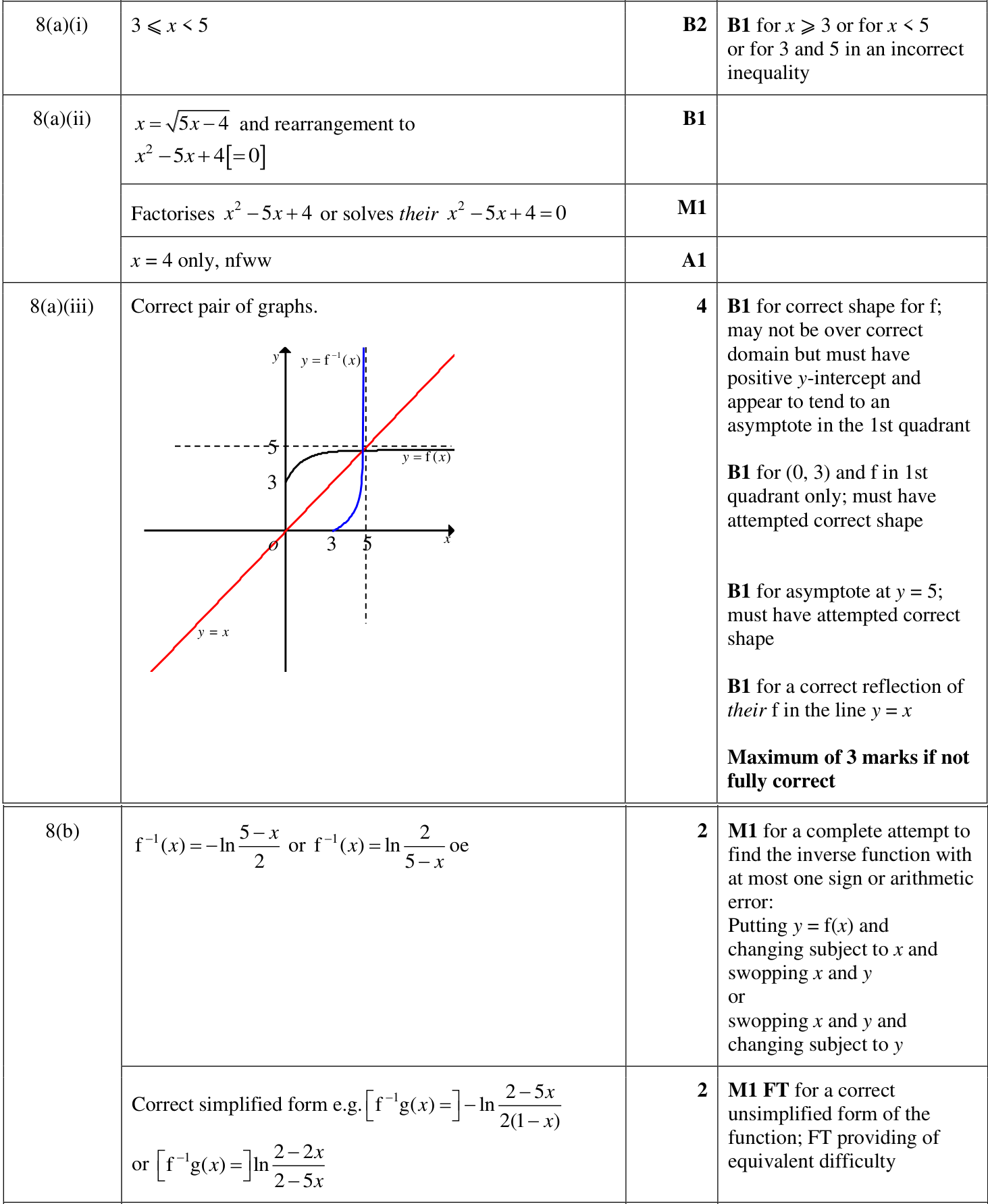
(a)(i) Find the domain of \(f^{-1}\).
(a)(ii) Solve
\(f^{-1}(x)=\sqrt{5x-4}.\)
(a)(iii) Sketch, on the same diagram, the graphs of \(y=f(x)\) and \(y=f^{-1}(x)\), showing the intercepts and asymptotes.
(b) The function \(g\) is defined for \(0\leq x\leq0.2\) by
\(g(x)=\frac{3}{1-x}.\)
Find and simplify an expression for \(f^{-1}g(x)\).
0606 P21 - Jun 2020 - Q11 - 10 marks
The function \(f\) is defined by
\(f(x)=\ln(2x+1)\qquad\text{for }x\geq0.\)
(a) Sketch the graph of \(y=f(x)\) and hence sketch the graph of \(y=f^{-1}(x)\).
The function \(g\) is defined by
\(g(x)=(x-4)^2+1\qquad\text{for }x\leq4.\)
(b)(i) Find an expression for \(g^{-1}(x)\) and state its domain and range.
(b)(ii) Find and simplify an expression for \(fg(x)\).
(b)(iii) Explain why the function \(gf\) does not exist.

0606 P12 - Nov 2020 - Q6 - 5 marks
The function \(\mathrm{f}\) is defined by
\(\mathrm{f}(x)=x^2+2x-3,\qquad x\geq -1.\)
(a) Explain why \(\mathrm{f}^{-1}\) exists.
(b) On the same axes, sketch the graphs of \(y=\mathrm{f}(x)\) and \(y=\mathrm{f}^{-1}(x)\), giving the coordinates of the vertex of each graph and the intercepts on the coordinate axes.

0606 P11 - Nov 2019 - Q5 - 7 marks
\(f(x)=3e^{2x}+1\quad\text{for }x\in\mathbb{R}\)
\(g(x)=x+1\quad\text{for }x\in\mathbb{R}\)
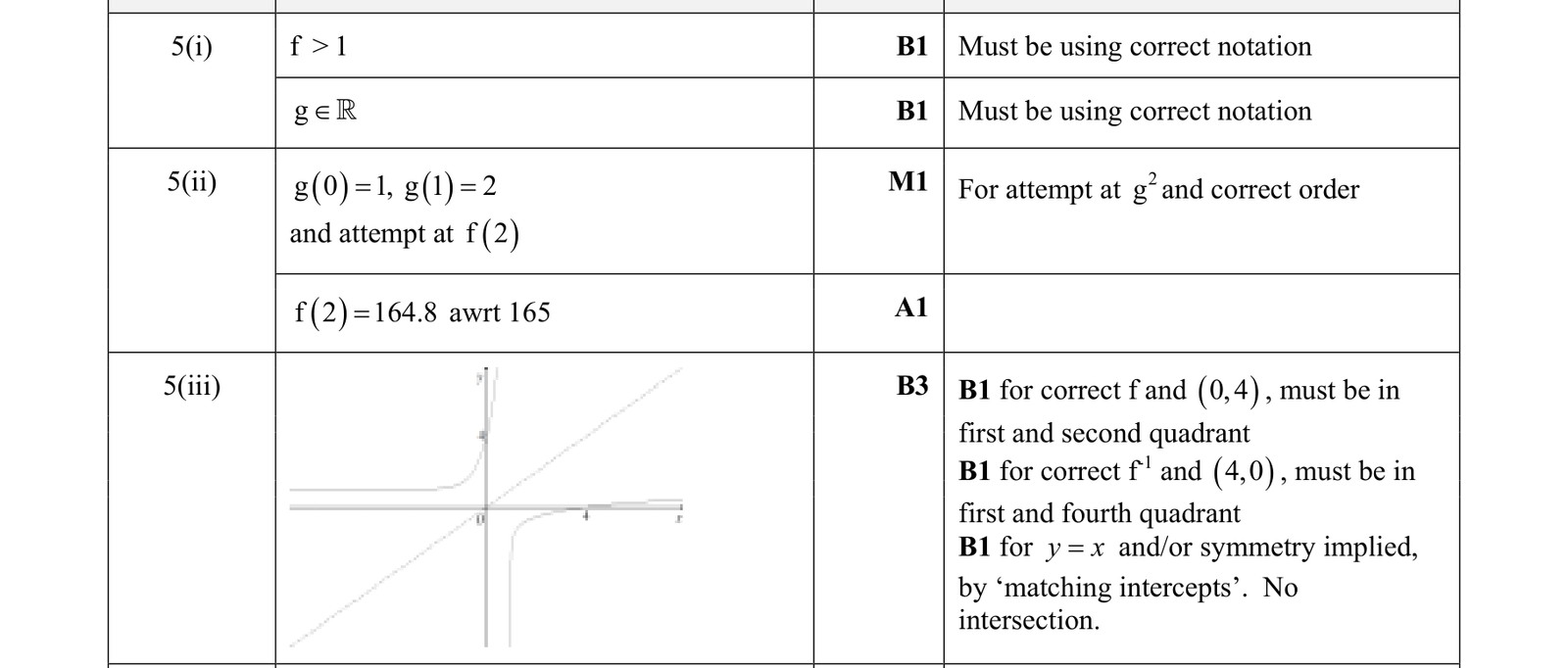
(i) Write down the range of \(f\) and of \(g\).
(ii) Evaluate \(fg^2(0)\).
(iii) On the axes below, sketch the graphs of \(y=f(x)\) and \(y=f^{-1}(x)\), stating the coordinates of the points where the graphs meet the coordinate axes.
0606 P22 - Jun 2017 - Q9 - 9 marks
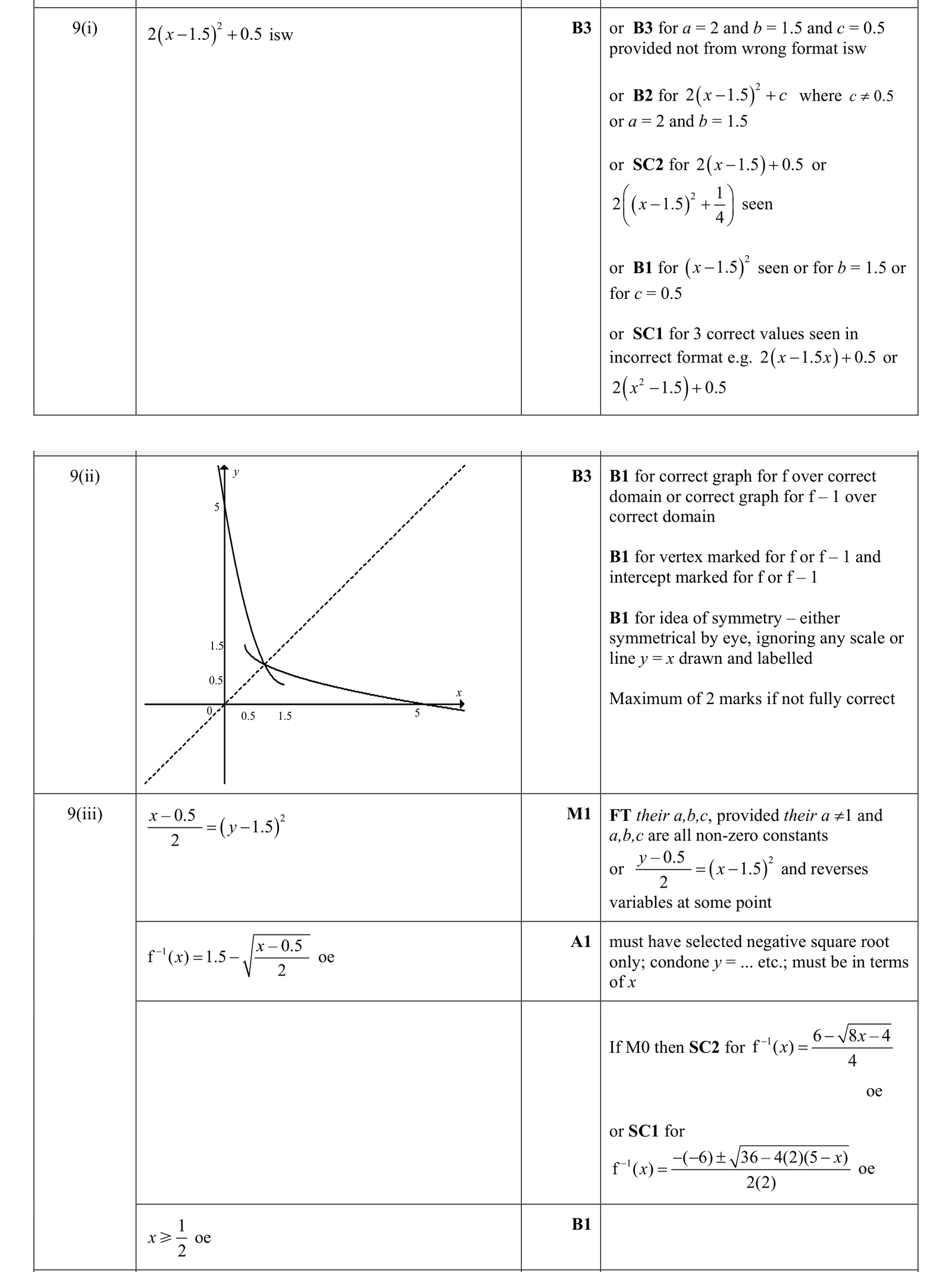
A function \(f\) is defined, for \(x\leqslant \dfrac32\), by \(f(x)=2x^2-6x+5\).
(i) Express \(f(x)\) in the form \(a(x-b)^2+c\), where \(a\), \(b\) and \(c\) are constants.
(ii) On the same axes, sketch the graphs of \(y=f(x)\) and \(y=f^{-1}(x)\), showing the geometrical relationship between them.
(iii) Using your answer from part (i), find an expression for \(f^{-1}(x)\), stating its domain.

0606 P23 - Jun 2017 - Q2 - 4 marks
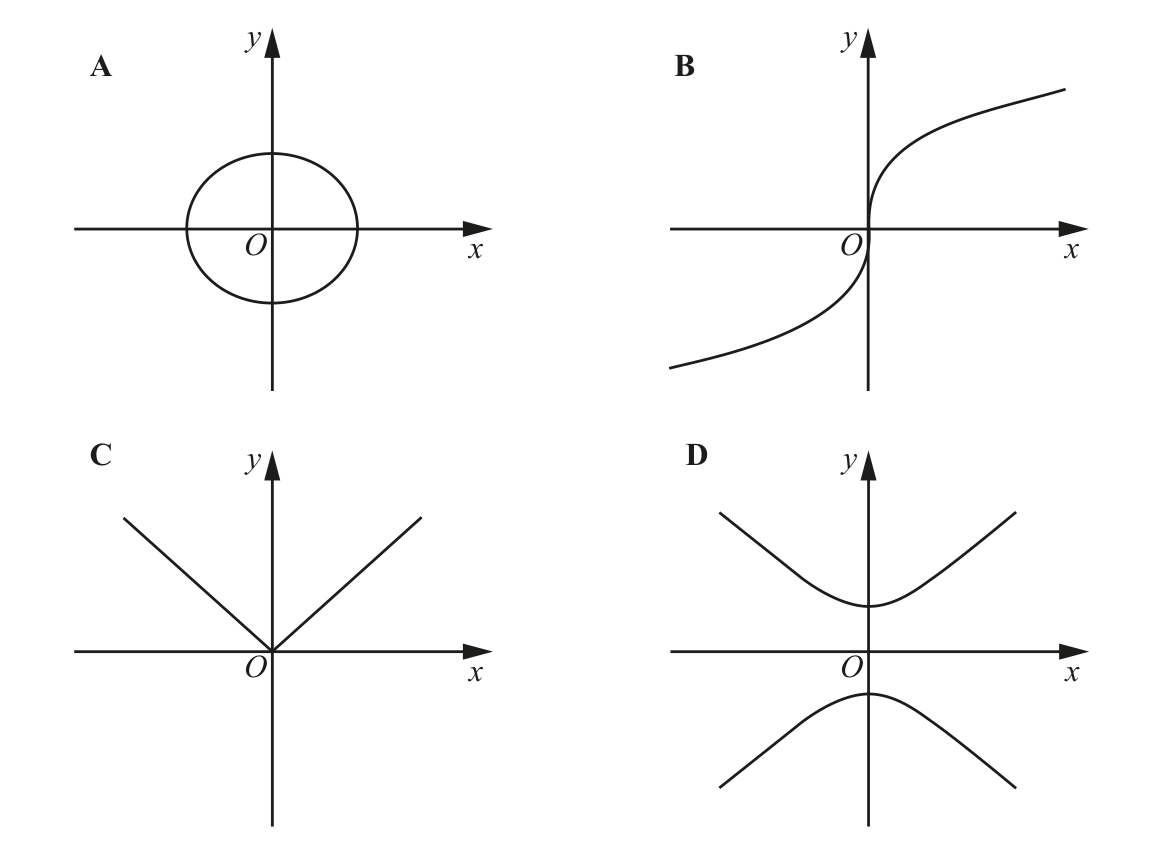
The four graphs are labelled \(A\), \(B\), \(C\) and \(D\).
(i) Write down the letter of each graph that represents a function, giving a reason for your choice.
(ii) Write down the letter of each graph that represents a function which has an inverse, giving a reason for your choice.

0606 P23 - Jun 2017 - Q9 - 9 marks
The functions \(f\) and \(g\) are defined, for \(x\gt 1\), by
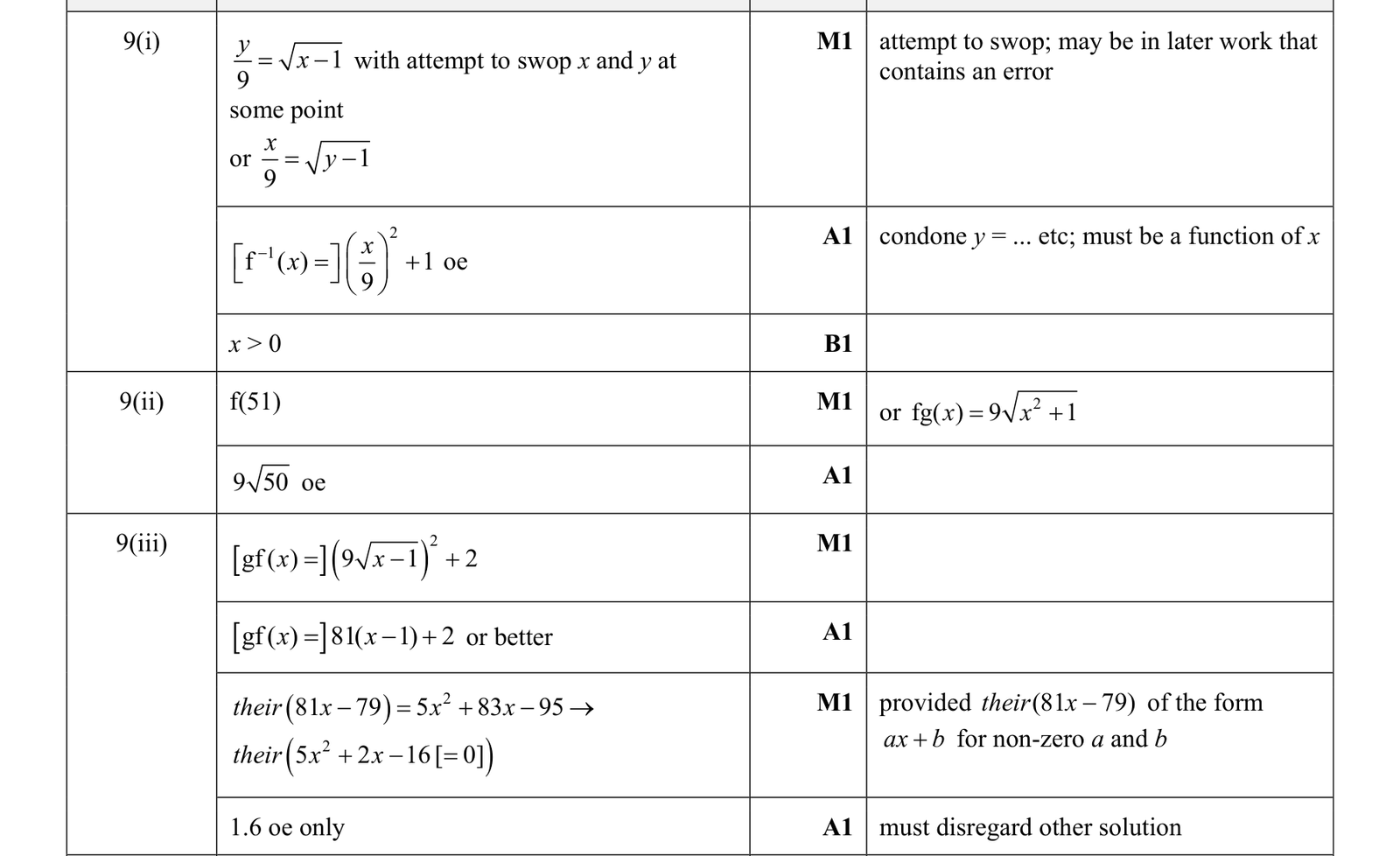
\(f(x)=9\sqrt{x-1}, \qquad g(x)=x^2+2.\)
(i) Find an expression for \(f^{-1}(x)\), stating its domain.
(ii) Find the exact value of \(fg(7)\).
(iii) Solve \(gf(x)=5x^2+83x-95\).
A1.1 — Examples and logical conclusions
Years 5-7 · Lesson 1: Examples and logical conclusions
Can three positive integers have their sum equal to their product? Give an example or prove that it is impossible.
Source: Can or Cannot? — Khamovniki, Russian Grade 6, Series 1, 20 September 2014. K1, Problem 1. Preparation-circle worksheet.
A1.2 — Examples and logical conclusions
Years 5-7 · Lesson 1: Examples and logical conclusions
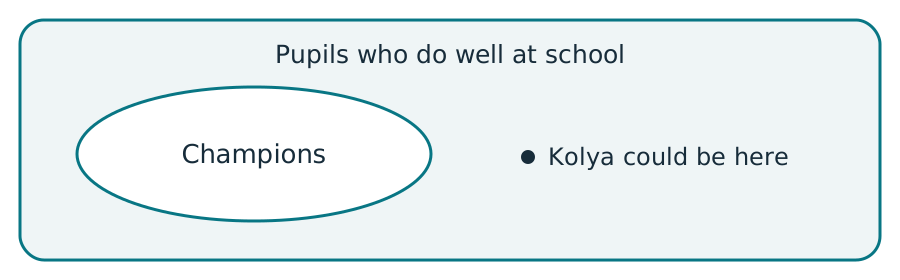
Kolya’s mother says, “Every champion does well at school.” Kolya replies, “I do well at school, so I am a champion.” Does his conclusion follow? Explain.
Source: Logic: the language of mathematics — Khamovniki, Russian Grades 5-7, Series 5, 18 October 2014. K2, Problem 1. Preparation-circle worksheet.
A1.3 — Examples and logical conclusions
Years 5-7 · Lesson 1: Examples and logical conclusions
A positive integer \(n\) is divisible by both positive integers \(a\) and \(b\). Can \(n\) fail to be divisible by \(ab\)? Give an example or a proof.
Source: Can or Cannot? — Khamovniki, Russian Grade 6, Series 1, 20 September 2014. K1, Problem 2. Preparation-circle worksheet.
A1.4 — Examples and logical conclusions
Years 5-7 · Lesson 1: Examples and logical conclusions
Some residents of a town have beautiful handwriting. No poet has beautiful handwriting, and every boxer is a poet. A visitor claims that every resident is a boxer or a poet. Can the claim be true? Explain.
Source: Logic: the language of mathematics — Khamovniki, Russian Grades 5-7, Series 5, 18 October 2014. K2, Problem 5. Preparation-circle worksheet.
A1.5 — Examples and logical conclusions
Years 5-7 · Lesson 1: Examples and logical conclusions
A zoo with both hippos and rhinos has no giraffes. Every zoo has at least a rhino or a hippo. Any zoo with hippos and giraffes also has rhinos. A particular zoo has a giraffe. Must it have a rhino? Can it have a hippo?
Source: Logic: the language of mathematics — Khamovniki, Russian Grades 5-7, Series 5, 18 October 2014. K2, Problem 6. Preparation-circle worksheet.
B1.1 — Use identities to see more
Year 10 · Lesson 1: Use identities to see more
Factor \( (2a+b)^2-(a-2b)^2 \).
B1.2 — Use identities to see more
Year 10 · Lesson 1: Use identities to see more
Let \(x+y=7\), \(xy=10\). Find \(x^2+y^2\) and \(x^3+y^3\) without finding \(x\) and \(y\) separately.
Source: Maths4U Olympiad — Symmetric Sum
B1.3 — Use identities to see more
Year 10 · Lesson 1: Use identities to see more
If \(x+y=1\), find \(x^3+y^3+3xy\).