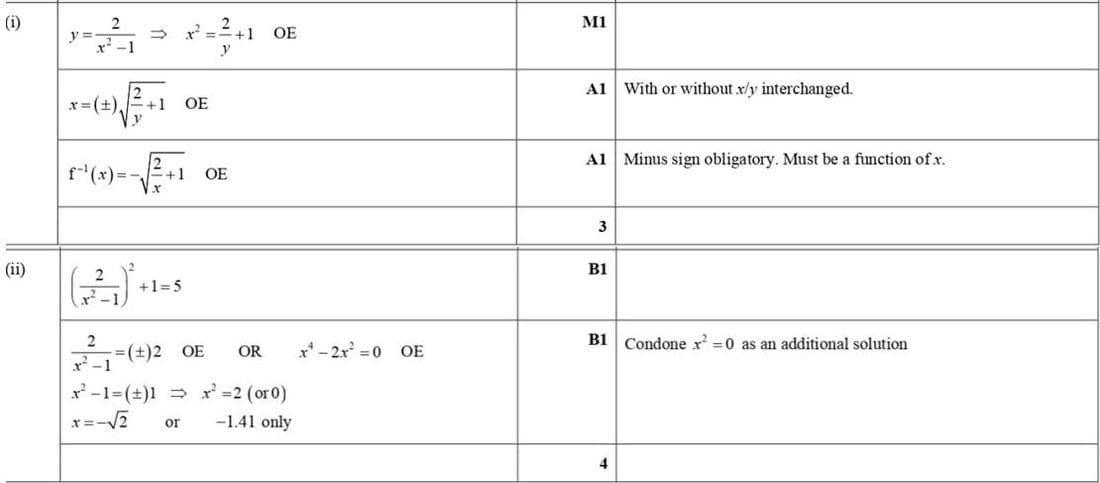
(i) Start with \(y = \frac{2}{x^2 - 1}\). Rearrange to get \(x^2 = \frac{2}{y} + 1\).
Solving for \(x\), we have \(x = \pm \sqrt{\frac{2}{y} + 1}\).
Since \(x < -1\), we take the negative root: \(x = -\sqrt{\frac{2}{y} + 1}\).
Thus, \(f^{-1}(x) = -\frac{\sqrt{2}}{\sqrt{x} + 1}\).
(ii) Solve \(gf(x) = 5\), which means \(g\left(\frac{2}{x^2 - 1}\right) = 5\).
Substitute \(g(x) = x^2 + 1\): \(\left(\frac{2}{x^2 - 1}\right)^2 + 1 = 5\).
This simplifies to \(\left(\frac{2}{x^2 - 1}\right)^2 = 4\).
Thus, \(\frac{2}{x^2 - 1} = \pm 2\).
For \(\frac{2}{x^2 - 1} = 2\), solve \(x^2 - 1 = 1\), giving \(x^2 = 2\) or \(x = \pm \sqrt{2}\).
For \(\frac{2}{x^2 - 1} = -2\), solve \(x^2 - 1 = -1\), giving \(x^2 = 0\) or \(x = 0\).
Since \(x < -1\), the valid solutions are \(x = -\sqrt{2}\) or \(x = -1.41\) only.