The functions f and g are defined by
\(f(x) = x^2 + 3\) for \(x > 0\),
\(g(x) = 2x + 1\) for \(x > -\frac{1}{2}\).
(a) Find an expression for \(fg(x)\).
(b) Find an expression for \((fg)^{-1}(x)\) and state the domain of \((fg)^{-1}\).
(c) Solve the equation \(fg(x) - 3 = gf(x)\).
Solution
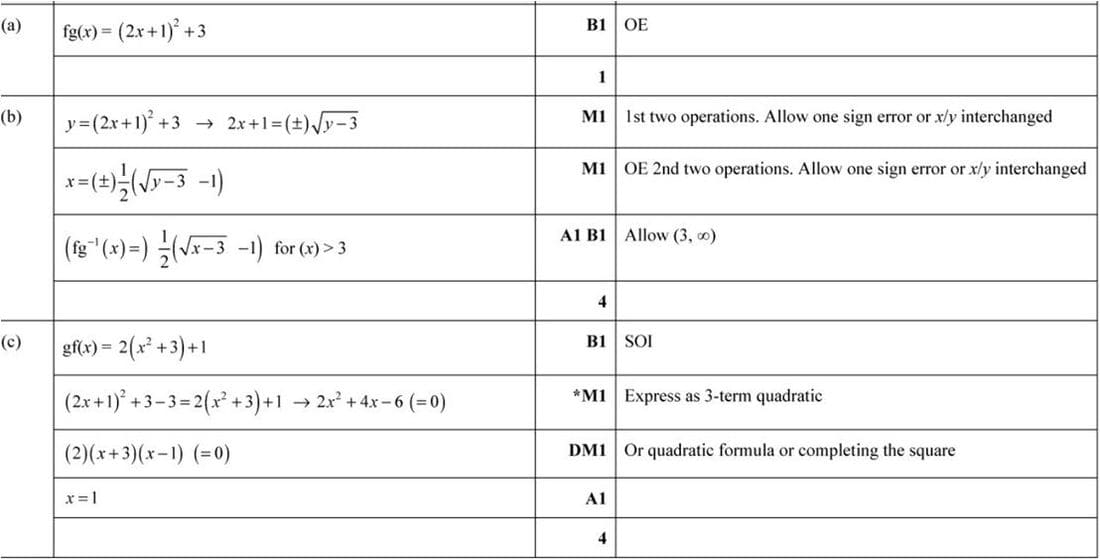
(a) To find \(fg(x)\), substitute \(g(x) = 2x + 1\) into \(f(x)\):
\(fg(x) = f(g(x)) = (2x+1)^2 + 3\).
(b) Let \(y = (2x+1)^2 + 3\). Solve for \(x\):
\(y - 3 = (2x+1)^2\)
\(2x+1 = \pm \sqrt{y-3}\)
\(x = \frac{1}{2}(\pm \sqrt{y-3} - 1)\)
Since \(x > 0\), choose the positive root:
\((fg)^{-1}(x) = \frac{1}{2}(\sqrt{x-3} - 1)\)
The domain of \((fg)^{-1}\) is \(x > 3\).
(c) Solve \(fg(x) - 3 = gf(x)\):
\((2x+1)^2 + 3 - 3 = 2(x^2+3) + 1\)
\((2x+1)^2 = 2x^2 + 6 + 1\)
\(4x^2 + 4x + 1 = 2x^2 + 7\)
\(2x^2 + 4x - 6 = 0\)
\(2(x+3)(x-1) = 0\)
\(x = 1\)
Log in to record attempts.