Past Exam Questions
← Back0606 P22 - Jun 2018 - Q10 - 7 marks
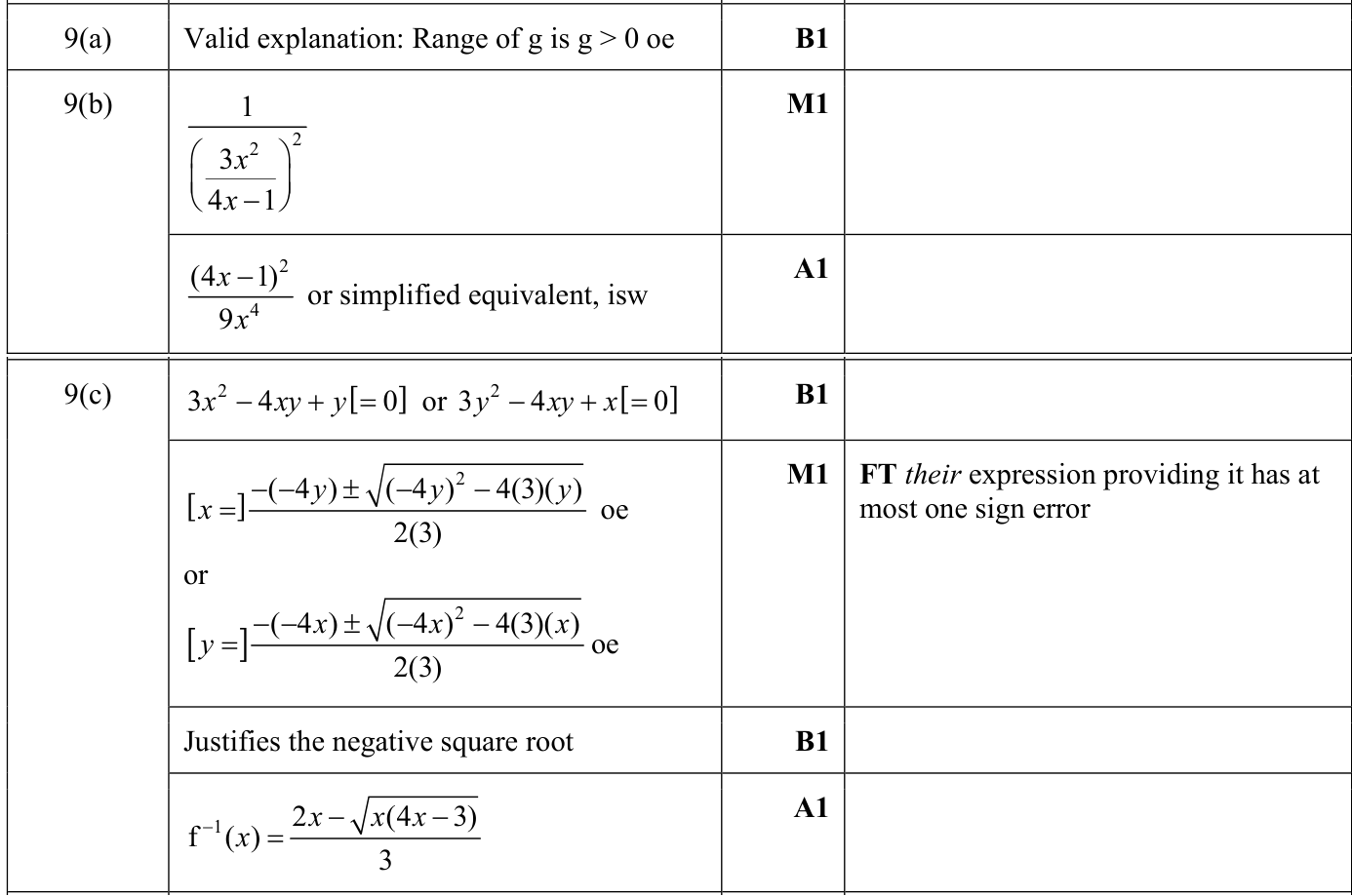
(a)(i) Sketch the graph of \(y=|(x+3)(x-5)|\), showing the coordinates of the points where the curve meets the \(x\)-axis.
(a)(ii) Write down a suitable domain for the function \(f(x)=|(x+3)(x-5)|\) such that \(f\) has an inverse.
(b) The functions \(g\) and \(h\) are defined by
\(g(x)=3x-1\quad\text{for }x\gt 1, \qquad h(x)=\frac4x\quad\text{for }x\ne0.\)
(i) Find \(hg(x)\).
(ii) Find \((hg)^{-1}(x)\).
(c) Given that \(p(a)=b\) and that \(p\) has an inverse, write down \(p^{-1}(b)\).
0606 P23 - Jun 2025 - Q4 - 8 marks
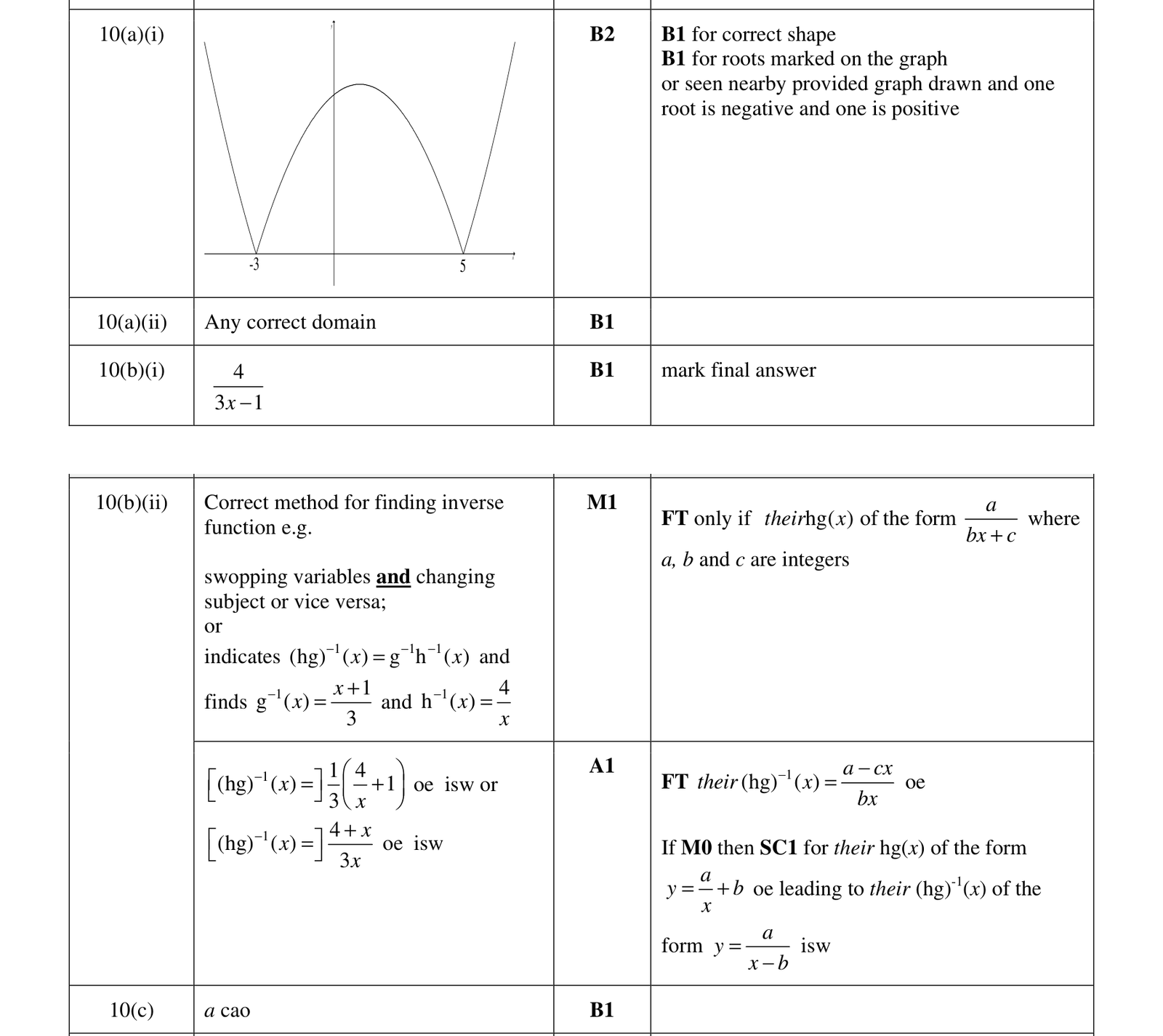
The function f is defined by \(\mathrm{f}(x)=2 x-1\) for \(x \in \mathbb{R}\). (a) Explain why the function \(\mathrm{f}^{2}\) can be formed.
(b) On the axes, sketch the graph of \(y=\left|\mathrm{f}^{2}(x)\right|\).
State any intercepts with the coordinate axes.
(c) It is given that \(\left|\mathrm{f}^{2}(x)\right| \leqslant a x+b\) for \(-1 \leqslant x \leqslant 3\) and for no other values of \(x\).
Find the values of \(a\) and \(b\).
0606 P21 - Jun 2024 - Q1 - 5 marks
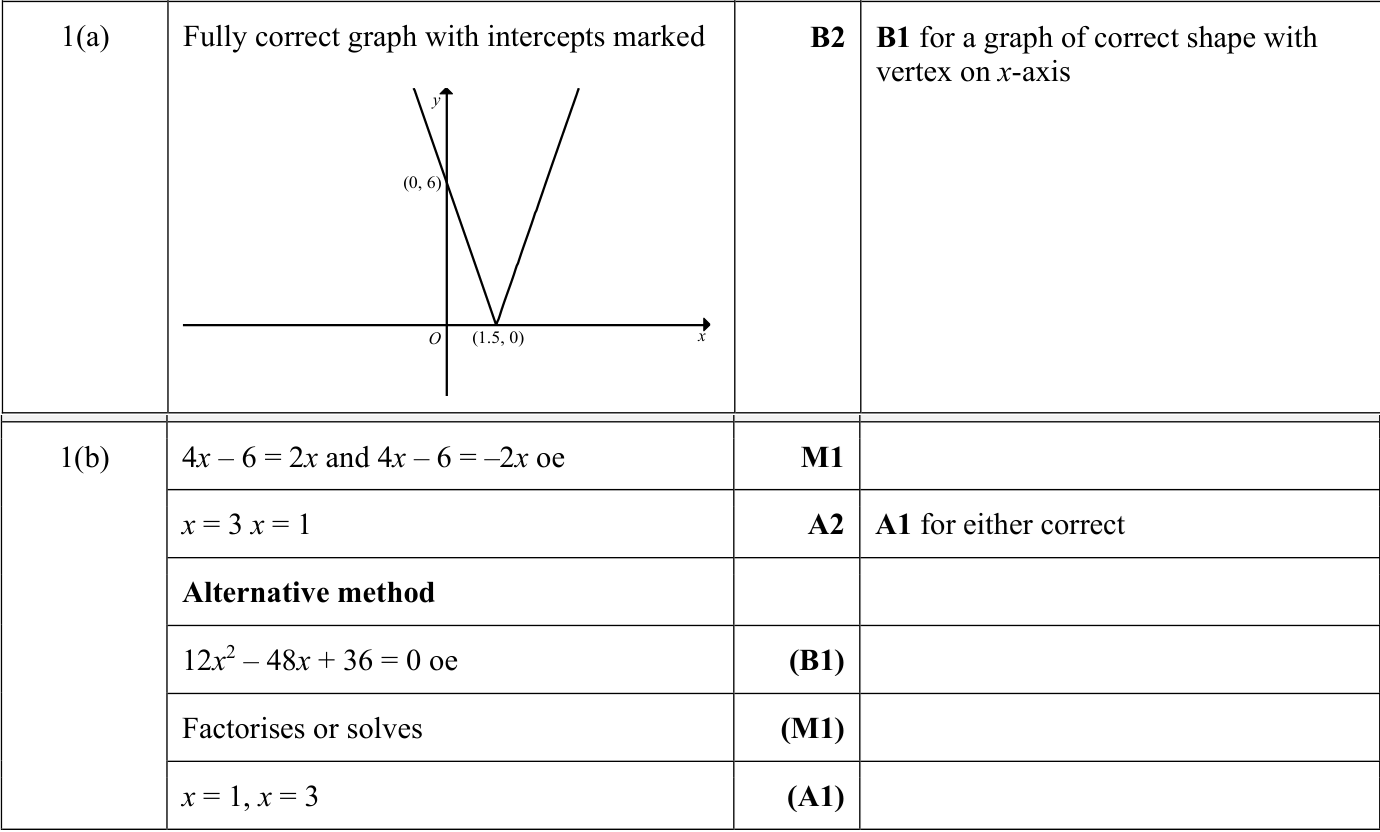
(a) On the axes, sketch the graph of \(y=|4 x-6|\), showing the points where the graph meets the axes.
(b) Solve the equation \(|4 x-6|=|2 x|\).
0606 P22 - Jun 2022 - Q2 - 5 marks
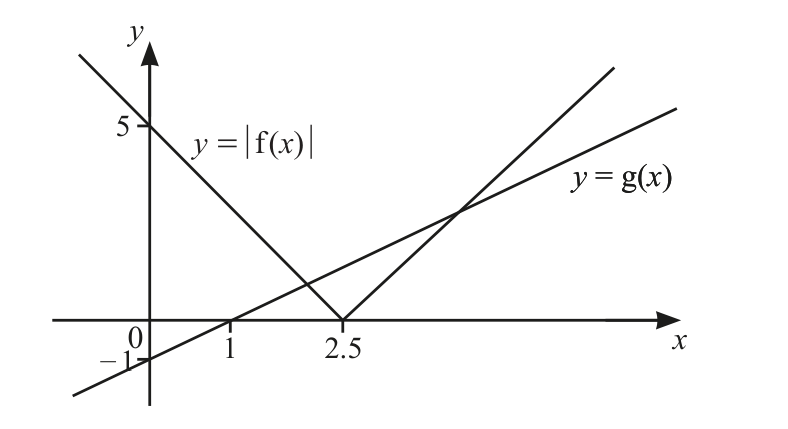
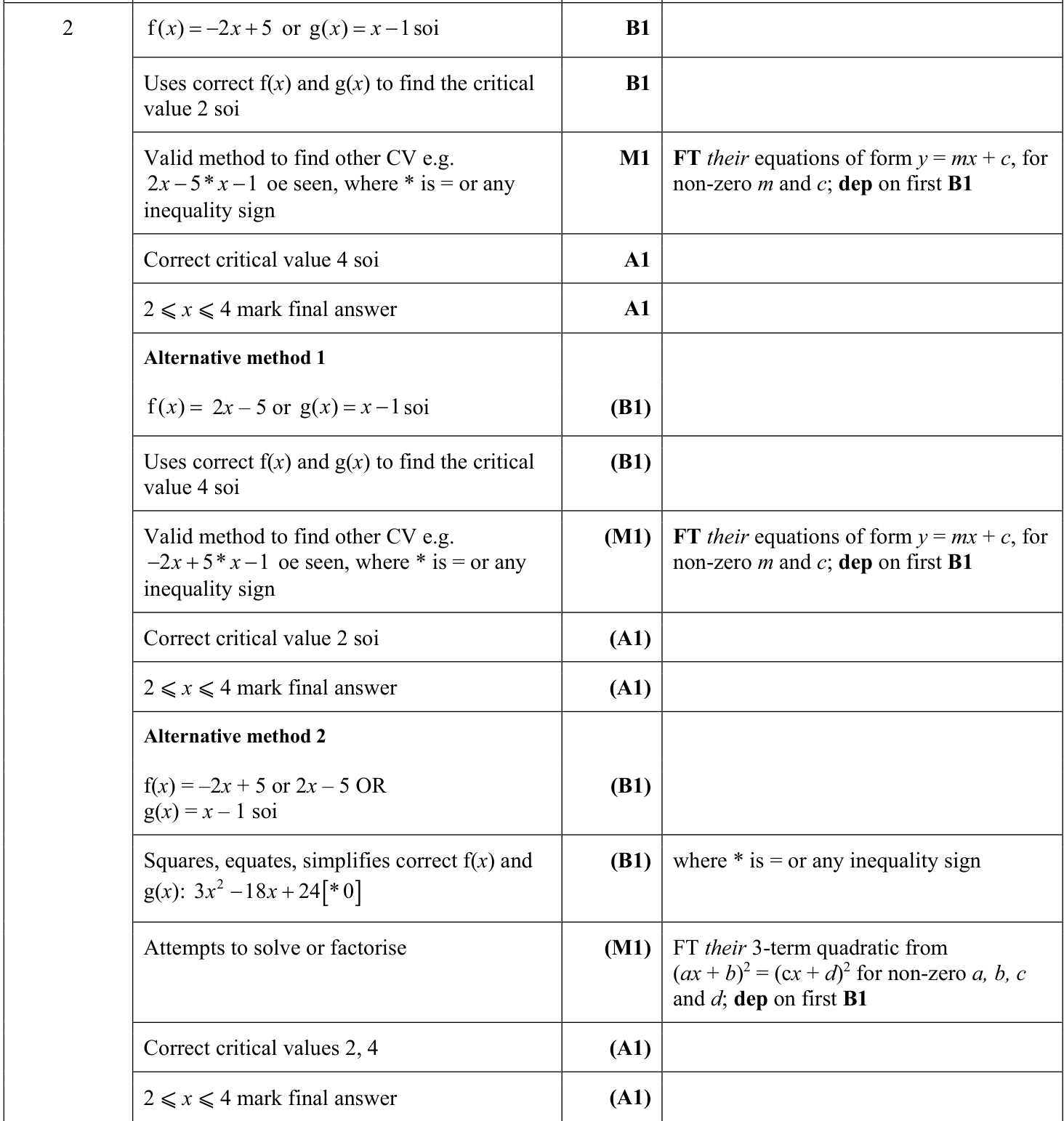
The diagram shows the graphs of \(y=|f(x)|\) and \(y=g(x)\), where \(y=f(x)\) and \(y=g(x)\) are straight lines. Solve the inequality \(|f(x)|\le g(x)\).
0606 P11 - Nov 2022 - Q1 - 6 marks
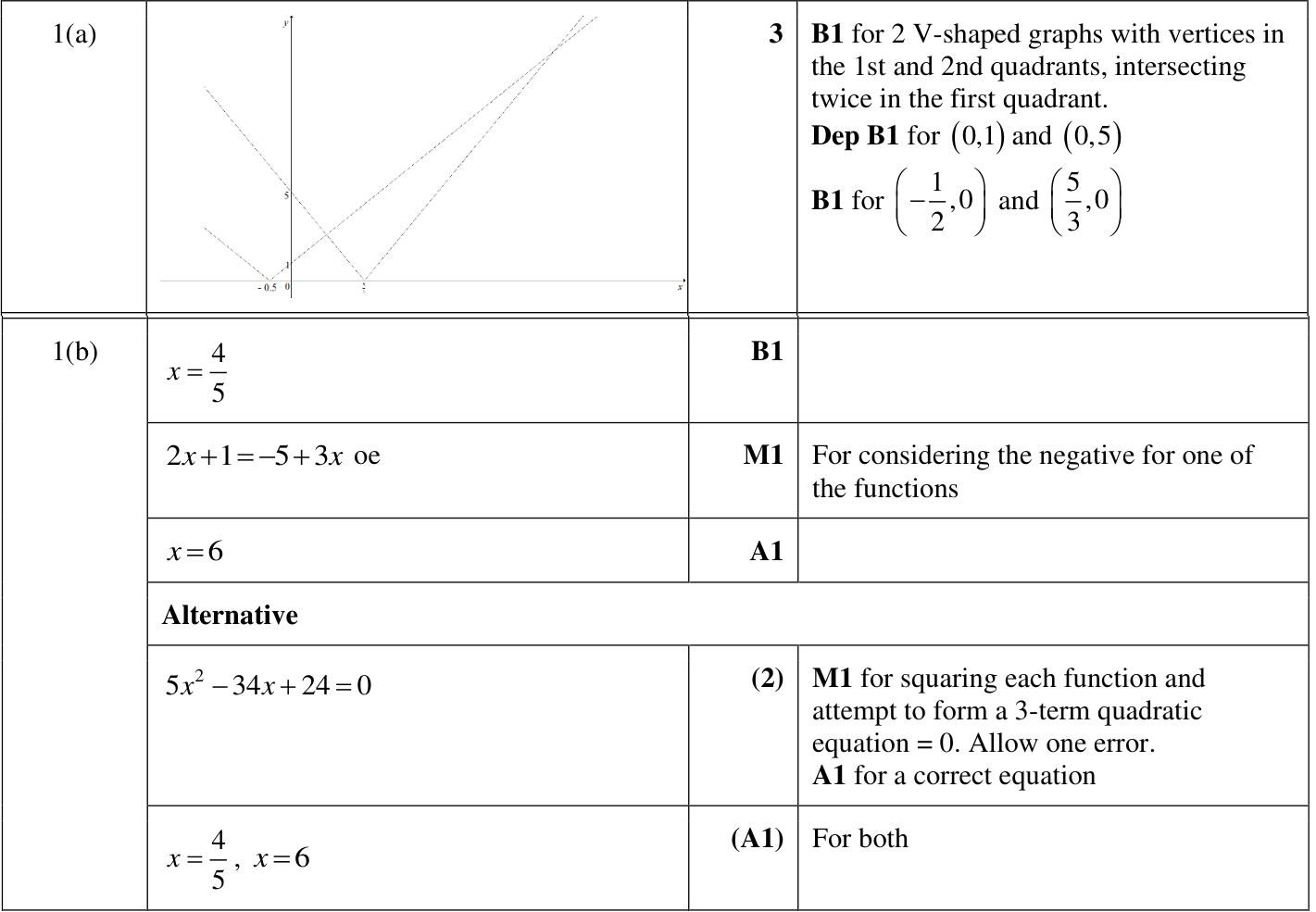
(a) On the axes, sketch the graphs of
\(y=\left|2x+1\right|\quad\text{and}\quad y=\left|5-3x\right|\)
for \(-2\leq x\leq 8\). State the coordinates of the points where these graphs meet the coordinate axes.
(b) Solve the equation
\(\left|2x+1\right|=\left|5-3x\right|.\)
0606 P22 - Nov 2021 - Q1 - 6 marks
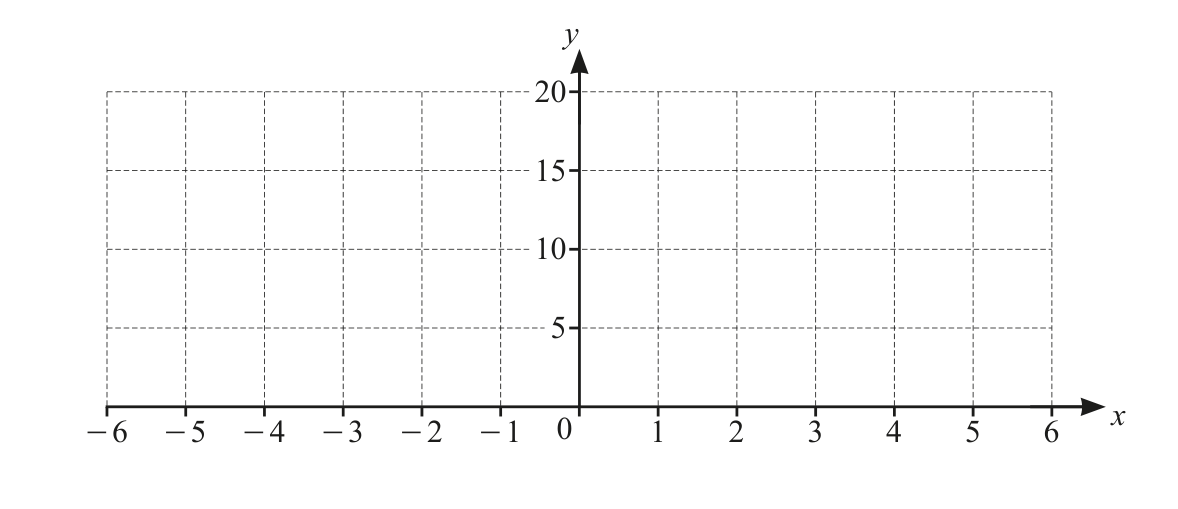
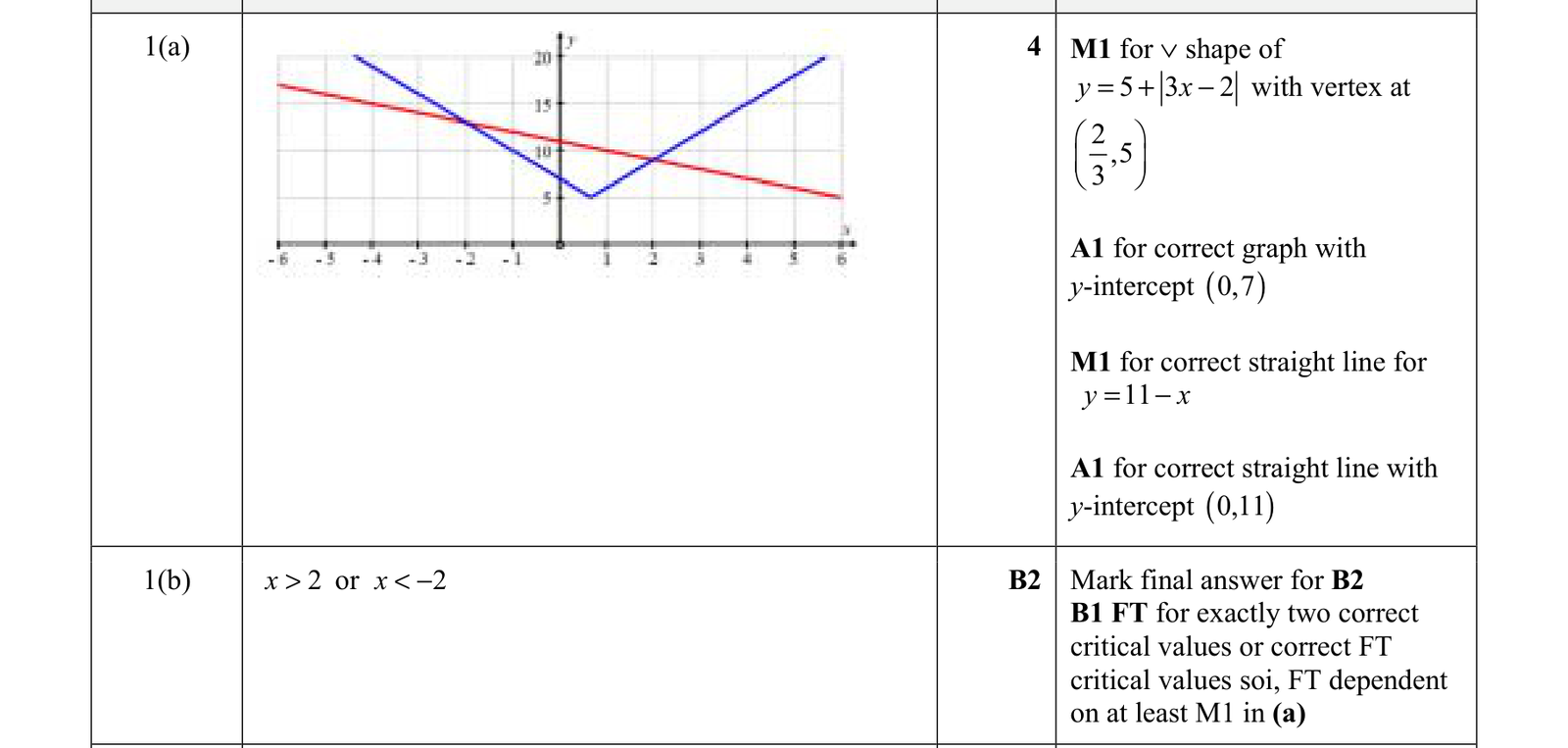
(a) On the axes, draw the graphs of
\(y=5+|3x-2|\quad\text{and}\quad y=11-x.\)
(b) Using the graphs, or otherwise, solve the inequality
\(11-x\lt 5+|3x-2|.\)
0606 P23 - Nov 2021 - Q1 - 6 marks
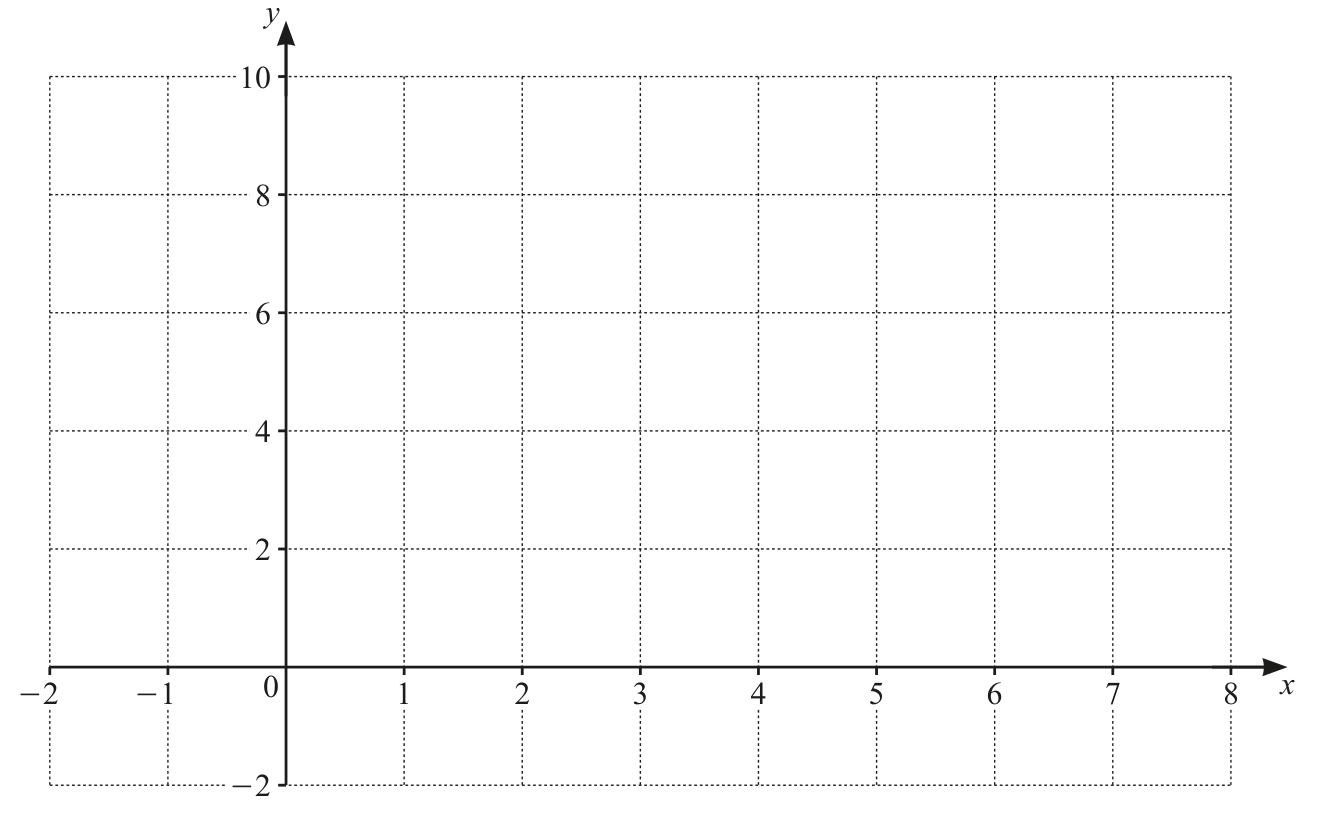
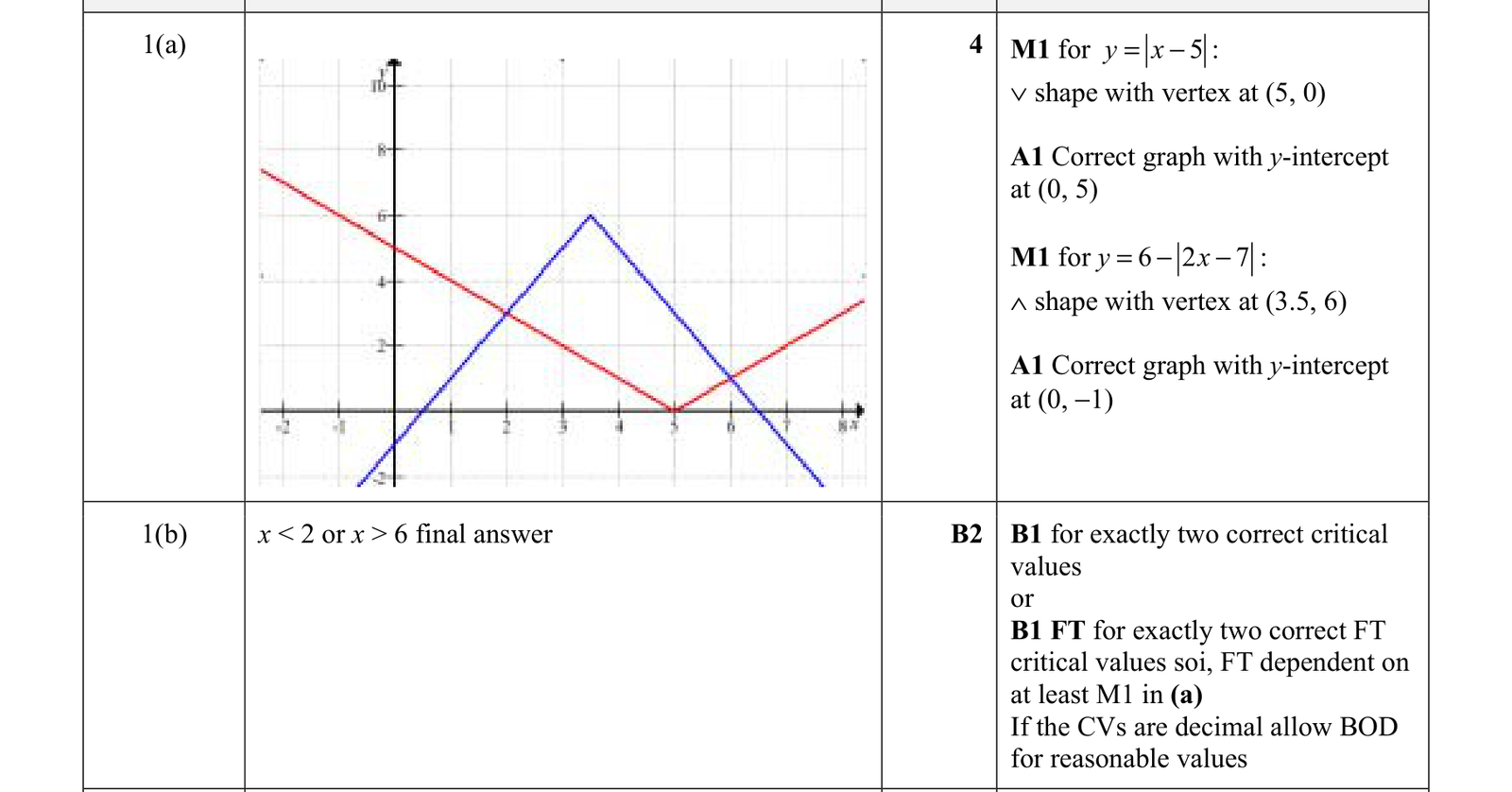
(a) On the axes draw the graphs of
\(y=|x-5|\quad\text{and}\quad y=6-|2x-7|.\)
(b) Use your graphs to solve the inequality
\(|x-5|\gt 6-|2x-7|.\)
0606 P22 - Mar 2020 - Q5 - 6 marks
The function \(f\) is defined by
\(f(x)=|5x-7|.\)
(a) Sketch the graph of \(y=f(x)\), showing the coordinates of the points where the graph meets the axes.
(b) Solve the equation
\(5|5x-7|-1=14.\)

0606 P21 - Jun 2019 - Q3 - 6 marks
(i) Sketch the graph of \(y=|5x-3|\), showing the coordinates of the points where the graph meets the coordinate axes.
(ii) Solve the equation \(|5x-3|=2-x\).
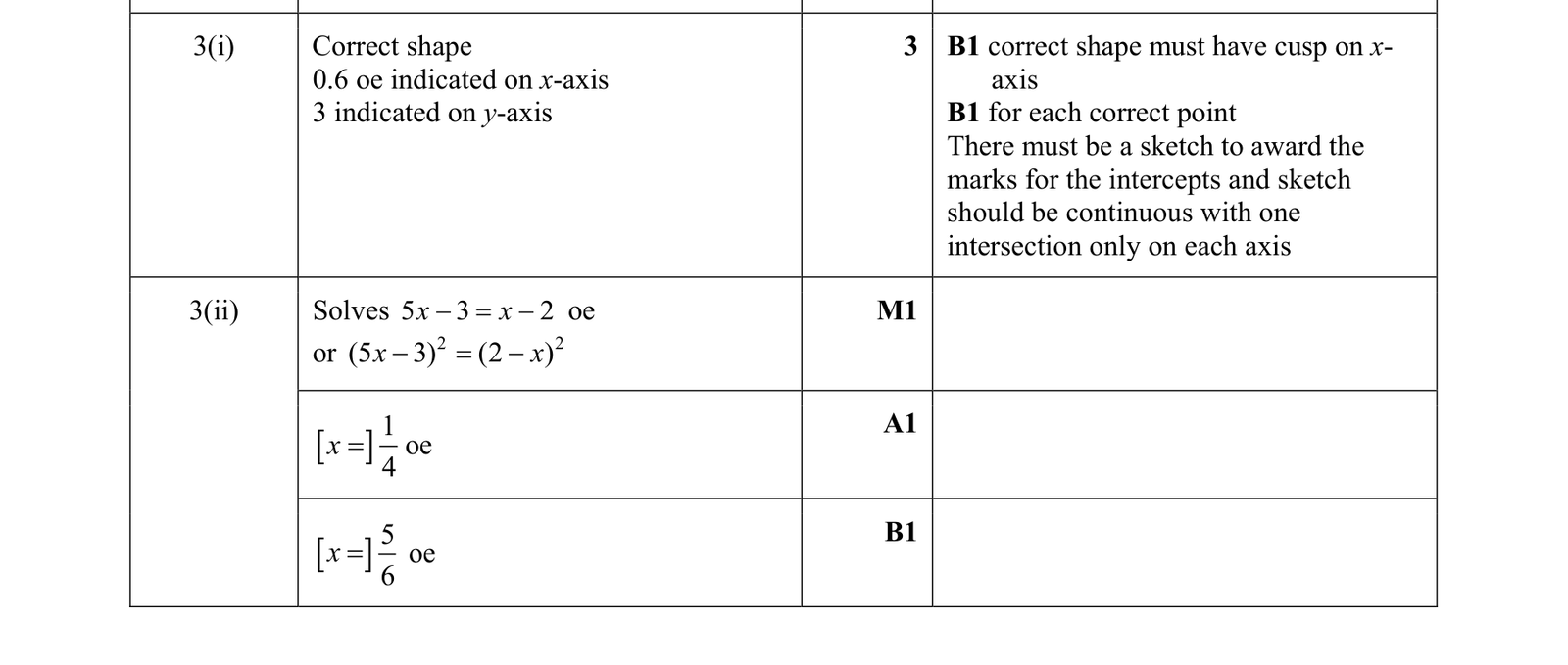
0606 P21 - Nov 2019 - Q1 - 5 marks
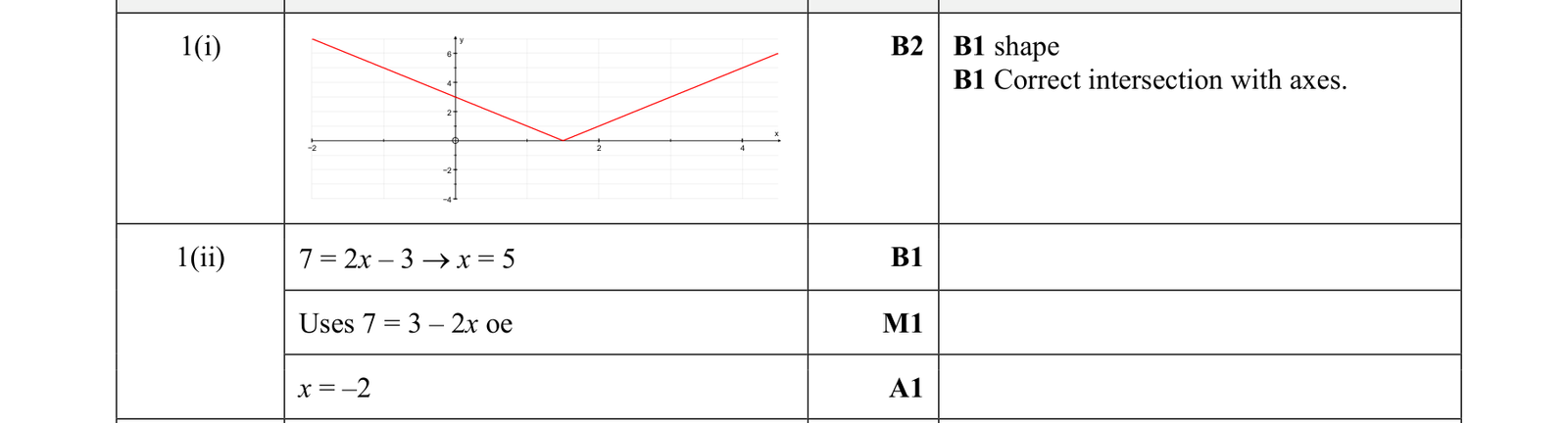
(i) Draw the graph of
\(y=|2x-3|.\)
(ii) Solve the equation
\(7-|2x-3|=0.\)
0606 P12 - Nov 2018 - Q3 - 6 marks
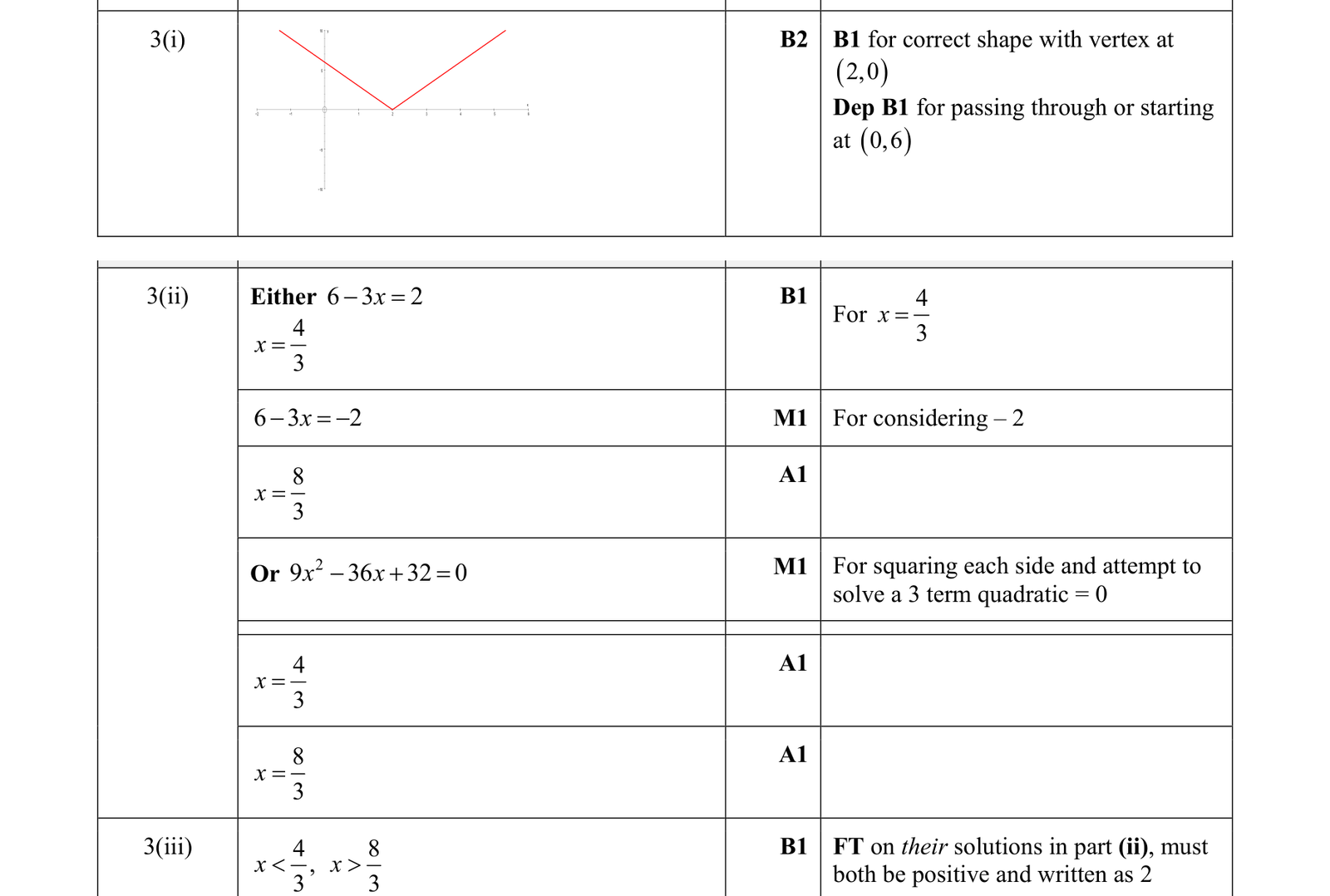
(i) Sketch the graph of \(y=\left|6-3x\right|\), showing the coordinates of the points where the graph meets the coordinate axes.
(ii) Solve \(\left|6-3x\right|=2\).
(iii) Hence find the values of \(x\) for which \(\left|6-3x\right|\gt 2\).
0606 P11 - Jun 2017 - Q8 - 11 marks
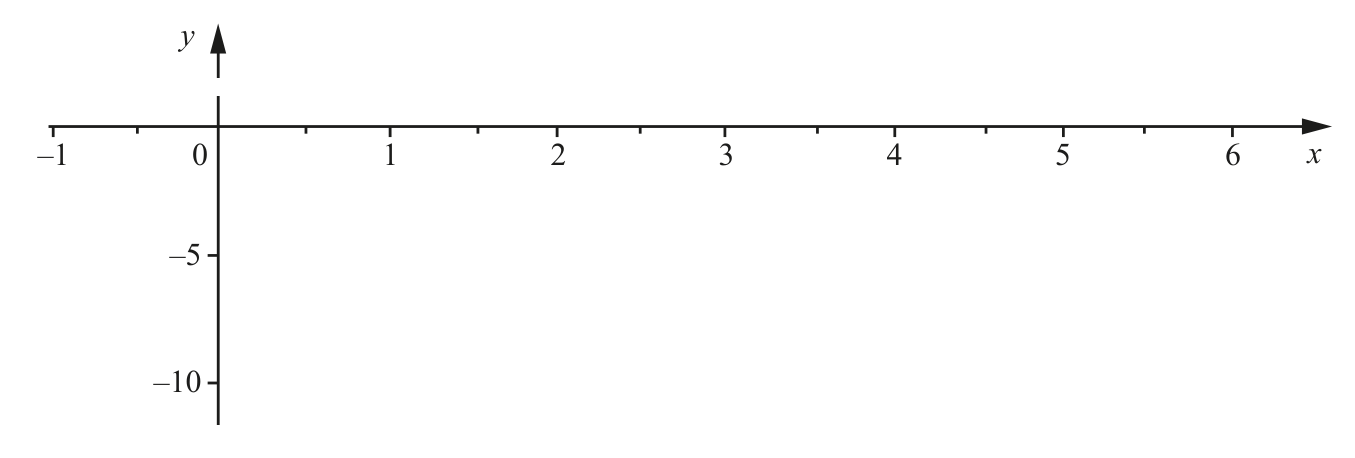
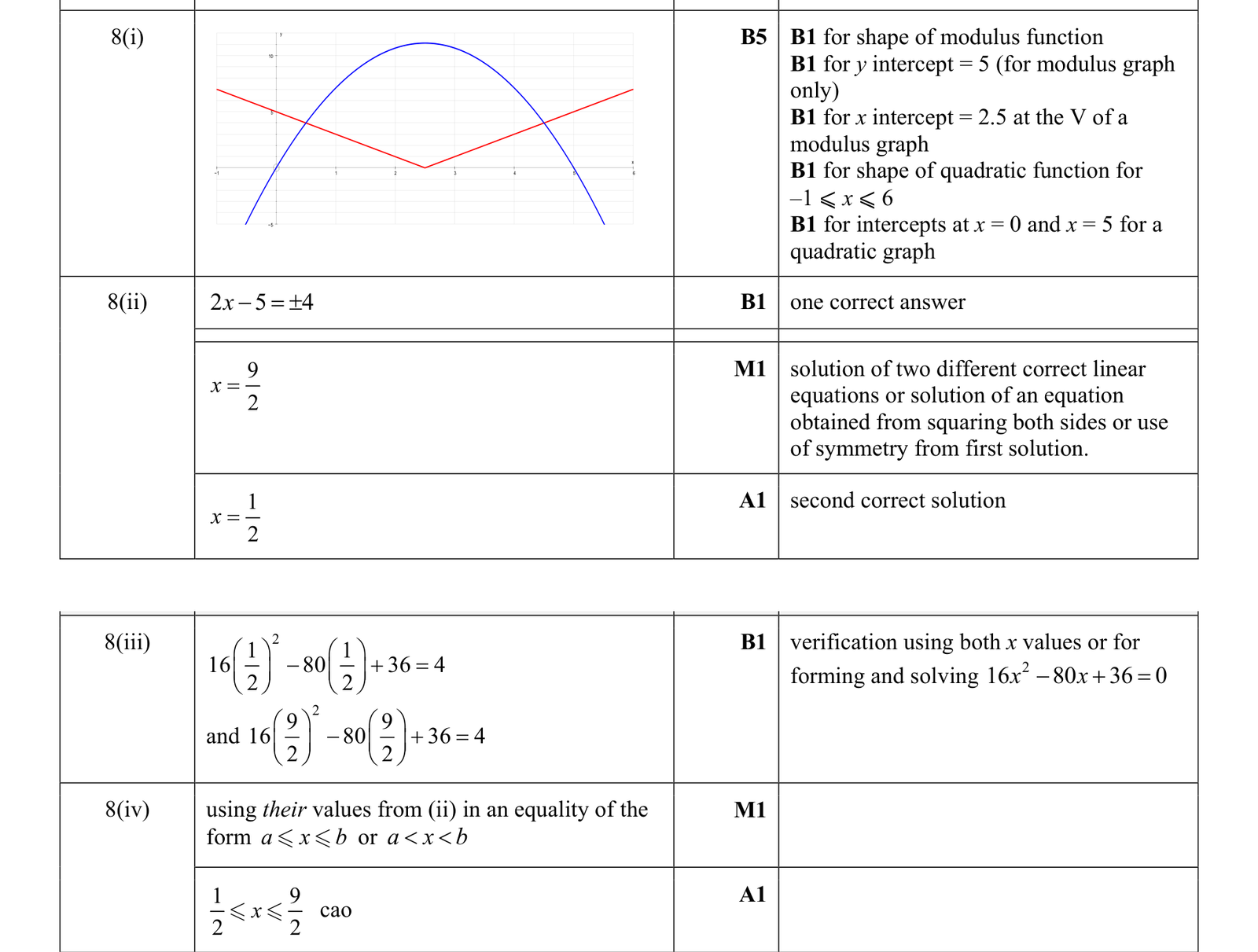
(i) On the axes, sketch the graphs of \(y=|2x-5|\) and \(9y=80x-16x^2\).
(ii) Solve \(|2x-5|=4\).
(iii) Hence show that the graphs of \(y=|2x-5|\) and \(9y=80x-16x^2\) intersect at the points where \(y=4\).
(iv) Hence find the values of \(x\) for which \(9|2x-5|\le 80x-16x^2\).
0606 P23 - Nov 2025 - Q2 - 10 marks
(a) (i)
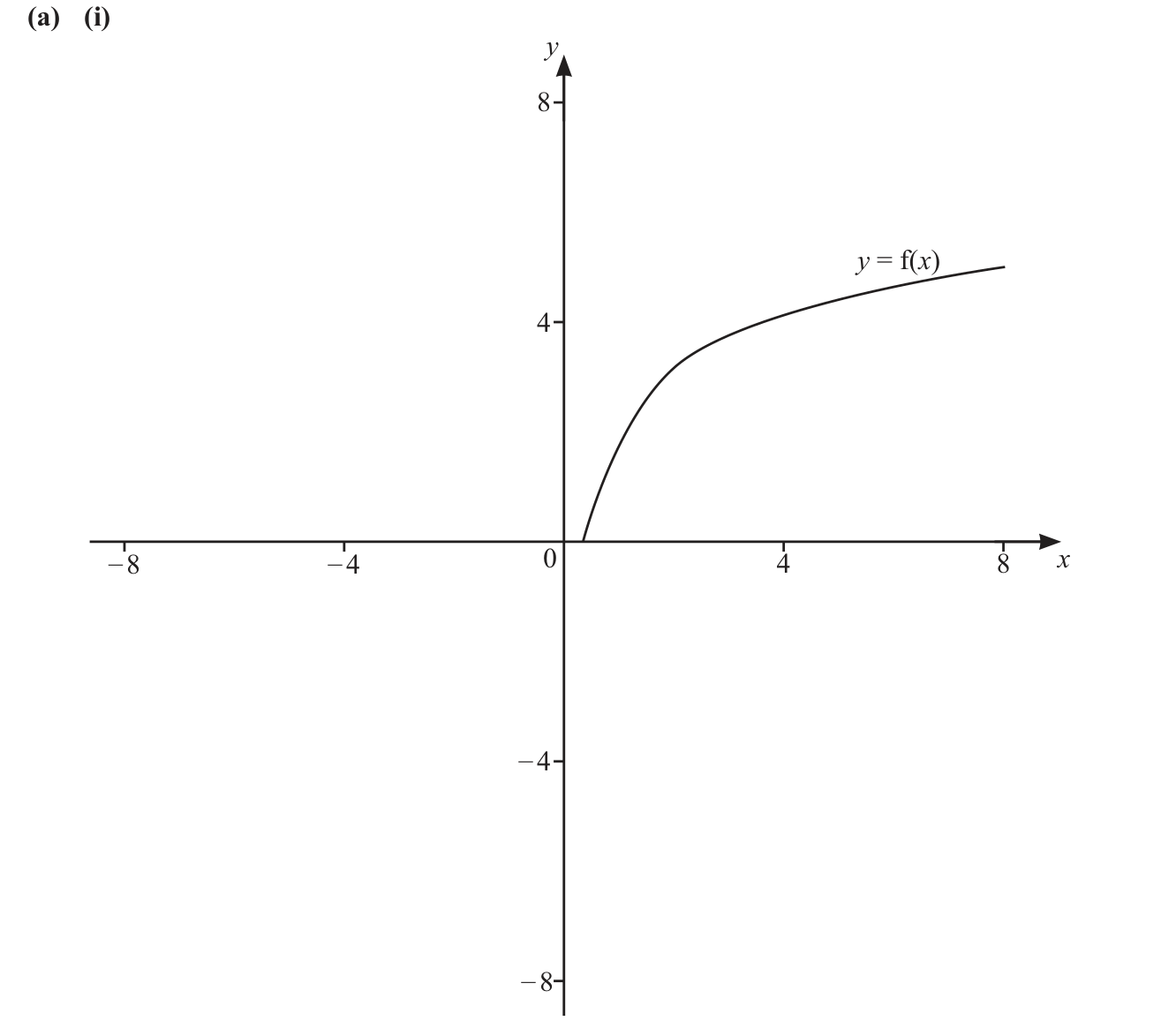
The diagram shows the graph of \(y=\mathrm{f}(x)\).
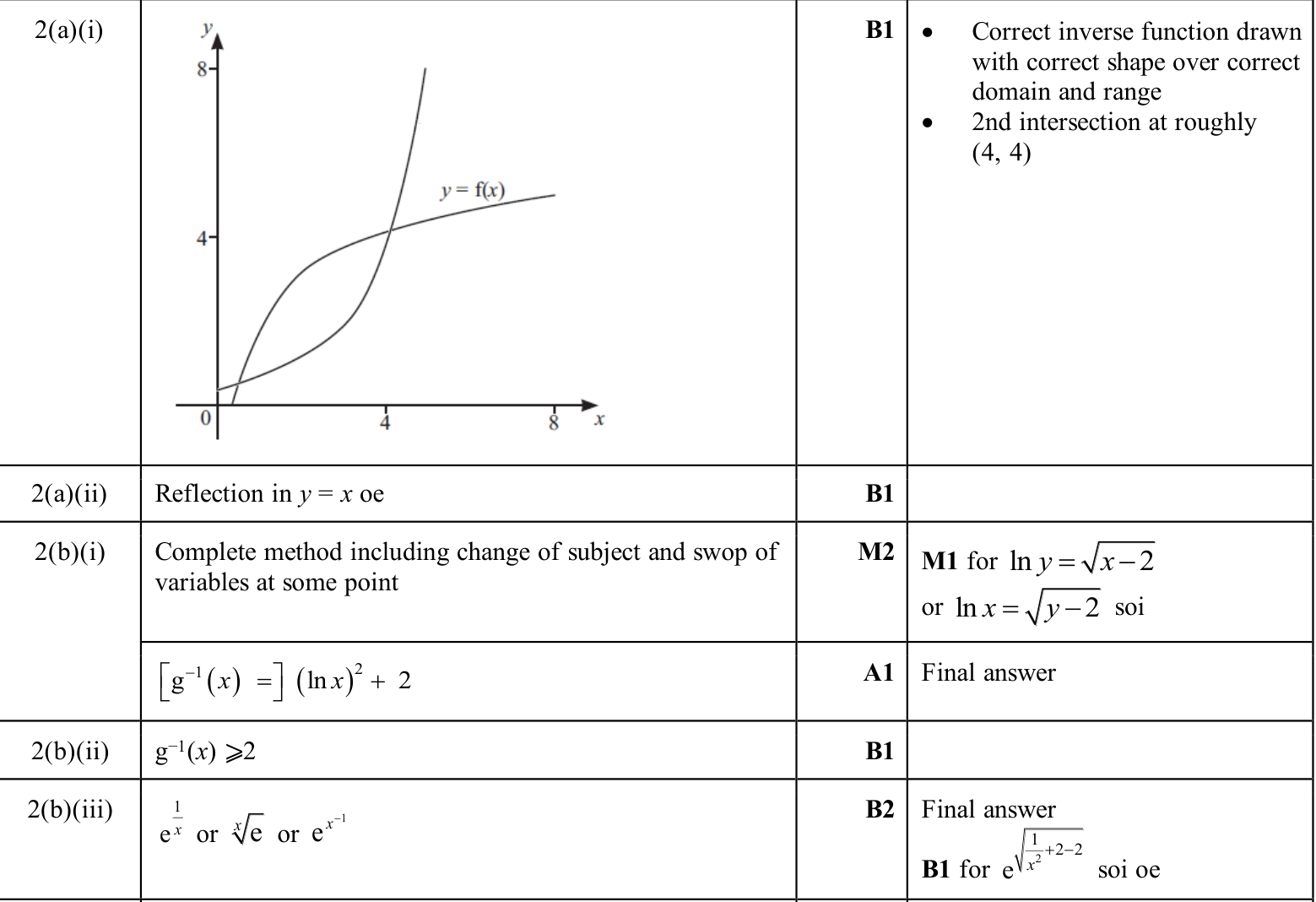
On the same diagram sketch the graph of \(y=\mathrm{f}^{-1}(x)\).
(ii) Describe the relationship between the graph of \(\mathrm{f}(x)\) and the graph of \(\mathrm{f}^{-1}(x)\).
(b) A function g is defined by \(\mathrm{g}(x)=\mathrm{e}^{\sqrt{x-2}}\) for \(x \geqslant 2\).
(i) Find an expression for \(\mathrm{g}^{-1}(x)\).
(ii) Write down the range of \(\mathrm{g}^{-1}\).
(iii) A function h is defined by \(\mathrm{h}(x)=\frac{1}{x^{2}}+2\) for \(x\gt 0\).
Find an expression for \(\operatorname{gh}(x)\) in its simplest form.
0606 P12 - Jun 2025 - Q9 - 8 marks
It is given that \(\mathrm{f}(x)=2\ln(3x-4)\), for \(x\gt a\), and that \(\mathrm{f}^{-1}\) exists.
(a) Find the least possible value of \(a\).
(b) For your value of \(a\), find the range of \(\mathrm{f}\).
(c) For your value of \(a\), find an expression for \(\mathrm{f}^{-1}(x)\).
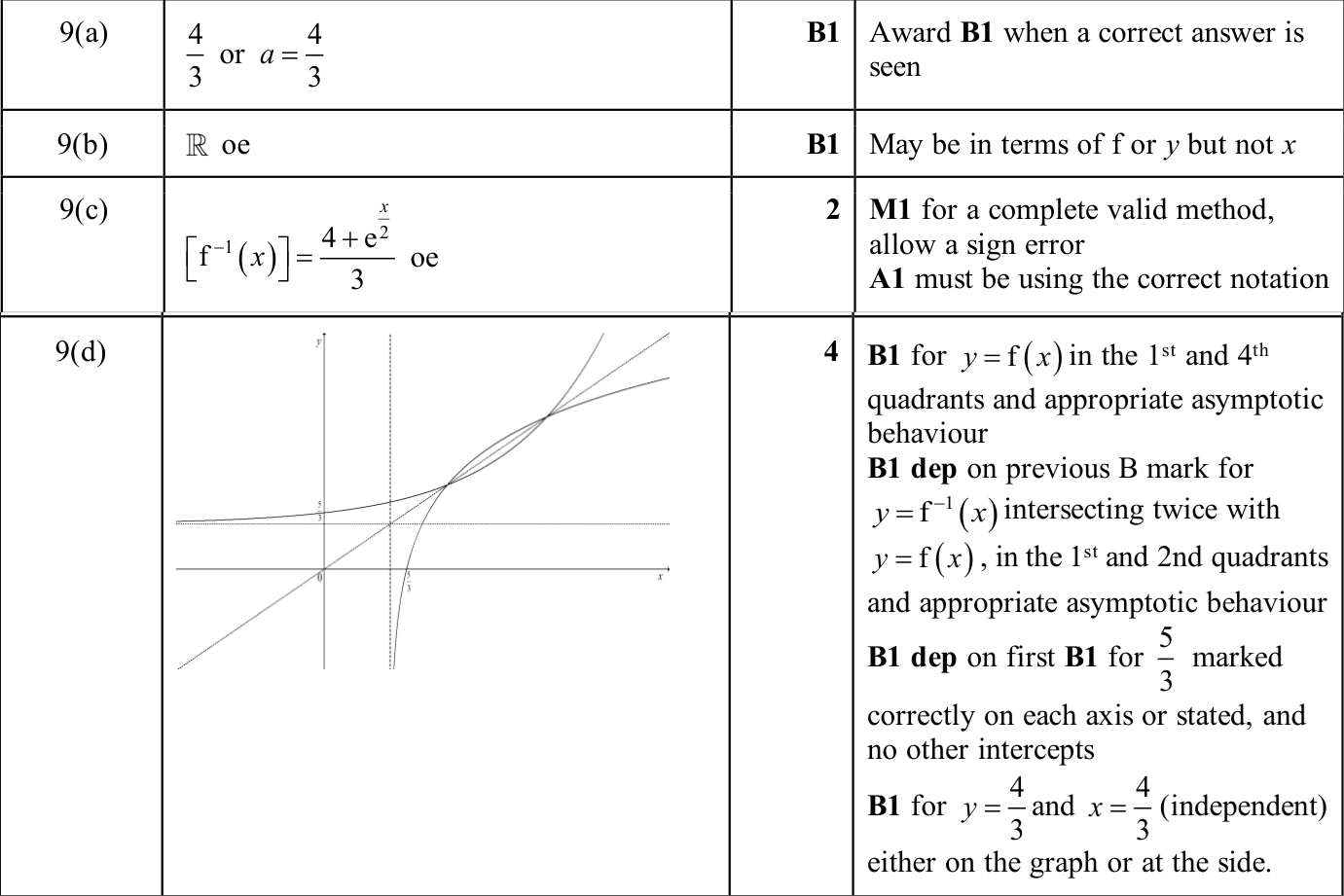
(d) It is given that the equation \(\mathrm{f}(x)=\mathrm{f}^{-1}(x)\) has two roots. For your value of \(a\), sketch the graphs of \(y=\mathrm{f}(x)\) and \(y=\mathrm{f}^{-1}(x)\) on the axes. Label each graph. State the intercepts of each graph with the axes. State the equations of any asymptotes.
0606 P13 - Jun 2025 - Q9 - 12 marks
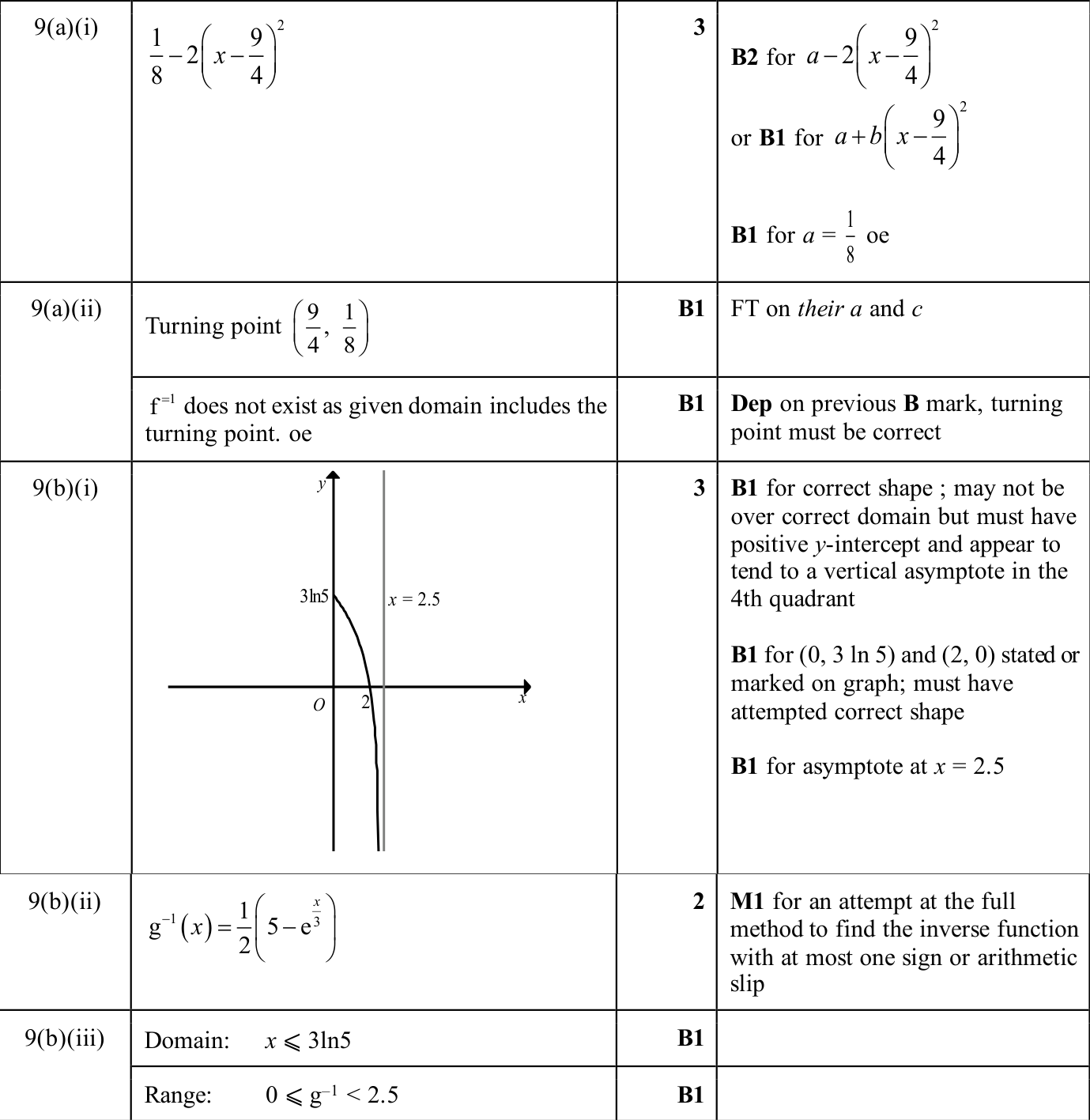
The function f is defined by \(\mathrm{f}(x)=-2 x^{2}+9 x-10\) for \(0 \leqslant x \leqslant 3\). (a) (i) Write \(\mathrm{f}(x)\) in the form \(a+b(x+c)^{2}\) where \(a, b\) and \(c\) are constants.
(ii) Hence determine whether or not \(\mathrm{f}^{-1}\) exists.
(b) The function g is defined by \(\mathrm{g}(x)=3 \ln (5-2 x)\) for \(0 \leqslant x\lt 2.5\). (i) On the axes, sketch the graph of \(y=\mathrm{g}(x)\).
State the exact values of the intercepts with the coordinate axes and the equation of any asymptote.
(ii) Find an expression for \(\mathrm{g}^{-1}(x)\).
(iii) Find the domain and range of \(\mathrm{g}^{-1}\).
Give each of your answers in exact form.
0606 P21 - Jun 2025 - Q7 - 8 marks
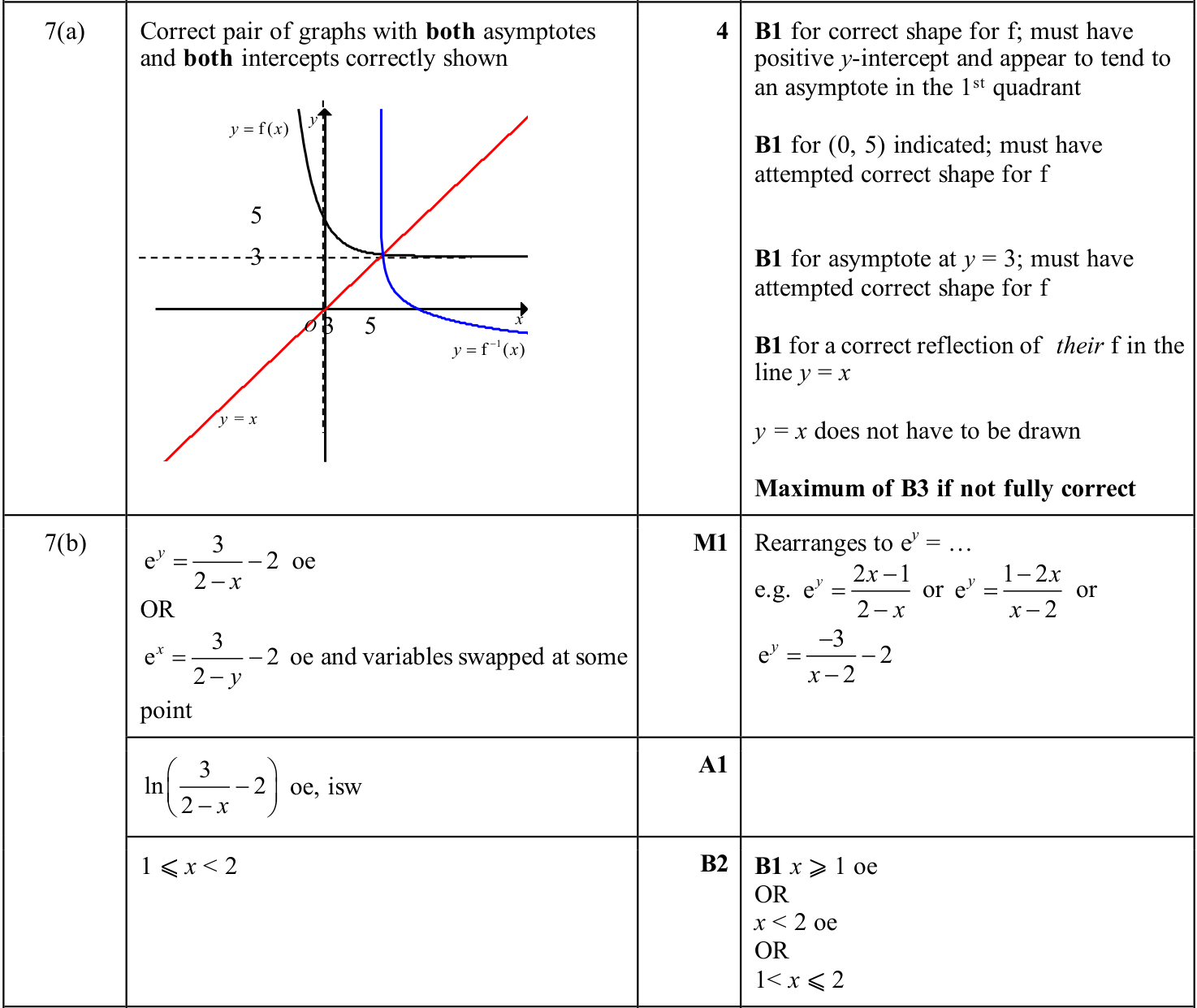
(a) The function f is defined by \(\mathrm{f}(x)=2 \mathrm{e}^{-x}+3\) for \(x \in \mathbb{R}\). On the axes, sketch the graph of \(y=\mathrm{f}(x)\) and hence, on the same axes, sketch the graph of \(y=\mathrm{f}^{-1}(x)\). Show clearly - the positions of any points where your graphs meet the coordinate axes - the positions of any asymptotes.
(b) The function g is defined by \(\mathrm{g}(x)=2-\frac{3}{\mathrm{e}^{x}+2}\) for \(x \geqslant 0\).
Given that \(\mathrm{g}^{-1}\) exists, find an expression for \(\mathrm{g}^{-1}(x)\) and state its domain.
0606 P12 - Mar 2025 - Q5 - 8 marks
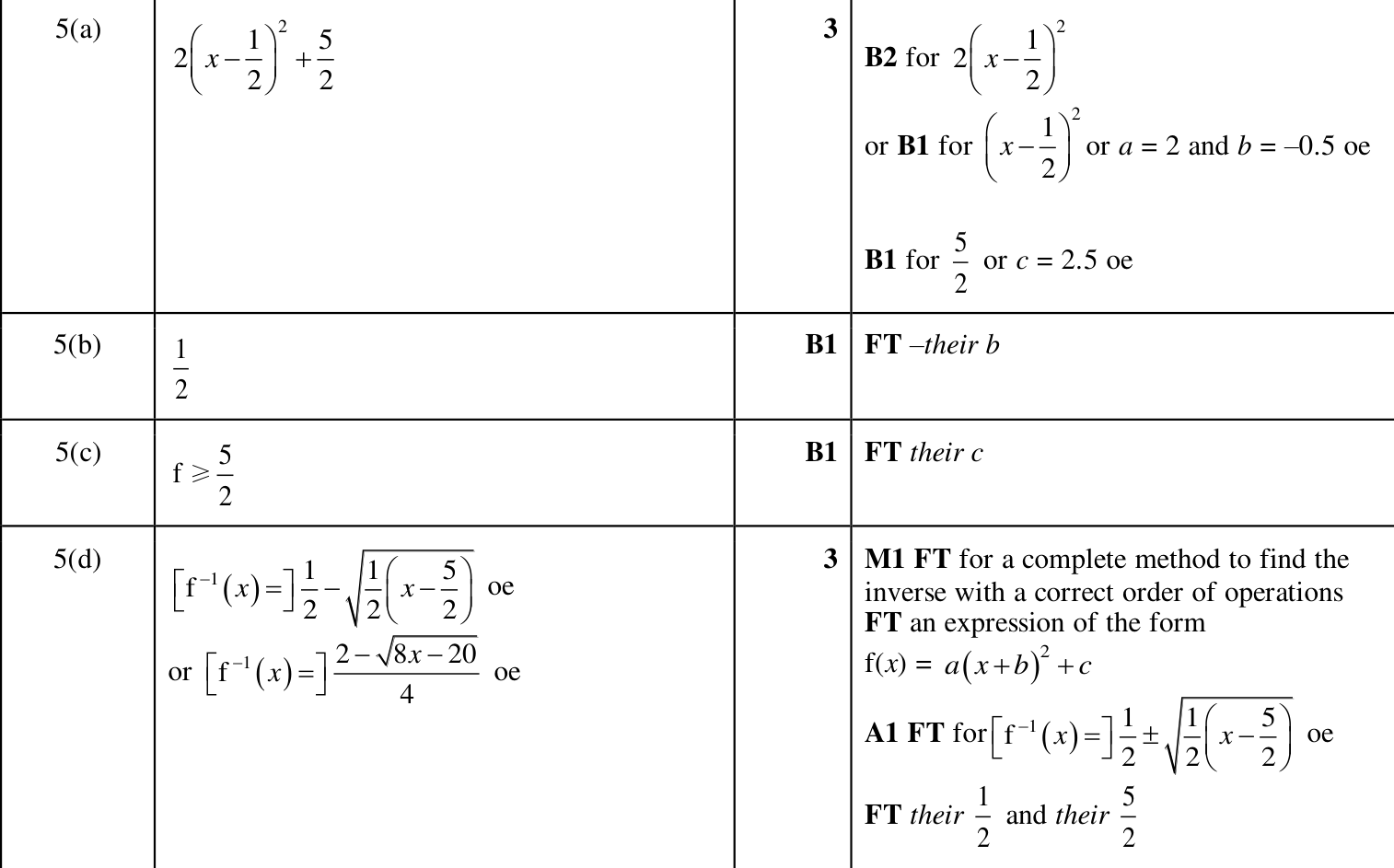
(a) Write \(2x^2-2x+3\) in the form \(a(x+b)^2+c\), where \(a\), \(b\) and \(c\) are constants.
It is given that \(\mathrm{f}(x)=2x^2-2x+3\), for \(x\leqslant p\).
(b) Write down the greatest value of \(p\) for which \(\mathrm{f}\) has an inverse.
(c) Using this value of \(p\), write down the range of \(\mathrm{f}\).
(d) Using this value of \(p\), find an expression for \(\mathrm{f}^{-1}\).
0606 P21 - Nov 2024 - Q11 - 7 marks
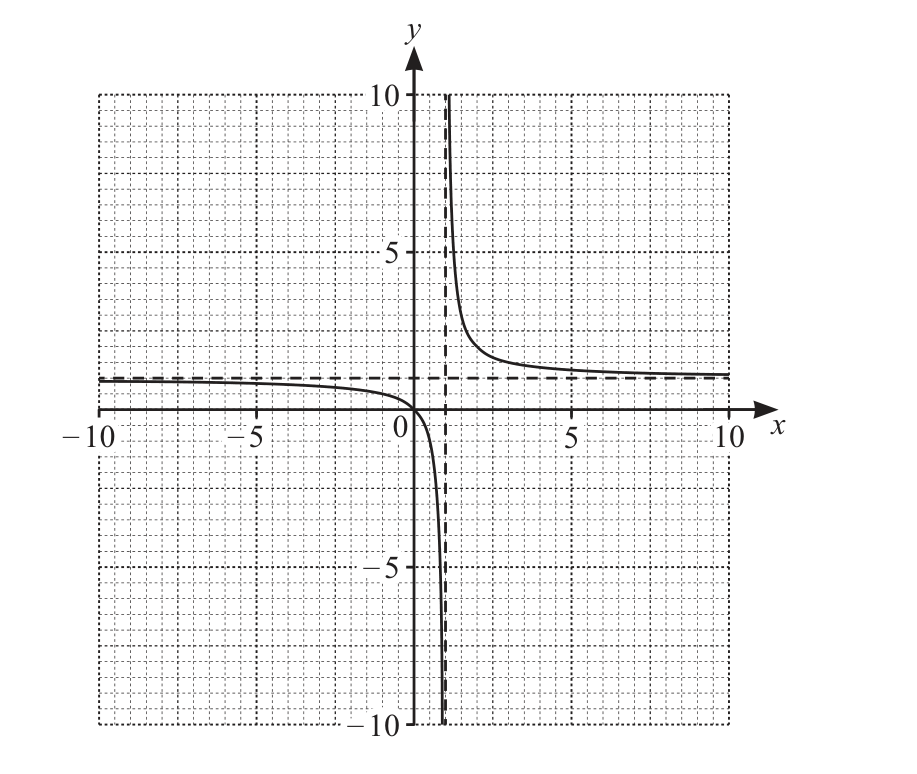
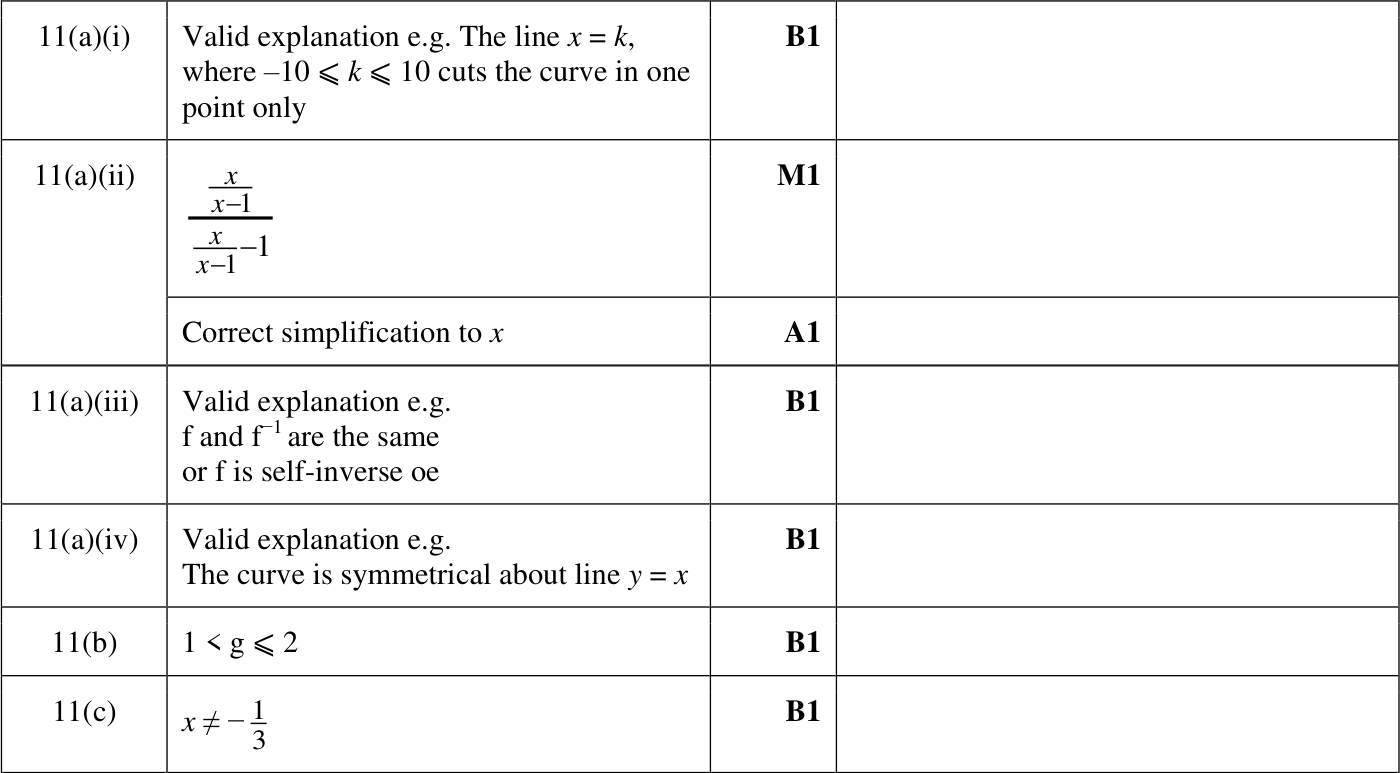
(a) \(\mathrm{f}(x)=\frac{x}{x-1}\) for \(-10 \leqslant x \leqslant 10, x \neq 1\). The diagram shows the graph of \(y=\mathrm{f}(x)\). (i) Use the diagram to explain why f is a function.
(ii) Find \(\mathrm{ff}(x)\), giving your answer in its simplest form.
(iii) Using your answer to part (ii) state the relationship between the functions f and \(\mathrm{f}^{-1}\).
(iv) Explain how the diagram shows the relationship between f and \(\mathrm{f}^{-1}\).
(b) A function g is defined by \(\mathrm{g}(x)=\frac{x}{x-1}\) for \(x \geqslant 2\). Find the range of g .
(c) A function h is defined by \(\mathrm{h}(x)=\frac{2 x}{3 x+1}\) for the largest possible domain. State the domain of h .
0606 P23 - Nov 2024 - Q2 - 9 marks
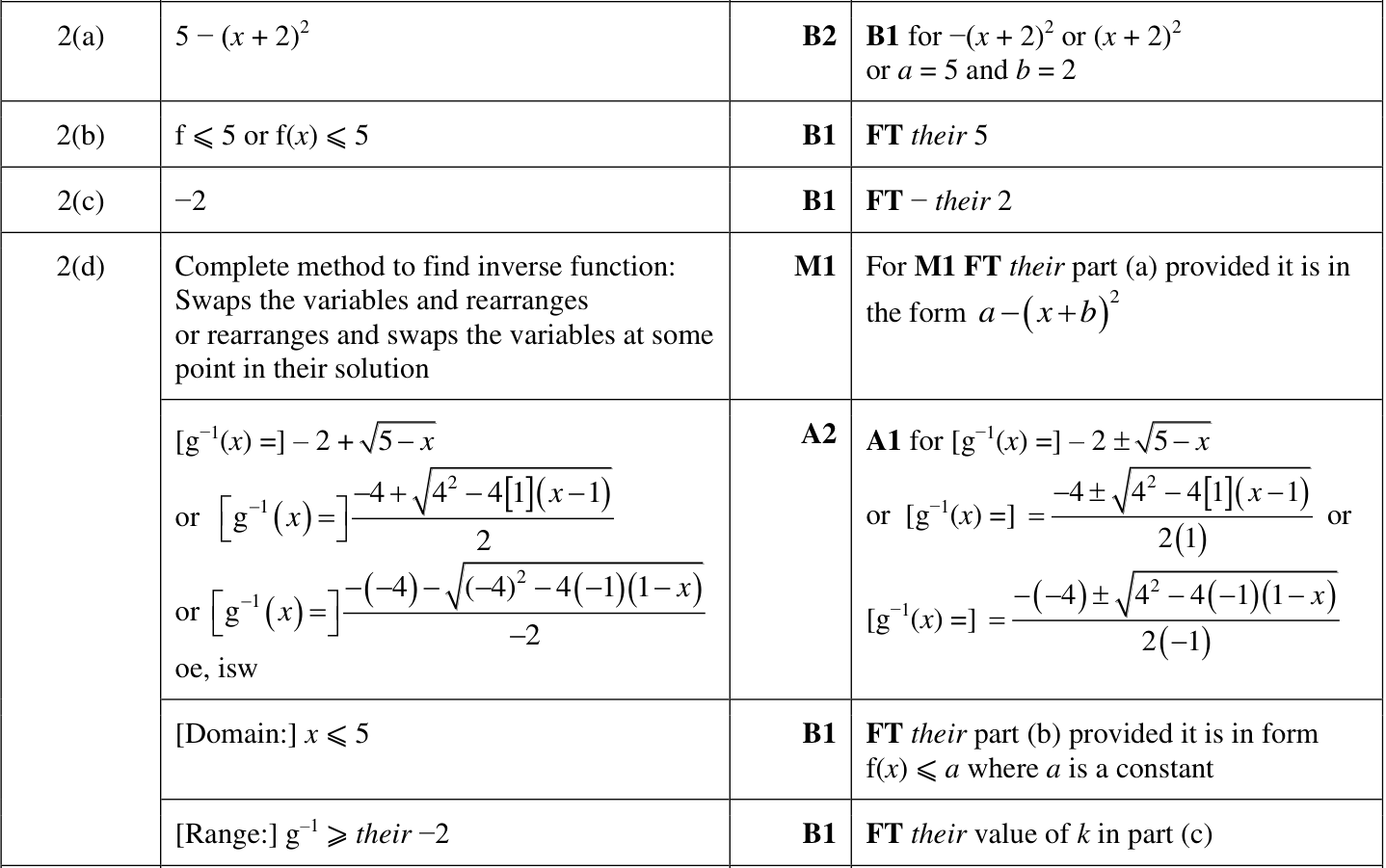
The function f is defined by \(\mathrm{f}(x)=1-4 x-x^{2}\) for all real values of \(x\). (a) Write \(\mathrm{f}(x)\) in the form \(a-(x+b)^{2}\), where \(a\) and \(b\) are constants.
(b) Find the range of f.
The function g is defined by \(\mathrm{g}(x)=1-4 x-x^{2}\) for \(x \geqslant k\), where \(k\) is a constant. (c) State the least possible value of \(k\) such that g has an inverse.
(d) Using your value of \(k\), find \(\mathrm{g}^{-1}(x)\), stating its domain and range.
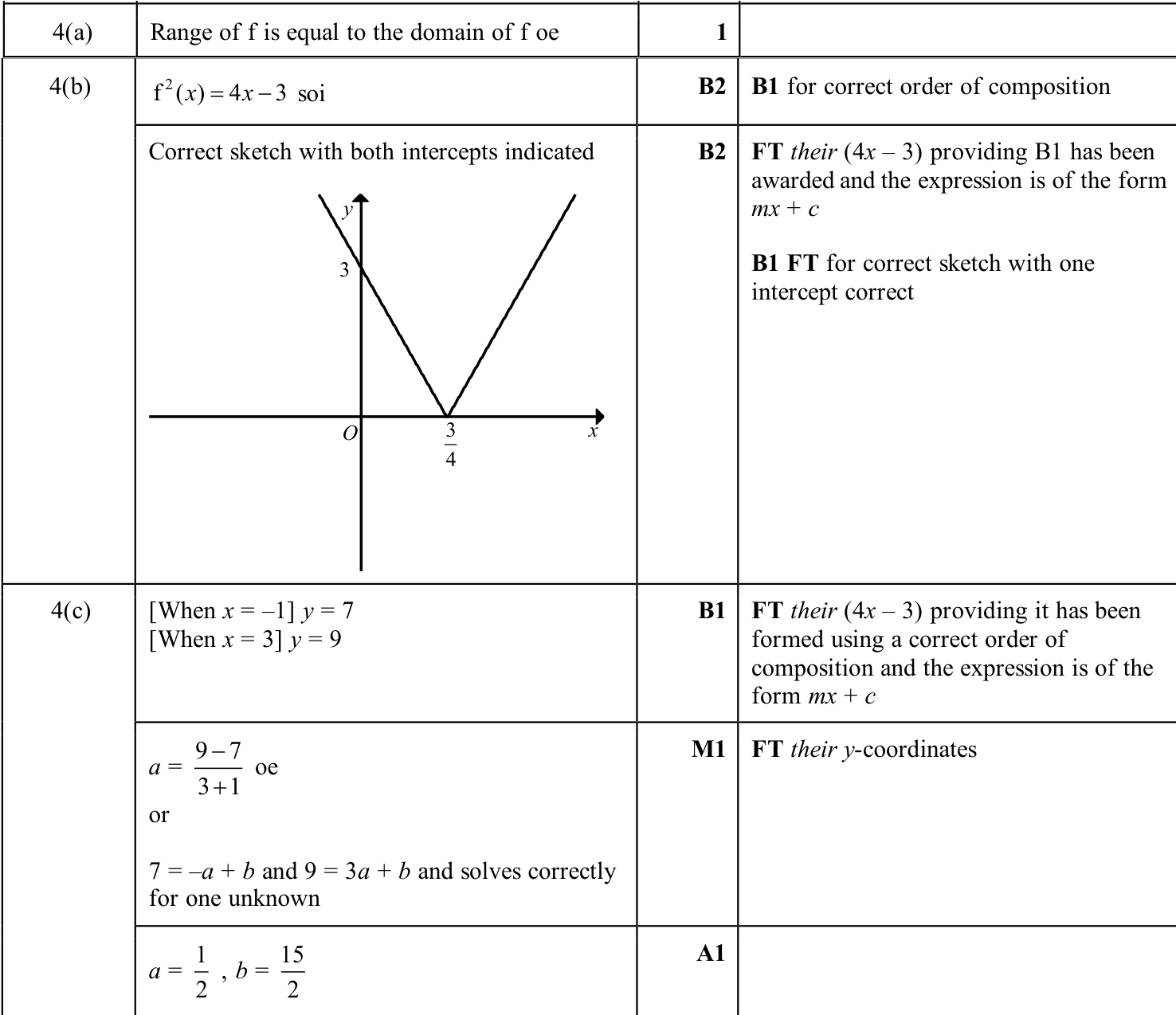
0606 P21 - Jun 2024 - Q9 - 7 marks
The functions \(f\) and \(g\) are defined by \(\begin{array}{ll} \mathrm{f}(x)=\frac{3 x^{2}}{4 x-1} & \text { for } x\lt 0 \\ \mathrm{~g}(x)=\frac{1}{x^{2}} & \text { for } x\lt 0 \end{array}\) (a) Explain why the function fg does not exist. (b) Given that the function gf does exist, find and simplify an expression for \(\mathrm{gf}(x)\). (c) Show that \(\mathrm{f}^{-1}(x)\) can be written as \(\frac{p x-\sqrt{x(q x+r)}}{3}\) where \(p, q\) and \(r\) are integers.