Past Exam Questions
← Back9231 P11 - Nov 2025 - Q4 - 8 marks
(a) The quartic equation \(x^4+x^3+x^2+x+1=0\) has roots \(\alpha,\beta,\gamma,\delta\). Show that a quartic equation with roots \(2\alpha+1,2\beta+1,2\gamma+1,2\delta+1\) is \(y^4-2y^3+4y^2+2y+11=0\).
(b) The sum \((2\alpha+1)^n+(2\beta+1)^n+(2\gamma+1)^n+(2\delta+1)^n\) is denoted by \(S_n\). Find \(S_2\).
(c) Given that \(S_3=-22\), find \(S_4\).
9231 P13 - Jun 2015 - Q1 - 6 marks
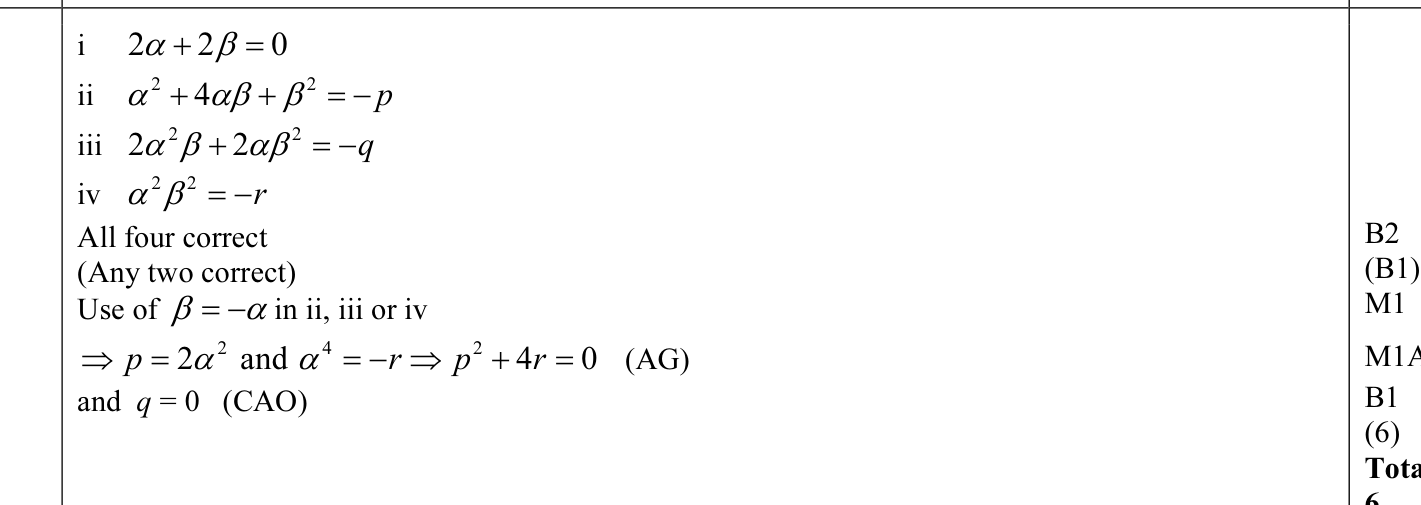
The quartic equation \(x^{4}-p x^{2}+q x-r=0\), where \(p, q\) and \(r\) are real constants, has two pairs of equal roots. Show that \(p^{2}+4 r=0\) and state the value of \(q\).
0606 P12 - Mar 2019 - Q1 - 6 marks
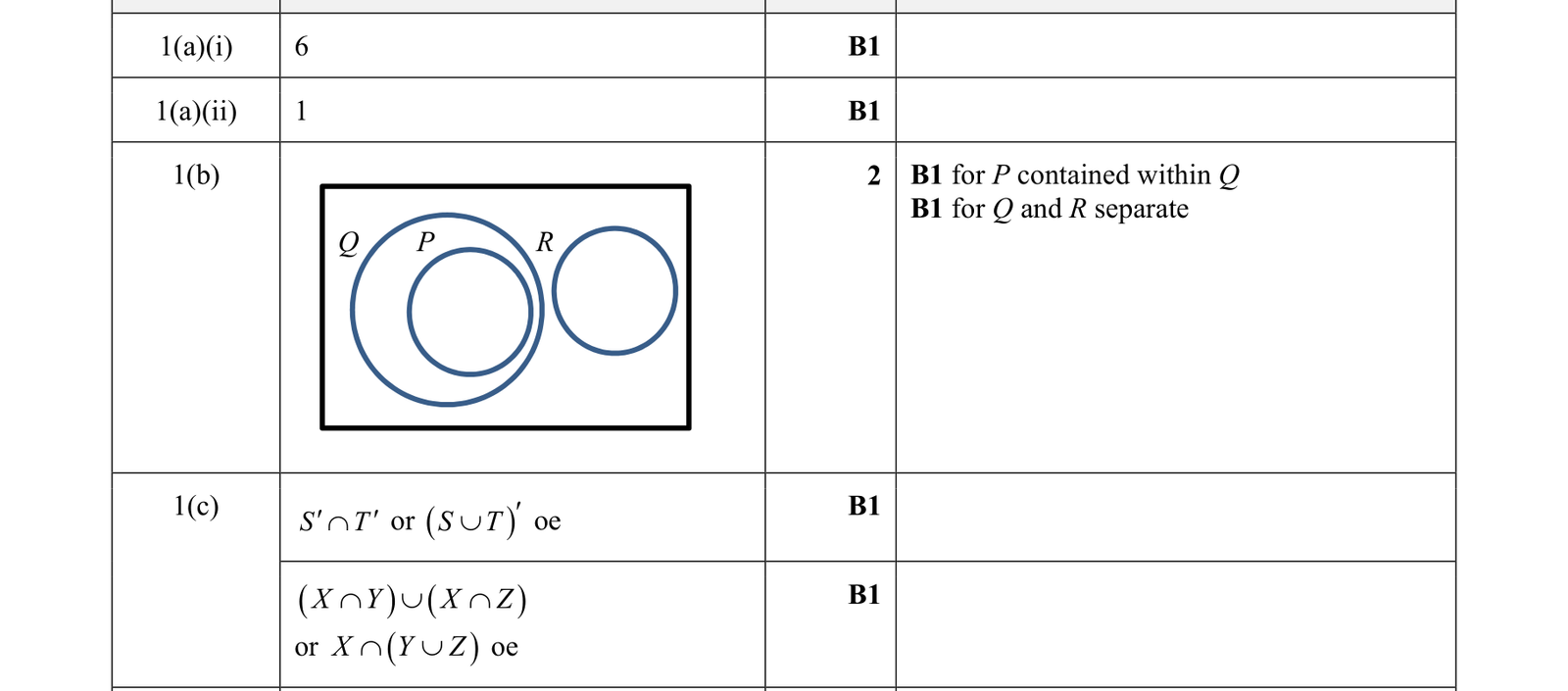
(a) The universal set is \(\mathcal E=\{x:1\lt x\lt 20,\ x\in\mathbb Z\}\). The set \(A\) contains the multiples of 3 and the set \(B\) contains the multiples of 4.
(i) Find \(n(A)\).
(ii) Find \(n(A\cap B)\).
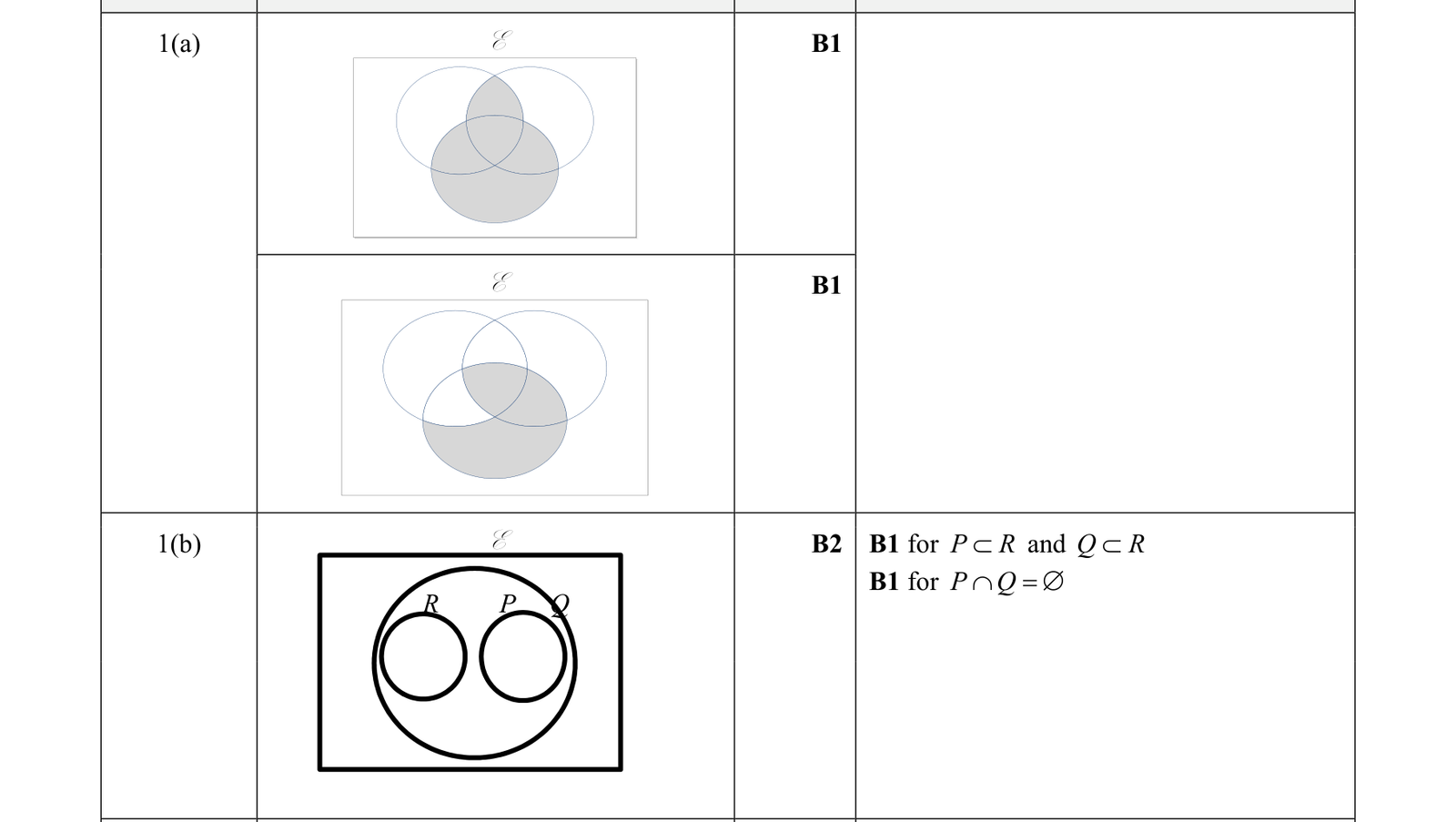
(b) On the Venn diagram, draw sets \(P\), \(Q\) and \(R\) such that \(P\subset Q\) and \(Q\cap R=\varnothing\).
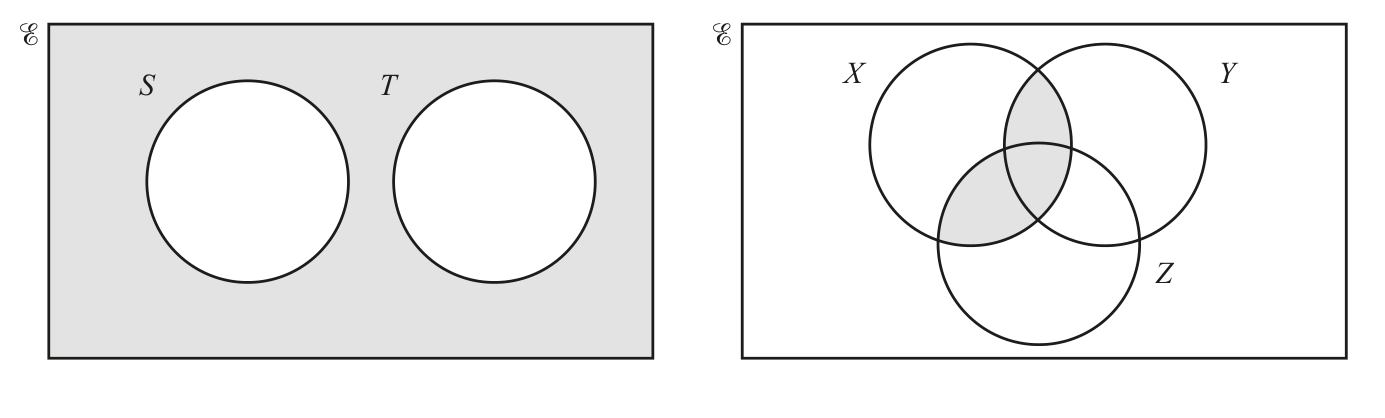
(c) For each shaded Venn diagram, describe the shaded region in set notation.
0606 P11 - Jun 2019 - Q1 - 4 marks
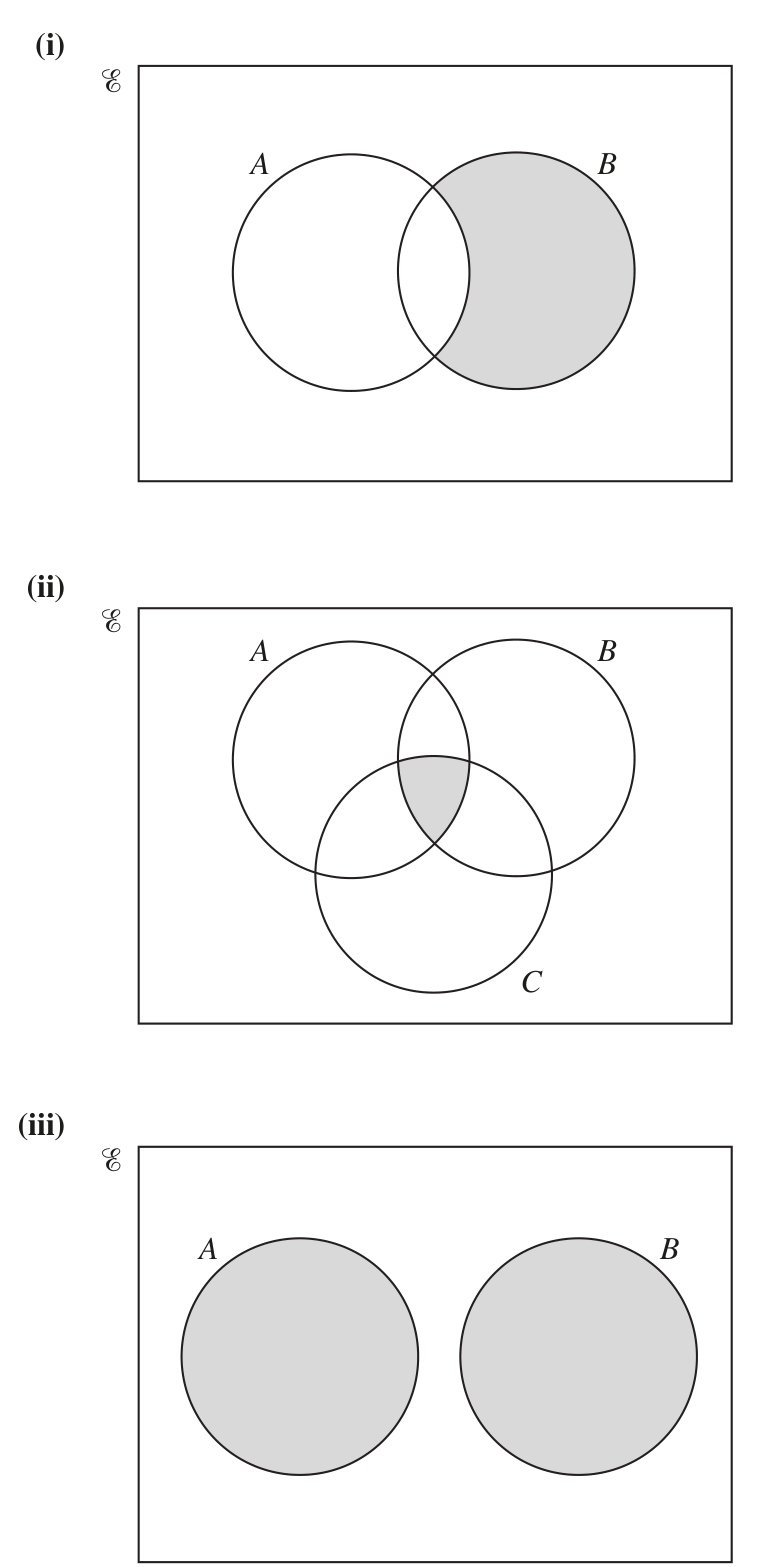
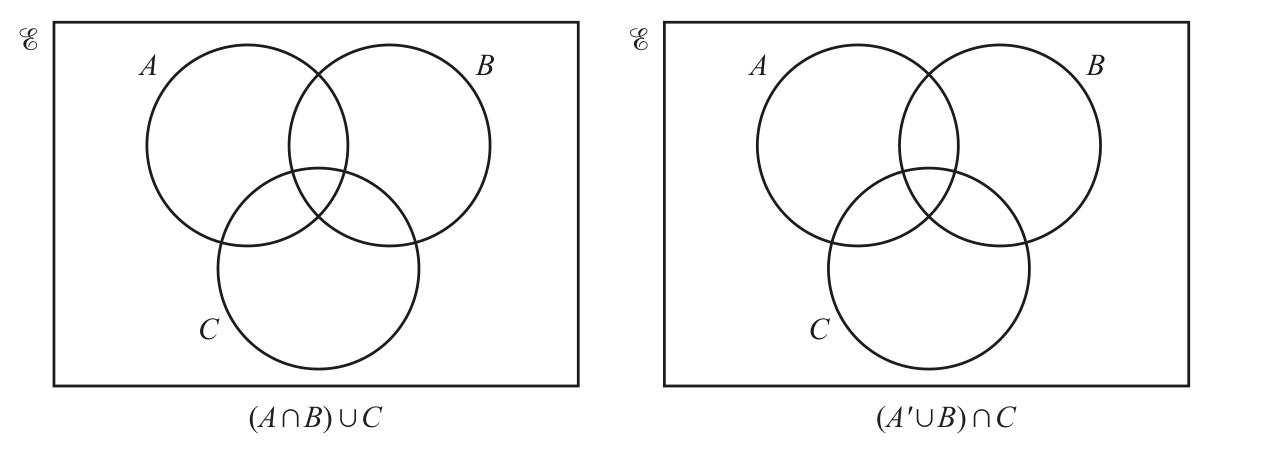
(a) On the Venn diagrams, shade the regions indicated:
(i) \((A\cap B)\cup C\)
(ii) \((A'\cup B)\cap C\)
(b) On a Venn diagram, draw sets \(P\), \(Q\) and \(R\) such that \(P\subset R\), \(Q\subset R\), and \(P\cap Q=\varnothing\).
0606 P12 - Jun 2019 - Q1 - 5 marks
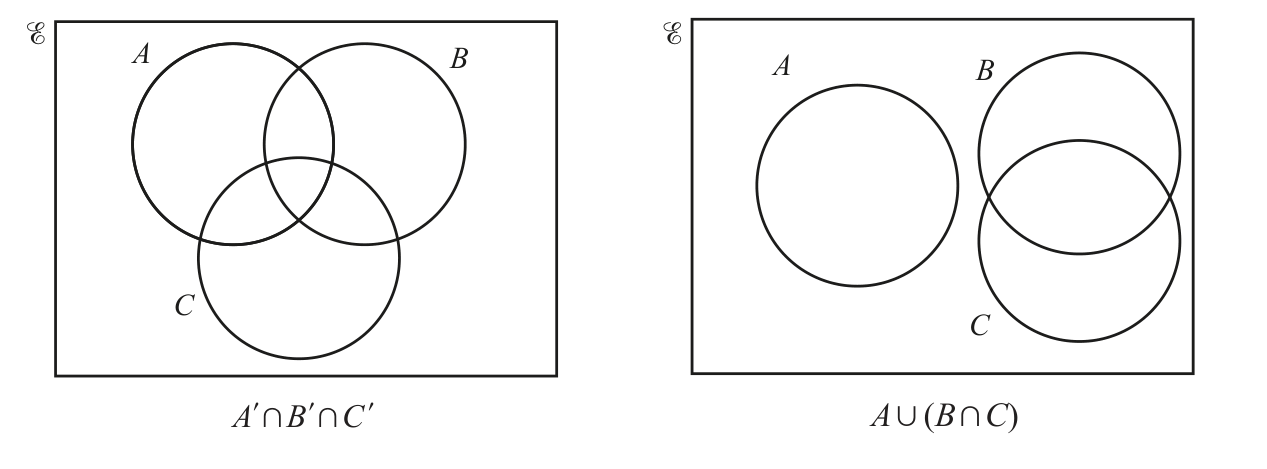
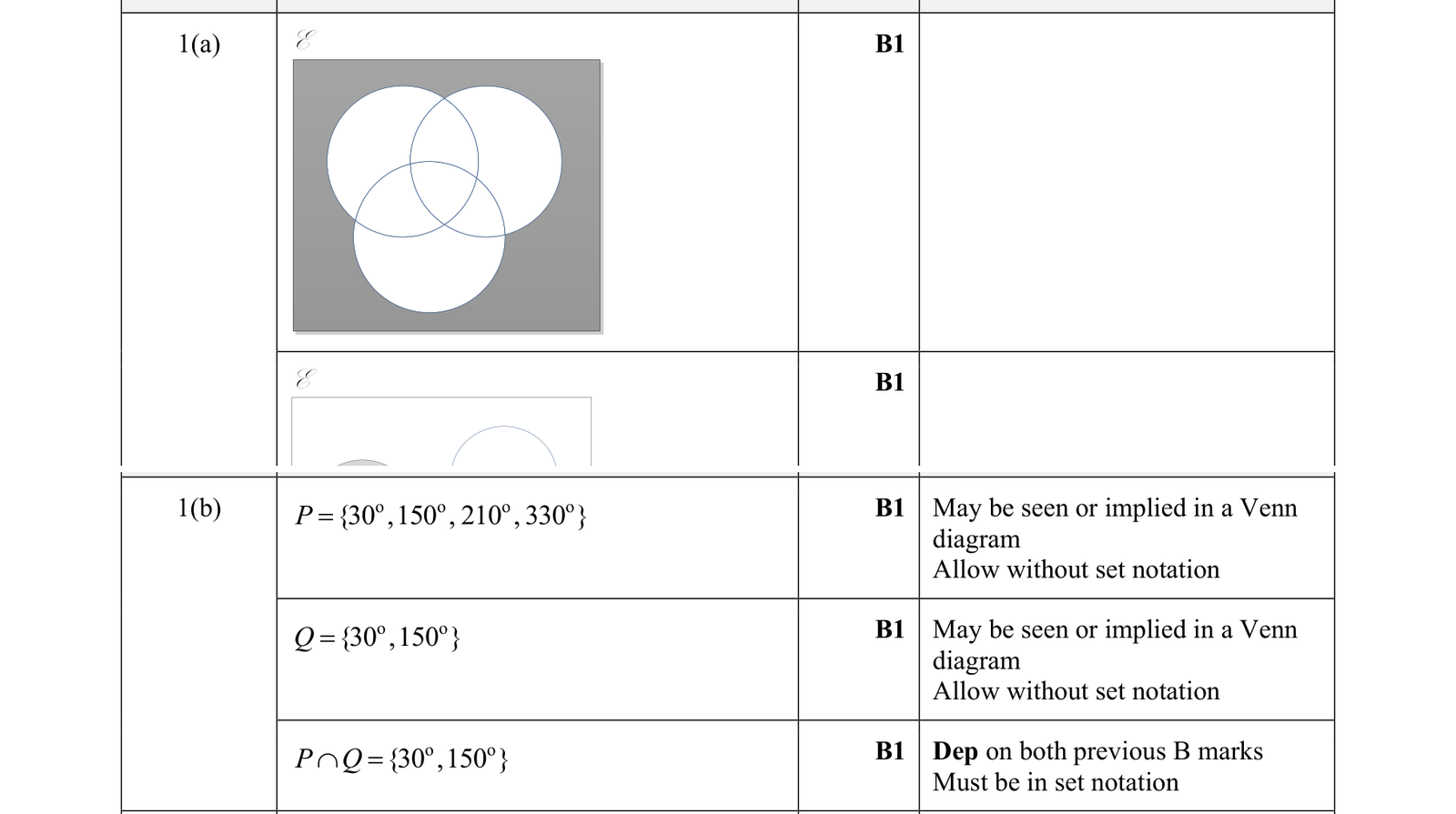
(a) On the Venn diagrams, shade the regions indicated.
(i) \(A'\cap B'\cap C'\)
(ii) \(A\cup(B\cap C)\)
(b) Given \(\mathcal E=\{x:0^\circ\leq x\leq 360^\circ\}\), \(P=\{x:\cos 2x=0.5\}\), and \(Q=\{x:\sin x=0.5\}\), find \(P\cap Q\).
0606 P13 - Jun 2019 - Q1 - 3 marks
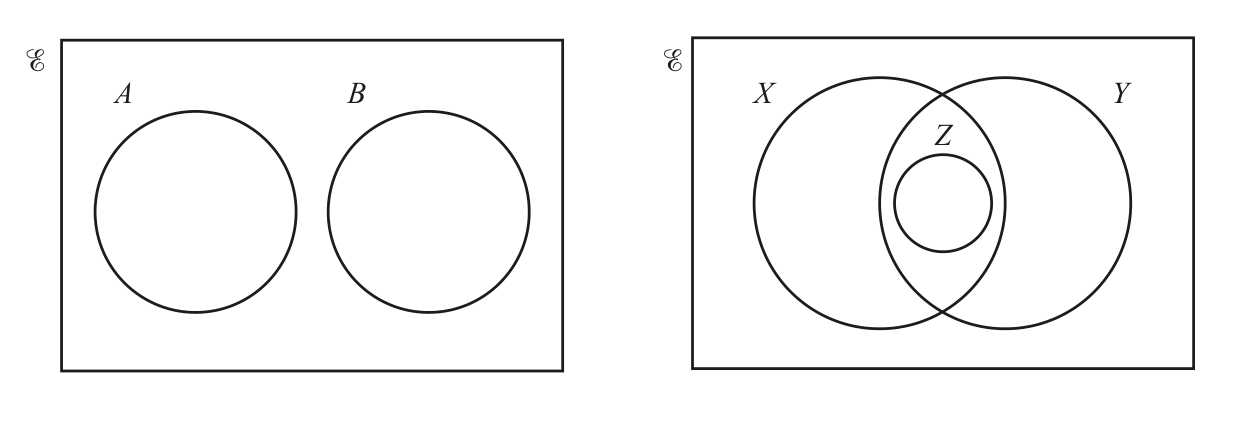
Describe, using set notation, the relationship between the sets shown in each Venn diagram.

0606 P11 - Nov 2019 - Q1 - 2 marks
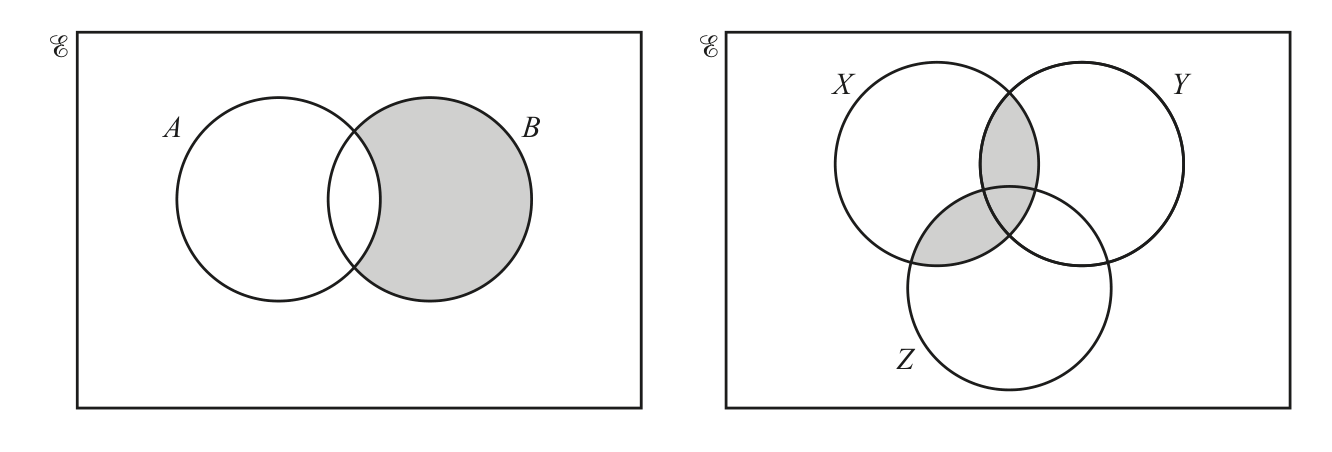
Using set notation, describe the regions shaded on the Venn diagrams below.

0606 P13 - Nov 2019 - Q1 - 5 marks
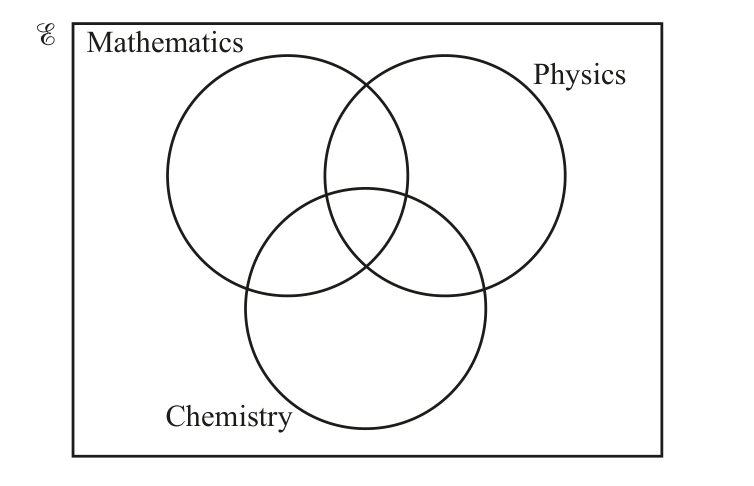
In a group of \(145\) students, the numbers studying mathematics, physics and chemistry are given below. All students study at least one of the three subjects.
\(x\) students study all \(3\) subjects.
\(24\) students study both mathematics and chemistry.
\(23\) students study both physics and chemistry.
\(28\) students study both mathematics and physics.
\(50\) students study chemistry.
\(75\) students study physics.
\(80\) students study mathematics.
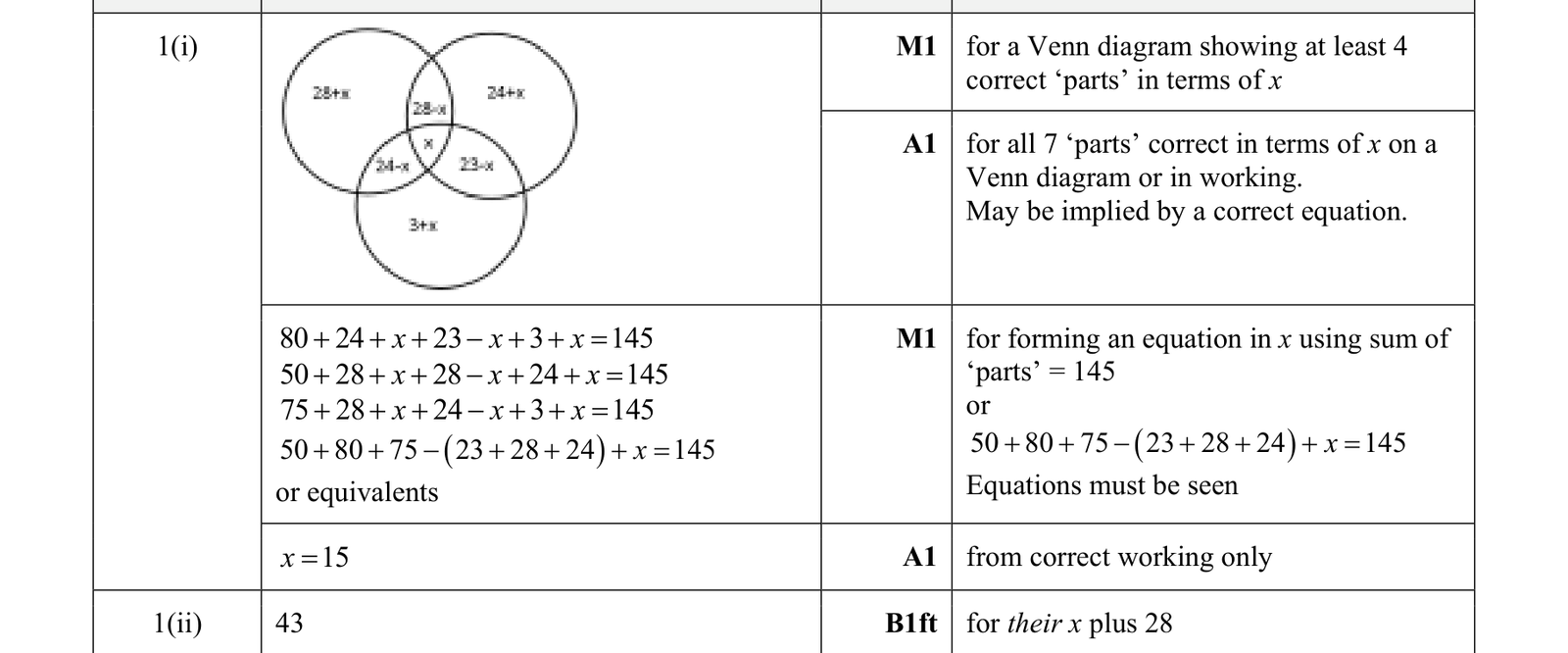
(i) Using the Venn diagram, find the value of \(x\).
(ii) Find the number of students who study mathematics only.
0606 P22 - Nov 2019 - Q1 - 3 marks
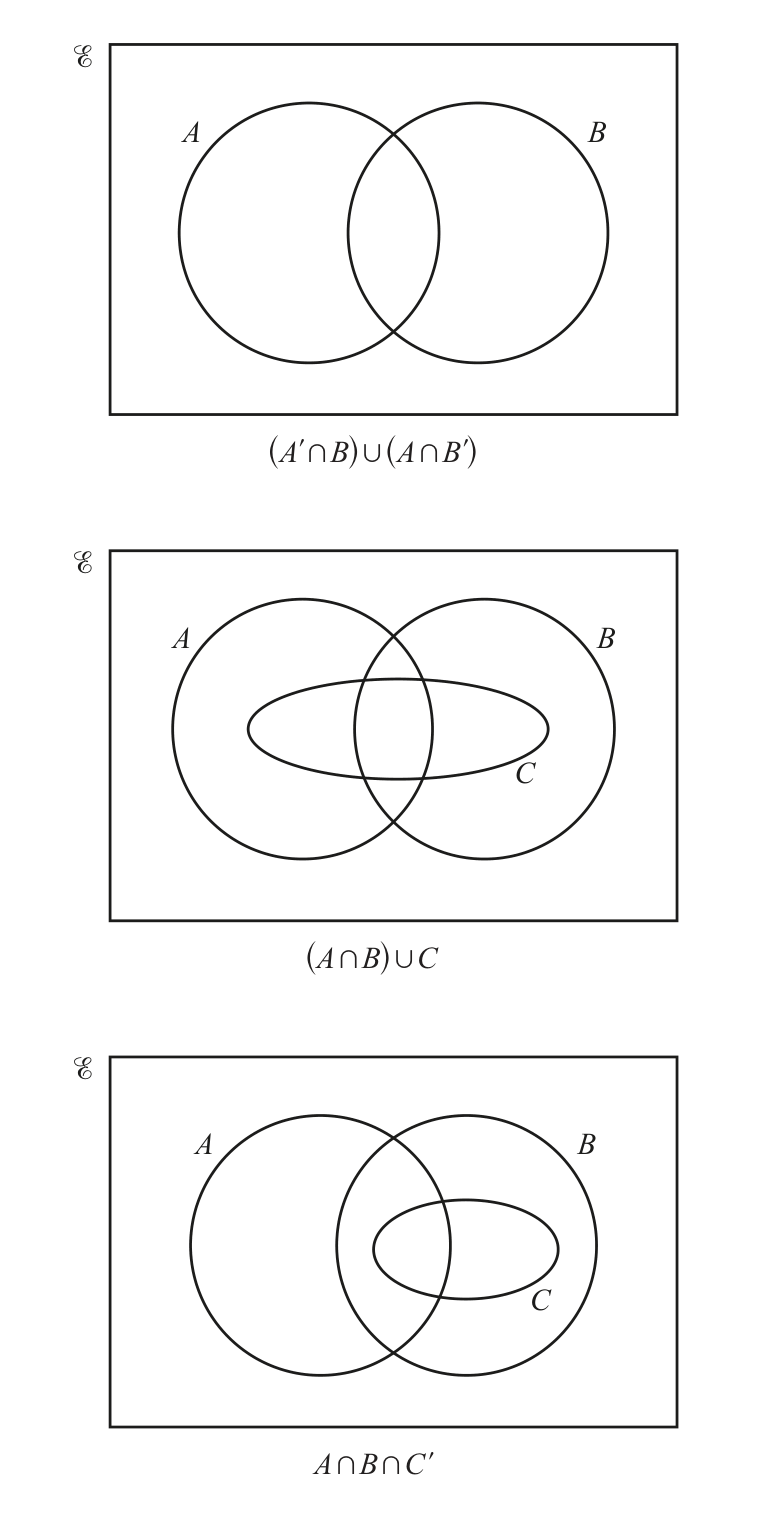
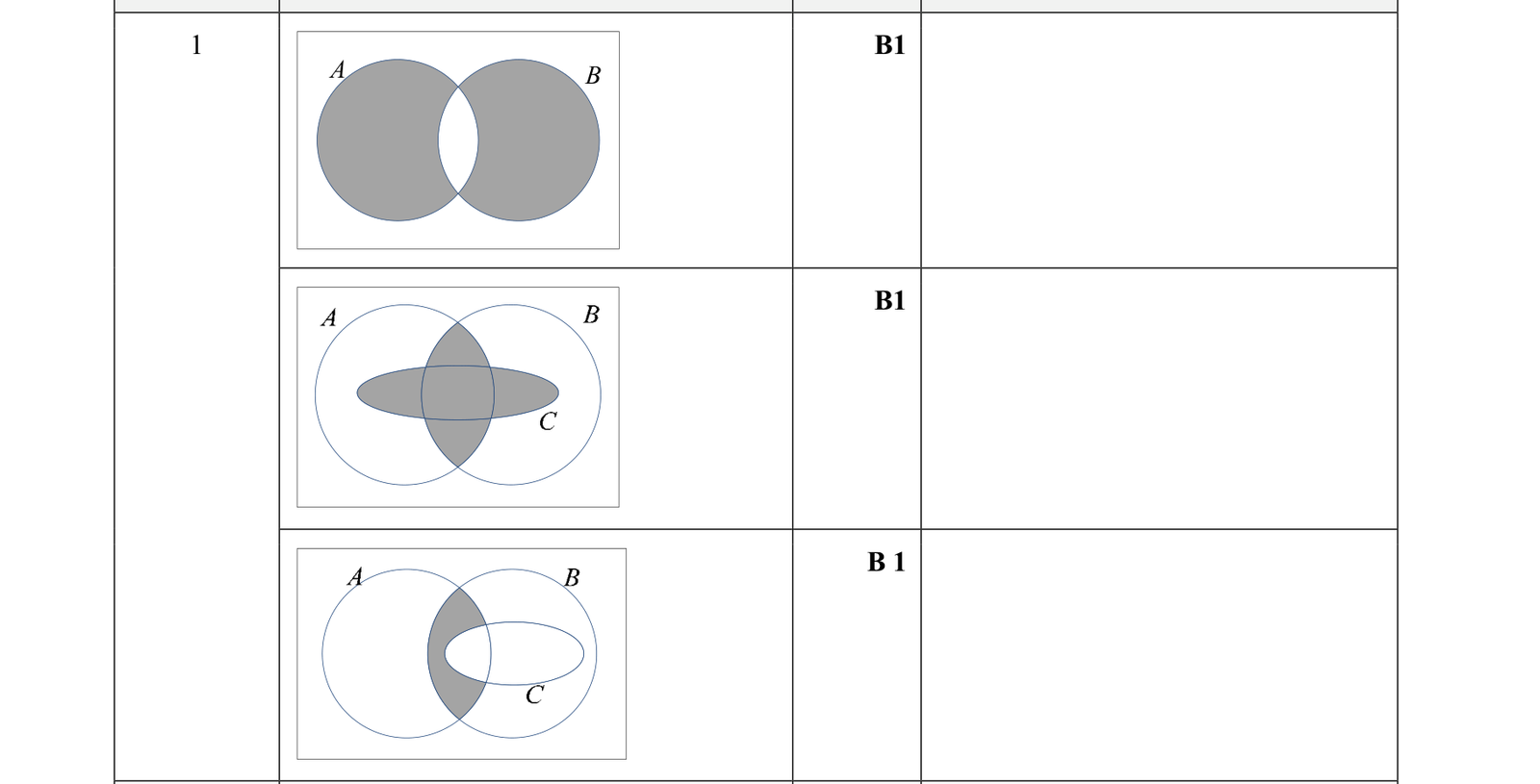
On each of the Venn diagrams, shade the indicated region.
(i) \((A'\cap B)\cup(A\cap B')\)
(ii) \((A\cap B)\cup C\)
(iii) \(A\cap B\cap C'\)
0606 P22 - Mar 2018 - Q1 - 5 marks
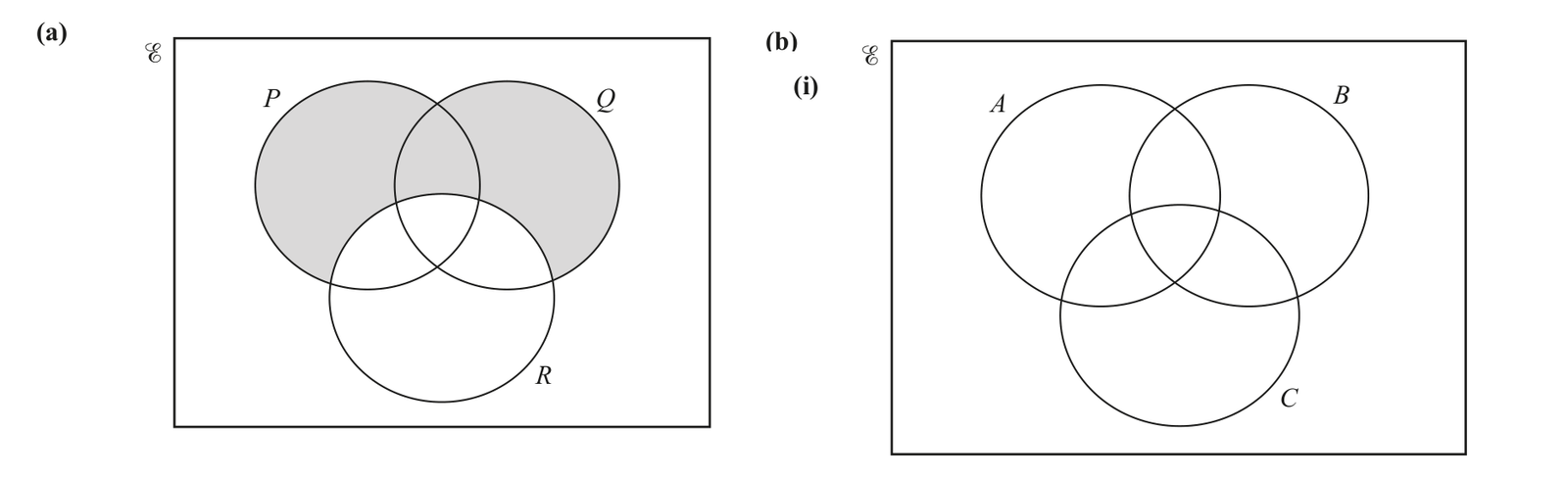
(a) Using set notation, write down the set represented by the shaded region in the Venn diagram.
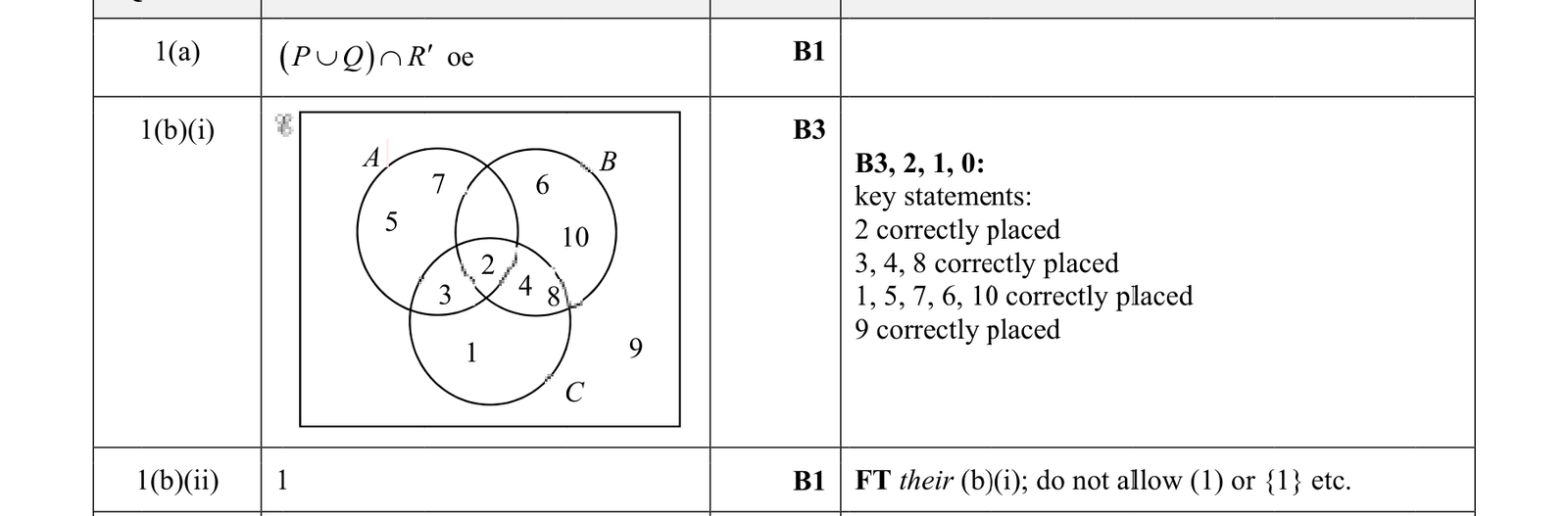
(b) The universal set is \(\mathcal E=\{1,2,3,4,5,6,7,8,9,10\}\).
\(A=\{x:x\text{ is a prime number}\}\), \(B=\{x:x\text{ is an even number}\}\), and \(C=\{1,2,3,4,8\}\).
(i) Complete the Venn diagram to show the elements of each set.
(ii) Write down the value of \(n((A\cup B\cup C)')\).
0606 P21 - Jun 2018 - Q1 - 4 marks
\(A\), \(B\) and \(C\) are subsets of the same universal set.
(i) Write each of the following statements in words.
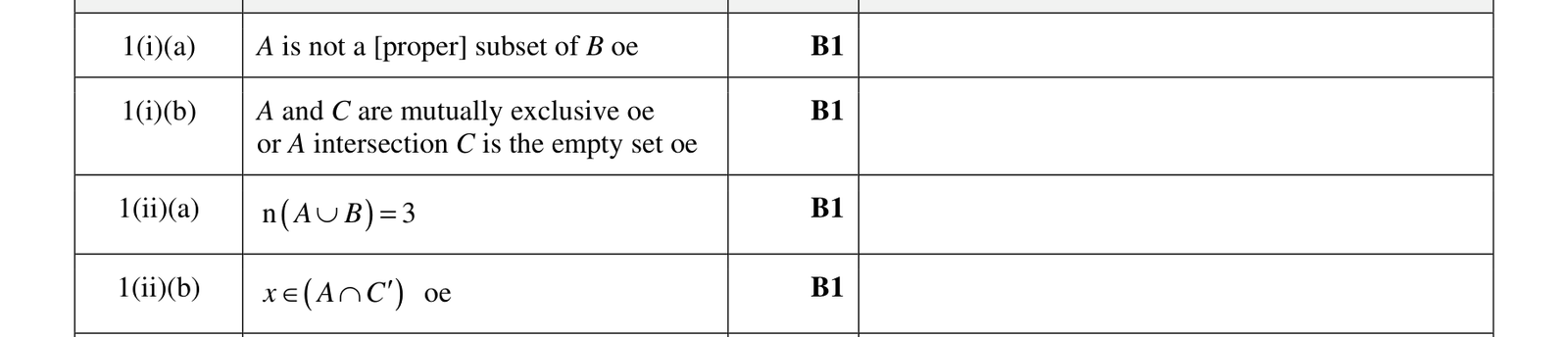
(a) \(A\not\subseteq B\)
(b) \(A\cap C=\varnothing\)
(ii) Write each of the following statements in set notation.
(a) There are \(3\) elements in set \(A\) or \(B\) or both.
(b) \(x\) is an element of \(A\) but it is not an element of \(C\).
0606 P22 - Jun 2018 - Q2 - 5 marks
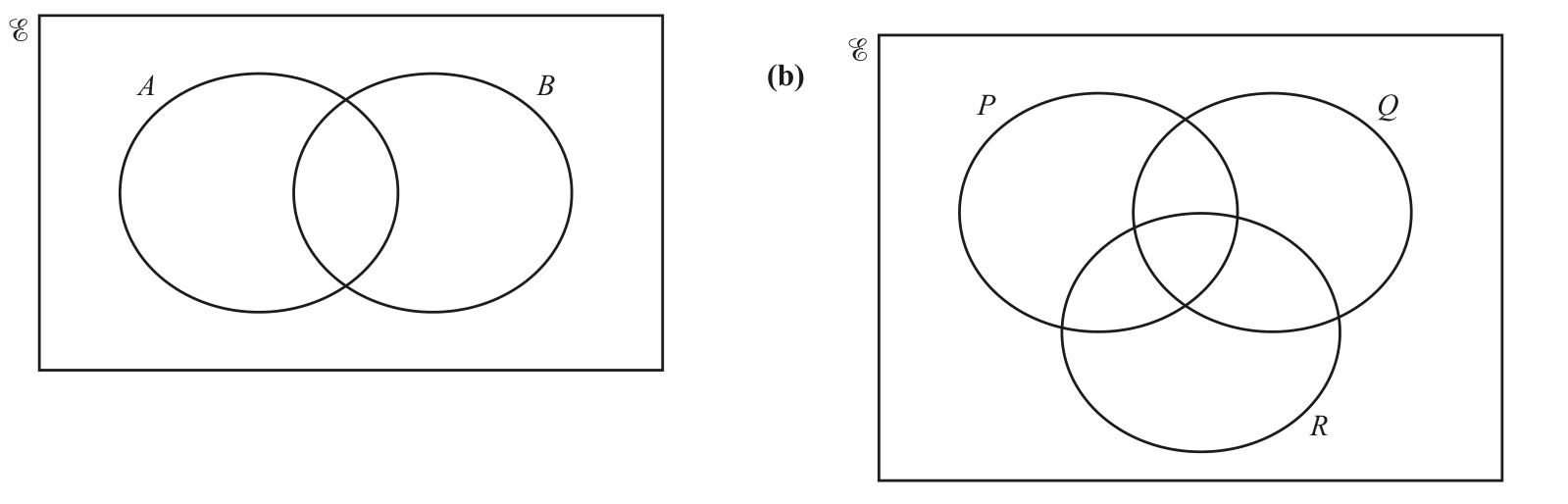
(a) On the Venn diagram, shade the region that represents \(A\cap B'\).
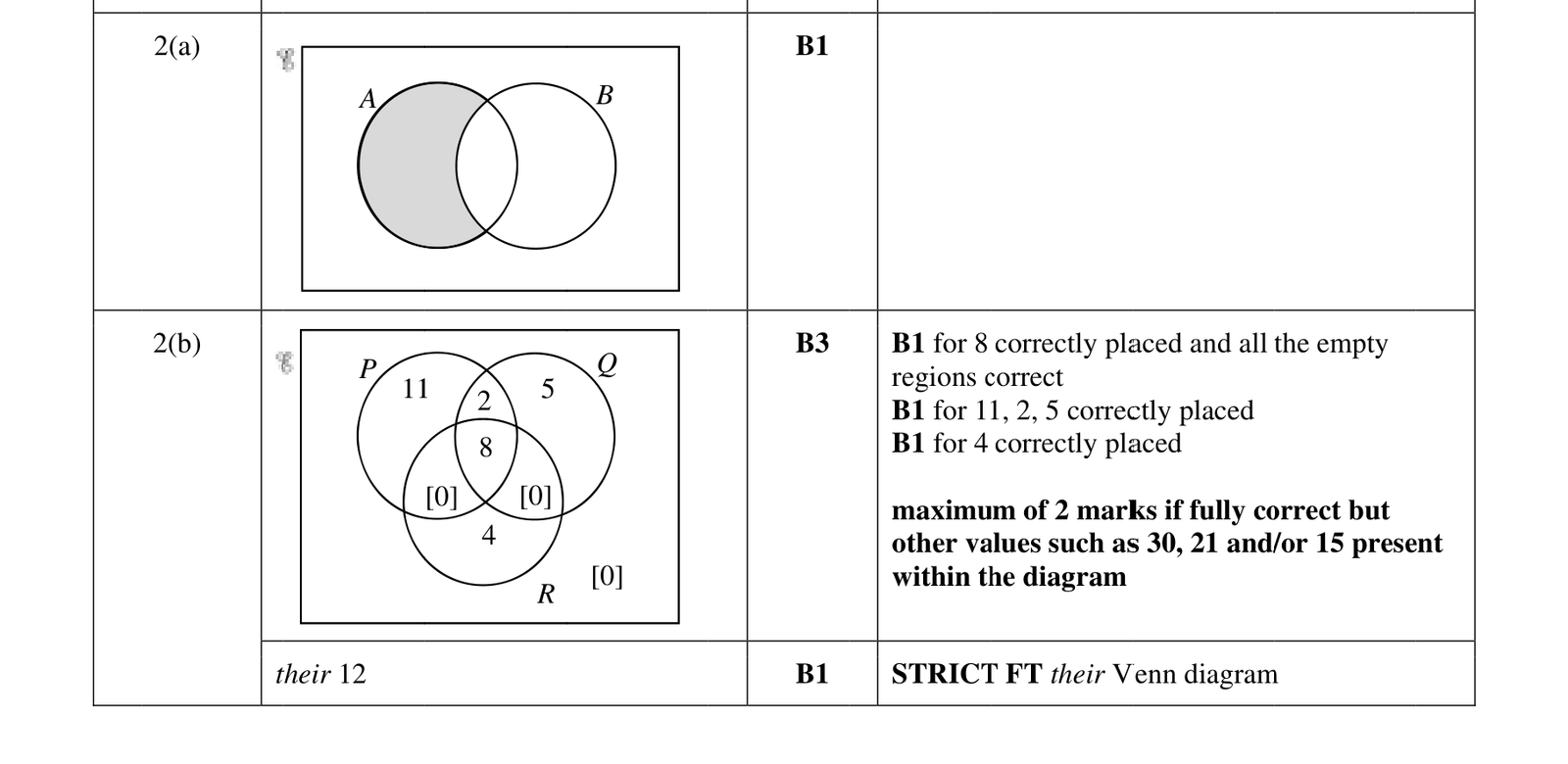
(b) The universal set \(\xi\) and sets \(P\), \(Q\) and \(R\) satisfy the information shown in the question. Complete the Venn diagram and state \(n(R)\).
0606 P23 - Jun 2018 - Q1 - 4 marks
\(A\), \(B\) and \(C\) are subsets of the same universal set.
(i) Write each of the following statements in words.
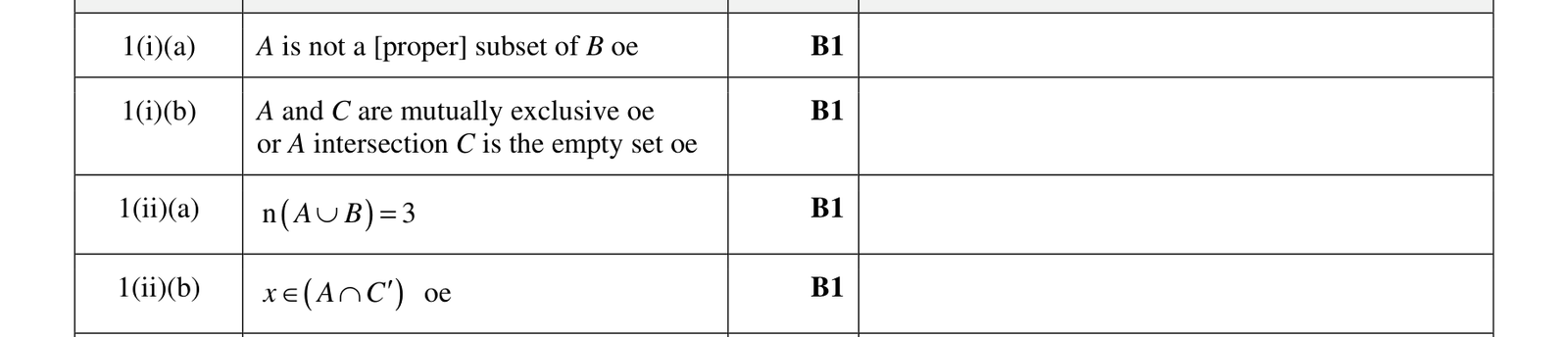
(a) \(A\not\subseteq B\)
(b) \(A\cap C=\varnothing\)
(ii) Write each of the following statements in set notation.
(a) There are \(3\) elements in set \(A\) or \(B\) or both.
(b) \(x\) is an element of \(A\) but it is not an element of \(C\).
0606 P21 - Nov 2018 - Q11 - 6 marks
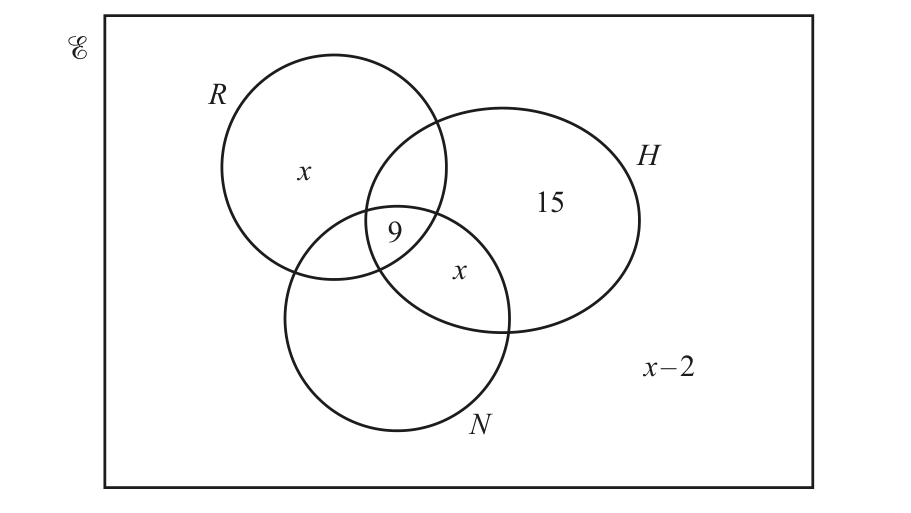
There are \(70\) girls in a year group at a school. The Venn diagram gives some information about the numbers of these girls who play rounders \((R)\), hockey \((H)\) and netball \((N)\).
\(n(R)=28,\qquad n(H)=38,\qquad n(N)=35.\)
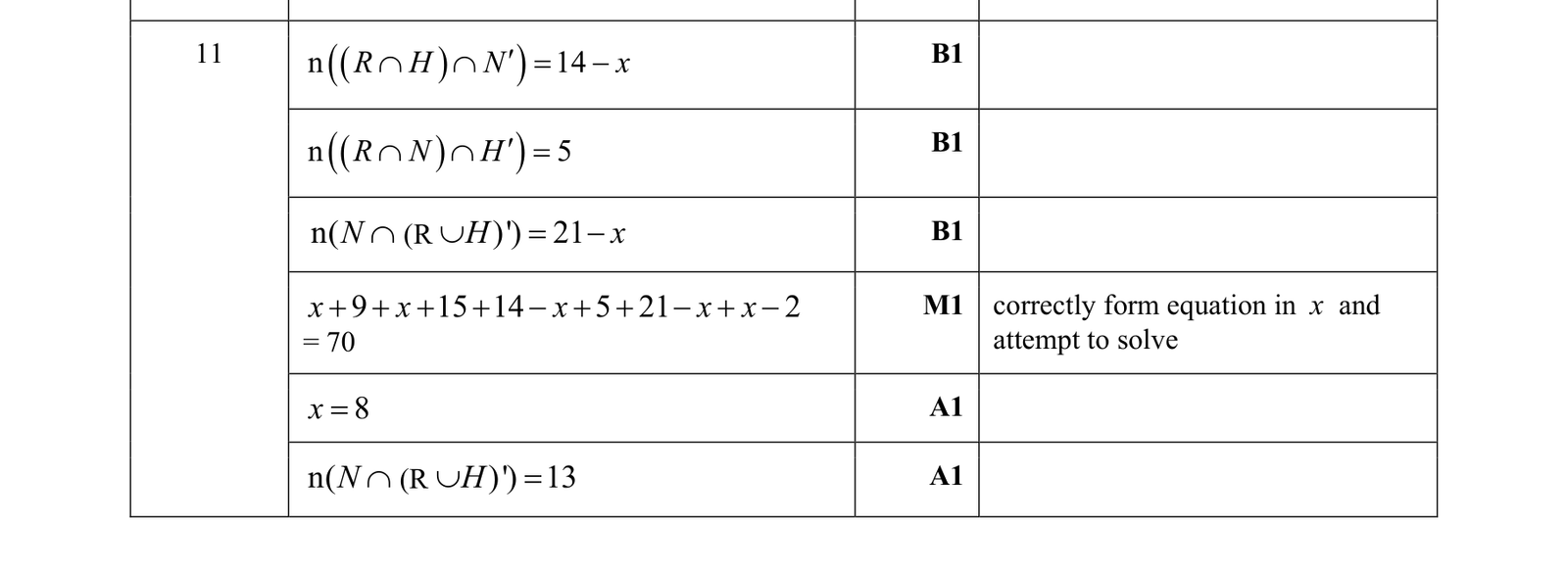
Find the value of \(x\) and hence the number of girls who play netball only.
0606 P22 - Nov 2018 - Q2 - 5 marks
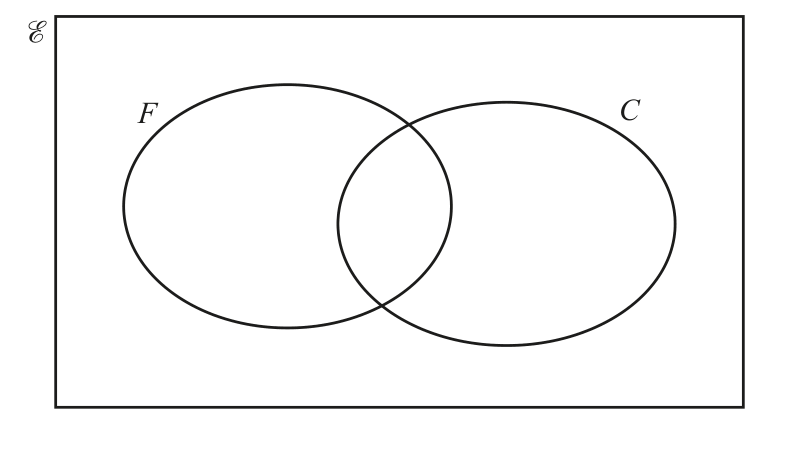
There are \(105\) boys in a year group at a school. Some boys play football \((F)\) and some play cricket \((C)\).
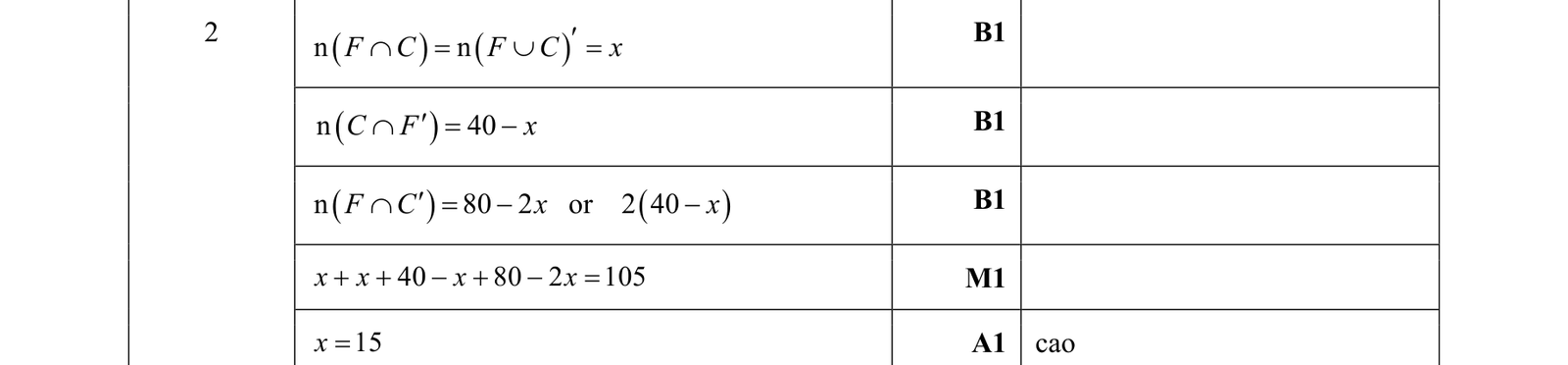
\(x\) boys play both football and cricket. The number of boys that play neither game is the same as the number of boys that play both. \(40\) boys play cricket. The number of boys that only play football is twice the number of boys that only play cricket.
Complete the Venn diagram and find the value of \(x\).
0606 P23 - Nov 2018 - Q2 - 3 marks
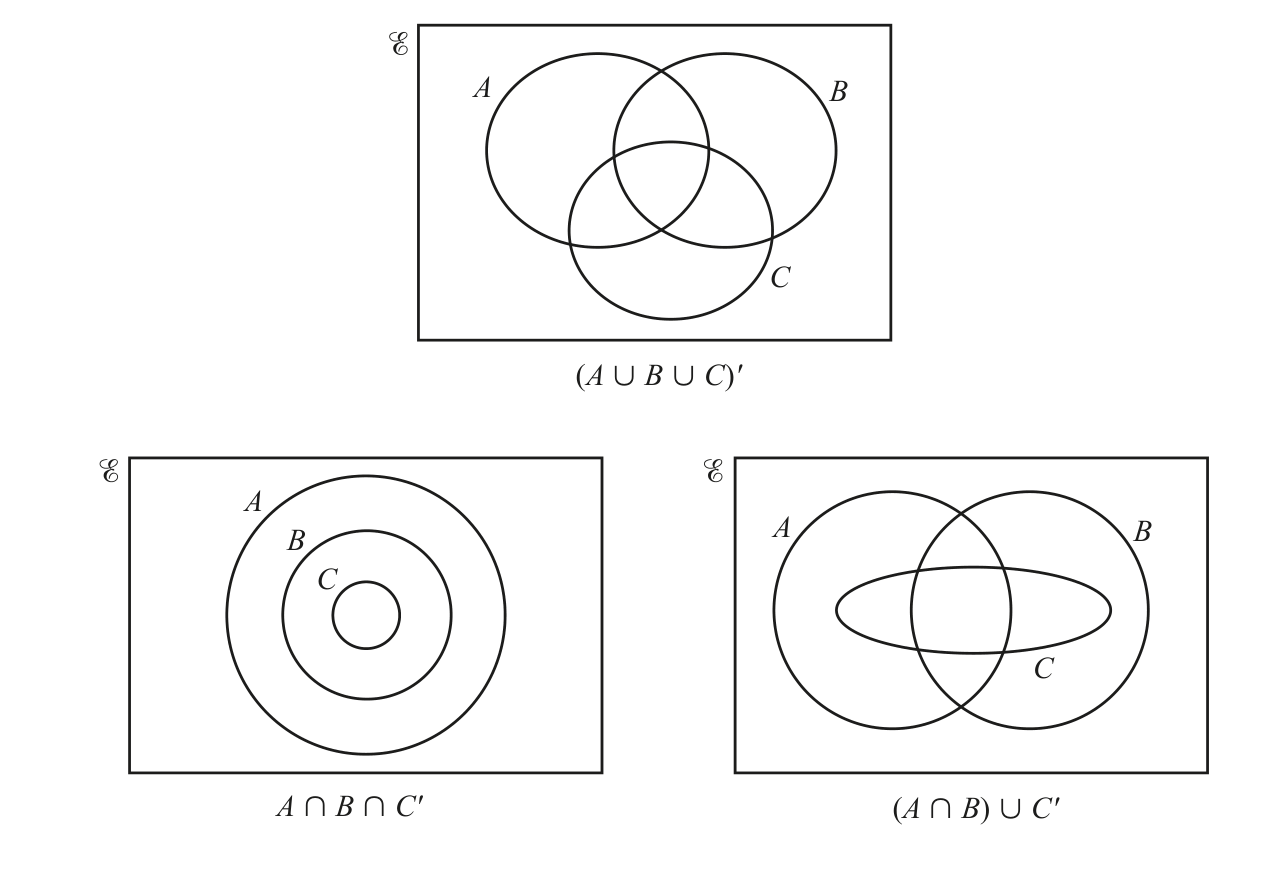
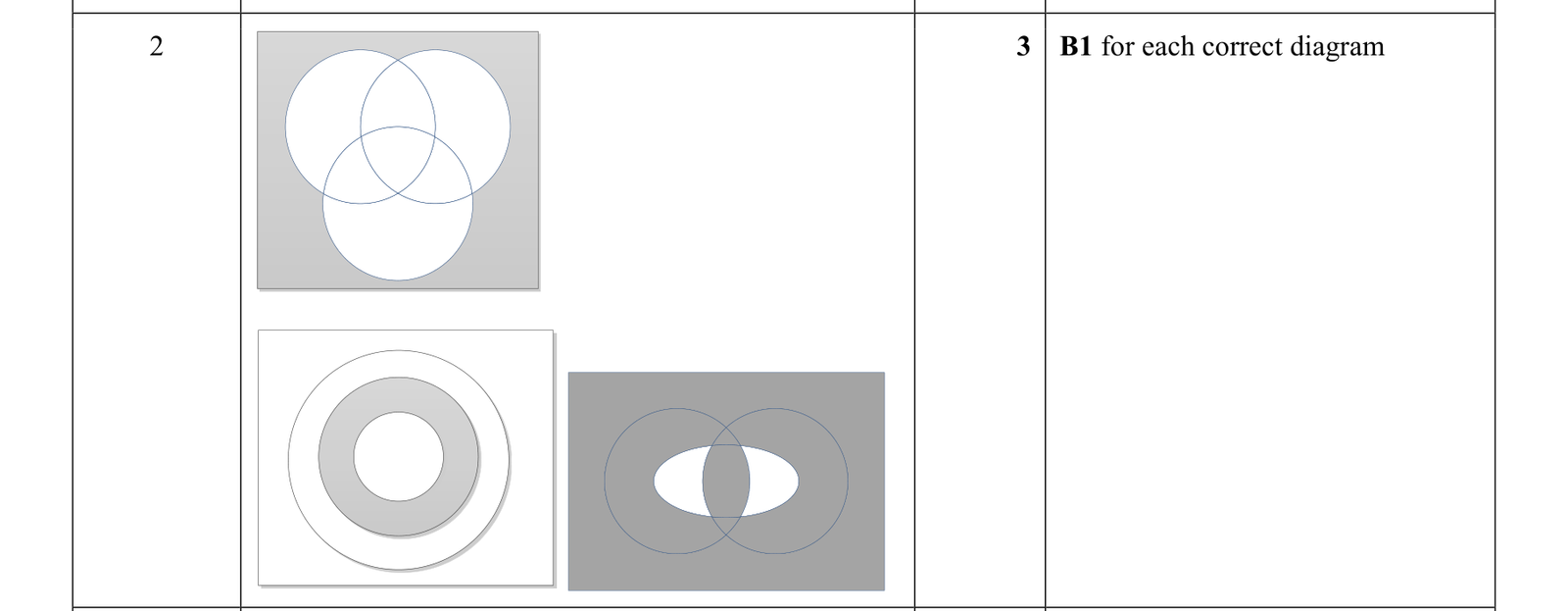
On each of the Venn diagrams, shade the region indicated:
\((A\cup B\cup C)',\qquad A\cap B\cap C',\qquad (A\cap B)\cup C'.\)
0606 P12 - Jun 2017 - Q1 - 3 marks
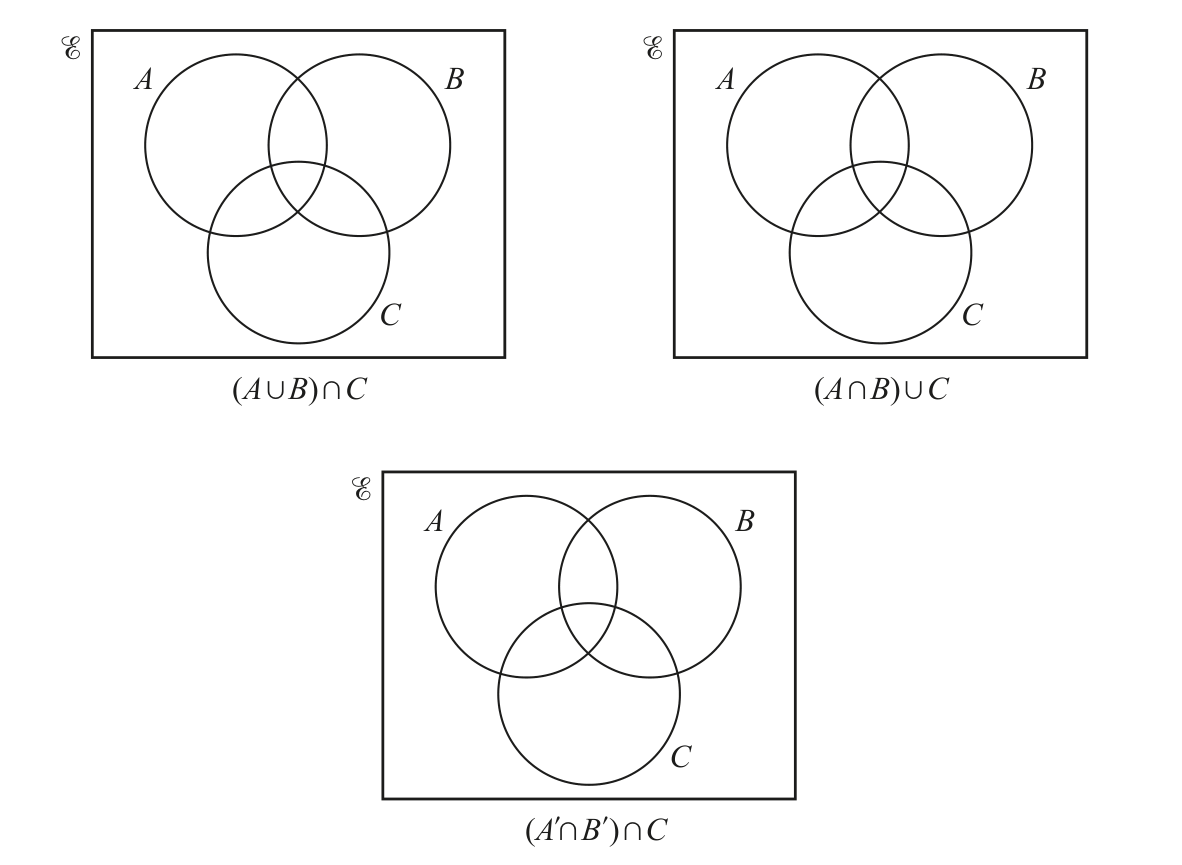
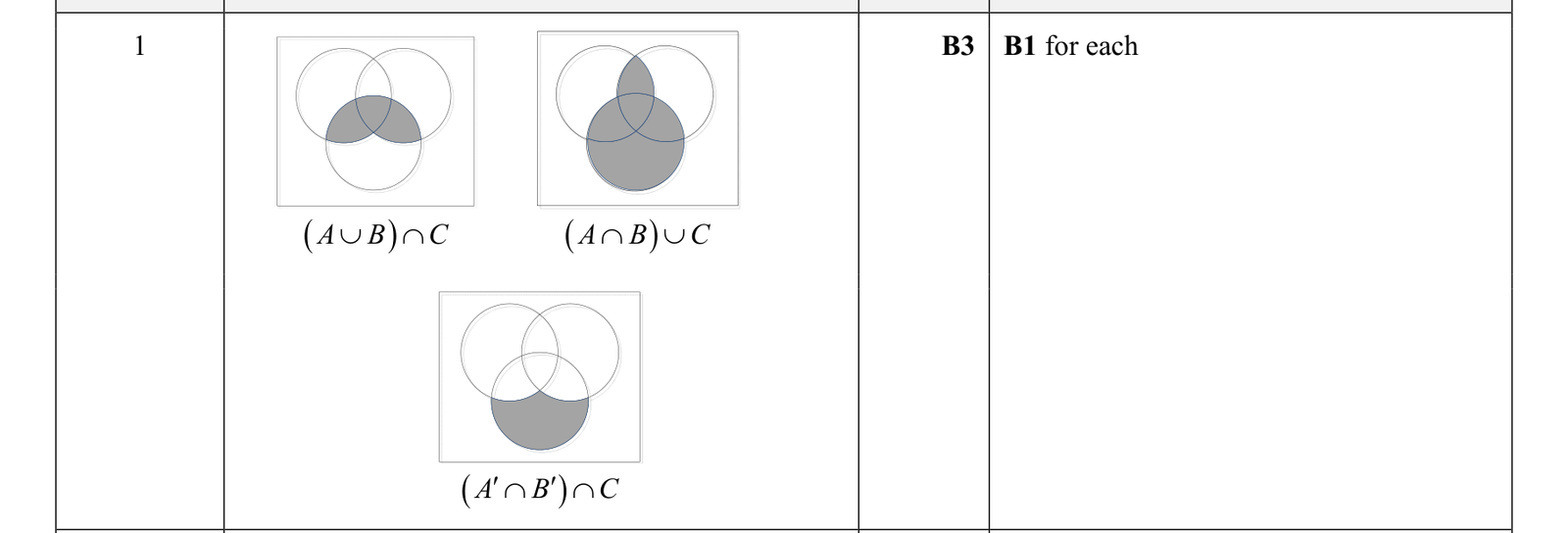
On each of the Venn diagrams, shade the region which represents the given set.
\((A\cup B)\cap C,\qquad (A\cap B)\cup C,\qquad (A'\cap B')\cap C\)
0606 P13 - Jun 2017 - Q1 - 2 marks
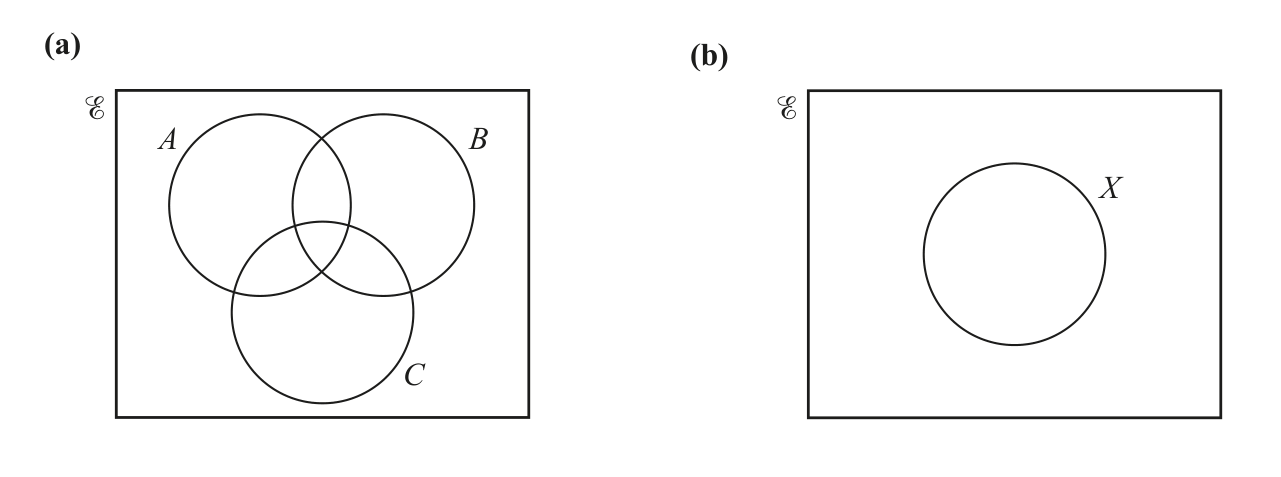
(a) On the Venn diagram below, shade the region which represents
\((A\cap B')\cup(C\cap B').\)
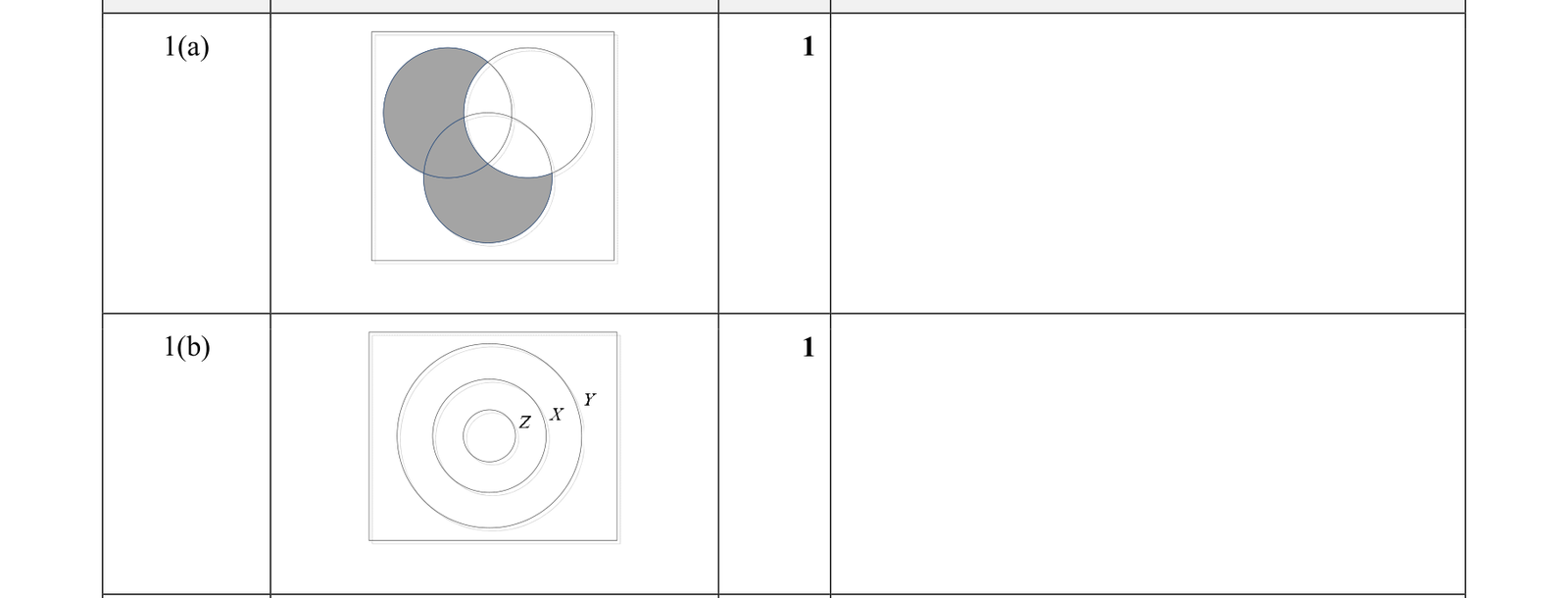
(b) Complete the Venn diagram below to show the sets \(Y\) and \(Z\) such that
\(Z\subset X\subset Y.\)
0606 P21 - Jun 2017 - Q7 - 6 marks
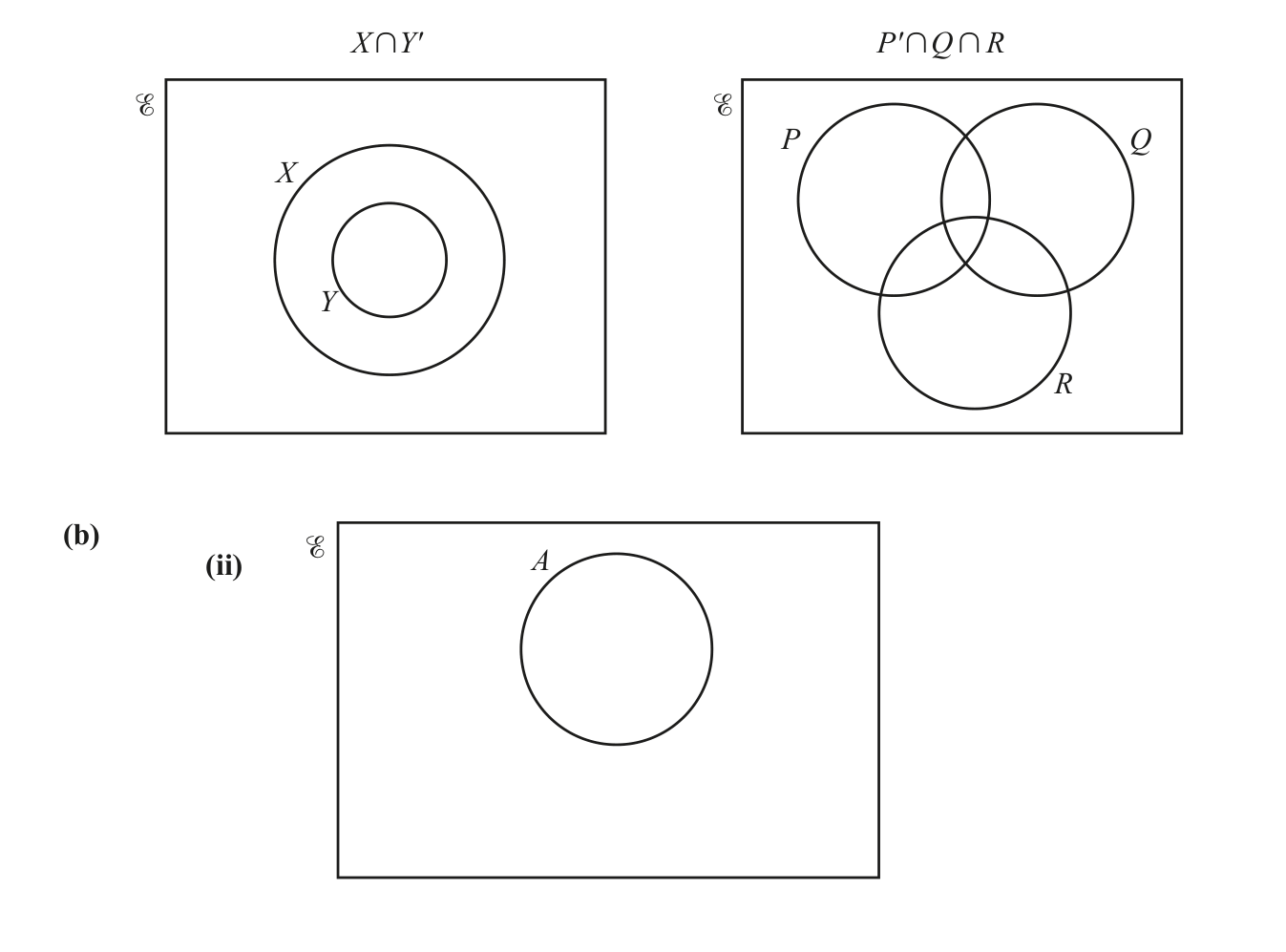
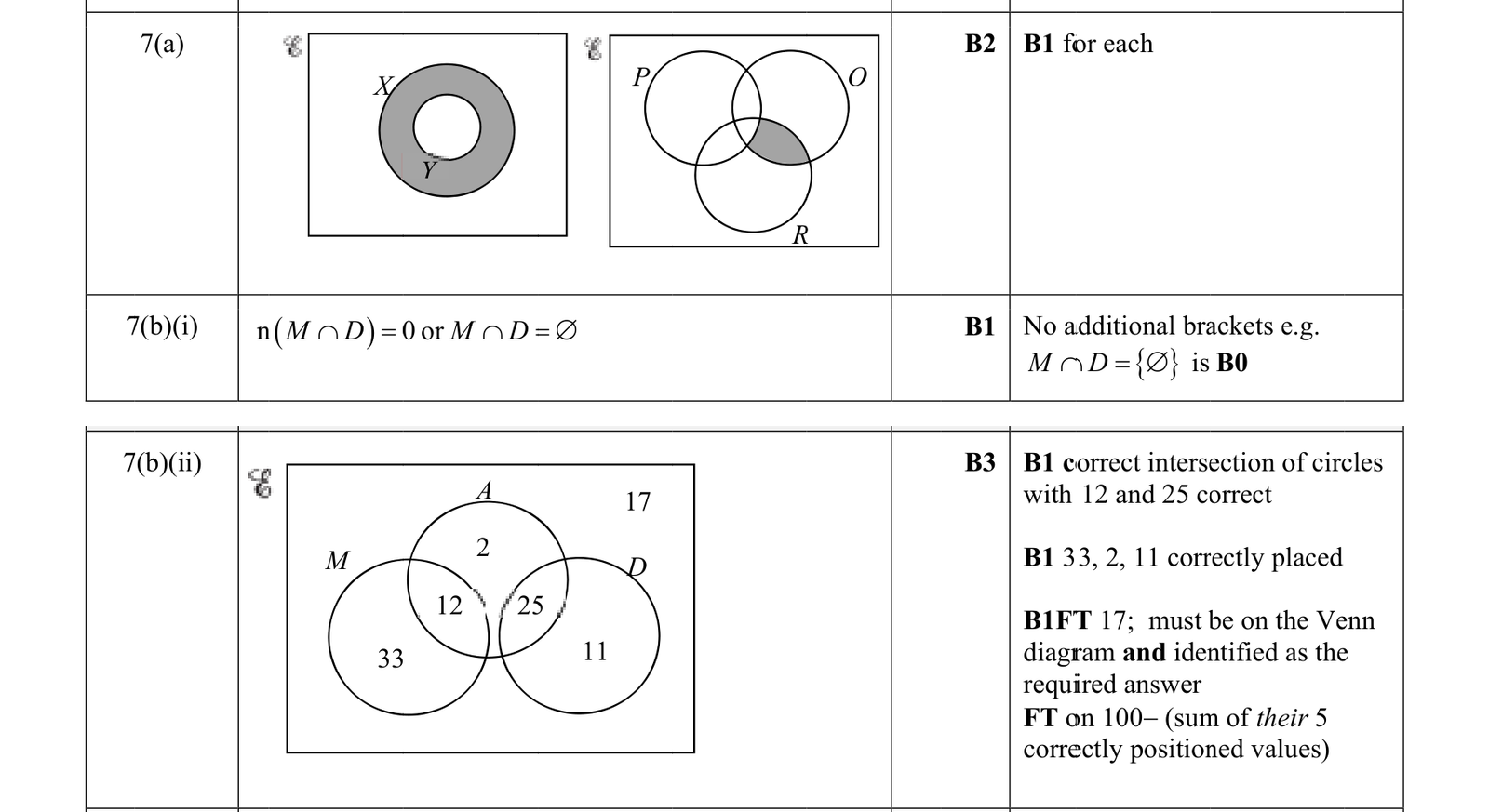
(a) On each of the Venn diagrams shown, shade the region which represents the given set.
(b) In a group of students, each student studies at most two of art, music and design. No student studies both music and design.
\(A\) denotes the set of students who study art, \(M\) denotes the set of students who study music, and \(D\) denotes the set of students who study design.
(i) Write the following using set notation: No student studies both music and design.
There are \(100\) students in the group. \(39\) students study art, \(45\) study music and \(36\) study design. \(12\) students study both art and music. \(25\) students study both art and design.
(ii) Complete the Venn diagram below to represent this information and hence find the number of students in the group who do not study any of these subjects.
0606 P11 - Nov 2017 - Q1 - 3 marks
Express in set notation the shaded regions shown in the Venn diagrams.