Answer: \(a=150\), range \(0\leqslant \mathrm{g}\mathrm{f}(x)\leqslant\frac1{\sqrt2}\); \(\mathrm{g}^2\) does not exist.
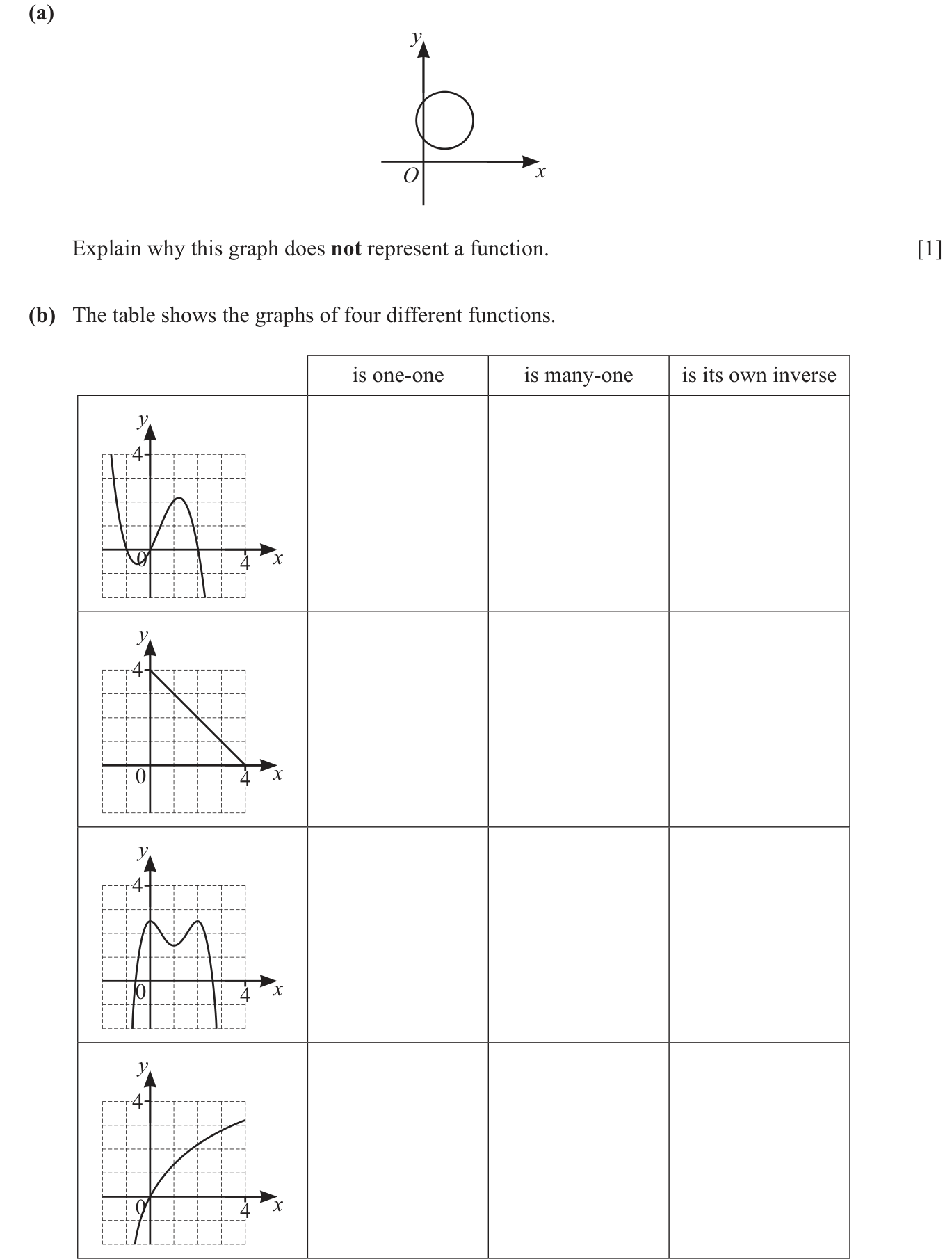
(b) Use the horizontal line test to decide whether a relation is one-one or many-one. A relation is one-one if no horizontal line cuts its graph more than once; otherwise it is many-one.
From the given diagrams, the relation with repeated horizontal values is many-one. The straight line \(y=4-x\) is one-one, and it is its own inverse because reflecting it in the line \(y=x\) gives the same line. The multi-turn curve is many-one. The increasing curve is one-one.
(c) The composite function \(\mathrm g\mathrm f\) exists only if every output of \(\mathrm f\) is allowed as an input of \(\mathrm g\).
The domain of \(\mathrm g\) is
\(x\geqslant\dfrac12.\)
Since \(\mathrm f(x)=\sin x\), we need
\(\sin x\geqslant\dfrac12\)
for every \(x\) in the interval \(30^\circ\leqslant x\leqslant a^\circ\).
Starting at \(30^\circ\), the largest interval for which \(\sin x\geqslant\dfrac12\) is
\(30^\circ\leqslant x\leqslant150^\circ.\)
Hence the largest possible value is
\(a=150.\)
Now
\(\mathrm g\mathrm f(x)=\sqrt{\sin x-\dfrac12}.\)
On \(30^\circ\leqslant x\leqslant150^\circ\), the smallest value of \(\sin x\) is \(\dfrac12\), and the largest value is \(1\). Therefore
\(0\leqslant \sin x-\dfrac12\leqslant\dfrac12.\)
Taking square roots, the range of \(\mathrm g\mathrm f\) is
\(0\leqslant \mathrm g\mathrm f(x)\leqslant\dfrac1{\sqrt2}.\)
For \(\mathrm g^2\) to exist, the range of \(\mathrm g\) must be a subset of the domain of \(\mathrm g\). The range of \(\mathrm g\) is \([0,\infty)\), while the domain is \([\frac12,\infty)\). Since values such as \(0\) are outputs of \(\mathrm g\) but are not in the domain of \(\mathrm g\), \(\mathrm g^2\) does not exist.