Past Exam Questions
← Back9231 P11 - Jun 2011 - Q2 - 6 marks
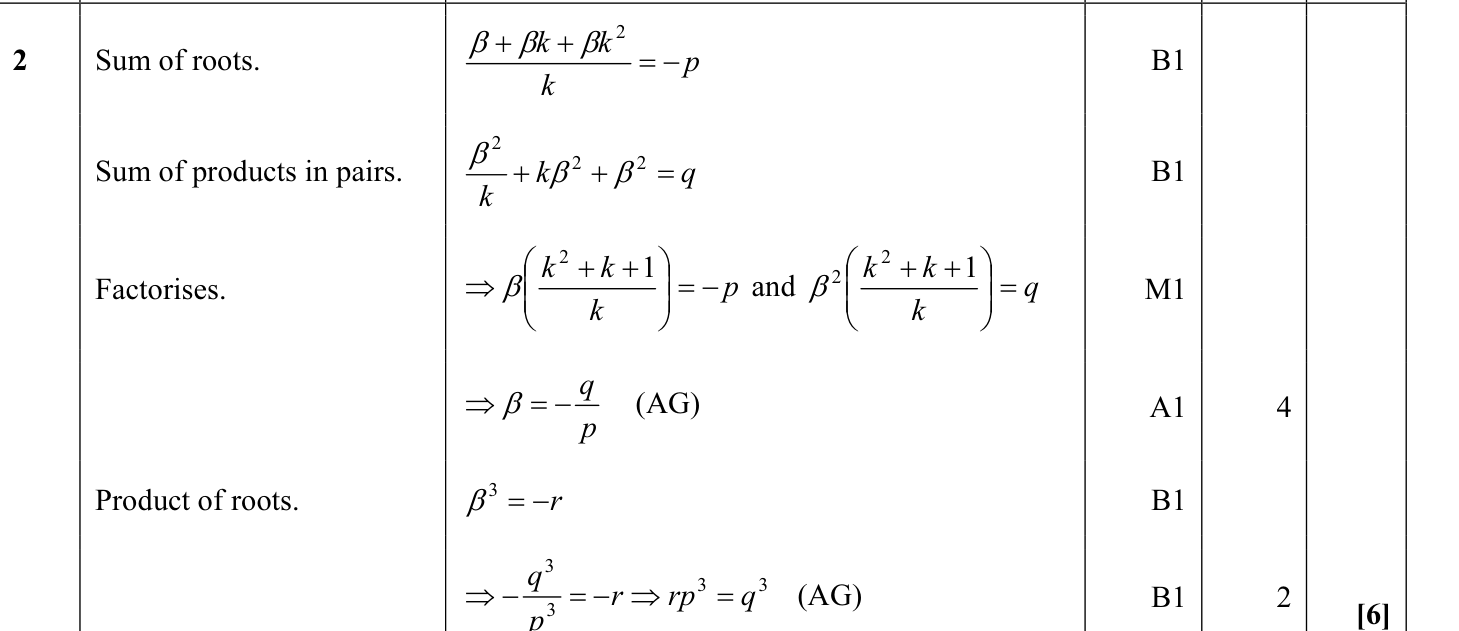
The roots of the equation
\(x^{3}+p x^{2}+q x+r=0\)
are \(\frac{\beta}{k}, \beta, k \beta\), where \(p, q, r, k\) and \(\beta\) are non-zero real constants. Show that \(\beta=-\frac{q}{p}\).
Deduce that \(r p^{3}=q^{3}\).
9231 P13 - Jun 2012 - Q8 - 10 marks
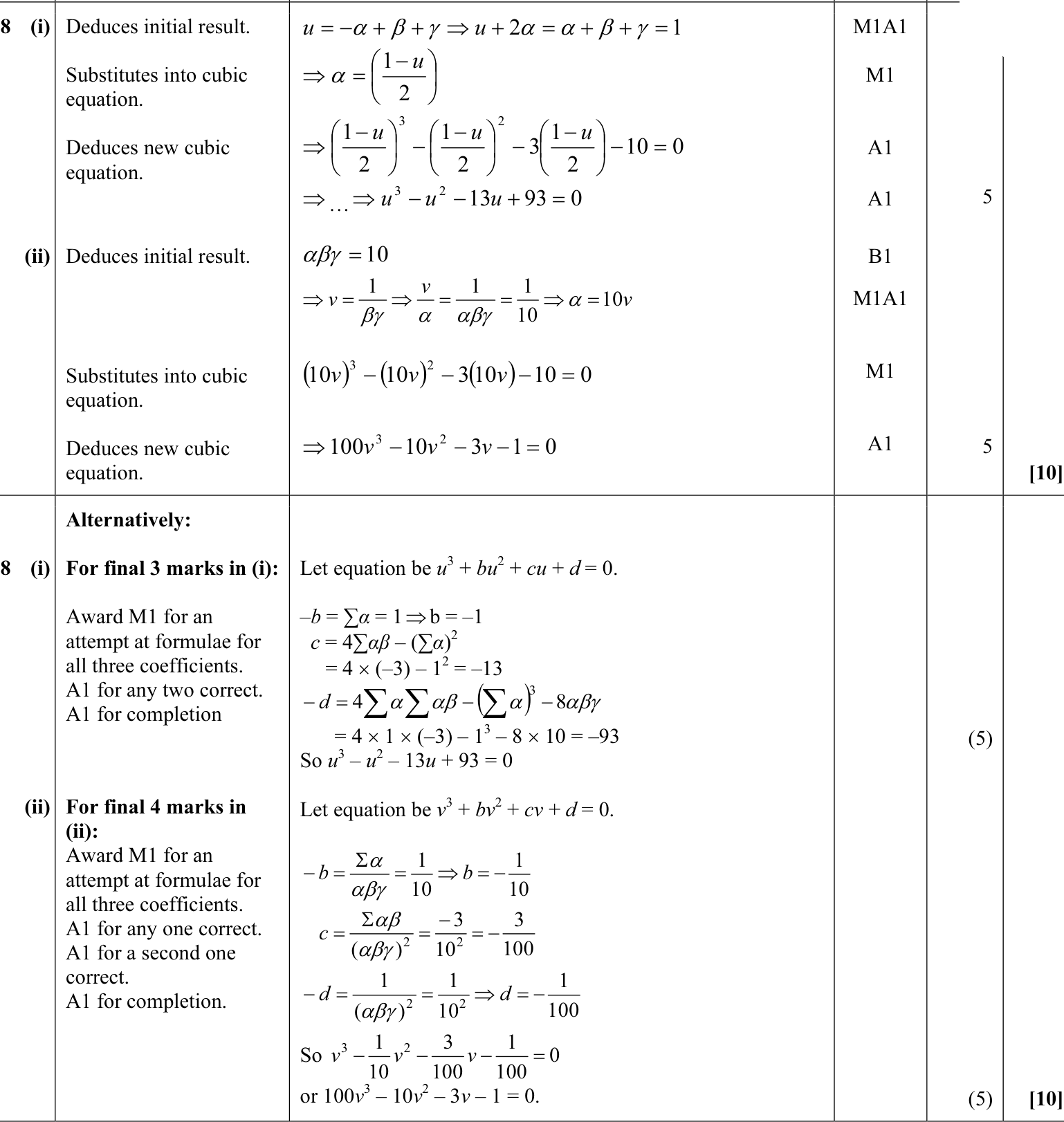
The cubic equation \(x^{3}-x^{2}-3 x-10=0\) has roots \(\alpha, \beta, \gamma\).
(i) Let \(u=-\alpha+\beta+\gamma\). Show that \(u+2 \alpha=1\), and hence find a cubic equation having roots \(-\alpha+\beta+\gamma\), \(\alpha-\beta+\gamma, \alpha+\beta-\gamma\).
(ii) State the value of \(\alpha \beta \gamma\) and hence find a cubic equation having roots \(\frac{1}{\beta \gamma}, \frac{1}{\gamma \alpha}, \frac{1}{\alpha \beta}\).
9231 P12 - Jun 2014 - Q1 - 5 marks
The equation \(x^{3}+p x+q=0\), where \(p\) and \(q\) are constants, with \(q \neq 0\), has one root which is the reciprocal of another root. Prove that \(p+q^{2}=1\).

9231 P13 - Nov 2012 - Q7 - 8 marks
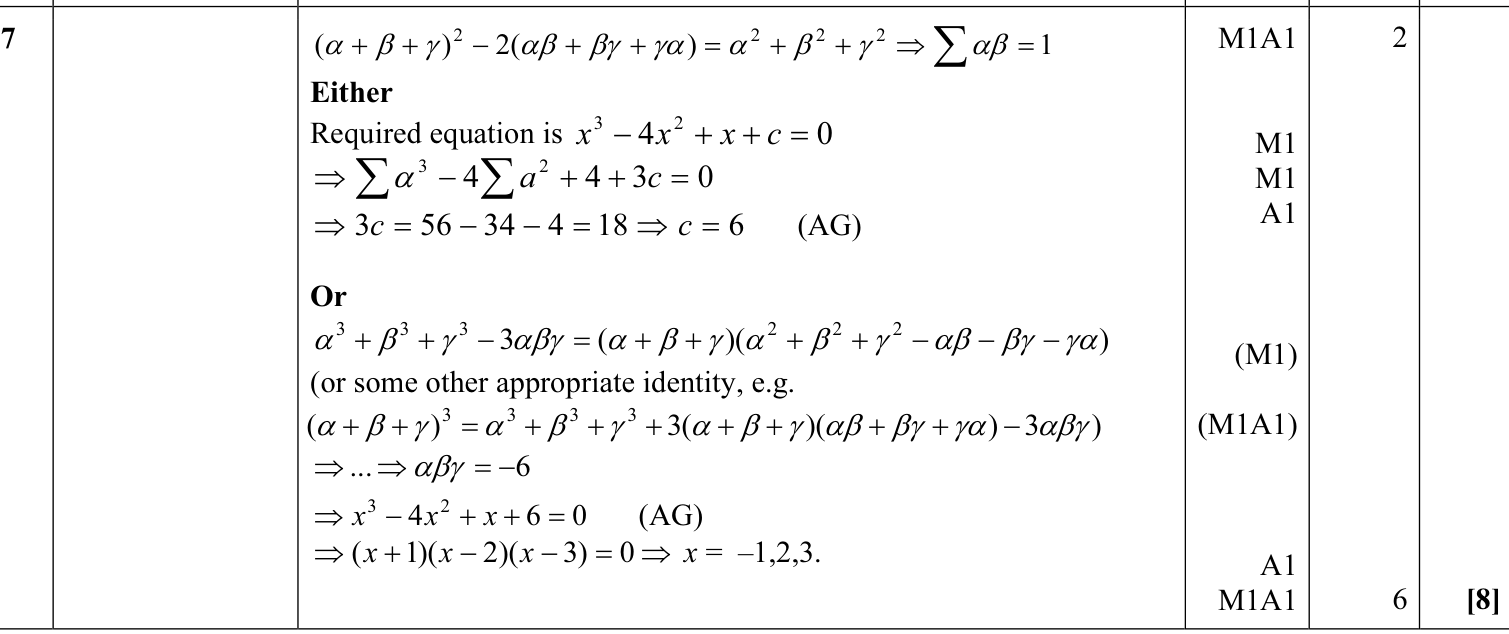
A cubic equation has roots \(\alpha, \beta\) and \(\gamma\) such that
\(\begin{aligned} \alpha+\beta+\gamma & =4, \\ \alpha^{2}+\beta^{2}+\gamma^{2} & =14, \\ \alpha^{3}+\beta^{3}+\gamma^{3} & =34 . \end{aligned}\)
Find the value of \(\alpha \beta+\beta \gamma+\gamma \alpha\).
Show that the cubic equation is
\(x^{3}-4 x^{2}+x+6=0\)
and solve this equation.
9231 P11 - Jun 2010 - Q6 - 9 marks
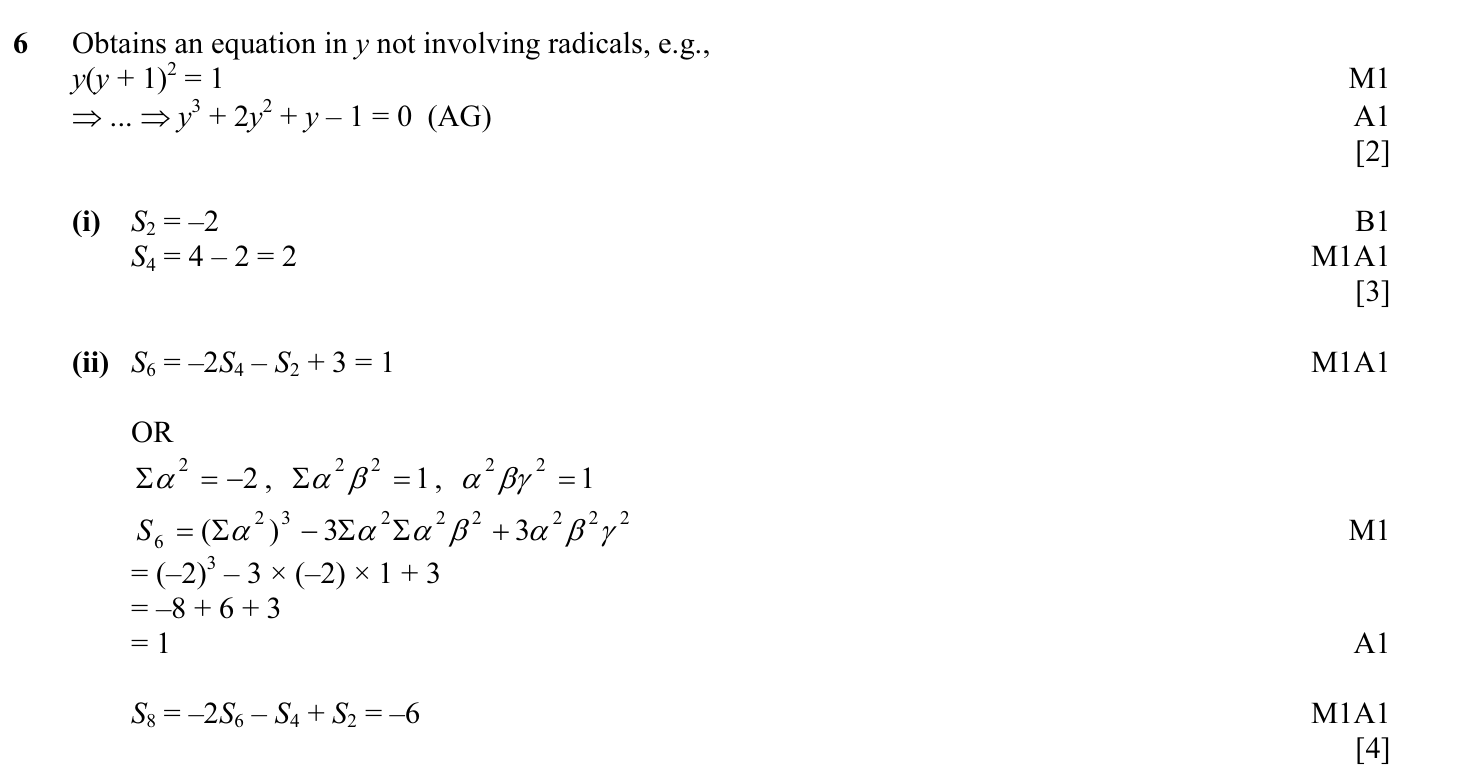
The equation
\(x^{3}+x-1=0\)
has roots \(\alpha, \beta, \gamma\). Use the relation \(x=\sqrt{ } y\) to show that the equation
\(y^{3}+2 y^{2}+y-1=0\)
has roots \(\alpha^{2}, \beta^{2}, \gamma^{2}\).
Let \(S_{n}=\alpha^{n}+\beta^{n}+\gamma^{n}\).
(i) Write down the value of \(S_{2}\) and show that \(S_{4}=2\).
(ii) Find the values of \(S_{6}\) and \(S_{8}\).
9231 P13 - Jun 2011 - Q3 - 6 marks
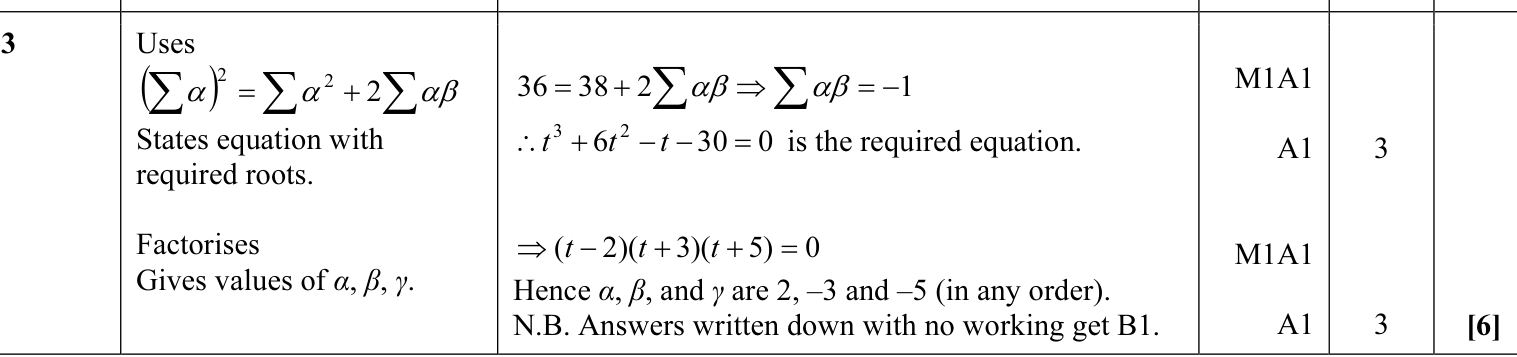
Find a cubic equation with roots \(\alpha, \beta\) and \(\gamma\), given that
\(\alpha+\beta+\gamma=-6, \quad \alpha^{2}+\beta^{2}+\gamma^{2}=38, \quad \alpha \beta \gamma=30 .\)
Hence find the numerical values of the roots.
9231 P11 - Nov 2011 - Q1 - 7 marks
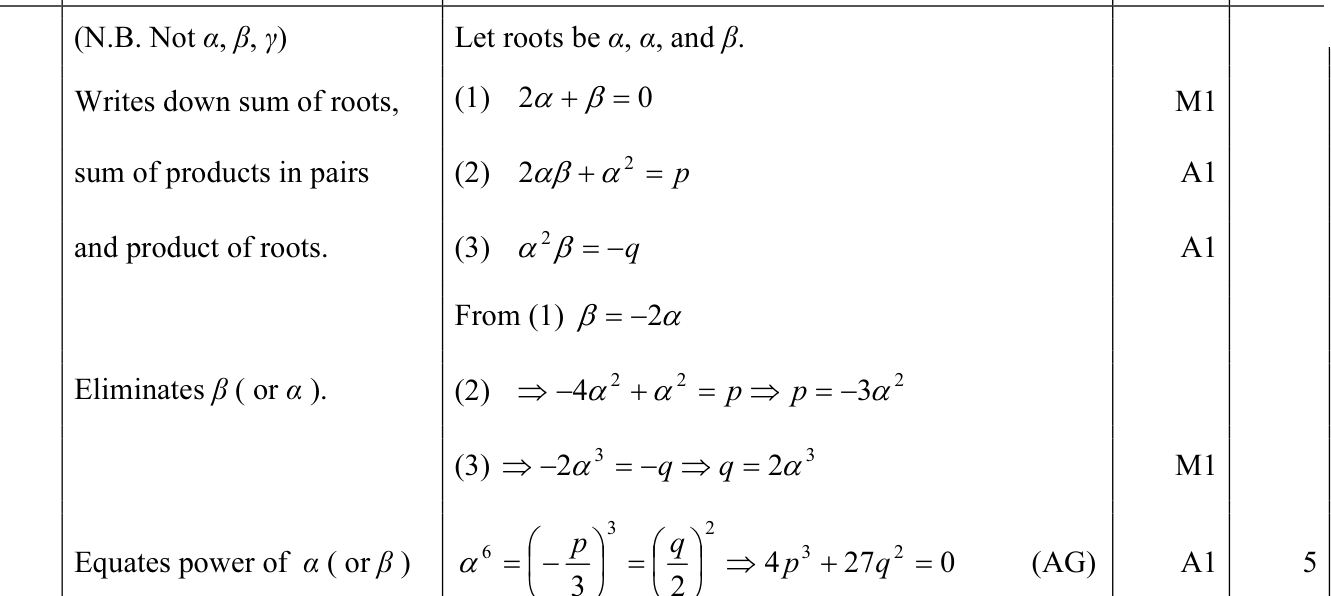
The equation \(x^{3}+p x+q=0\) has a repeated root. Prove that \(4 p^{3}+27 q^{2}=0\).
9231 P13 - Nov 2011 - Q3 - 7 marks
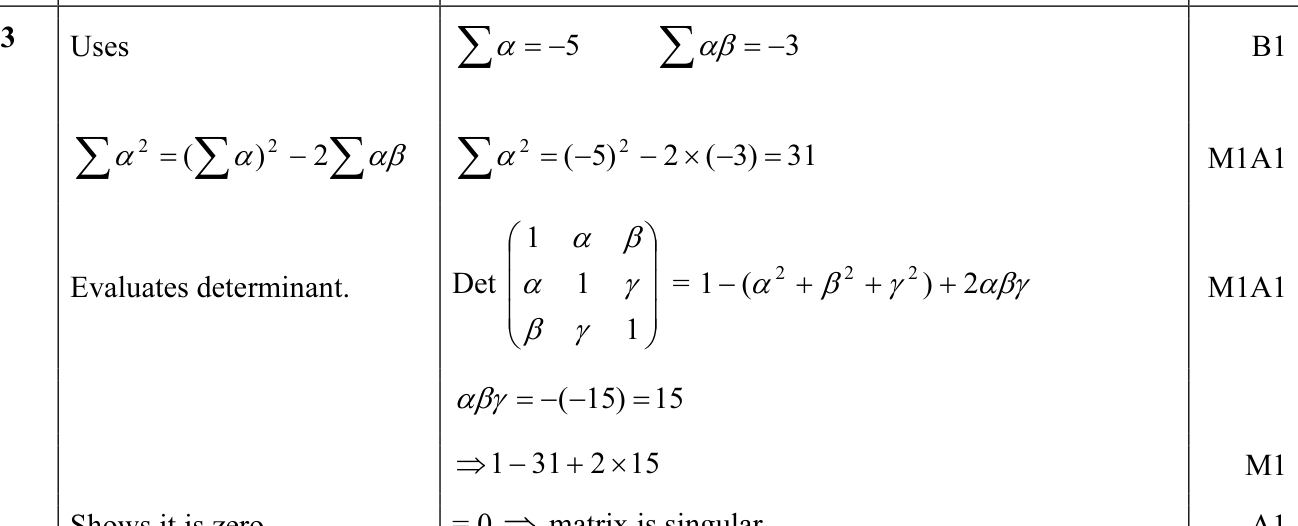
The equation
\(x^{3}+5 x^{2}-3 x-15=0\)
has roots \(\alpha, \beta, \gamma\). Find the value of \(\alpha^{2}+\beta^{2}+\gamma^{2}\).
Hence show that the matrix \(\left(\begin{array}{ccc}1 & \alpha & \beta \\ \alpha & 1 & \gamma \\ \beta & \gamma & 1\end{array}\right)\) is singular.
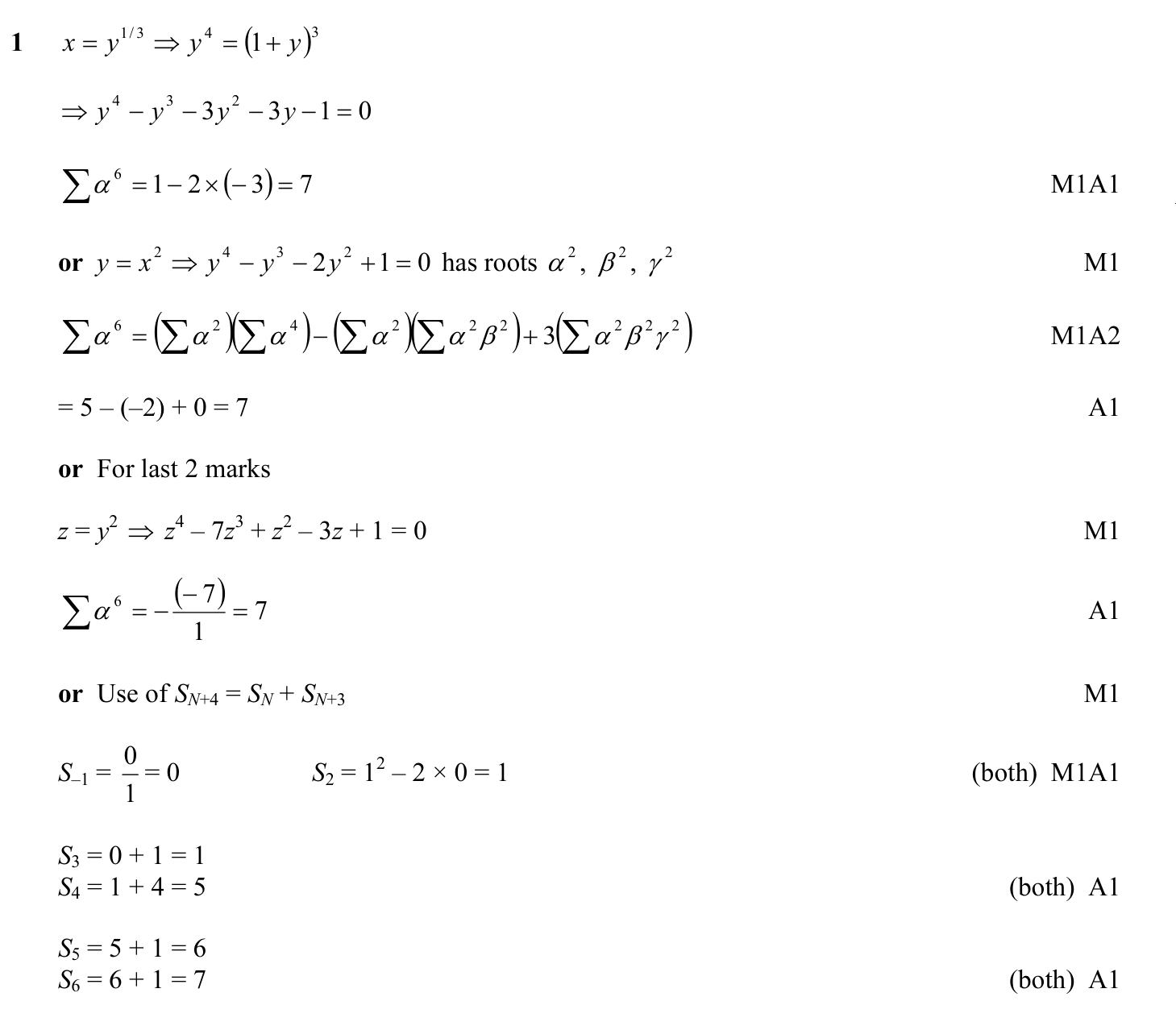
9231 P1 - Jun 2009 - Q1 - 5 marks
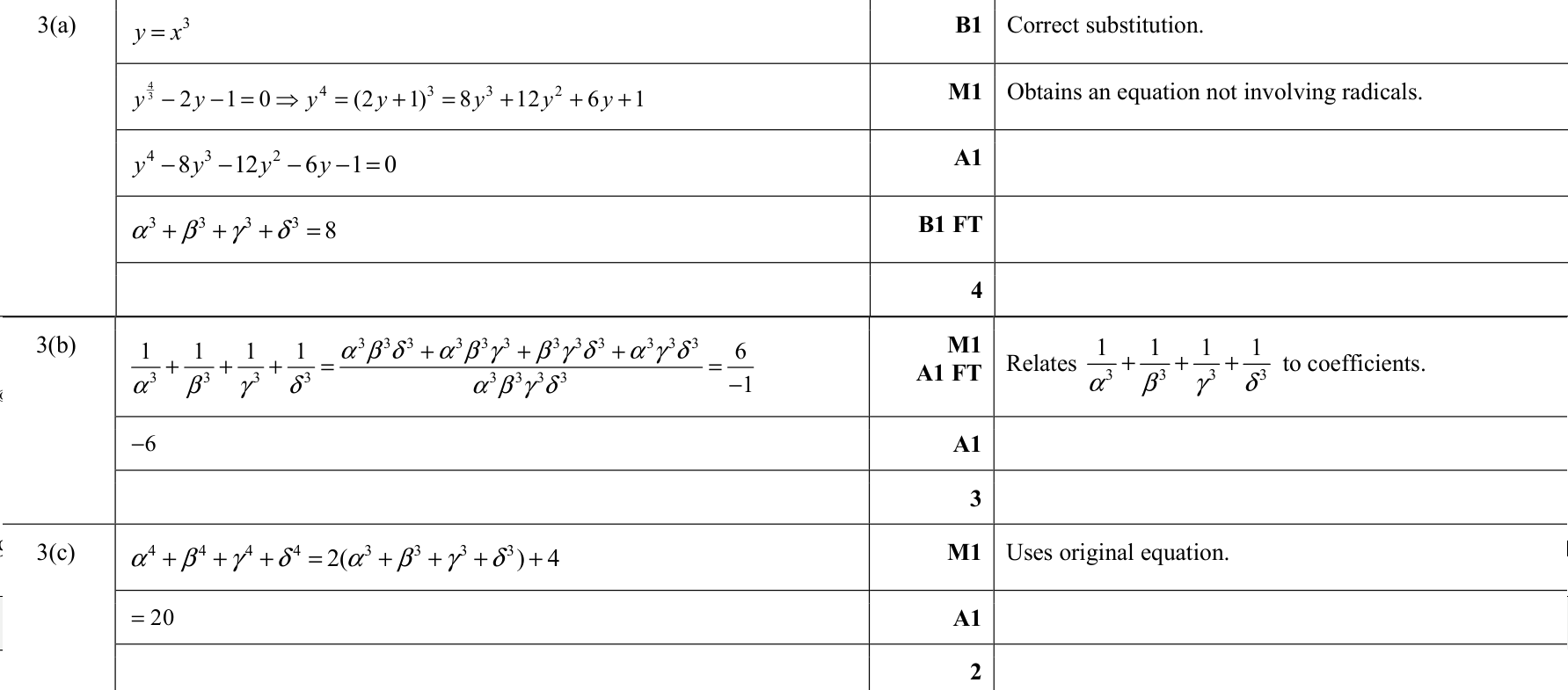
The equation
\(x^{4}-x^{3}-1=0\)
has roots \(\alpha, \beta, \gamma, \delta\). By using the substitution \(y=x^{3}\), or by any other method, find the exact valu. \(\alpha^{6}+\beta^{6}+\gamma^{6}+\delta^{6}\).
9231 P13 - Jun 2010 - Q5 - 8 marks
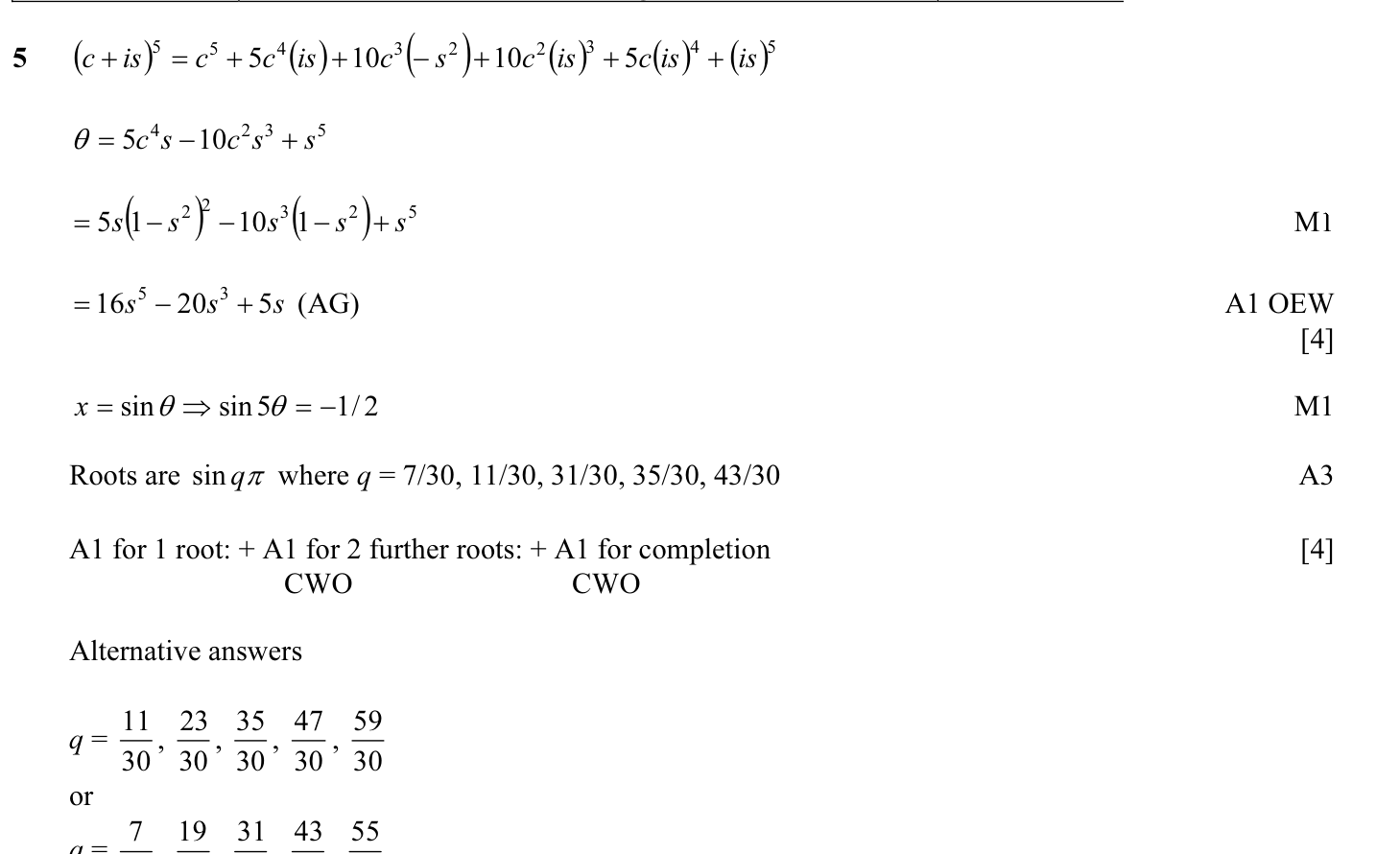
Use de Moivre's theorem to show that
\(\sin 5 \theta=16 \sin ^{5} \theta-20 \sin ^{3} \theta+5 \sin \theta .\)
Hence find all the roots of the equation
\(32 x^{5}-40 x^{3}+10 x+1=0\)
in the form \(\sin (q \pi)\), where \(q\) is a positive rational number.
9231 P13 - Jun 2010 - Q10 - 10 marks
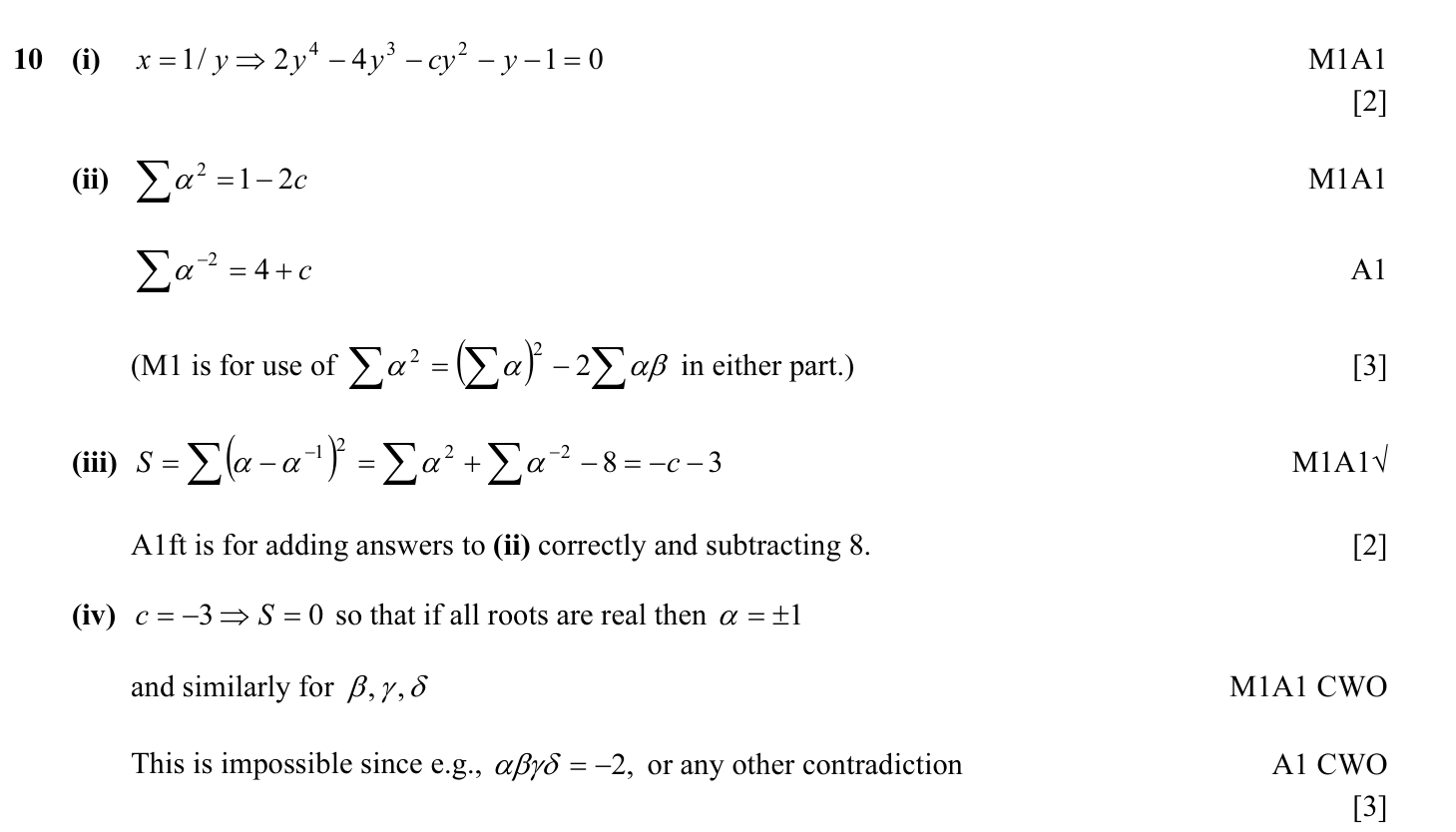
The equation
\(x^{4}+x^{3}+c x^{2}+4 x-2=0,\)
where \(c\) is a constant, has roots \(\alpha, \beta, \gamma, \delta\).
(i) Use the substitution \(y=\frac{1}{x}\) to find an equation which has roots \(\frac{1}{\alpha}, \frac{1}{\beta}, \frac{1}{\gamma}, \frac{1}{\delta}\).
(ii) Find, in terms of \(c\), the values of \(\alpha^{2}+\beta^{2}+\gamma^{2}+\delta^{2}\) and \(\frac{1}{\alpha^{2}}+\frac{1}{\beta^{2}}+\frac{1}{\gamma^{2}}+\frac{1}{\delta^{2}}\).
(iii) Hence find
\(\left(\alpha-\frac{1}{\alpha}\right)^{2}+\left(\beta-\frac{1}{\beta}\right)^{2}+\left(\gamma-\frac{1}{\gamma}\right)^{2}+\left(\delta-\frac{1}{\delta}\right)^{2}\)
in terms of \(c\).
(iv) Deduce that when \(c=-3\) the roots of the given equation are not all real.
9231 P1 - Nov 2009 - Q5 - 9 marks
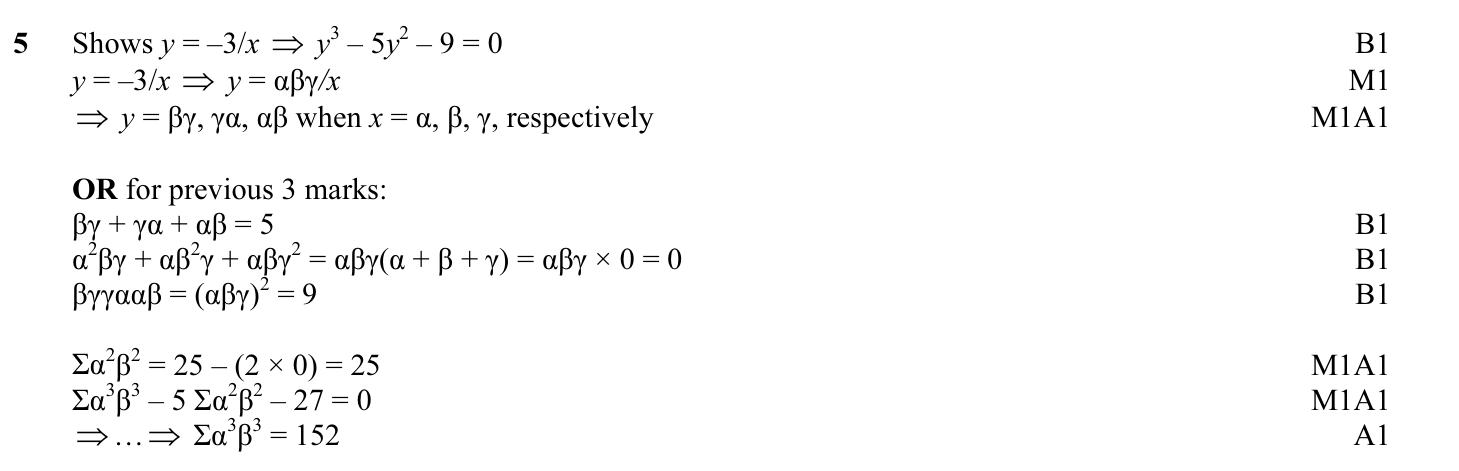
The equation
\(x^{3}+5 x+3=0\)
has roots \(\alpha, \beta, \gamma\). Use the substitution \(x=-\frac{3}{y}\) to find a cubic equation in \(y\) and show that the roots of this equation are \(\beta \gamma, \gamma \alpha, \alpha \beta\).
Find the exact values of \(\beta^{2} \gamma^{2}+\gamma^{2} \alpha^{2}+\alpha^{2} \beta^{2}\) and \(\beta^{3} \gamma^{3}+\gamma^{3} \alpha^{3}+\alpha^{3} \beta^{3}\).
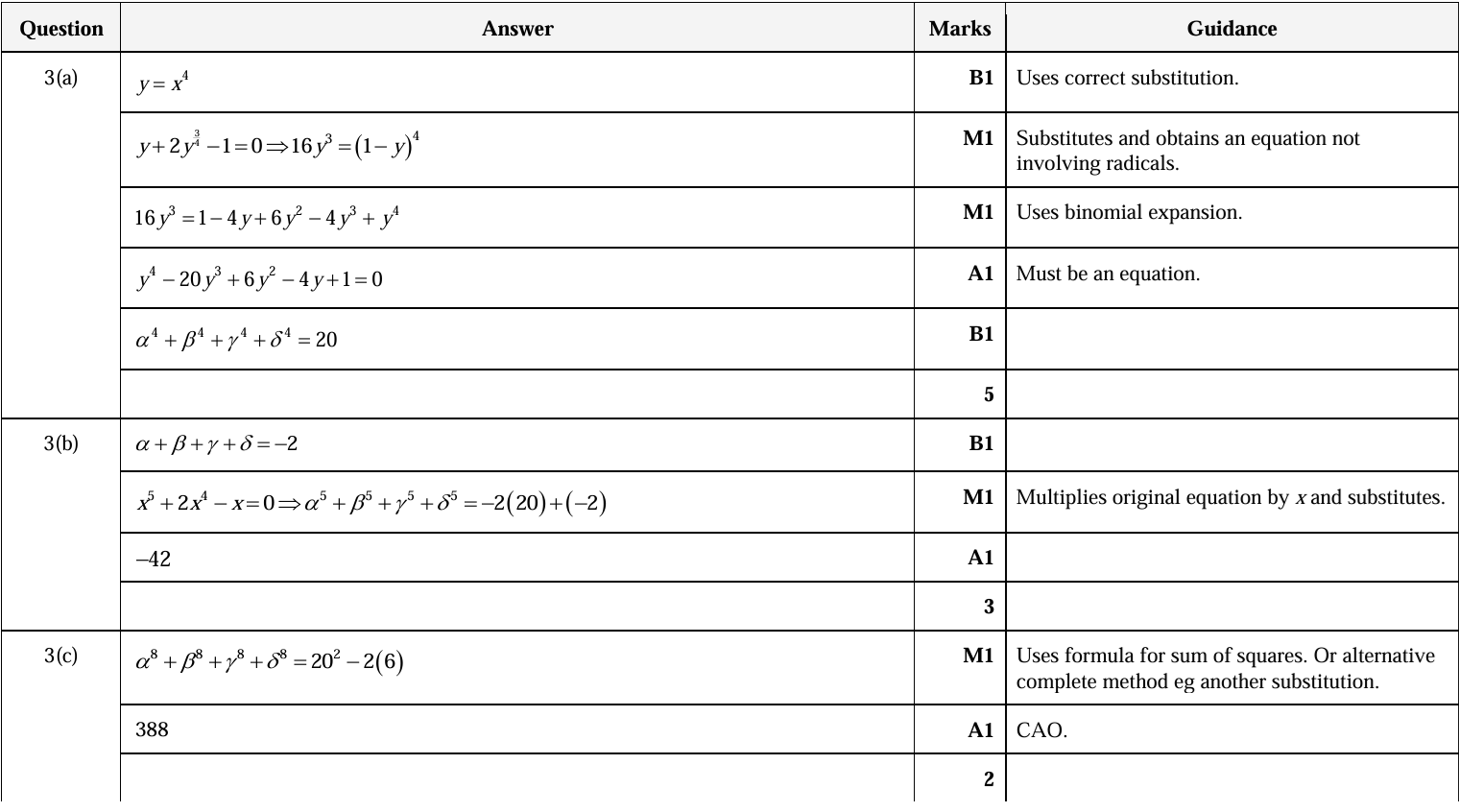
9231 P11 - Nov 2024 - Q03 - 10 marks
The quartic equation \(x^4 + 2x^3 - 1 = 0\) has roots \(\alpha, \beta, \gamma, \delta\).
(a) Find a quartic equation whose roots are \(\alpha^4, \beta^4, \gamma^4, \delta^4\) and state the value of \(\alpha^4 + \beta^4 + \gamma^4 + \delta^4\).
(b) Find the value of \(\alpha^5 + \beta^5 + \gamma^5 + \delta^5\).
(c) Find the value of \(\alpha^8 + \beta^8 + \gamma^8 + \delta^8\).
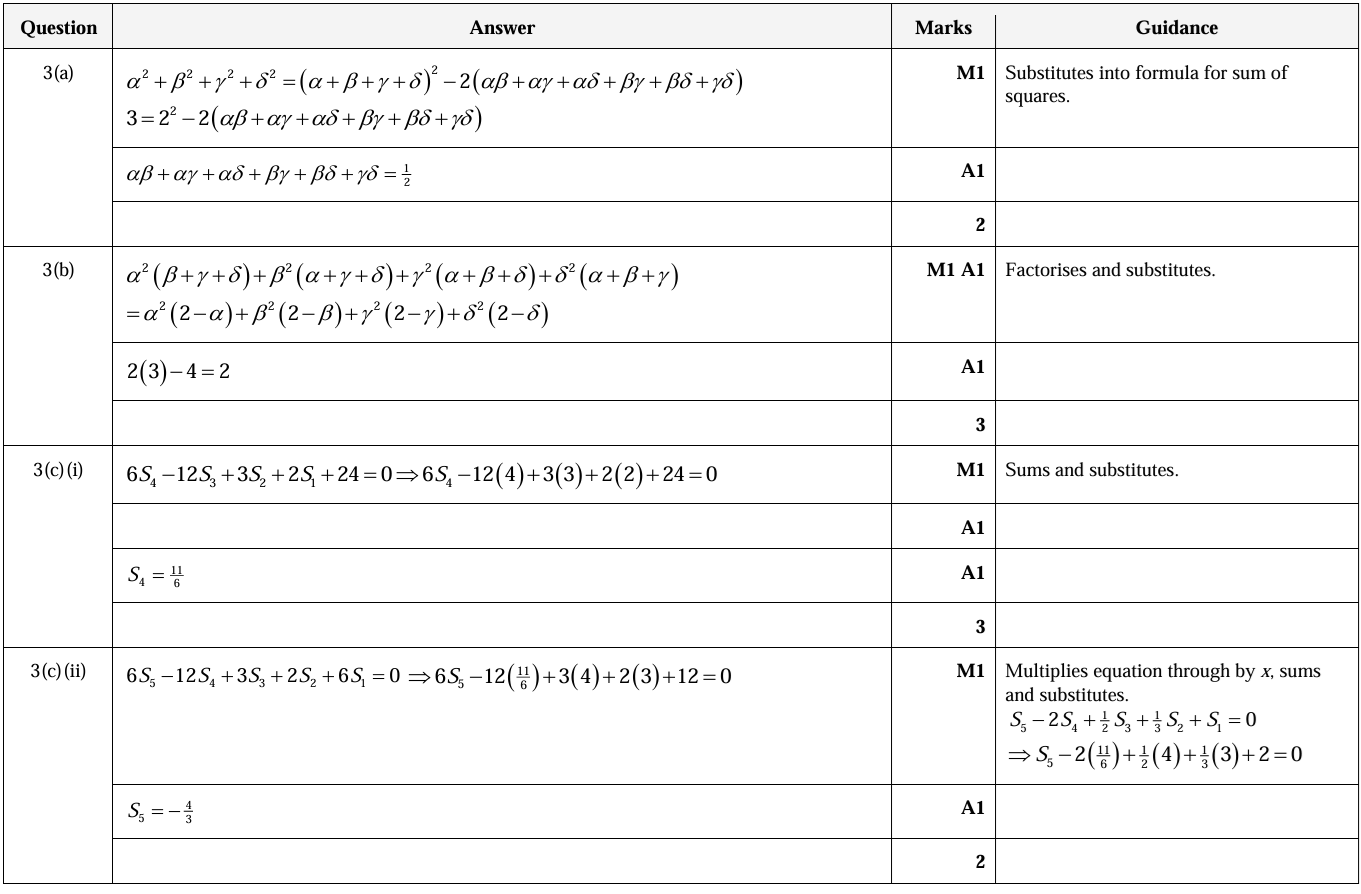
9231 P12 - Nov 2024 - Q03 - 10 marks
It is given that
\(\alpha + \beta + \gamma + \delta = 2,\)
\(\alpha^2 + \beta^2 + \gamma^2 + \delta^2 = 3,\)
\(\alpha^3 + \beta^3 + \gamma^3 + \delta^3 = 4.\)
(a) Find the value of \(\alpha \beta + \alpha \gamma + \alpha \delta + \beta \gamma + \beta \delta + \gamma \delta.\)
(b) Find the value of \(\alpha^2 \beta + \alpha^2 \gamma + \alpha^2 \delta + \beta^2 \alpha + \beta^2 \gamma + \beta^2 \delta + \gamma^2 \alpha + \gamma^2 \beta + \gamma^2 \delta + \delta^2 \alpha + \delta^2 \beta + \delta^2 \gamma.\)
(c) It is given that \(\alpha, \beta, \gamma, \delta\) are the roots of the equation
\(6x^4 - 12x^3 + 3x^2 + 2x + 6 = 0.\)
(i) Find the value of \(\alpha^4 + \beta^4 + \gamma^4 + \delta^4.\)
(ii) Find the value of \(\alpha^5 + \beta^5 + \gamma^5 + \delta^5.\)
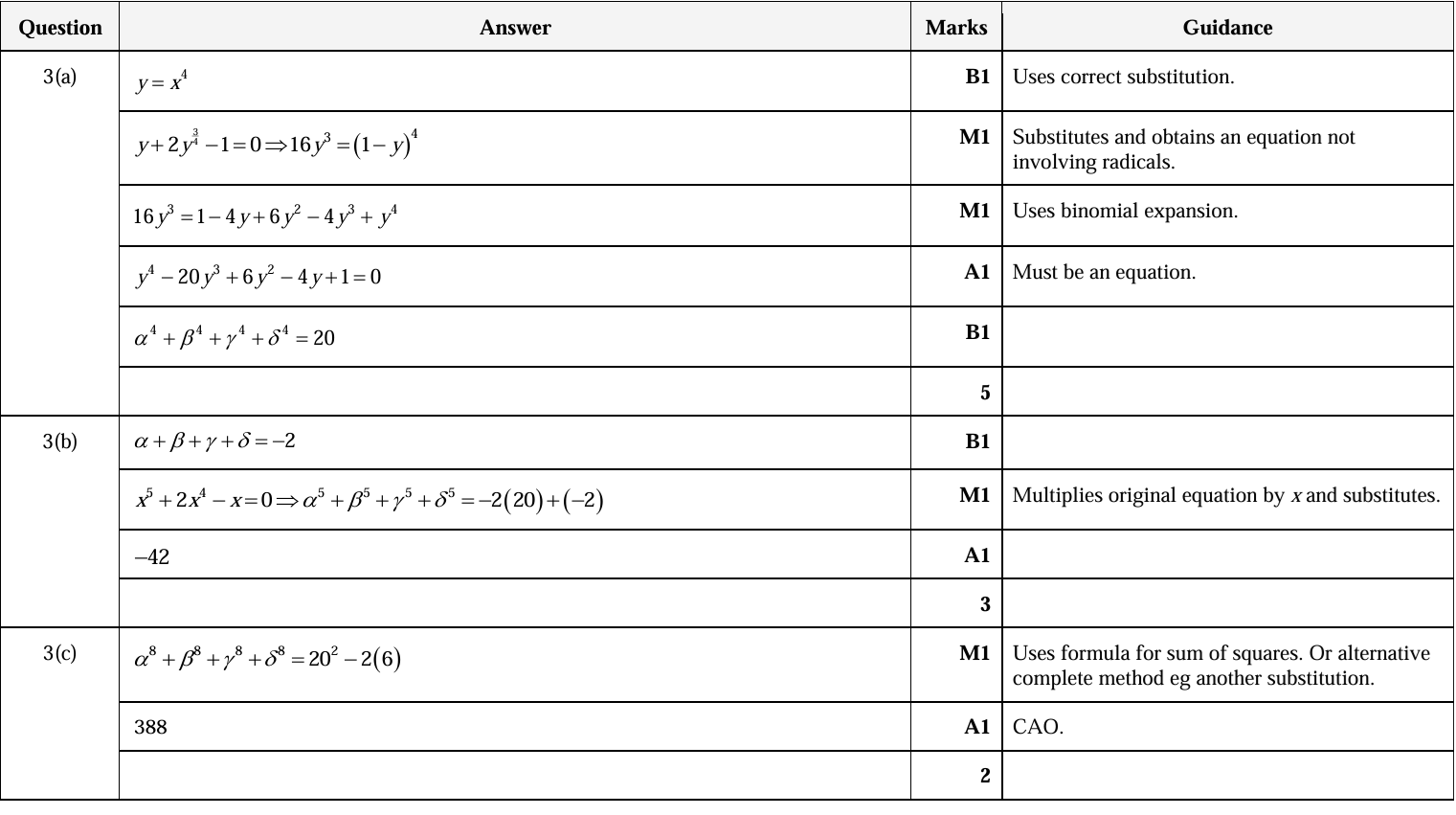
9231 P13 - Nov 2024 - Q03 - 10 marks
The quartic equation \(x^4 + 2x^3 - 1 = 0\) has roots \(\alpha, \beta, \gamma, \delta\).
(a) Find a quartic equation whose roots are \(\alpha^4, \beta^4, \gamma^4, \delta^4\) and state the value of \(\alpha^4 + \beta^4 + \gamma^4 + \delta^4\).
(b) Find the value of \(\alpha^5 + \beta^5 + \gamma^5 + \delta^5\).
(c) Find the value of \(\alpha^8 + \beta^8 + \gamma^8 + \delta^8\).
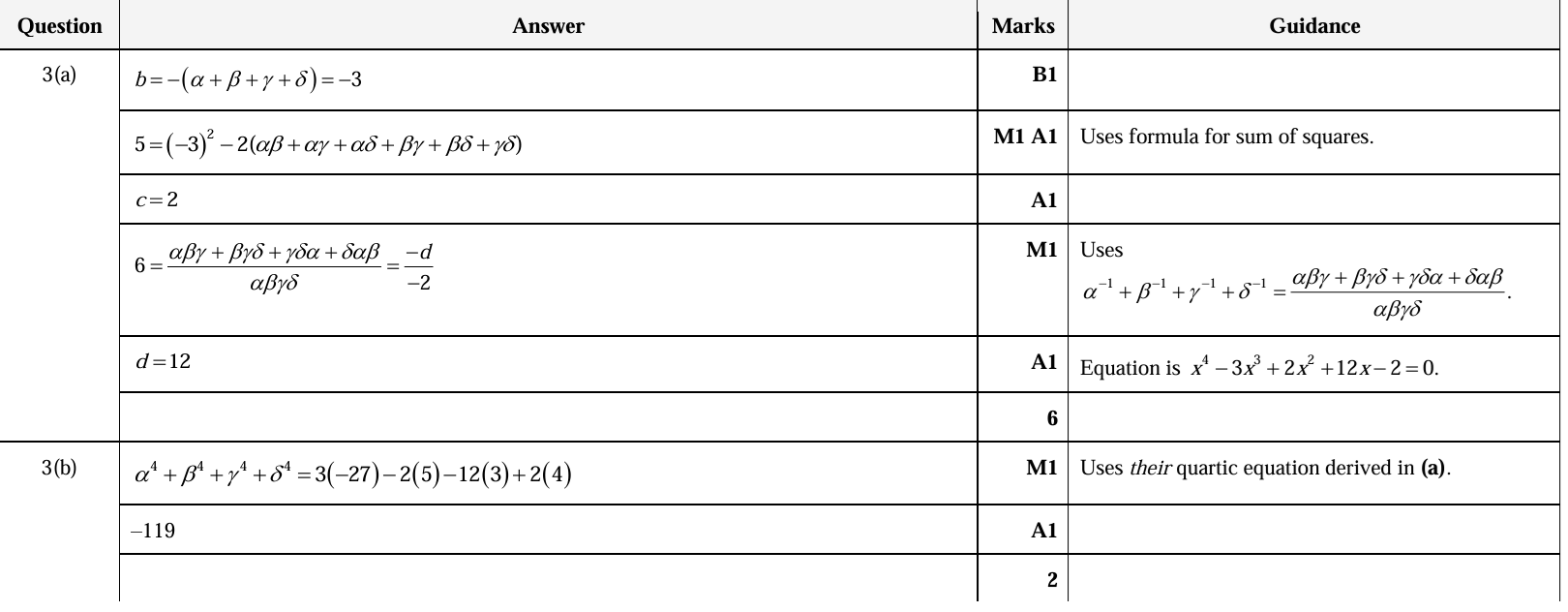
9231 P11 - Nov 2023 - Q03 - 8 marks
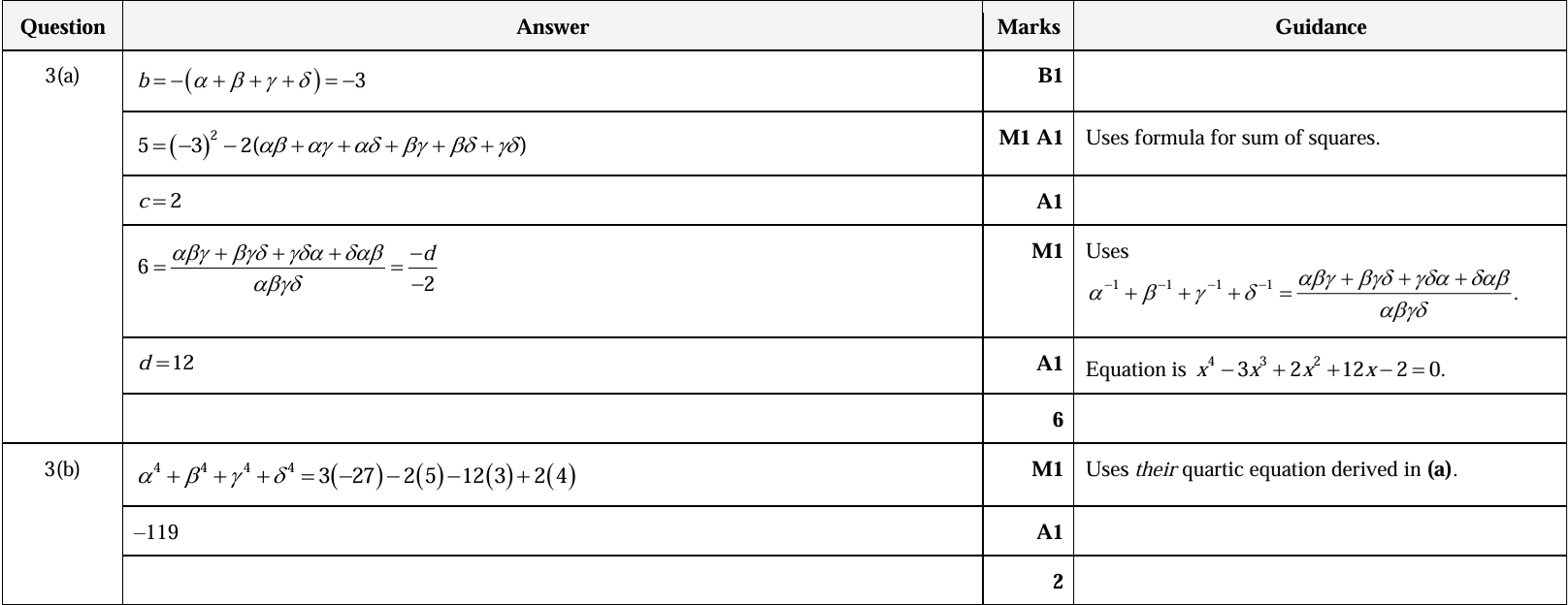
The quartic equation \(x^4 + bx^3 + cx^2 + dx - 2 = 0\) has roots \(\alpha, \beta, \gamma, \delta\). It is given that
\(\alpha + \beta + \gamma + \delta = 3,\)
\(\alpha^2 + \beta^2 + \gamma^2 + \delta^2 = 5,\)
\(\alpha^{-1} + \beta^{-1} + \gamma^{-1} + \delta^{-1} = 6.\)
(a) Find the values of \(b, c\) and \(d\).
(b) Given also that \(\alpha^3 + \beta^3 + \gamma^3 + \delta^3 = -27\), find the value of \(\alpha^4 + \beta^4 + \gamma^4 + \delta^4\).
9231 P13 - Nov 2023 - Q03 - 8 marks
The quartic equation \(x^4 + bx^3 + cx^2 + dx - 2 = 0\) has roots \(\alpha, \beta, \gamma, \delta\). It is given that
\(\alpha + \beta + \gamma + \delta = 3\),
\(\alpha^2 + \beta^2 + \gamma^2 + \delta^2 = 5\),
\(\alpha^{-1} + \beta^{-1} + \gamma^{-1} + \delta^{-1} = 6\).
(a) Find the values of \(b, c\) and \(d\).
(b) Given also that \(\alpha^3 + \beta^3 + \gamma^3 + \delta^3 = -27\), find the value of \(\alpha^4 + \beta^4 + \gamma^4 + \delta^4\).
9231 P13 - Jun 2023 - Q03 - 9 marks
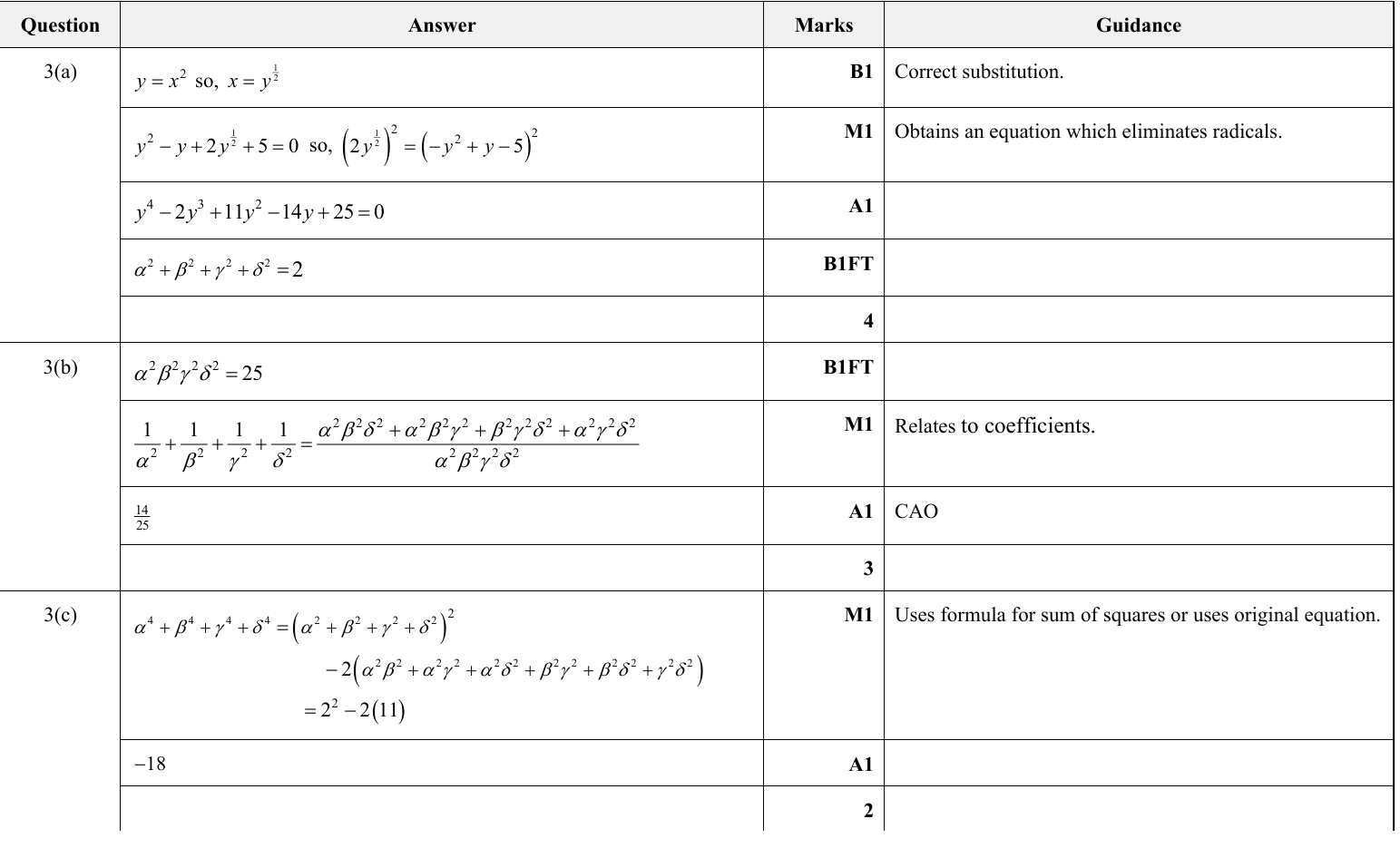
The equation \(x^4 - x^2 + 2x + 5 = 0\) has roots \(\alpha, \beta, \gamma, \delta\).
(a) Find a quartic equation whose roots are \(\alpha^2, \beta^2, \gamma^2, \delta^2\) and state the value of \(\alpha^2 + \beta^2 + \gamma^2 + \delta^2\).
(b) Find the value of \(\frac{1}{\alpha^2} + \frac{1}{\beta^2} + \frac{1}{\gamma^2} + \frac{1}{\delta^2}\).
(c) Find the value of \(\alpha^4 + \beta^4 + \gamma^4 + \delta^4\).
9231 P12 - Nov 2022 - Q02 - 9 marks
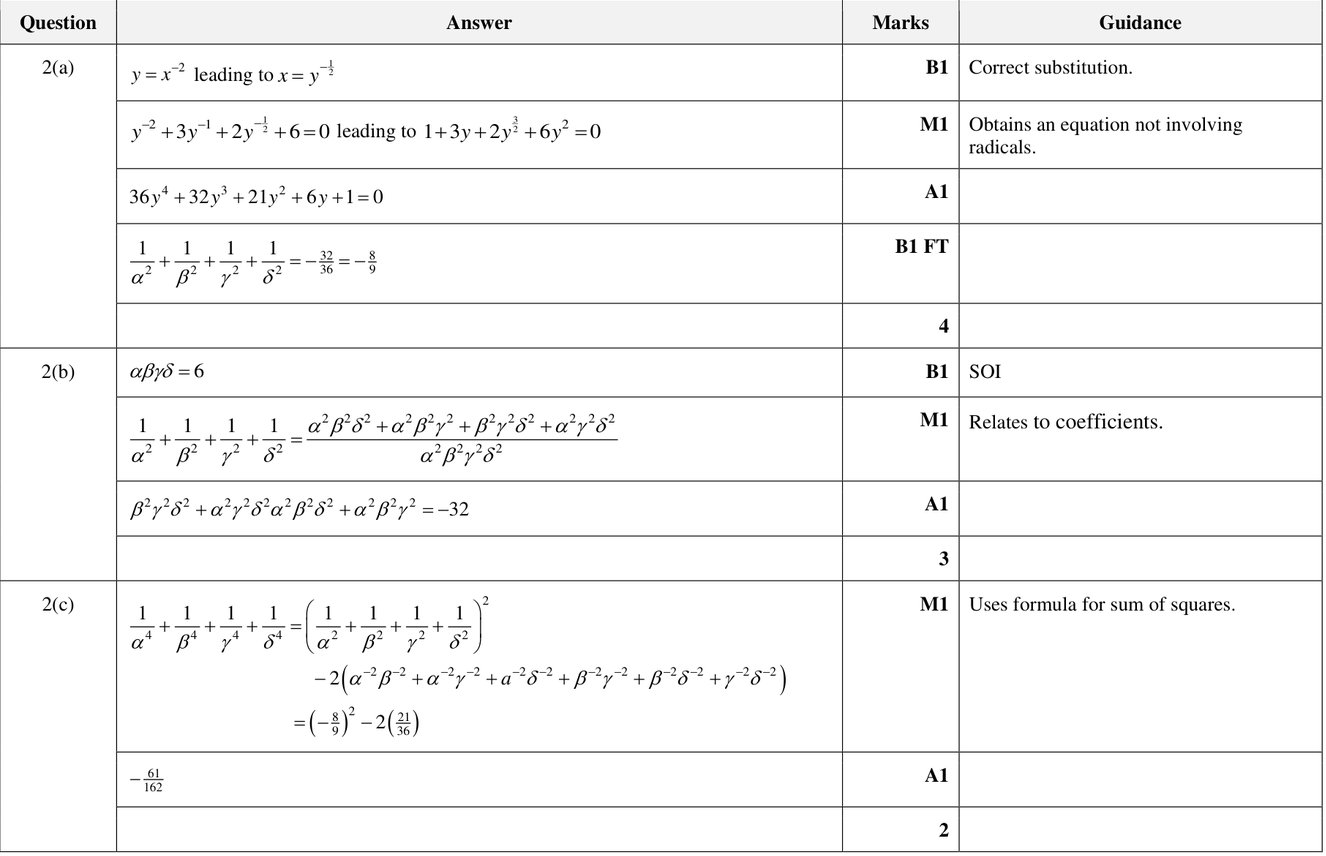
The equation \(x^4 + 3x^2 + 2x + 6 = 0\) has roots \(\alpha, \beta, \gamma, \delta\).
(a) Find a quartic equation whose roots are \(\frac{1}{\alpha^2}, \frac{1}{\beta^2}, \frac{1}{\gamma^2}, \frac{1}{\delta^2}\) and state the value of \(\frac{1}{\alpha^2} + \frac{1}{\beta^2} + \frac{1}{\gamma^2} + \frac{1}{\delta^2}\).
(b) Find the value of \(\beta^2 \gamma^2 \delta^2 + \alpha^2 \gamma^2 \delta^2 + \alpha^2 \beta^2 \delta^2 + \alpha^2 \beta^2 \gamma^2\).
(c) Find the value of \(\frac{1}{\alpha^4} + \frac{1}{\beta^4} + \frac{1}{\gamma^4} + \frac{1}{\delta^4}\).
9231 P12 - Jun 2021 - Q03 - 9 marks
The equation \(x^4 - 2x^3 - 1 = 0\) has roots \(\alpha, \beta, \gamma, \delta\).
(a) Find a quartic equation whose roots are \(\alpha^3, \beta^3, \gamma^3, \delta^3\) and state the value of \(\alpha^3 + \beta^3 + \gamma^3 + \delta^3\).
(b) Find the value of \(\frac{1}{\alpha^3} + \frac{1}{\beta^3} + \frac{1}{\gamma^3} + \frac{1}{\delta^3}\).
(c) Find the value of \(\alpha^4 + \beta^4 + \gamma^4 + \delta^4\).