Past Exam Questions
← Back0606 P12 - Nov 2017 - Q1 - 3 marks
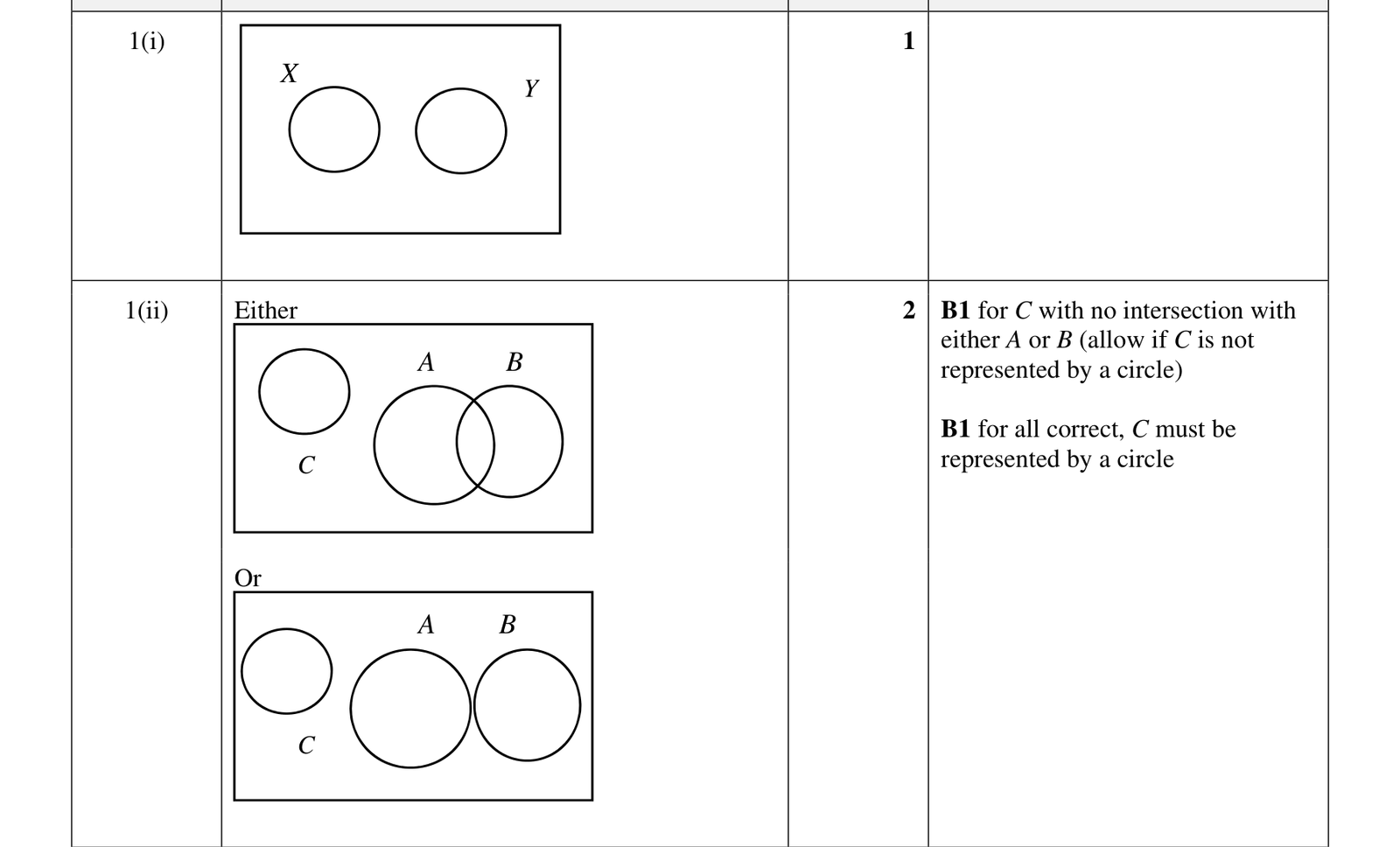
(i) On the Venn diagram, draw sets \(X\) and \(Y\) such that \(n(X\cap Y)=0\).
(ii) On the Venn diagram, draw sets \(A\), \(B\), and \(C\) such that \(C\subset(A\cup B)'\).

0606 P23 - Nov 2017 - Q1 - 5 marks
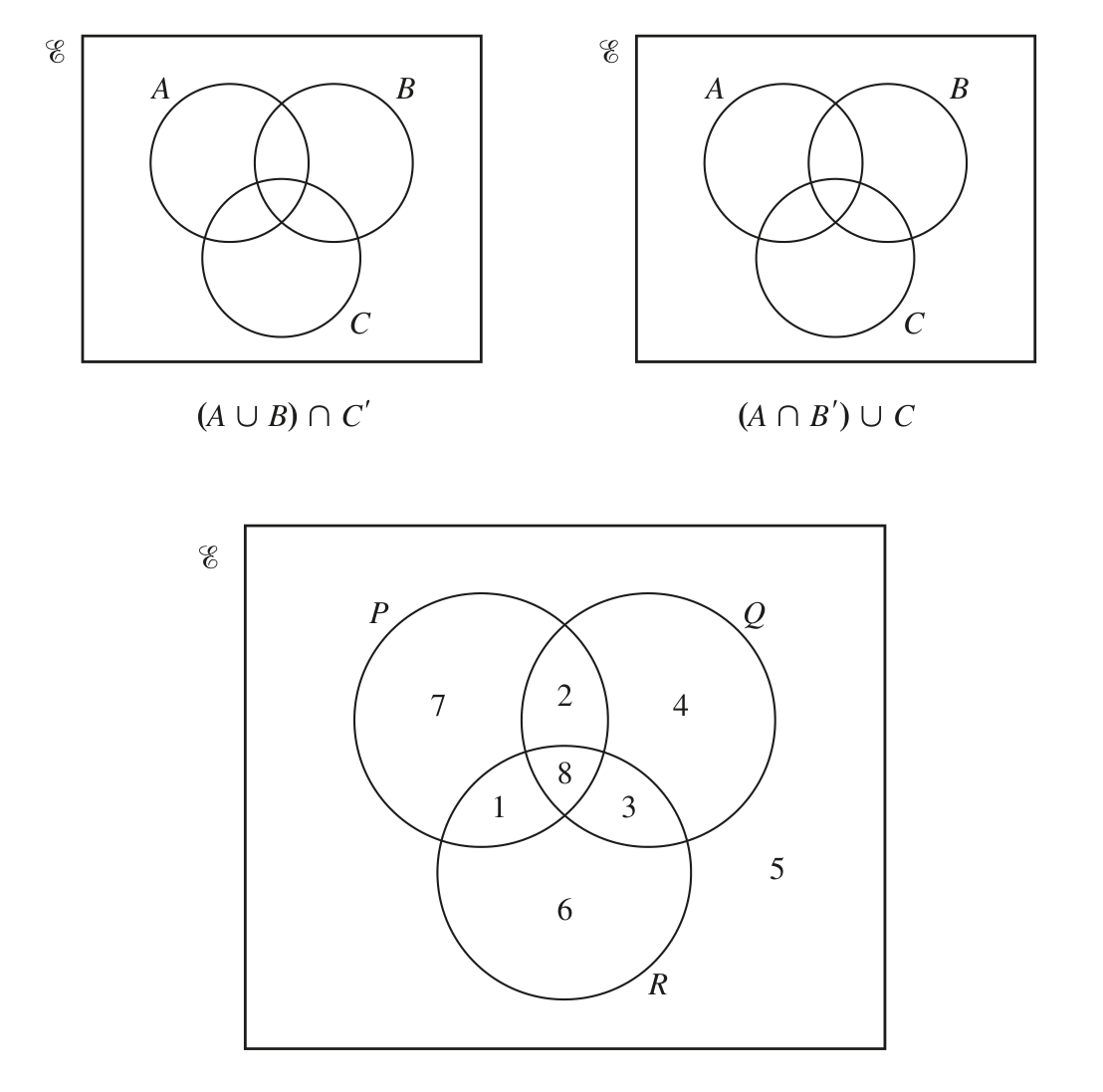
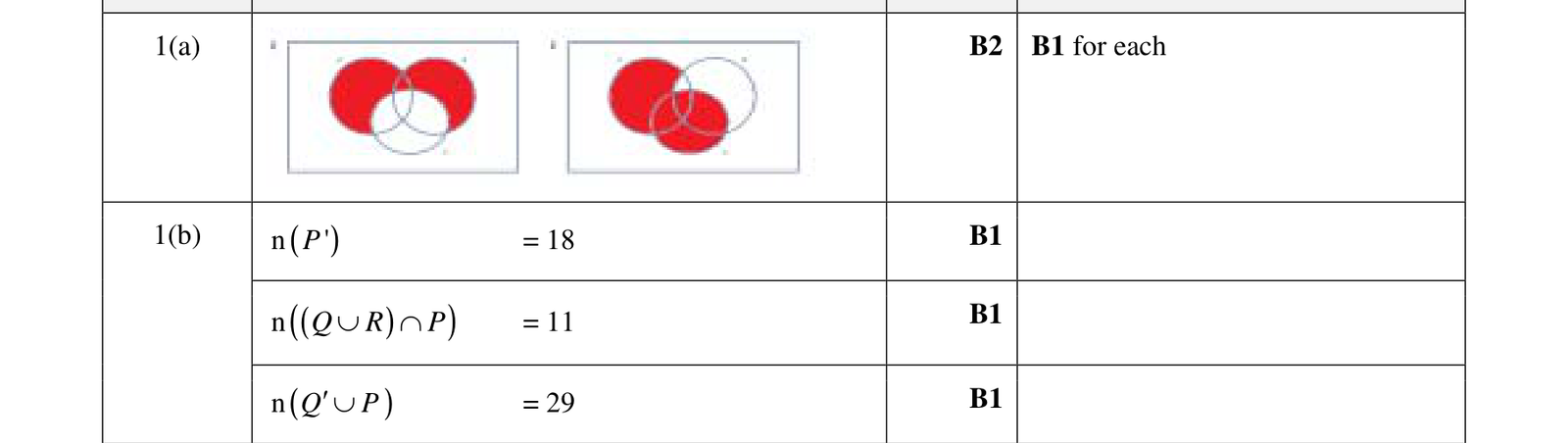
(a) On each diagram, shade the required set:
\((A\cup B)\cap C'\) and \((A\cap B')\cup C\).
(b) The Venn diagram shows the number of elements in each subset. Complete:
\(n(P')\), \(n((Q\cup R)\cap P)\), and \(n(Q'\cup P)\).
0606 P22 - Jun 2022 - Q1 - 3 marks
Do not use a calculator in this question.
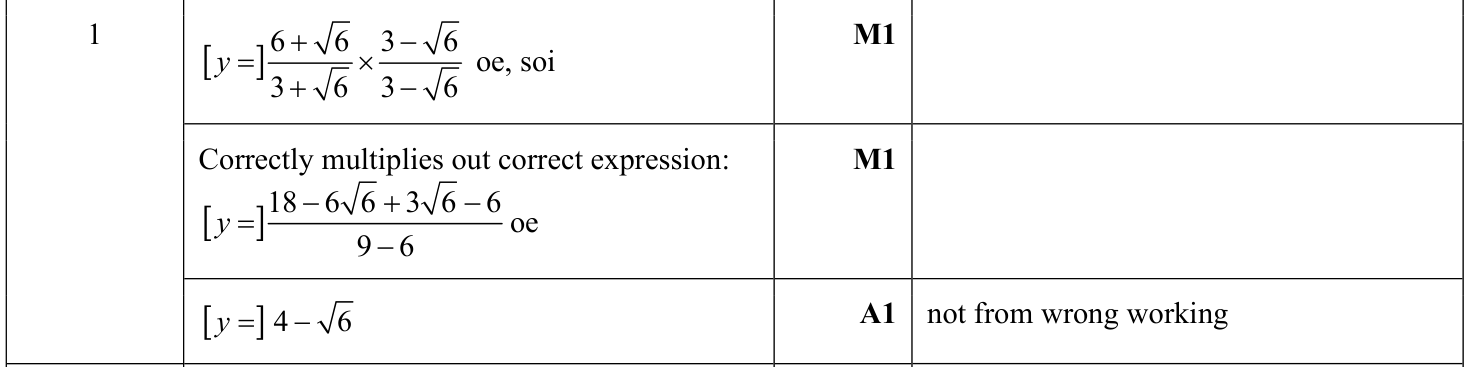
A curve has equation \(\displaystyle y=\frac{6+\sqrt{x}}{3+\sqrt{x}}\), where \(x\ge0\). Find the exact value of \(y\) when \(x=6\). Give your answer in the form \(a+b\sqrt{c}\), where \(a\), \(b\) and \(c\) are integers.
0606 P23 - Jun 2022 - Q2 - 4 marks
Do not use a calculator in this question.
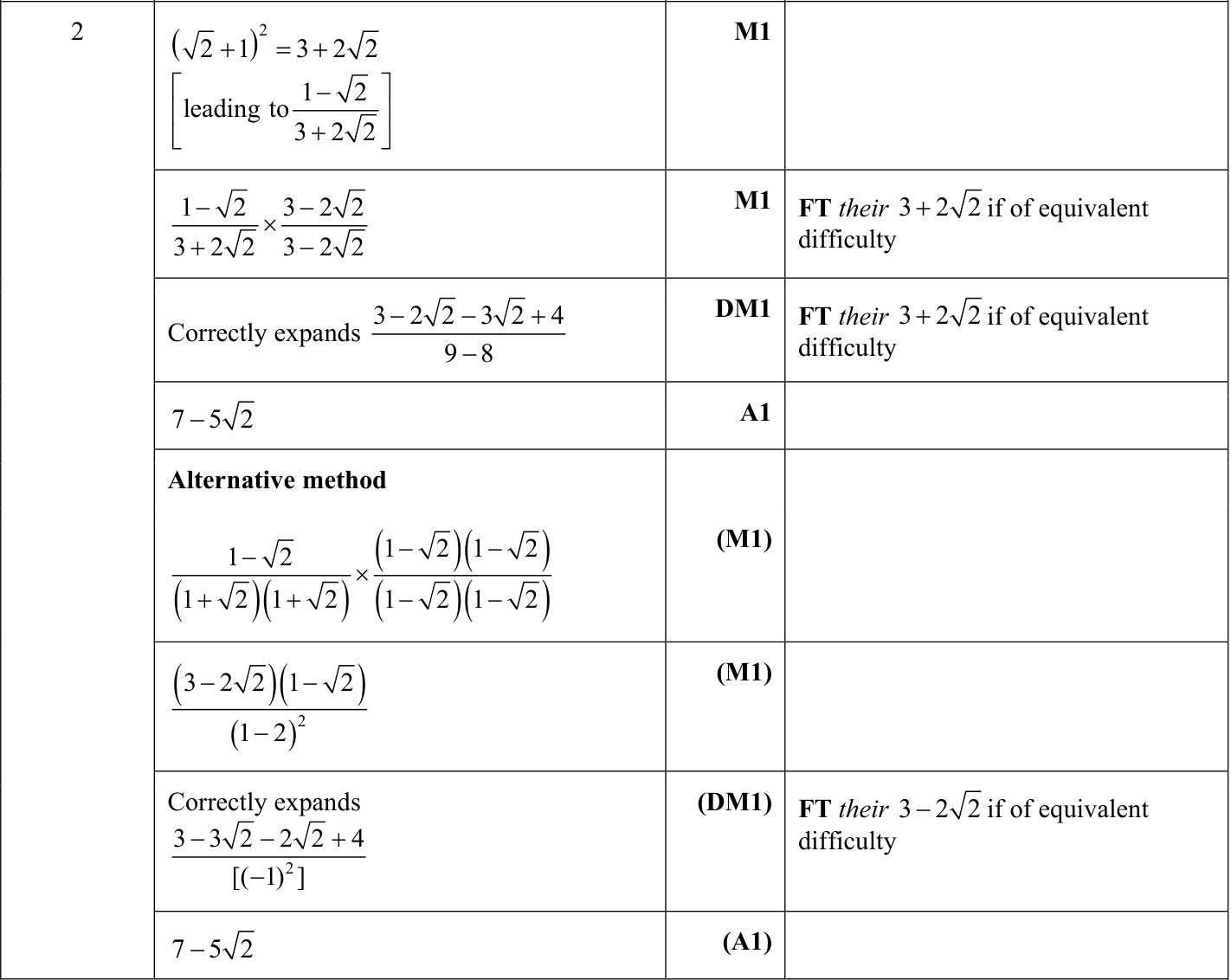
The variables \(x\) and \(y\) are related by the equation \(y=kx^2\). It is given that \(y=1-\sqrt2\) when \(x=1+\sqrt2\). Find the exact value of \(k\), giving your answer in the form \(a+b\sqrt c\), where \(a\), \(b\) and \(c\) are integers.
0606 P22 - Jun 2020 - Q2 - 5 marks
Do not use a calculator in this question.
The point \((1-\sqrt5,p)\) lies on the curve
\(y=\frac{10+2\sqrt5}{x^2}.\)
Find the exact value of \(p\), simplifying your answer.

0606 P11 - Jun 2018 - Q3 - 4 marks
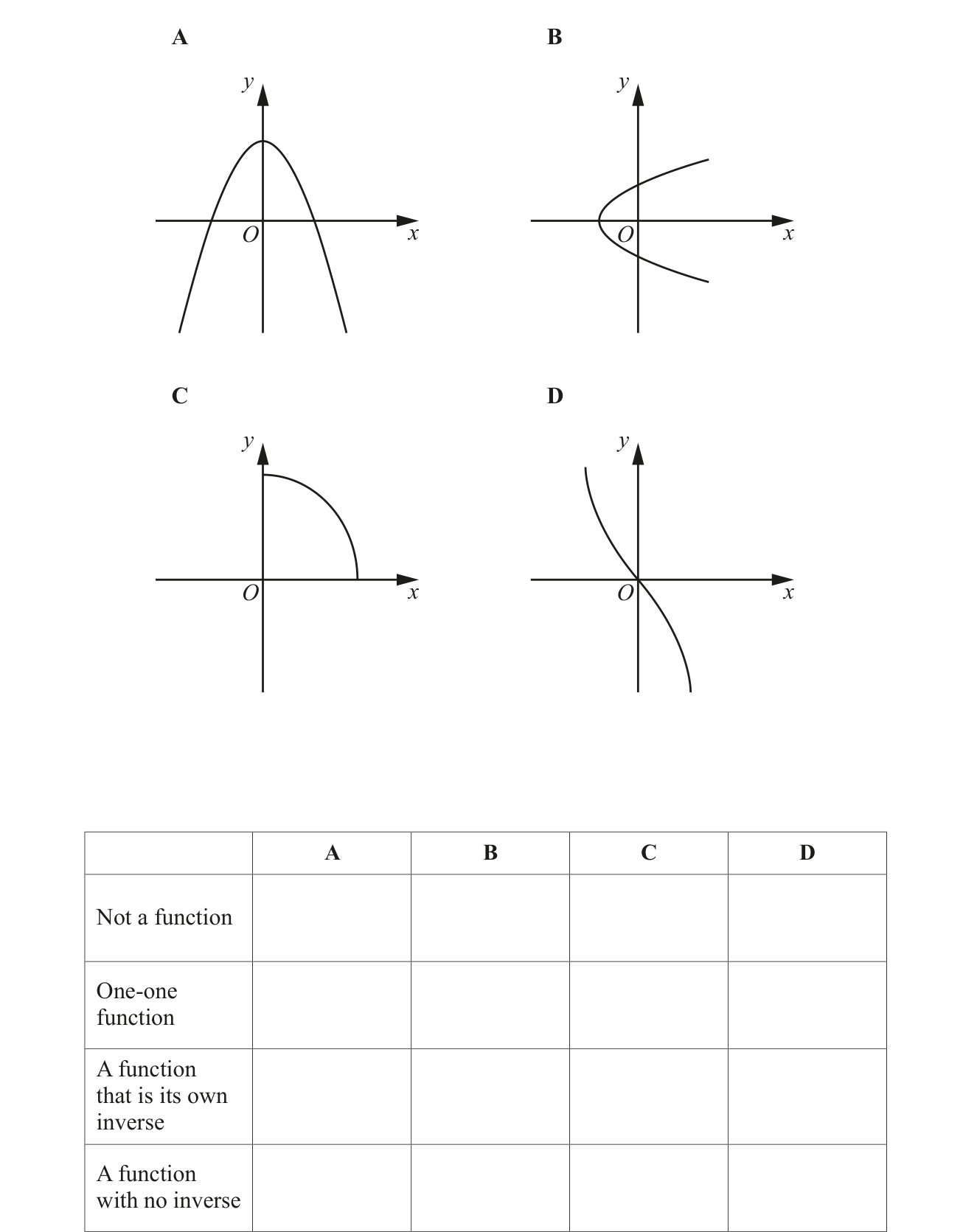
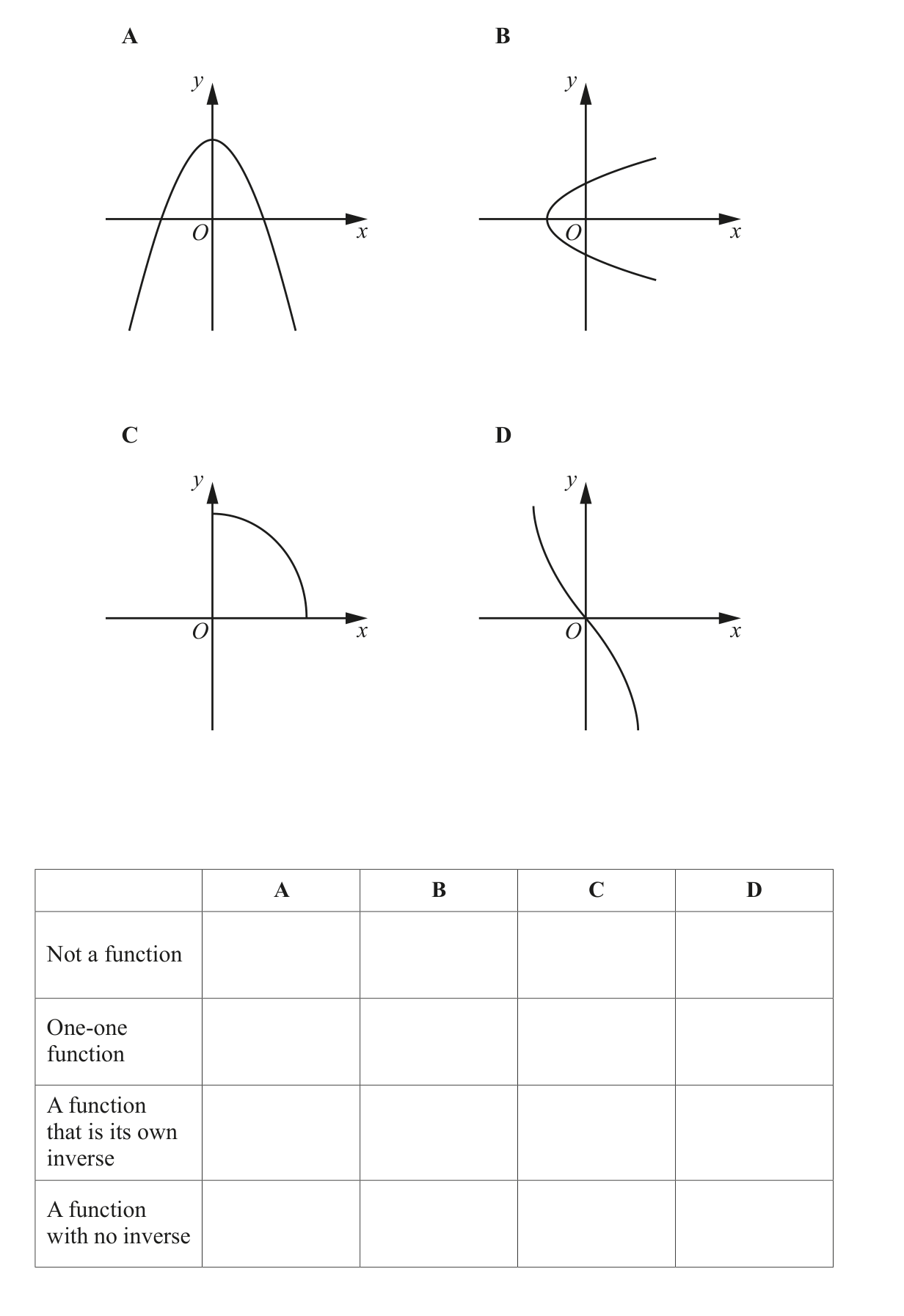
Diagrams \(A\) to \(D\) show four different graphs. In each case the whole graph is shown and the scales on the two axes are the same.
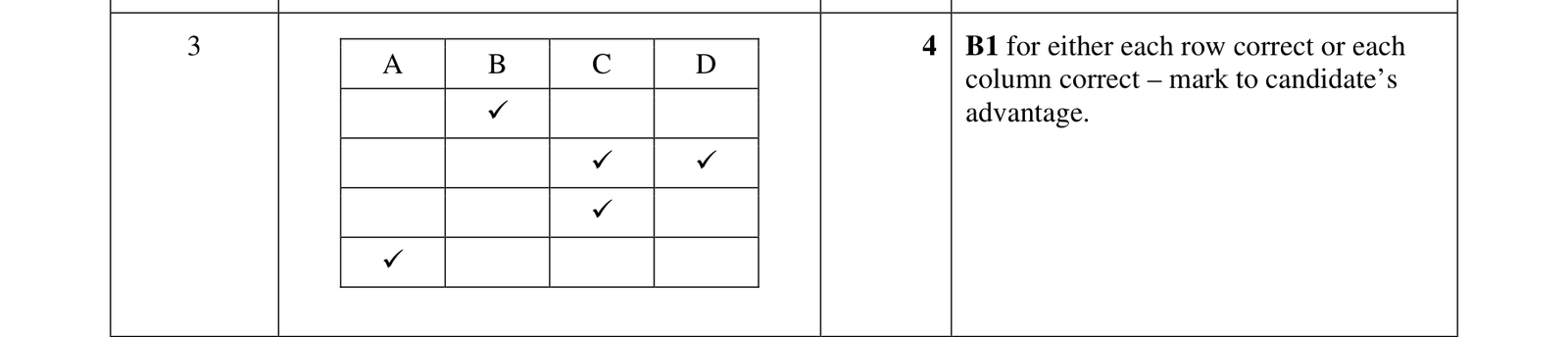
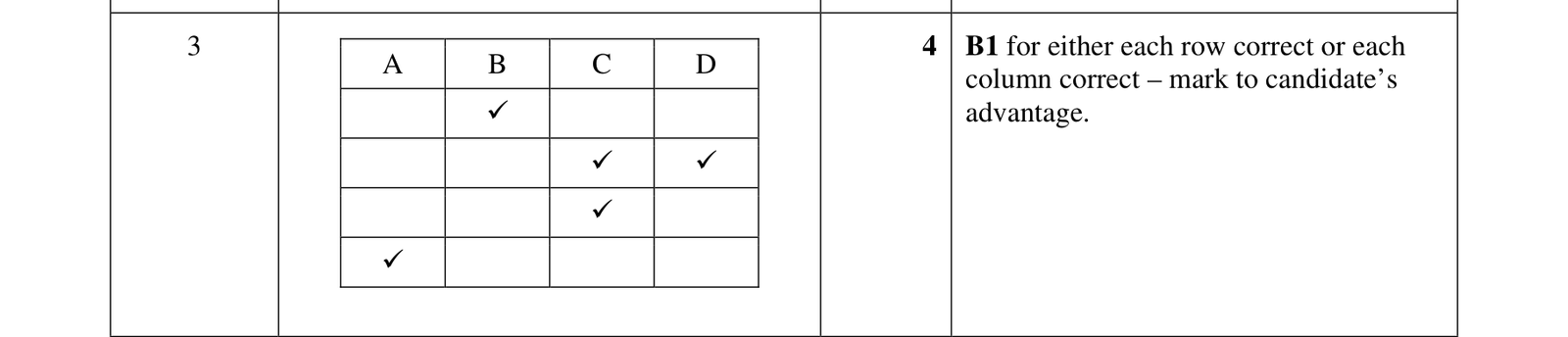
Place ticks in the boxes in the table to indicate which descriptions, if any, apply to each graph. There may be more than one tick in any row or column of the table.
0606 P13 - Jun 2018 - Q3 - 4 marks
Diagrams \(A\) to \(D\) show four different graphs. In each case the whole graph is shown and the scales on the two axes are the same.
Place ticks in the boxes in the table to indicate which descriptions, if any, apply to each graph. There may be more than one tick in any row or column of the table.
0606 P22 - Nov 2025 - Q9 - 5 marks
It is given that \(\mathrm{f}(x)=\ln(2x+5)\) for \(x\gt a\), where \(a\) is a constant.
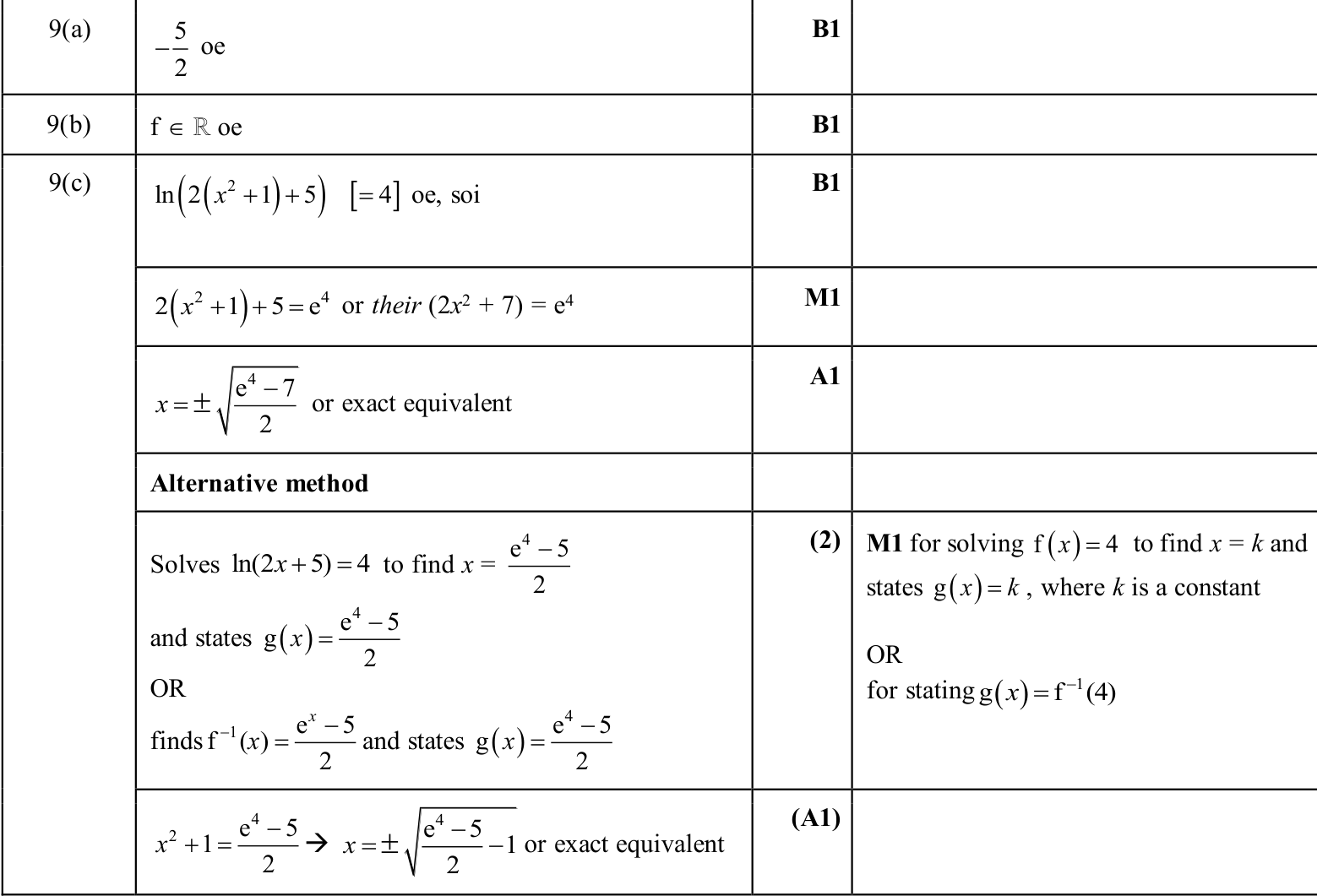
(a) Write down the least possible value of \(a\).
(b) Using your value of \(a\), write down the range of \(\mathrm{f}\).
It is also given that \(\mathrm{g}(x)=x^2+1\), for \(x\in\mathbb{R}\).
(c) Using your value of \(a\), solve the equation \(\mathrm{fg}(x)=4\). Give your answers in exact form.
0606 P11 - Nov 2025 - Q4 - 10 marks
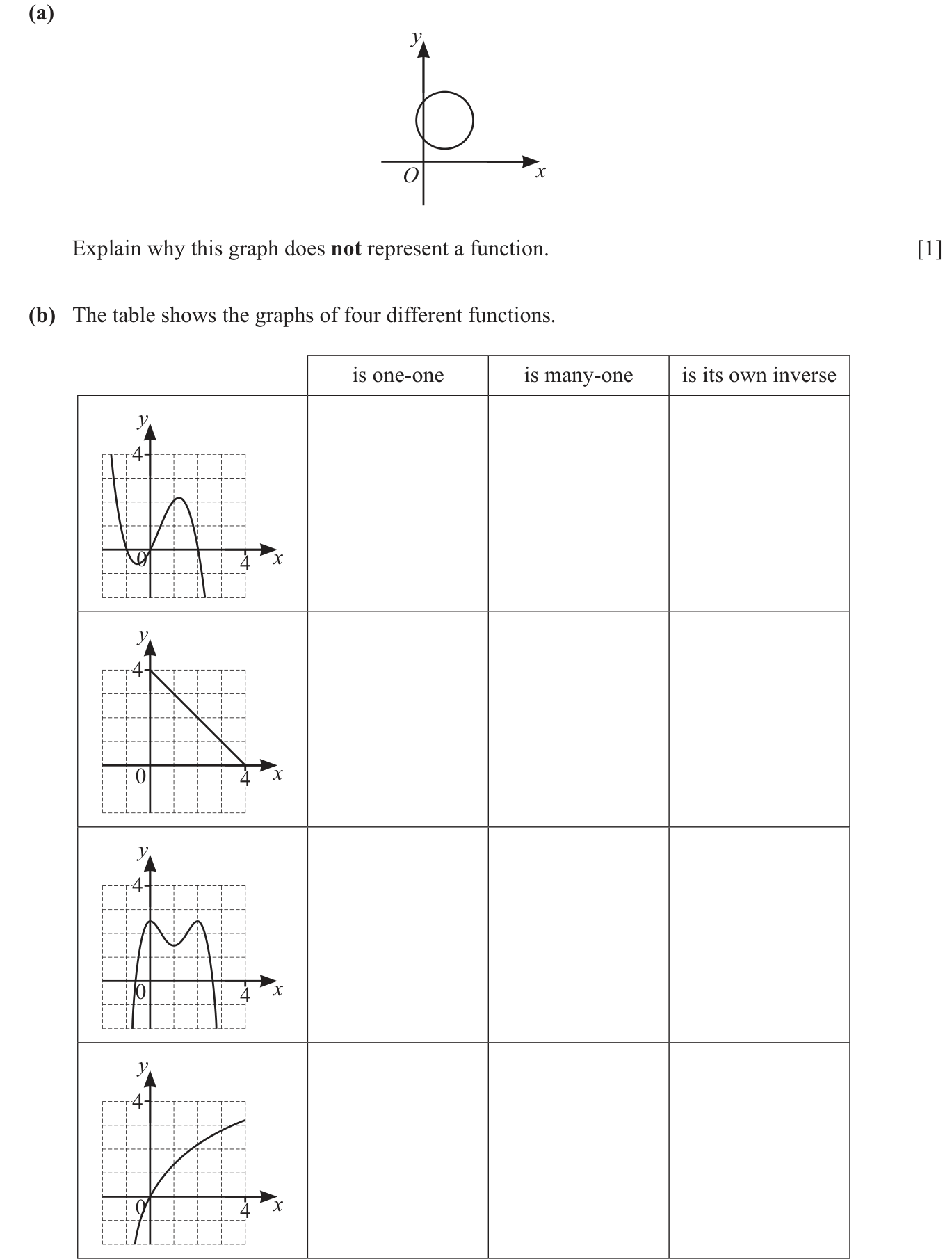
The diagrams show four different relations.
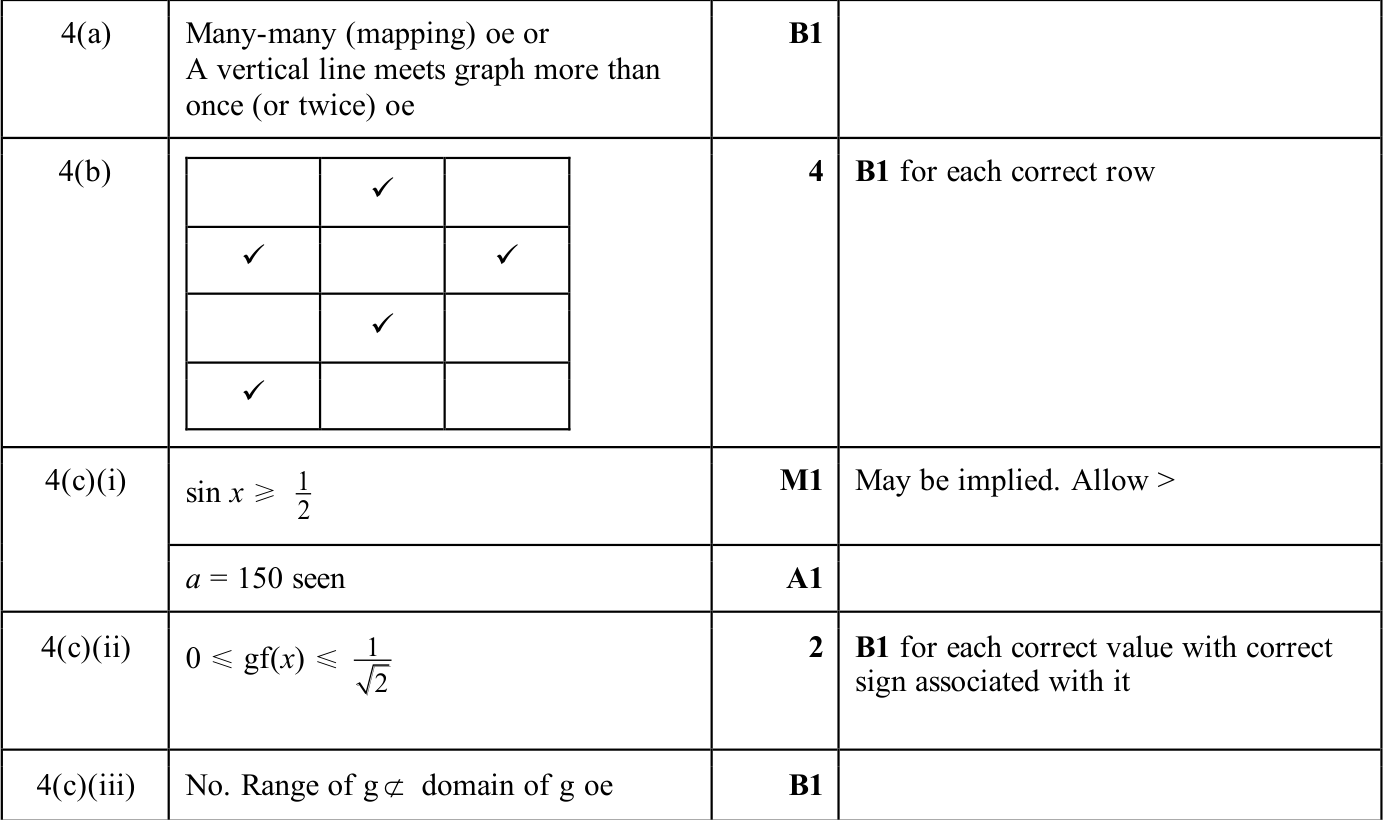
(b) State whether each relation is one-one, many-one, and whether it is its own inverse.
(c) The functions are given by \(\mathrm{f}:x\mapsto\sin x\), for \(30^\circ\leqslant x\leqslant a^\circ\), and \(\mathrm{g}:x\mapsto\sqrt{x-\frac12}\), for \(x\geqslant\frac12\). Given that \(\mathrm{g}\mathrm{f}\) exists, find the largest possible value of \(a\), the range of \(\mathrm{g}\mathrm{f}\), and explain why \(\mathrm{g}^2\) does not exist.
0606 P22 - Jun 2025 - Q3 - 4 marks
Functions \(f\) and \(g\) are such that
\(\mathrm{f}(x)=\frac{3x}{x+4}\) for \(x\gt 0\).
\(\mathrm{g}(x)=\sqrt{x+2}\) for \(x\gt -2\).
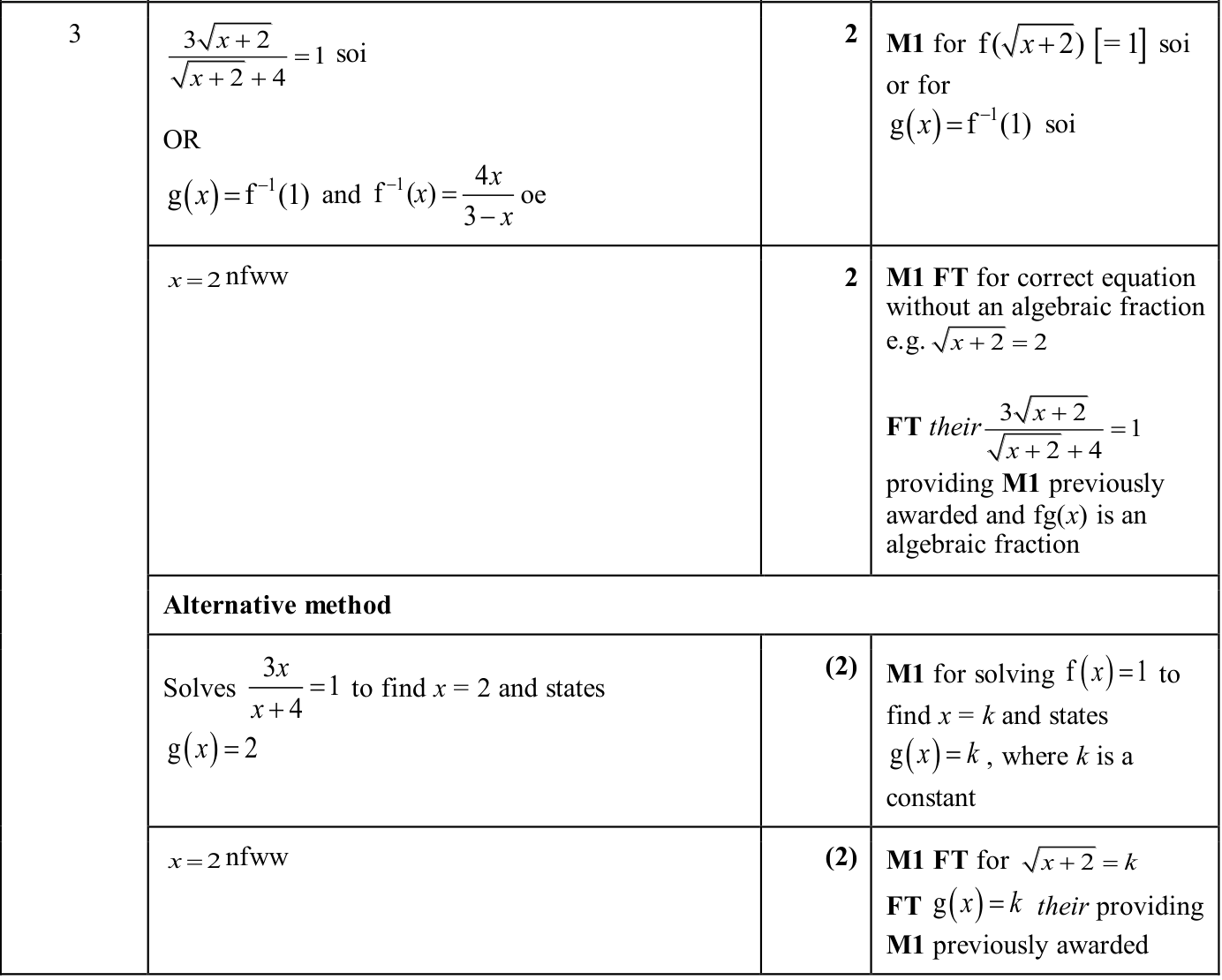
Solve the equation \(\mathrm{fg}(x)=1\).
0606 P22 - Mar 2025 - Q7 - 5 marks
It is given that \(\mathrm f(x)=2\mathrm e^x+a\) for \(x\geqslant0\), where \(a\) is an integer, and \(\mathrm g(x)=\sqrt{x-1}\) for \(x\geqslant1\).
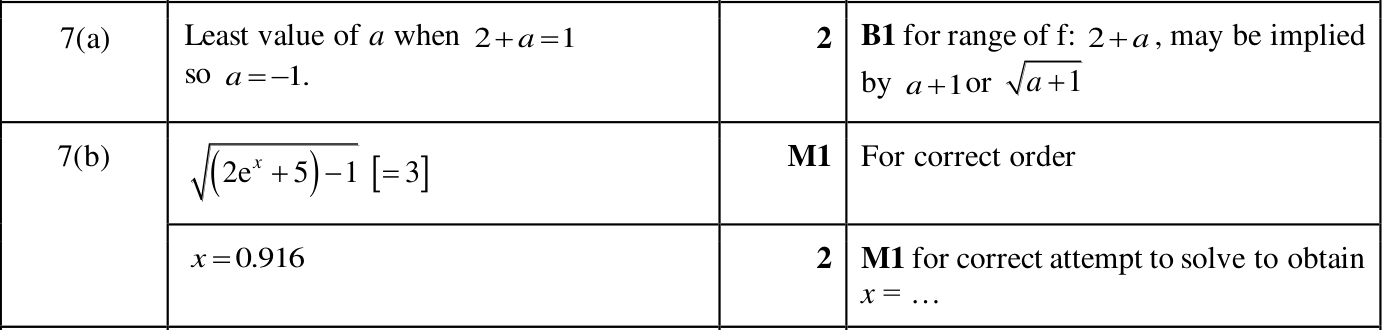
(a) Find the least value of \(a\) so that the function \(\mathrm{gf}\) exists for all \(x\geqslant0\).
(b) In the case where \(a=5\), solve the equation \(\mathrm{gf}(x)=3\). Give your answer correct to 3 decimal places.
0606 P23 - Nov 2023 - Q1 - 6 marks
The functions \(\mathrm f\) and \(\mathrm g\) are defined as follows, for all real values of \(x\).
\(\mathrm f:x\mapsto2\sin x+3\cos x\)
\(\mathrm g:x\mapsto \mathrm e^{3x}-1\)
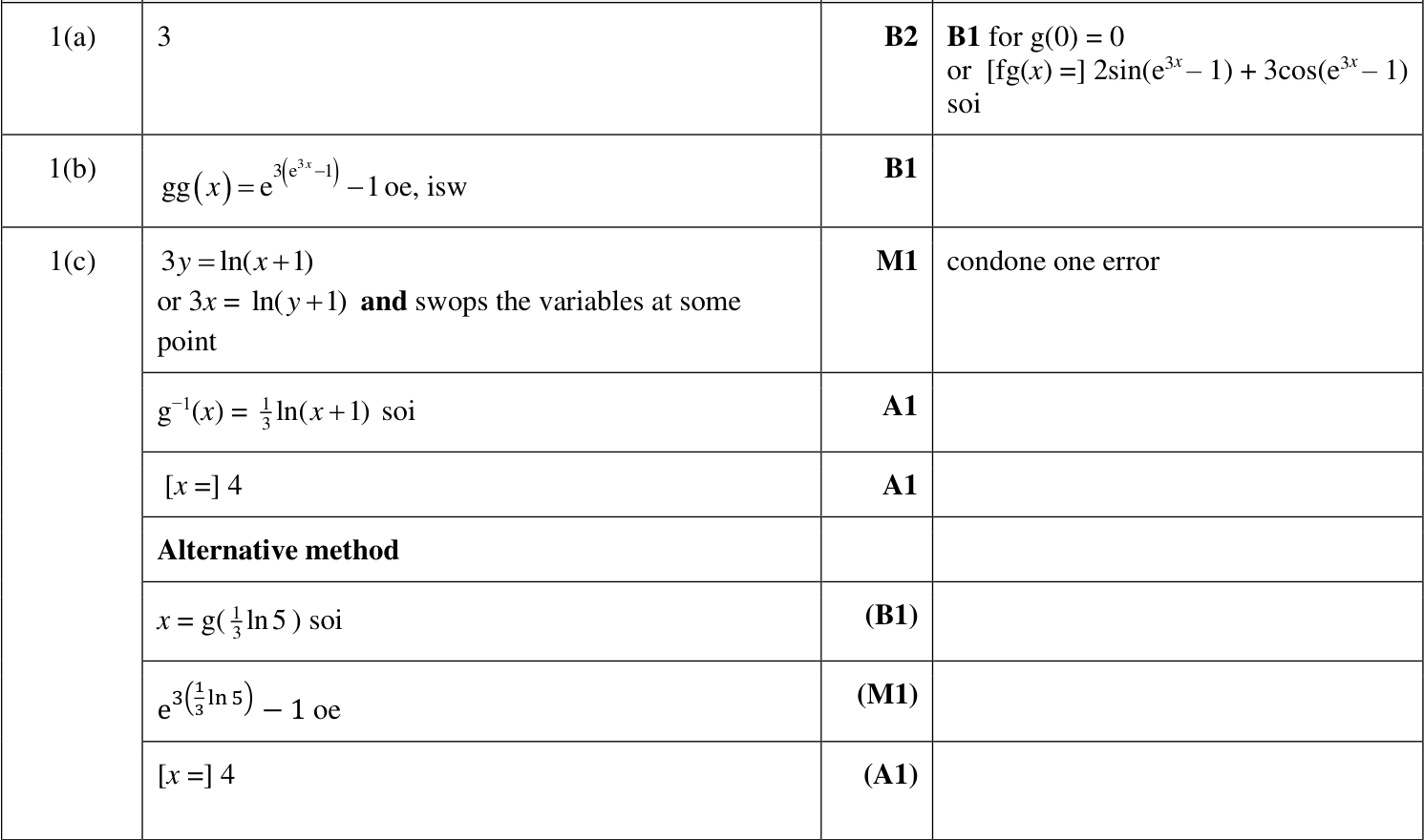
(a) Find the value of \(\mathrm{fg}(0)\).
(b) Find \(\mathrm{gg}(x)\) in terms of \(x\), giving your answer in its simplest form.
(c) Solve the equation \(\mathrm g^{-1}(x)=\frac13\ln5\).
0606 P13 - Jun 2022 - Q6 - 10 marks
(a) It is given that \(\mathrm f:x\mapsto2x^2\), for \(x\ge0\), and \(\mathrm g:x\mapsto2x+1\), for \(x\ge0\).
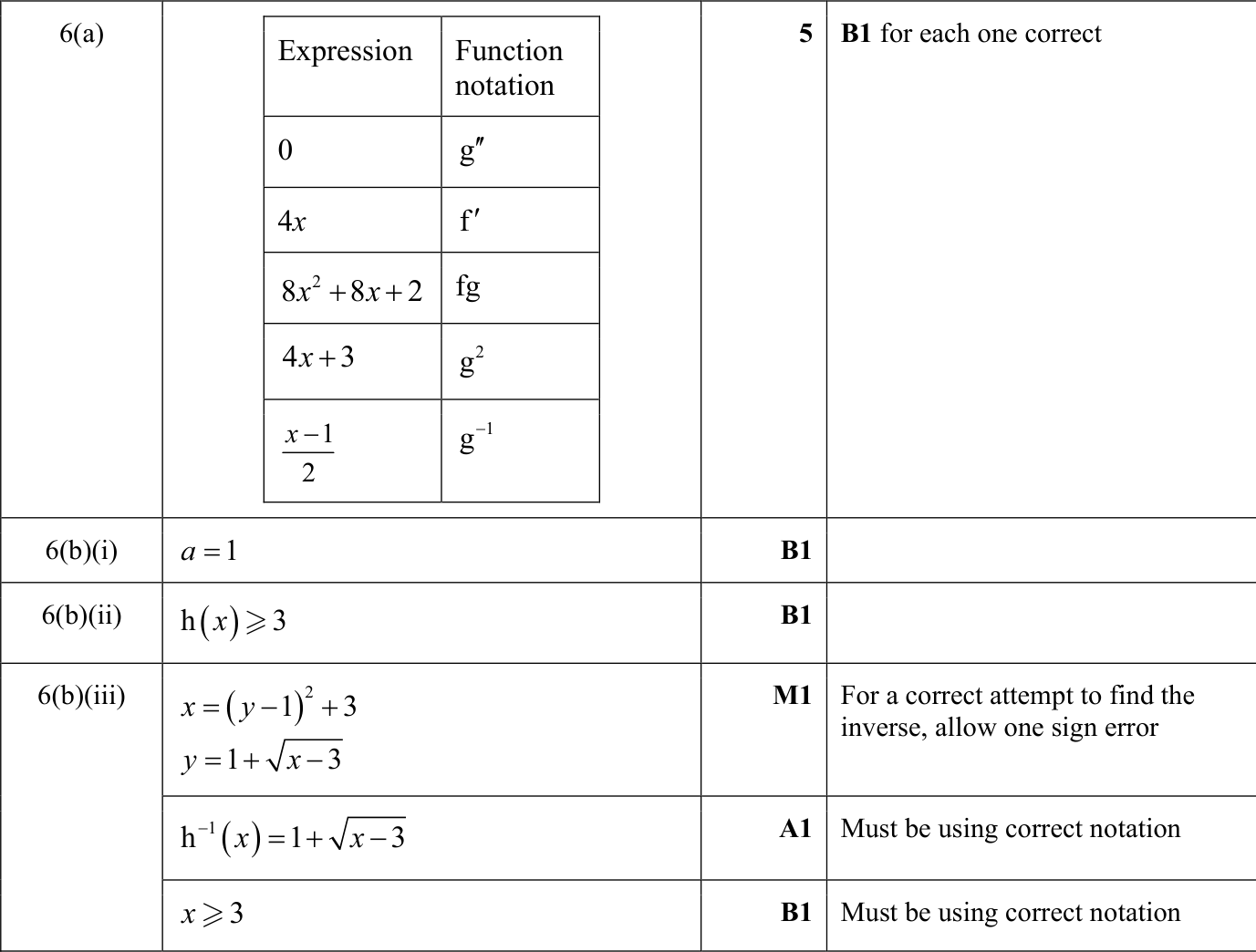
Each of the expressions in the table can be written as one of \(\mathrm f'\), \(\mathrm f''\), \(\mathrm g'\), \(\mathrm g''\), \(\mathrm{fg}\), \(\mathrm{gf}\), \(\mathrm f^2\), \(\mathrm g^2\), \(\mathrm f^{-1}\), \(\mathrm g^{-1}\). Complete the table.
| Expression | Function notation |
|---|---|
| \(2\) | \(\mathrm g'\) |
| \(4x\) | |
| \(8x^2+8x+2\) | |
| \(4x+3\) | |
| \(\frac{x-1}{2}\) |
(b) It is given that \(\mathrm h(x)=(x-1)^2+3\), for \(x\ge a\). The value of \(a\) is as small as possible such that \(\mathrm h^{-1}\) exists.
(i) Write down the value of \(a\).
(ii) Write down the range of \(\mathrm h\).
(iii) Find \(\mathrm h^{-1}(x)\) and state its domain.
0606 P21 - Nov 2022 - Q9 - 10 marks
The functions \(f(x)\) and \(g(x)\) are defined as follows for \(x\gt -\frac23\) by
\(f(x)=x^2+1, \qquad g(x)=\ln(3x+2).\)
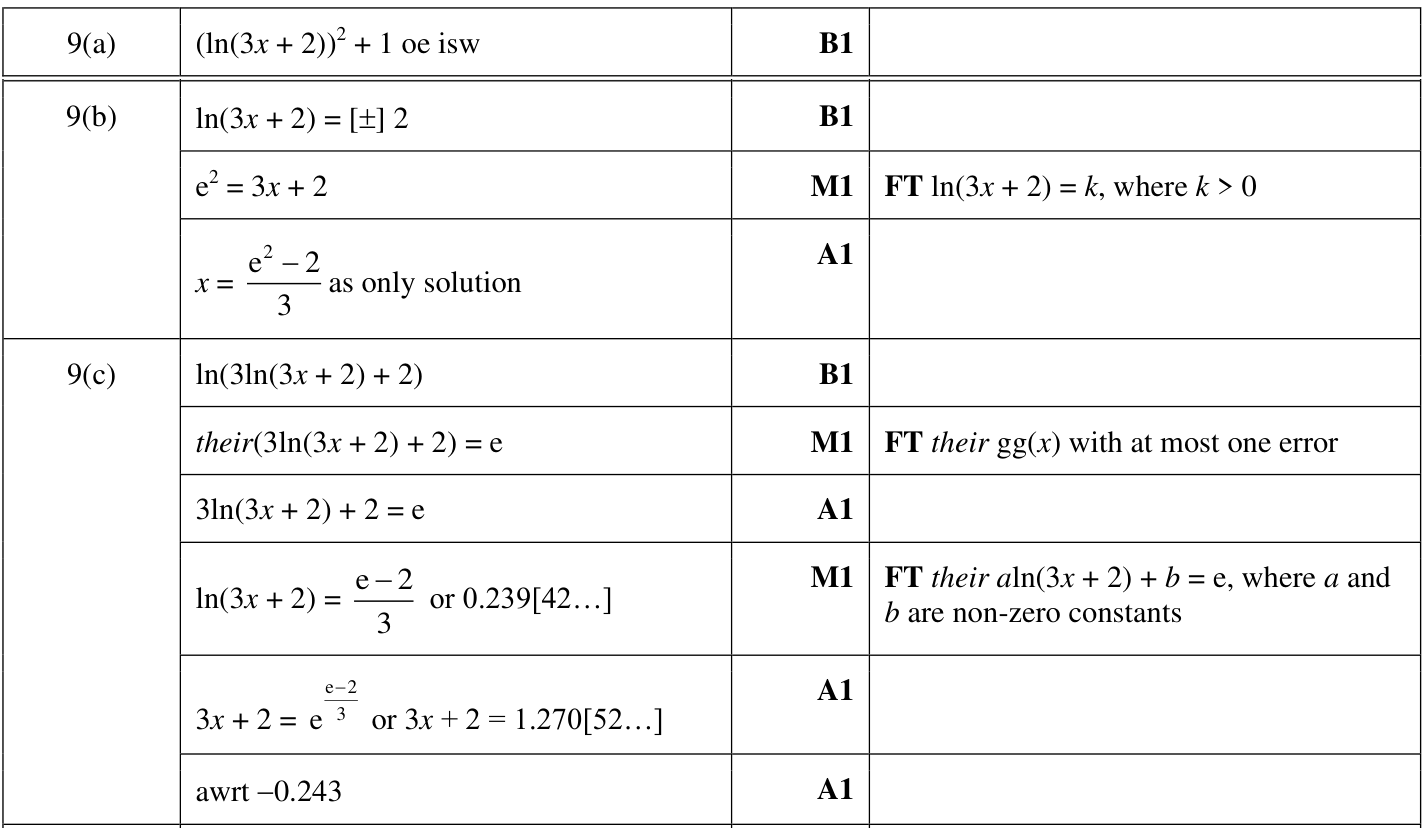
(a) Find \(fg(x)\).
(b) Solve the equation \(fg(x)=5\), giving your answer in exact form.
(c) Solve the equation \(gg(x)=1\).
0606 P11 - Jun 2021 - Q5 - 7 marks
The functions \(\mathrm f\) and \(\mathrm g\) are defined as follows.
\(\mathrm f(x)=x^2+4x\quad\text{for }x\in\mathbb R,\)
\(\mathrm g(x)=1+\mathrm e^{2x}\quad\text{for }x\in\mathbb R.\)
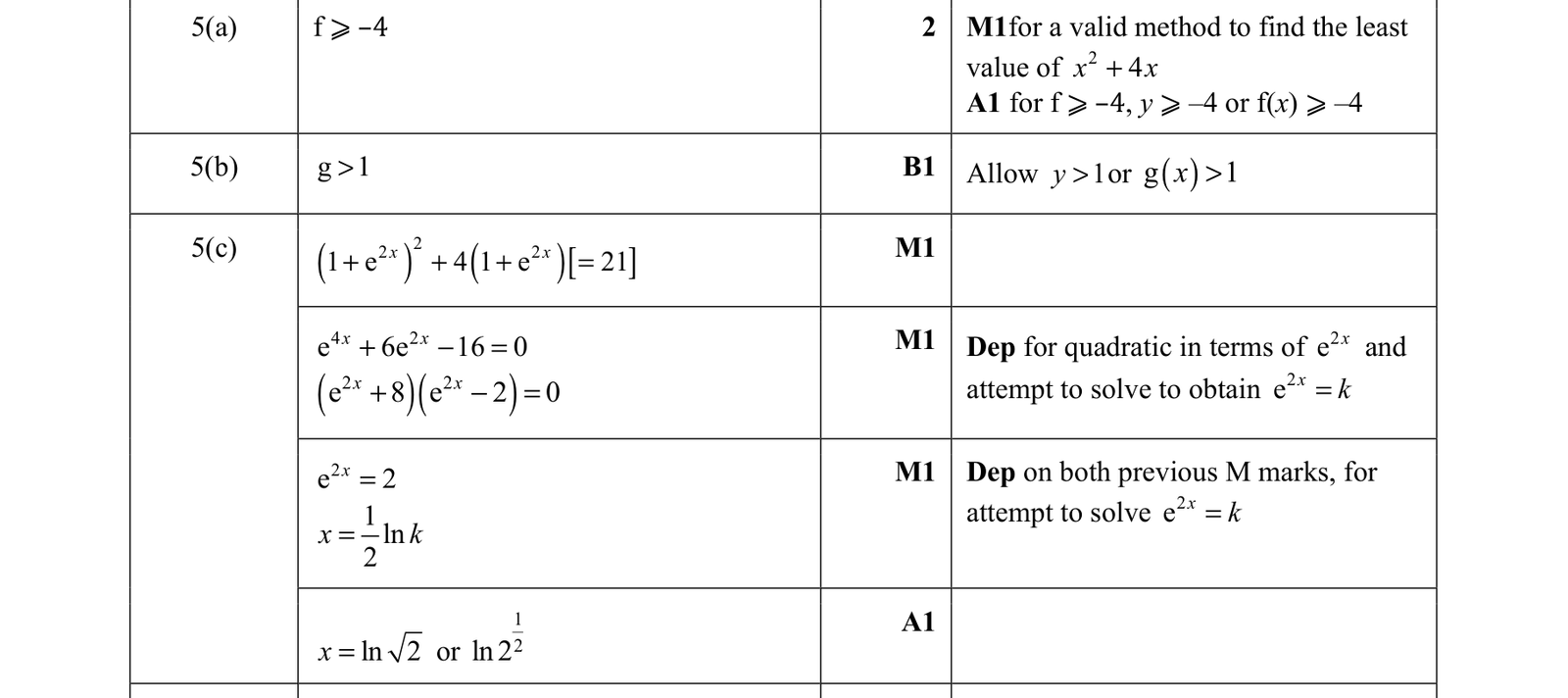
(a) Find the range of \(\mathrm f\).
(b) Write down the range of \(\mathrm g\).
(c) Find the exact solution of the equation \(\mathrm{fg}(x)=21\), giving your answer as a single logarithm.
0606 P21 - Nov 2021 - Q9 - 9 marks
The functions \(\mathrm f\) and \(\mathrm g\) are defined for \(x\gt 1\) by
\(\mathrm f(x)=\frac{x+3}{x-1},\qquad \mathrm g(x)=1+x^2.\)
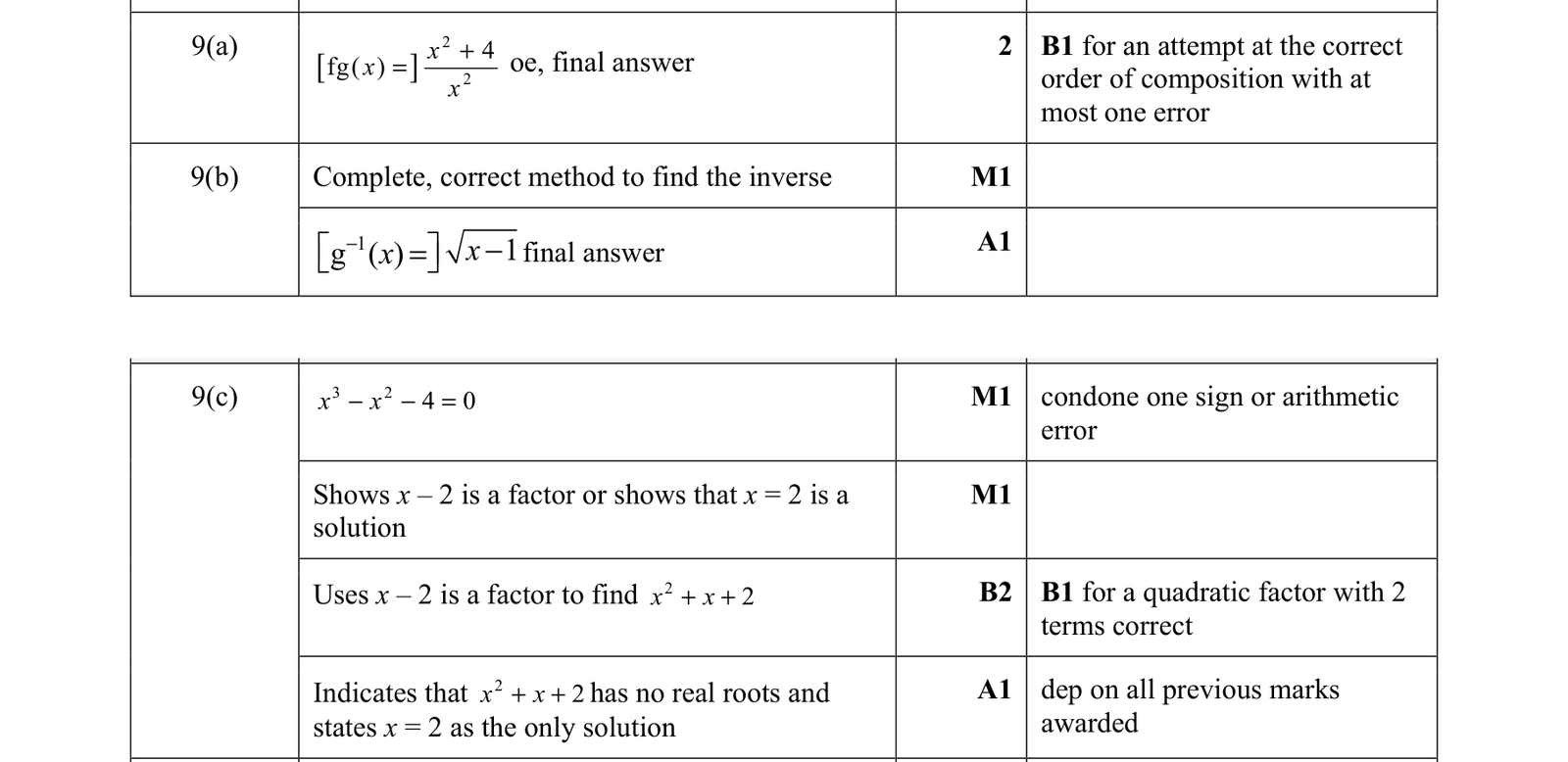
(a) Find \(\mathrm{fg}(x)\).
(b) Find \(\mathrm g^{-1}(x)\).
(c) Without using a calculator, solve the equation \(\mathrm f(x)=\mathrm g(x)\).
0606 P13 - Jun 2020 - Q1 - 7 marks
\(f(x)=3+e^x\quad\text{for }x\in\mathbb R\)
\(g(x)=9x-5\quad\text{for }x\in\mathbb R\)
(a) Find the range of \(f\) and of \(g\).
(b) Find the exact solution of \(f^{-1}(x)=g'(x)\).
(c) Find the solution of \(g^2(x)=112\).

0606 P12 - Nov 2019 - Q5 - 7 marks
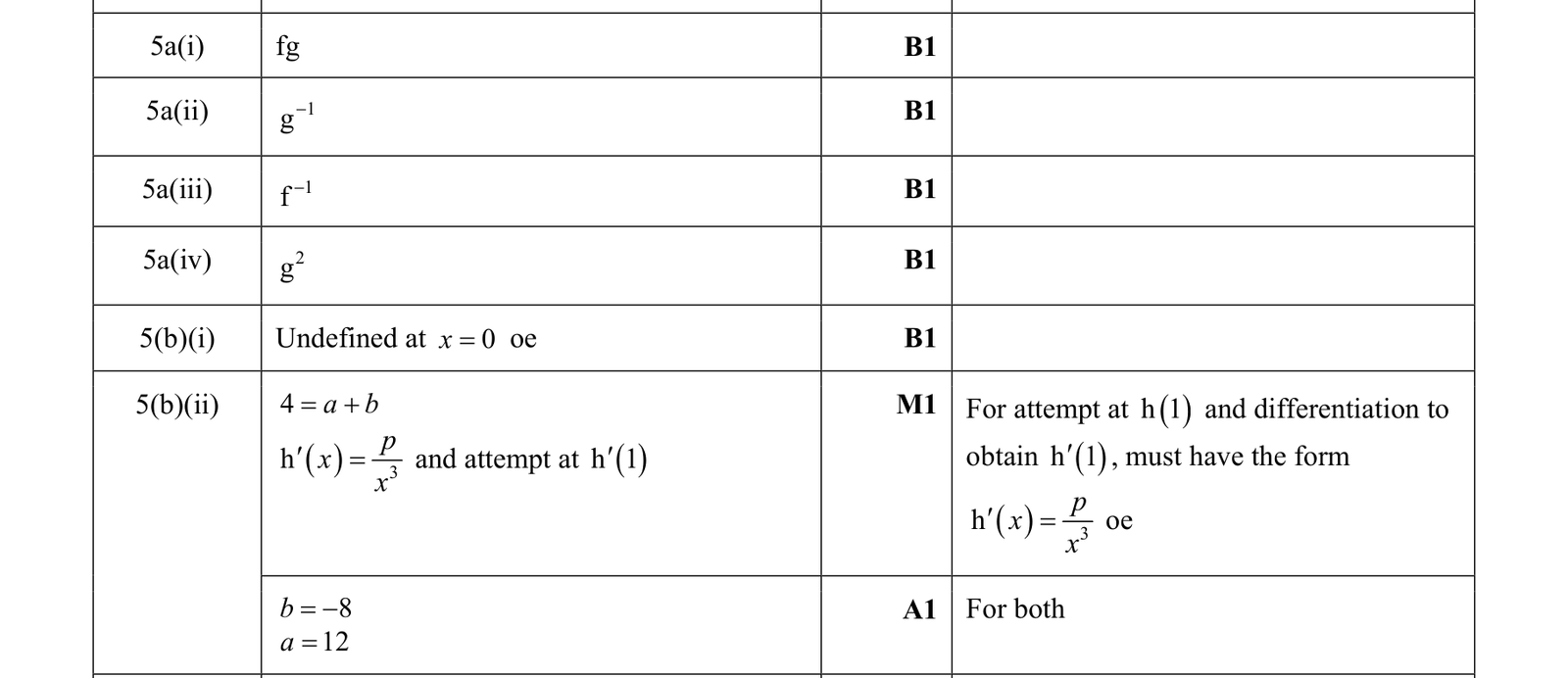
(a) It is given that
\(f:x\mapsto\sqrt{x}\quad\text{for }x\geq0,\)
\(g:x\mapsto x+5\quad\text{for }x\geq0.\)
Identify each of the following functions with one of \(f^{-1}\), \(g^{-1}\), \(fg\), \(gf\), \(f^2\), \(g^2\).
(i) \(\sqrt{x+5}\)
(ii) \(x-5\)
(iii) \(x^2\)
(iv) \(x+10\)
(b) It is given that
\(h(x)=a+\frac{b}{x^2},\)
where \(a\) and \(b\) are constants.
(i) Why is \(-2\leq x\leq2\) not a suitable domain for \(h(x)\)?
(ii) Given that \(h(1)=4\) and \(h'(1)=16\), find the value of \(a\) and of \(b\).
0606 P22 - Nov 2018 - Q11 - 9 marks
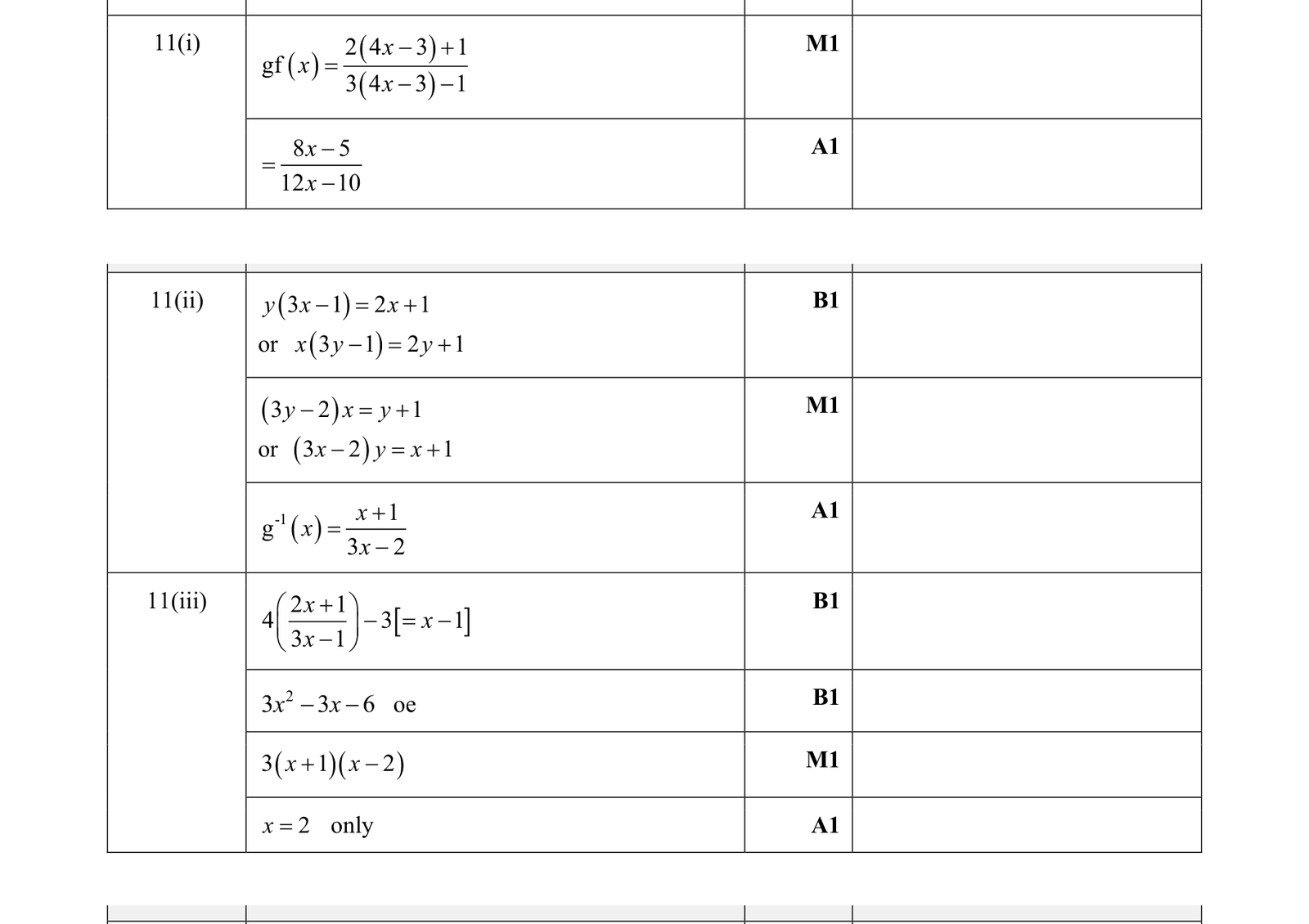
The functions \(f\) and \(g\) are defined for real values of \(x\gt 1\) by
\(f(x)=4x-3, \qquad g(x)=\frac{2x+1}{3x-1}.\)
(i) Find \(gf(x)\).
(ii) Find \(g^{-1}(x)\).
(iii) Solve \(fg(x)=x-1\).
0606 P22 - Jun 2017 - Q12 - 7 marks
The function \(g\) is defined, for \(x\gt -\dfrac12\), by
\(g(x)=\frac{3}{2x+1}.\)
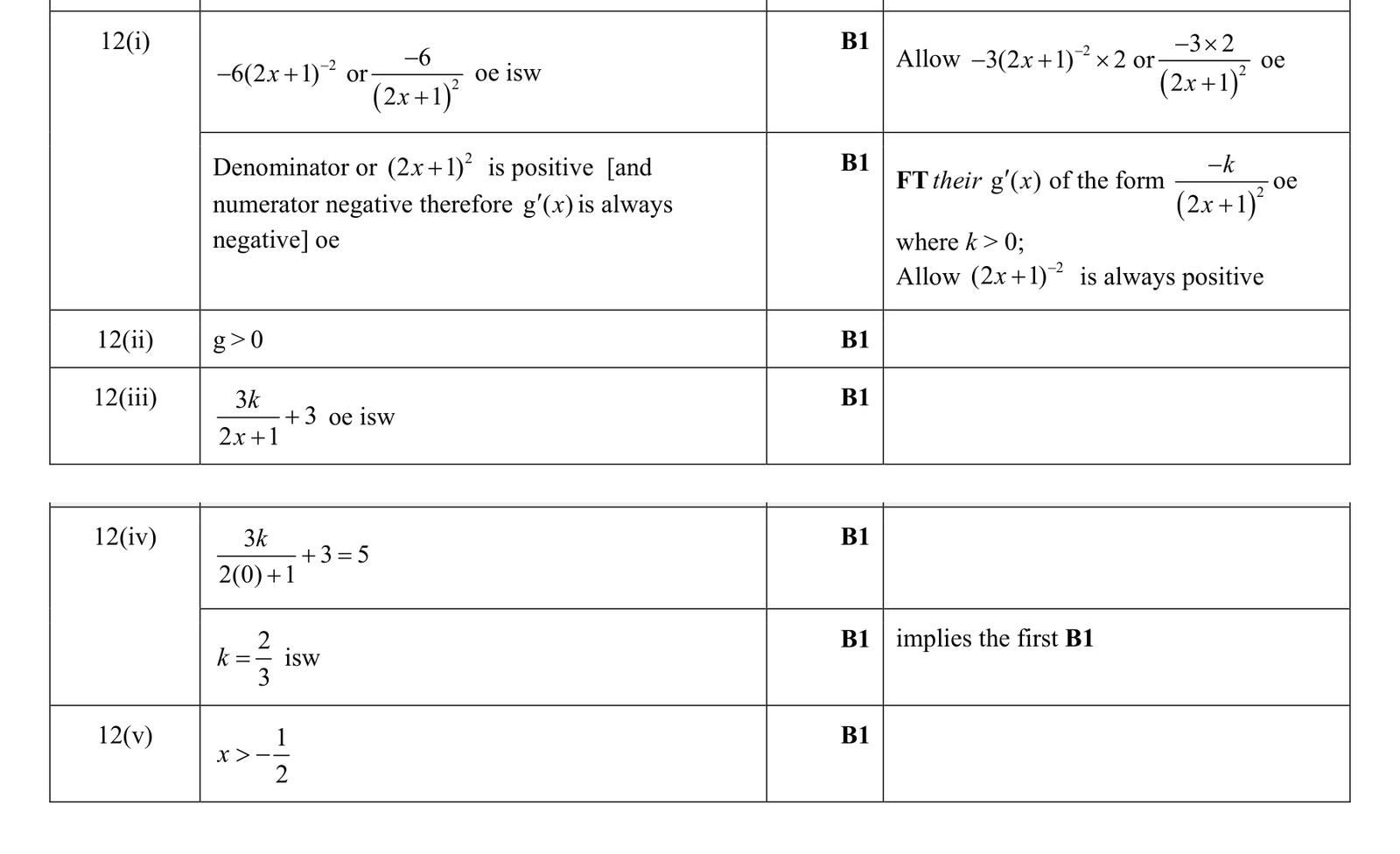
(i) Show that \(g'(x)\) is always negative.
(ii) Write down the range of \(g\).
The function \(h\) is defined, for all real \(x\), by \(h(x)=kx+3\), where \(k\) is a constant.
(iii) Find an expression for \(hg(x)\).
(iv) Given that \(hg(0)=5\), find the value of \(k\).
(v) State the domain of \(hg\).