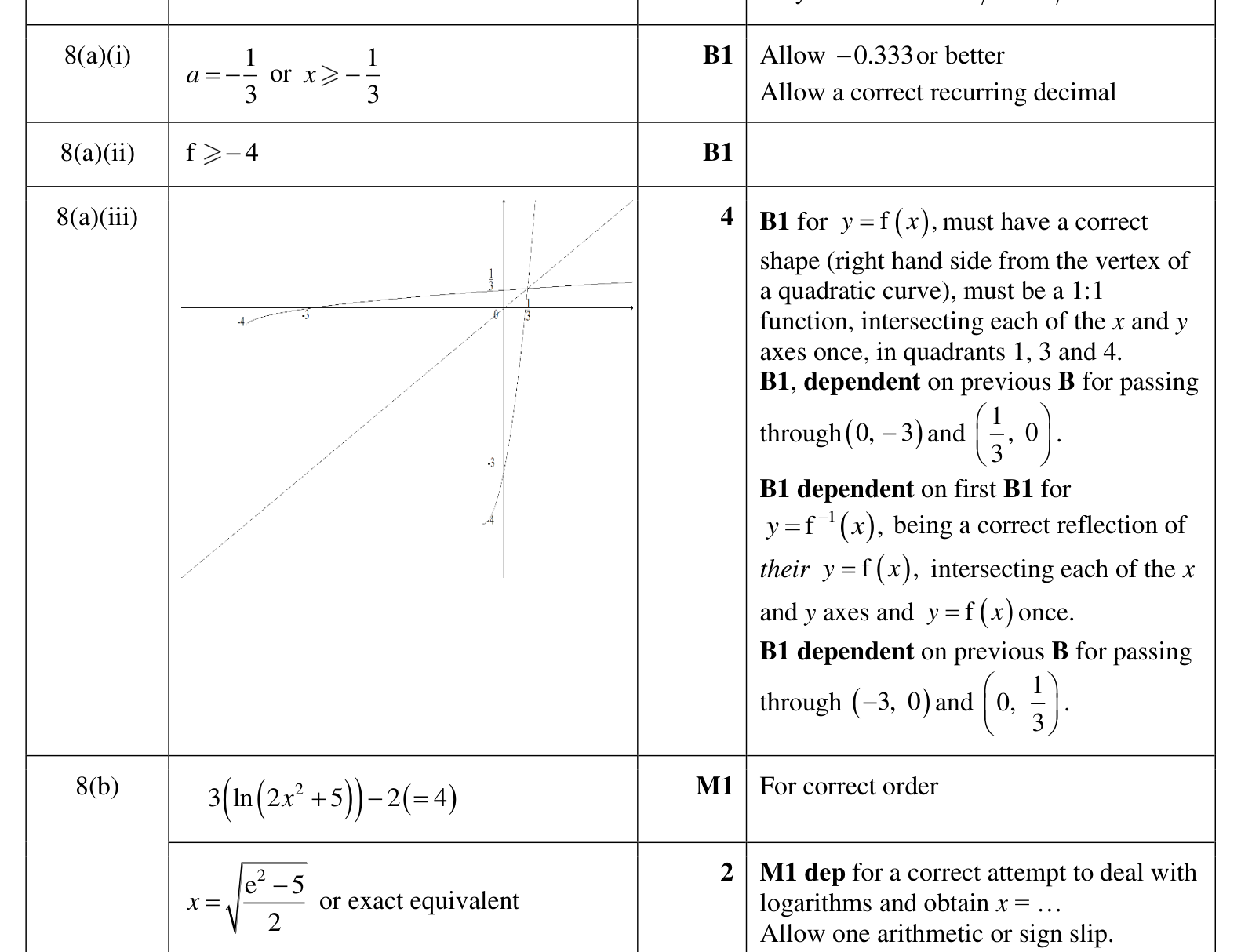
Answer: (a)(i) \(a=-\frac13\), (ii) \(f\geq-4\); (b) \(x=\sqrt{\frac{e^2-5}{2}}\).
For an inverse function, interchange \(x\) and \(y\), then rearrange to make \(y\) the subject. The domain of the original function becomes the range of the inverse.
(a)(i) The function is
\(f(x)=(3x+1)^2-4\).
This is a quadratic with vertex at
\(3x+1=0\),
so
\(x=-\frac13\).
For \(f^{-1}\) to exist on the domain \(x\geq a\), the function must be one-to-one on that domain. The least possible value is therefore the \(x\)-coordinate of the vertex:
\(a=-\frac13\).
(a)(ii) At the vertex,
\(f\left(-\frac13\right)=-4\).
Since the parabola opens upwards and the domain starts at the vertex, the range is
\(f(x)\geq-4\).
(a)(iii) The graph of \(y=f(x)\) is the right-hand half of the parabola with vertex \(\left(-\frac13,-4\right)\).
It passes through the \(y\)-axis at
\(f(0)=1-4=-3\),
so it passes through \((0,-3)\).
It meets the \(x\)-axis when
\((3x+1)^2-4=0\).
So \((3x+1)^2=4\), giving \(3x+1=2\) on the chosen domain, and hence \(x=\frac13\).
Thus \(y=f(x)\) passes through \(\left(\frac13,0\right)\).
The graph of \(y=f^{-1}(x)\) is the reflection of \(y=f(x)\) in the line \(y=x\).
So it passes through \((-3,0)\) and \(\left(0,\frac13\right)\), and its vertex is \(\left(-4,-\frac13\right)\).
(b) Since \(h(x)=3x-2\),
\(hg(x)=h(g(x))=3\ln(2x^2+5)-2\).
Set this equal to 4:
\(3\ln(2x^2+5)-2=4\).
So
\(3\ln(2x^2+5)=6\),
and hence
\(\ln(2x^2+5)=2\).
Therefore
\(2x^2+5=e^2\).
So
\(x^2=\frac{e^2-5}{2}\).
Since \(x\geq0\),
\(x=\sqrt{\frac{e^2-5}{2}}\).