0606 P23 - Nov 2023 - Q1 - 6 marks
7364
The functions \(\mathrm f\) and \(\mathrm g\) are defined as follows, for all real values of \(x\).
\(\mathrm f:x\mapsto2\sin x+3\cos x\)
\(\mathrm g:x\mapsto \mathrm e^{3x}-1\)
(a) Find the value of \(\mathrm{fg}(0)\).
(b) Find \(\mathrm{gg}(x)\) in terms of \(x\), giving your answer in its simplest form.
(c) Solve the equation \(\mathrm g^{-1}(x)=\frac13\ln5\).
Solution
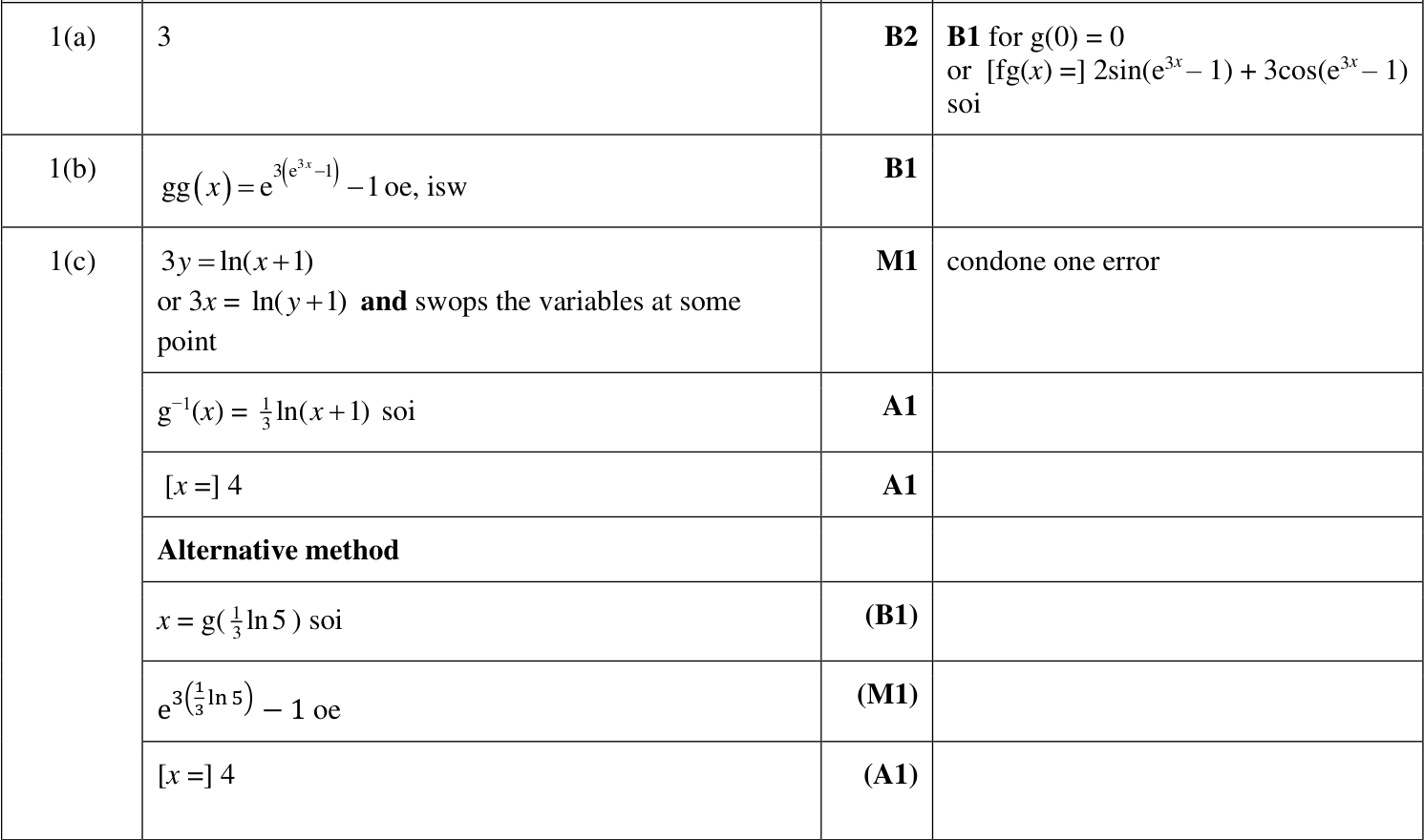
Answer: (a) \(3\); (b) \(\mathrm{gg}(x)=\mathrm e^{3\mathrm e^{3x}-3}-1\); (c) \(x=4\).
We start with the main method. Substitute one function into the other carefully and respect the stated domains.
(a) First find \(\mathrm g(0)\):
\(\mathrm g(0)=\mathrm e^0-1=0.\)
Therefore
\(\mathrm{fg}(0)=\mathrm f(\mathrm g(0))=\mathrm f(0).\)
So
\(\mathrm{fg}(0)=2\sin0+3\cos0=3.\)
(b) Since \(\mathrm g(x)=\mathrm e^{3x}-1\),
\(\mathrm{gg}(x)=\mathrm g(\mathrm g(x))=\mathrm e^{3(\mathrm e^{3x}-1)}-1.\)
Hence
\(\mathrm{gg}(x)=\mathrm e^{3\mathrm e^{3x}-3}-1.\)
(c) To find \(\mathrm g^{-1}\), let
\(y=\mathrm e^{3x}-1.\)
Then
\(y+1=\mathrm e^{3x},\)
so
\(\ln(y+1)=3x.\)
Thus
\(\mathrm g^{-1}(x)=\frac13\ln(x+1).\)
Now solve
\(\frac13\ln(x+1)=\frac13\ln5.\)
Multiplying by \(3\),
\(\ln(x+1)=\ln5,\)
so
\(x+1=5.\)
Therefore
\(x=4.\)
This completes the solution and gives the required result.