Past Exam Questions
← BackB1.4 — Use identities to see more
Year 10 · Lesson 1: Use identities to see more
Real numbers \(a,b,c\) satisfy
Find all possible triples \((a,b,c)\).
Source: Algebraic formulas — Khamovniki, Russian Group 7, 5 October 2024. K5, Problem 1. Preparation-circle worksheet.
B1.5 — Use identities to see more
Year 10 · Lesson 1: Use identities to see more
Real numbers \(a,b,c,d\) satisfy \(a+b=c+d\) and \(a^2+b^2=c^2+d^2\). Must \(a^3+b^3=c^3+d^3\)? Prove your answer.
Source: Algebraic formulas: continuation — Khamovniki, Russian Group 7, 19 October 2024. K6, Problem 3. Preparation-circle worksheet.
C1.1 — Symmetric expressions
Year 13 · Lesson 1: Symmetric expressions
Let \(x\ne0\) and \(x+\frac1x=3\). Find \(x^2+\frac1{x^2}\).
C1.2 — Symmetric expressions
Year 13 · Lesson 1: Symmetric expressions
Let \(x\ne0\) and \(x+\frac1x=3\). Find \(x^3+\frac1{x^3}\).
C1.3 — Symmetric expressions
Year 13 · Lesson 1: Symmetric expressions
Let \(a+b+c=0\). Prove that \(a^2+b^2+c^2=-2(ab+bc+ca)\) and \(a^3+b^3+c^3=3abc\).
Source: Maths4U Olympiad — Zero Sum
C1.4 — Symmetric expressions
Year 13 · Lesson 1: Symmetric expressions
Real numbers \(a,b,c\) satisfy \(a+b+c=0\) and \(a^2+b^2+c^2=1\). Find \(a^4+b^4+c^4\).
Source: Algebraic formulas: continuation — Khamovniki, Russian Group 7, 19 October 2024. K6, Problem 7. Preparation-circle worksheet.
C1.5 — Symmetric expressions
Year 13 · Lesson 1: Symmetric expressions
Let \(x+y+z=0\) and \(x^2+y^2+z^2=2\). Prove that the numbers \(x^3-x\), \(y^3-y\), \(z^3-z\) are equal.
Source: Maths4U Olympiad — Equal values
A2.1 — What cannot change?
Years 5-7 · Lesson 2: What cannot change?
The number \(4\) is written on a board. In one move, one may add \(2\). Can \(99\) be obtained?
Source: Maths4U Olympiad — Adding Two
A2.2 — What cannot change?
Years 5-7 · Lesson 2: What cannot change?
There are piles of \(3\), \(5\), and \(7\) stones. In one move, one stone may be moved from one pile to another. Can the piles become \(4\), \(6\), and \(10\)?
A2.3 — What cannot change?
Years 5-7 · Lesson 2: What cannot change?
There are \(9\) coins heads up. In one move, exactly two coins are flipped. Can all coins become tails up?
Source: Maths4U Olympiad — Two Coins
A2.4 — What cannot change?
Years 5-7 · Lesson 2: What cannot change?
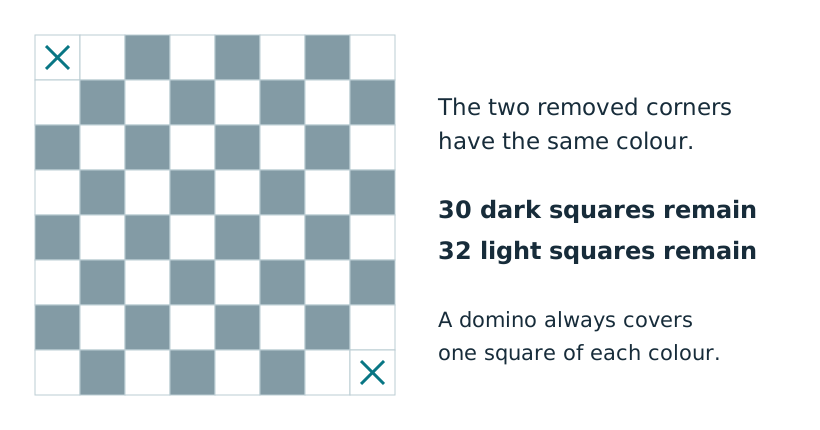
Two opposite corner squares are removed from an \(8\times8\) chessboard. Can the remaining squares be tiled by \(1\times2\) dominoes, with each domino covering two squares sharing a side?
A2.5 — What cannot change?
Years 5-7 · Lesson 2: What cannot change?
Thirty-three cups are upside down. In one move, you turn over exactly (a) two cups, (b) six cups, or (c) five cups. Treat the three rules as separate games. Under each rule, can you make every cup stand upright? Justify each answer.
Source: Can or Cannot? — Khamovniki, Russian Grade 6, Series 1, 20 September 2014. K1, Problem 4(a-c). Preparation-circle worksheet.
B2.1 — Make a useful product appear
Year 10 · Lesson 2: Make a useful product appear
Factor \(ab+ac+bd+cd\).
B2.2 — Make a useful product appear
Year 10 · Lesson 2: Make a useful product appear
Factor \(6x^3y-9x^2y^2+3xy^3\).
B2.3 — Make a useful product appear
Year 10 · Lesson 2: Make a useful product appear
Factor \(x^4+x^2+1\).
Source: Maths4U Olympiad — A Fourth Degree as a Quadratic Trinomial
B2.4 — Make a useful product appear
Year 10 · Lesson 2: Make a useful product appear
Prove that for every positive integer \(n\), the number \(n^4+4n^2+3\) is composite.
Source: Maths4U Olympiad — Compositeness of a Quadratic Form
B2.5 — Make a useful product appear
Year 10 · Lesson 2: Make a useful product appear
Prove that \(2020\cdot2022\cdot2024\cdot2026+16\) is a perfect square.
Source: Algebraic formulas: continuation — Khamovniki, Russian Group 7, 19 October 2024. K6, Problem 2. Preparation-circle worksheet.
C2.1 — Factorisation and primality
Year 13 · Lesson 2: Factorisation and primality
Factor \(8a^3+27b^3\).
Source: Maths4U Olympiad — Sum of Cubes
C2.2 — Factorisation and primality
Year 13 · Lesson 2: Factorisation and primality
Factor \(x^6-1\) into factors with integer coefficients.
Source: Maths4U Olympiad — Complete Factorisation of a Sixth Power
C2.3 — Factorisation and primality
Year 13 · Lesson 2: Factorisation and primality
Factor \(x^4+4y^4\).