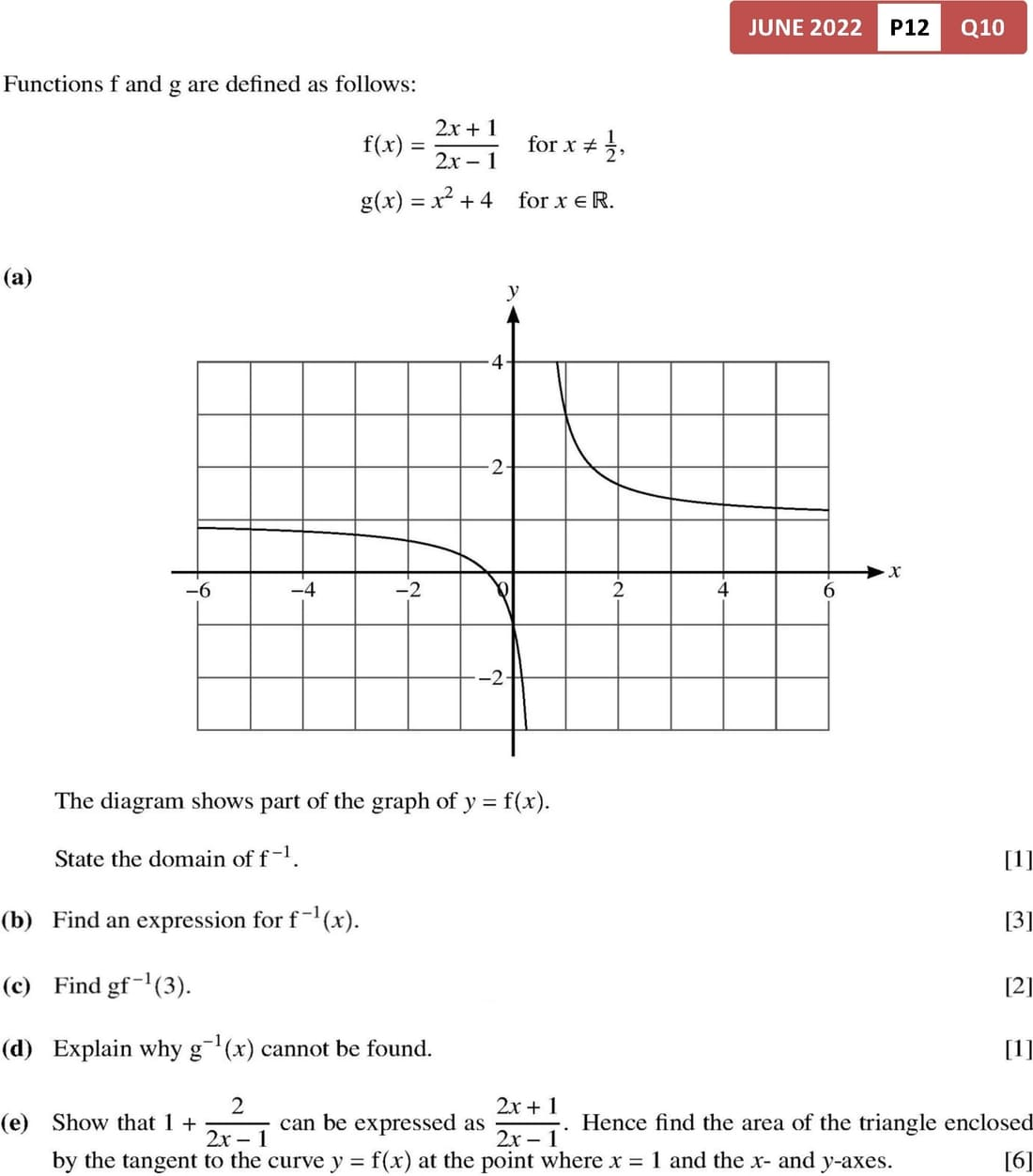
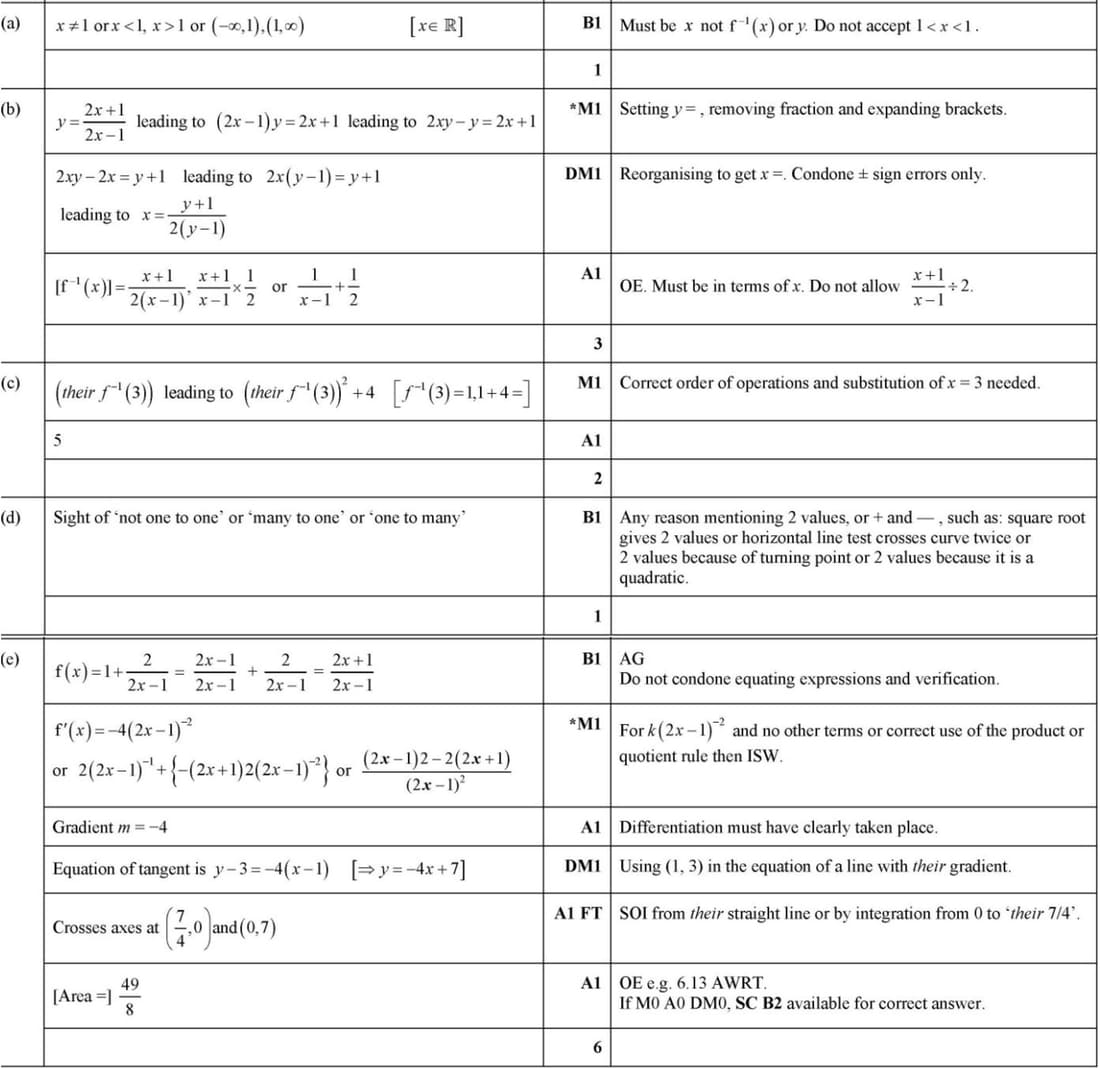
(a) The domain of \(f^{-1}\) is determined by the range of \(f(x)\). Since \(f(x)\) is undefined at \(x = \frac{1}{2}\), the domain of \(f^{-1}\) is \(x \neq 1\) or \(x < 1\), \(x > 1\) or \((-\infty, 1) \cup (1, \infty)\).
(b) To find \(f^{-1}(x)\), set \(y = \frac{2x+1}{2x-1}\) and solve for \(x\):
\(y(2x-1) = 2x+1\)
\(2xy - y = 2x + 1\)
\(2xy - 2x = y + 1\)
\(x(2y - 2) = y + 1\)
\(x = \frac{y+1}{2(y-1)}\)
Thus, \(f^{-1}(x) = \frac{x+1}{x-1}\).
(c) Substitute \(x = 3\) into \(f^{-1}(x)\):
\(f^{-1}(3) = \frac{3+1}{3-1} = 2\)
Then, \(g(f^{-1}(3)) = g(2) = 2^2 + 4 = 8\).
(d) \(g(x) = x^2 + 4\) is not one-to-one because it is a quadratic function, which means \(g^{-1}(x)\) cannot be found.
(e) Show that \(1 + \frac{2}{2x-1} = \frac{2x+1}{2x-1}\):
\(1 + \frac{2}{2x-1} = \frac{2x-1}{2x-1} + \frac{2}{2x-1} = \frac{2x+1}{2x-1}\)
Find the equation of the tangent at \(x = 1\):
\(f(x) = \frac{2x+1}{2x-1}\) gives \(f(1) = 3\)
The derivative \(f'(x) = \frac{-4}{(2x-1)^2}\) gives \(f'(1) = -4\)
The equation of the tangent is \(y - 3 = -4(x - 1)\) or \(y = -4x + 7\)
The tangent crosses the x-axis at \(x = \frac{7}{4}\) and the y-axis at \(y = 7\).
The area of the triangle is \(\frac{1}{2} \times \frac{7}{4} \times 7 = \frac{49}{8}\).