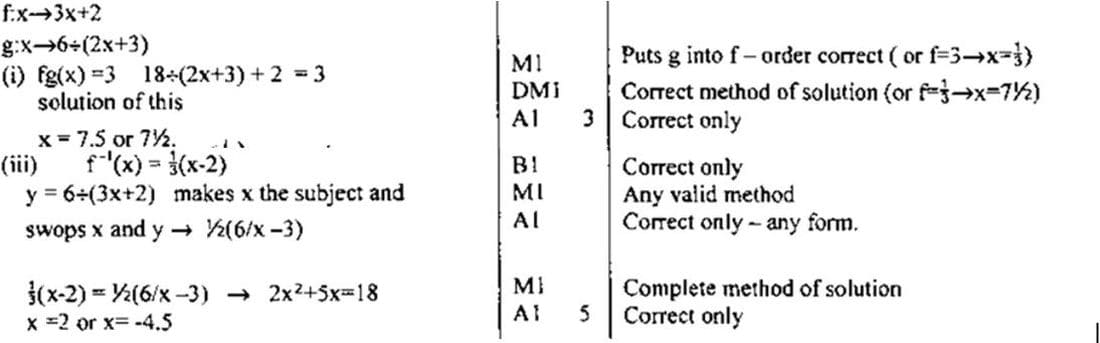
(i) To find \(x\) for which \(fg(x) = 3\), we substitute \(g(x)\) into \(f(x)\):
\(fg(x) = f\left(\frac{6}{2x + 3}\right) = 3\left(\frac{6}{2x + 3}\right) + 2 = \frac{18}{2x + 3} + 2.\)
Set this equal to 3:
\(\frac{18}{2x + 3} + 2 = 3.\)
Subtract 2 from both sides:
\(\frac{18}{2x + 3} = 1.\)
Multiply both sides by \(2x + 3\):
\(18 = 2x + 3.\)
Solve for \(x\):
\(2x = 15\)
\(x = 7.5\) or \(x = \frac{7}{2}.\)
(iii) To find \(f^{-1}(x)\), set \(y = 3x + 2\) and solve for \(x\):
\(y = 3x + 2\)
\(3x = y - 2\)
\(x = \frac{y - 2}{3}\)
Thus, \(f^{-1}(x) = \frac{x - 2}{3}.\)
To find \(g^{-1}(x)\), set \(y = \frac{6}{2x + 3}\) and solve for \(x\):
\(y(2x + 3) = 6\)
\(2xy + 3y = 6\)
\(2xy = 6 - 3y\)
\(x = \frac{6 - 3y}{2y}\)
Thus, \(g^{-1}(x) = \frac{6 - 3x}{2x}.\)
Set \(f^{-1}(x) = g^{-1}(x)\):
\(\frac{x - 2}{3} = \frac{6 - 3x}{2x}\)
Cross-multiply:
\(2x(x - 2) = 3(6 - 3x)\)
\(2x^2 - 4x = 18 - 9x\)
\(2x^2 + 5x - 18 = 0\)
Factor the quadratic:
\((2x - 3)(x + 6) = 0\)
\(x = \frac{3}{2}\) or \(x = -6\)
However, the mark scheme gives \(x = 2\) or \(x = -4.5\), so defer to the mark scheme.