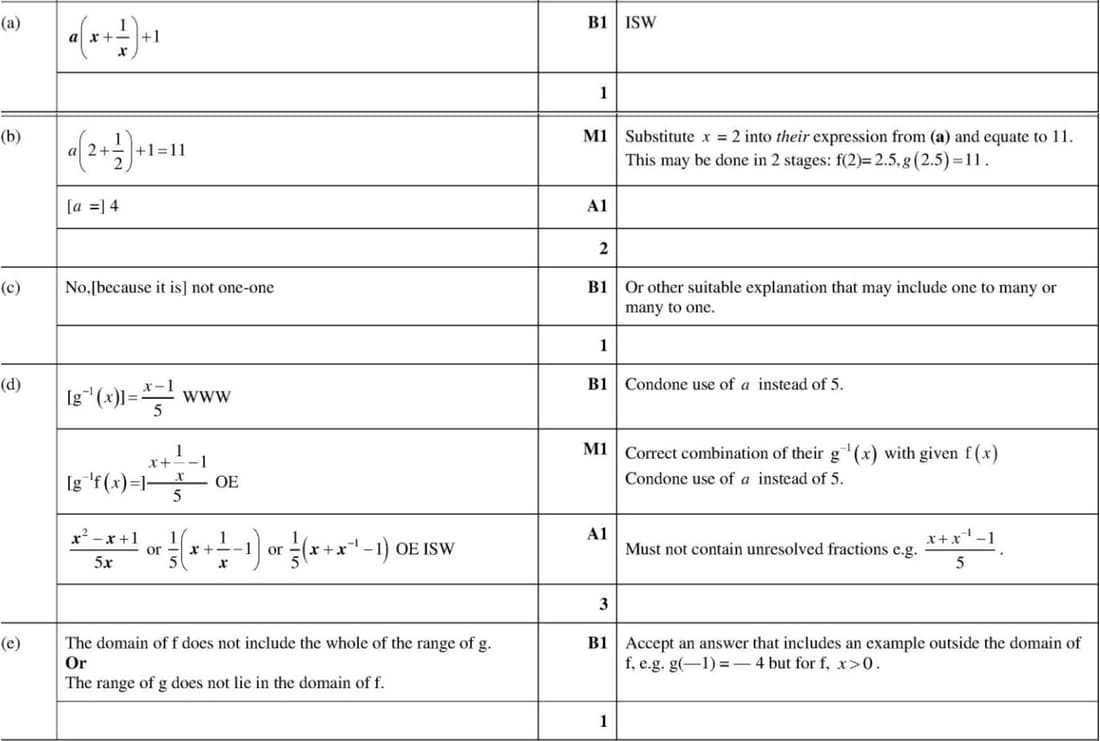
(c) The function \(f(x) = x + \frac{1}{x}\) is not one-one because it has a minimum point at \(x = 1\), meaning it is not strictly increasing or decreasing. Therefore, \(f\) does not have an inverse.
(d) To find \(g^{-1}(x)\), solve \(y = ax + 1\) for \(x\):
\(y - 1 = ax\)
\(x = \frac{y - 1}{a}\)
For \(a = 5\), \(g^{-1}(x) = \frac{x - 1}{5}\).
Substitute \(f(x) = x + \frac{1}{x}\) into \(g^{-1}(x)\):
\(g^{-1}f(x) = \frac{x + \frac{1}{x} - 1}{5}\).
(e) The composite function \(fg\) cannot be formed because the domain of \(f\) (\(x > 0\)) does not include the whole range of \(g\), which is all real numbers.