Past Exam Questions
← Back9709 P52 - Mar 2020 - Q2
An ordinary fair die is thrown 3 times. The random variable X is the number of times that a 1 or a 6 is obtained.
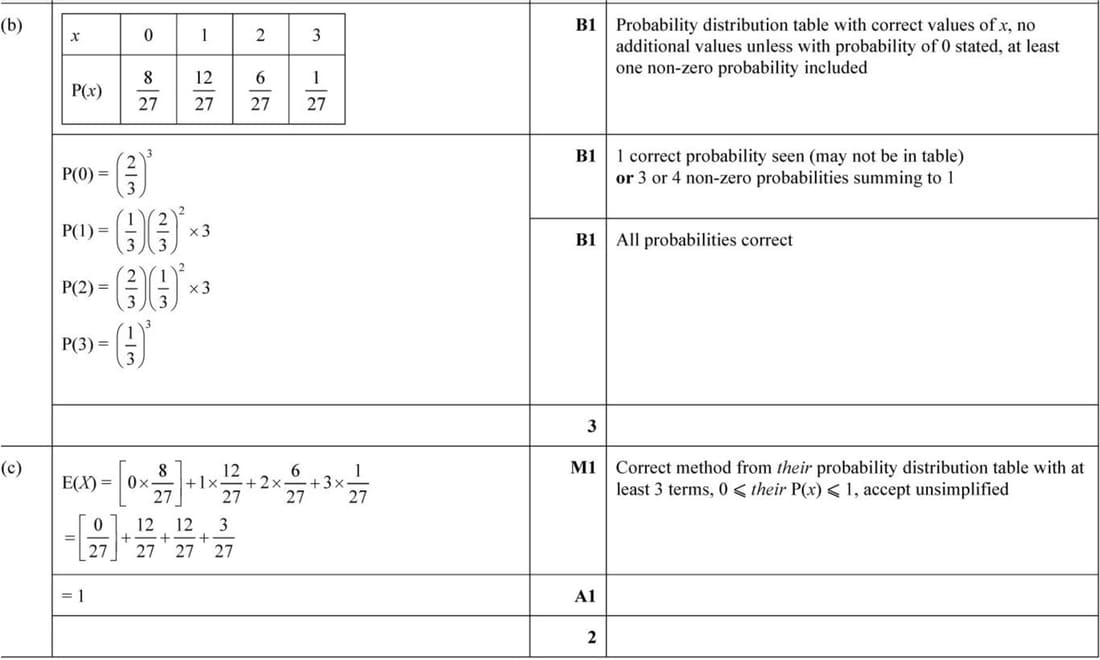
(b) Draw up the probability distribution table for X.
(c) Find E(X).
9709 P63 - Nov 2019 - Q6
A box contains 3 red balls and 5 white balls. One ball is chosen at random from the box and is not returned to the box. A second ball is now chosen at random from the box.
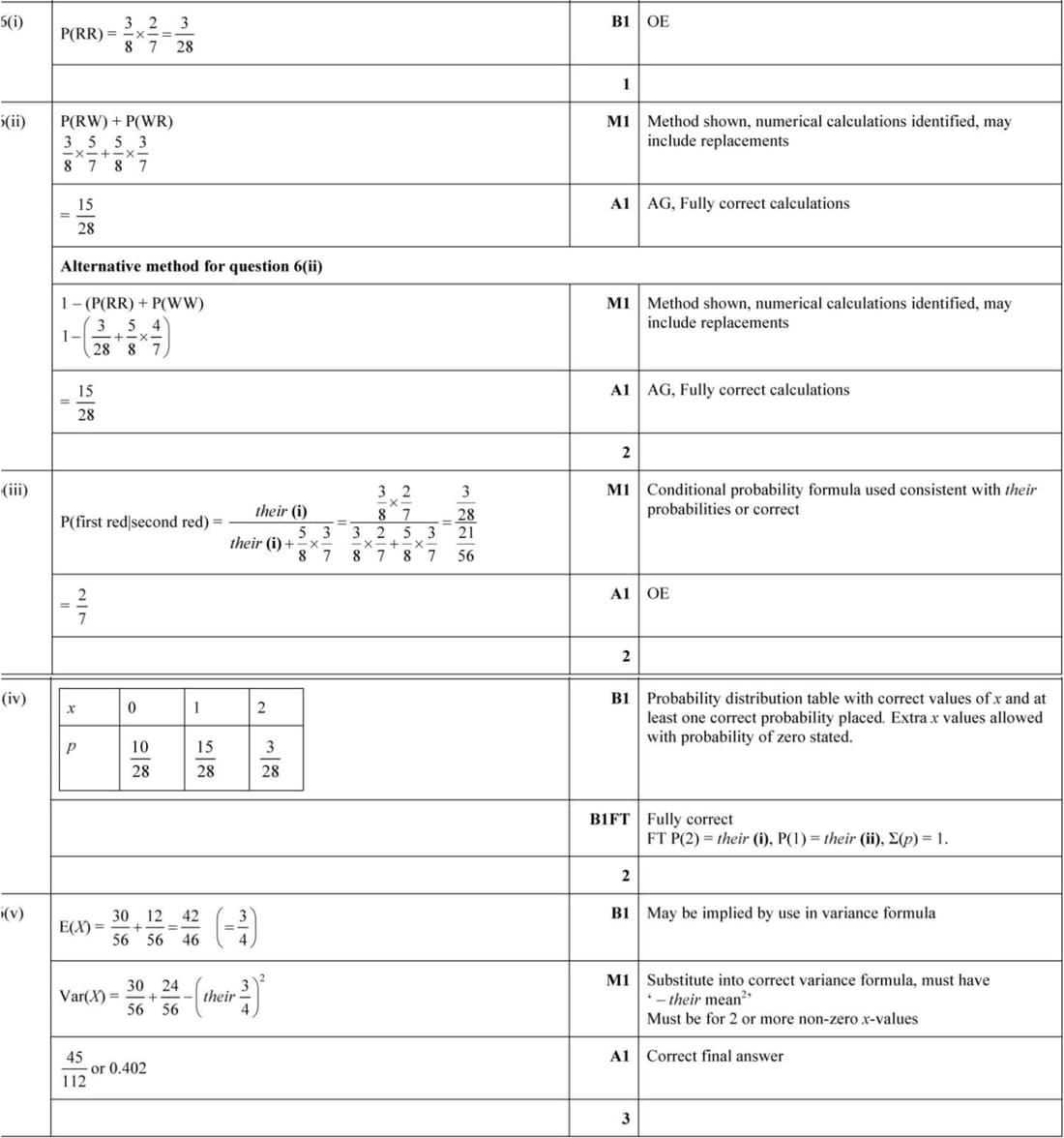
- Find the probability that both balls chosen are red.
- Show that the probability that the balls chosen are of different colours is \(\frac{15}{28}\).
- Given that the second ball chosen is red, find the probability that the first ball chosen is red.
The random variable \(X\) denotes the number of red balls chosen.
- Draw up the probability distribution table for \(X\).
- Find \(\text{Var}(X)\).
9709 P62 - Nov 2019 - Q5
A fair red spinner has four sides, numbered 1, 2, 3, 3. A fair blue spinner has three sides, numbered -1, 0, 2. When a spinner is spun, the score is the number on the side on which it lands. The spinners are spun at the same time. The random variable X denotes the score on the red spinner minus the score on the blue spinner.
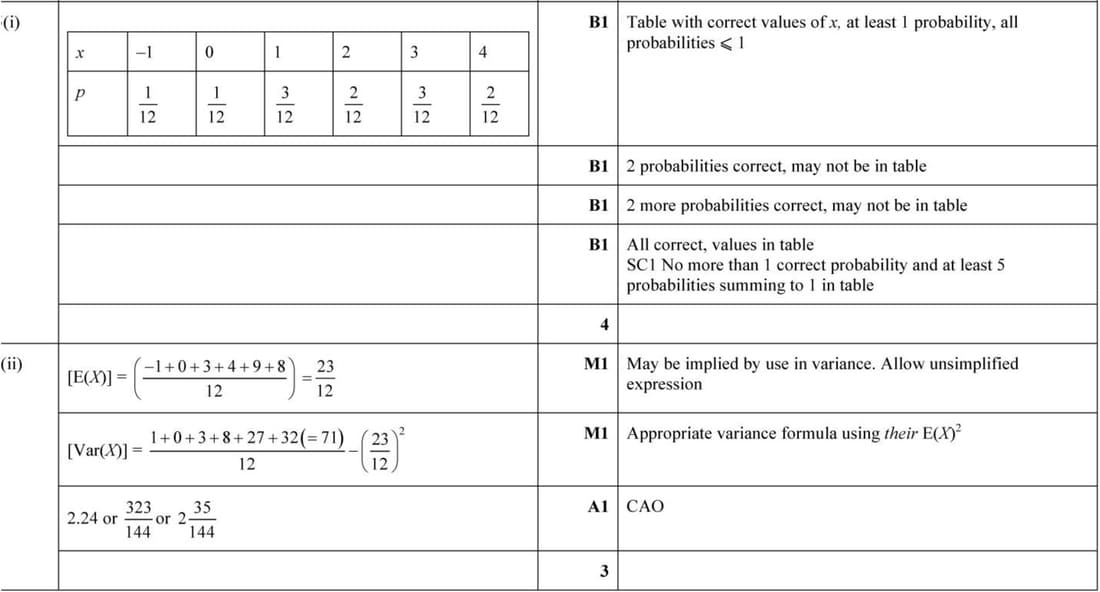
(i) Draw up the probability distribution table for X.
(ii) Find \(\text{Var}(X)\).
9709 P63 - Jun 2019 - Q6
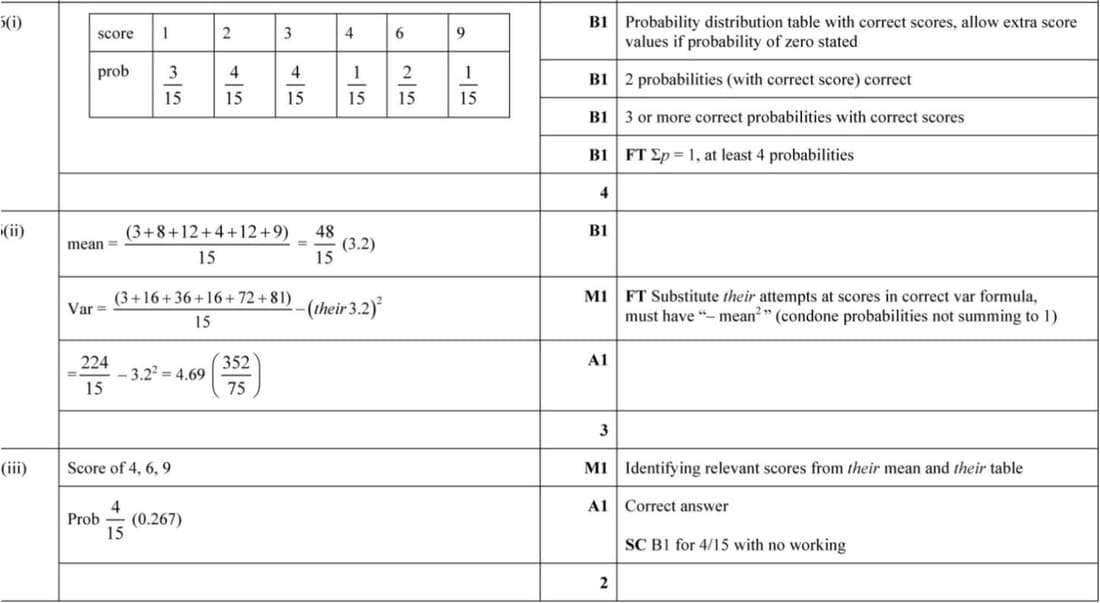
A fair five-sided spinner has sides numbered 1, 1, 1, 2, 3. A fair three-sided spinner has sides numbered 1, 2, 3. Both spinners are spun once and the score is the product of the numbers on the sides the spinners land on.
- Draw up the probability distribution table for the score.
- Find the mean and the variance of the score.
- Find the probability that the score is greater than the mean score.
9709 P62 - Jun 2019 - Q5
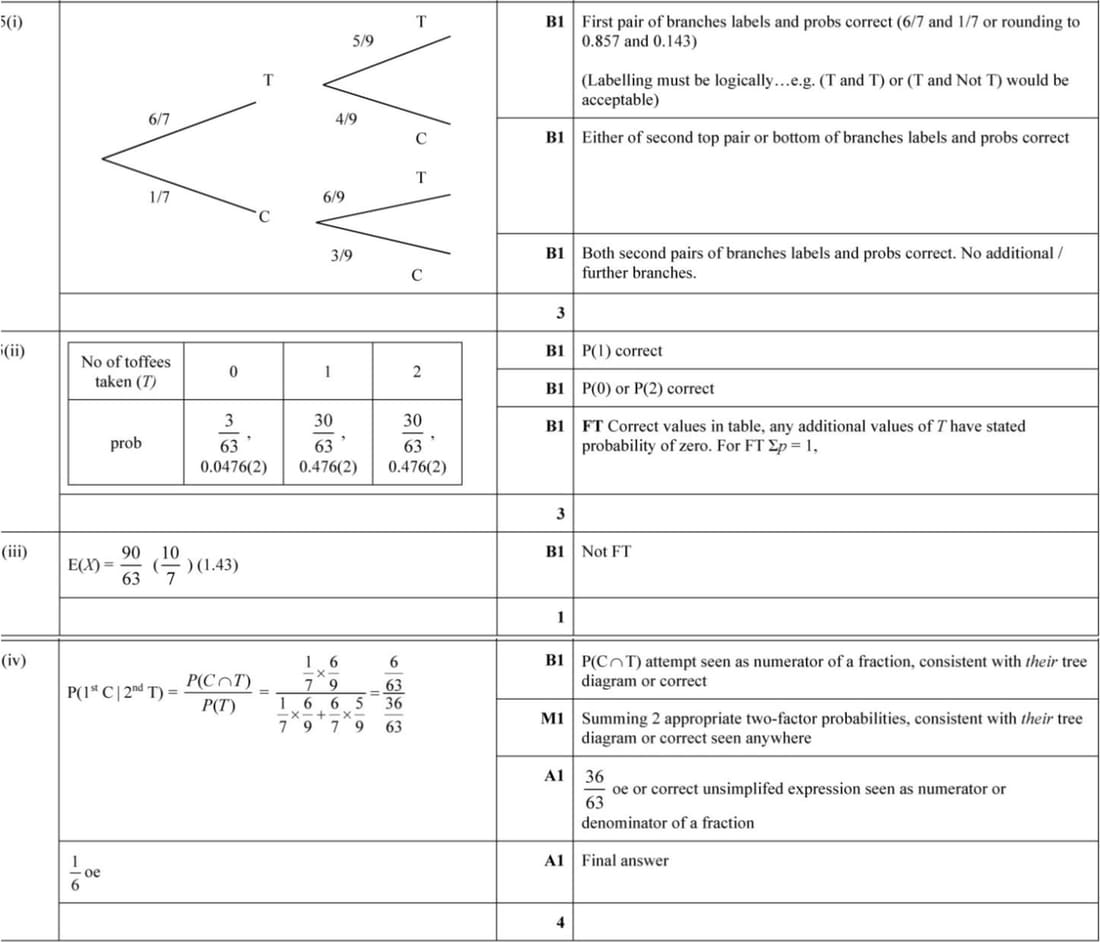
Maryam has 7 sweets in a tin; 6 are toffees and 1 is a chocolate. She chooses one sweet at random and takes it out. Her friend adds 3 chocolates to the tin. Then Maryam takes another sweet at random out of the tin.
- Draw a fully labelled tree diagram to illustrate this situation.
- Draw up the probability distribution table for the number of toffees taken.
- Find the mean number of toffees taken.
- Find the probability that the first sweet taken is a chocolate, given that the second sweet taken is a toffee.
9709 P61 - Jun 2019 - Q6
At a funfair, Amy pays $1 for two attempts to make a bell ring by shooting at it with a water pistol.
- If she makes the bell ring on her first attempt, she receives $3 and stops playing. This means that overall she has gained $2.
- If she makes the bell ring on her second attempt, she receives $1.50 and stops playing. This means that overall she has gained $0.50.
- If she does not make the bell ring in the two attempts, she has lost her original $1.
The probability that Amy makes the bell ring on any attempt is 0.2, independently of other attempts.
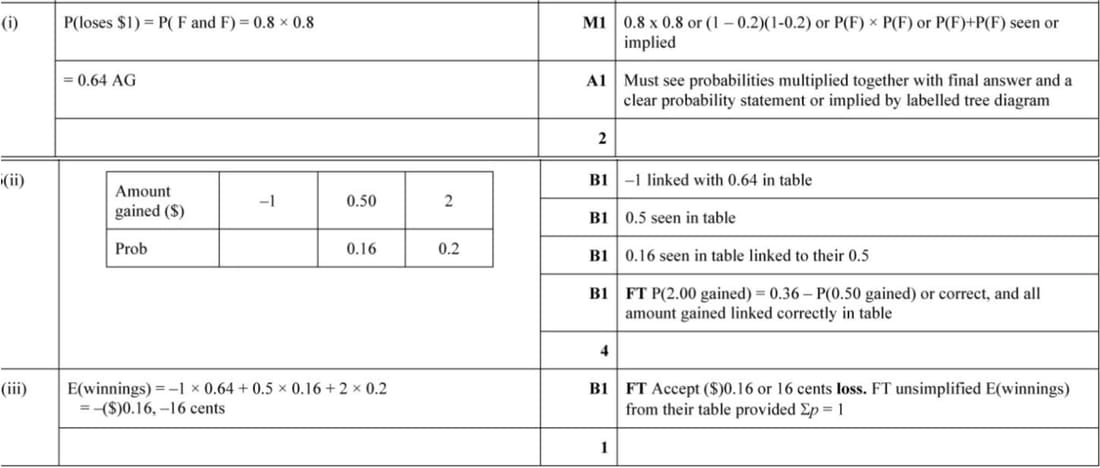
- Show that the probability that Amy loses her original $1 is 0.64. [2]
- Complete the probability distribution table for the amount that Amy gains. [4]
- Calculate Amy’s expected gain. [1]
9709 P62 - Mar 2019 - Q4
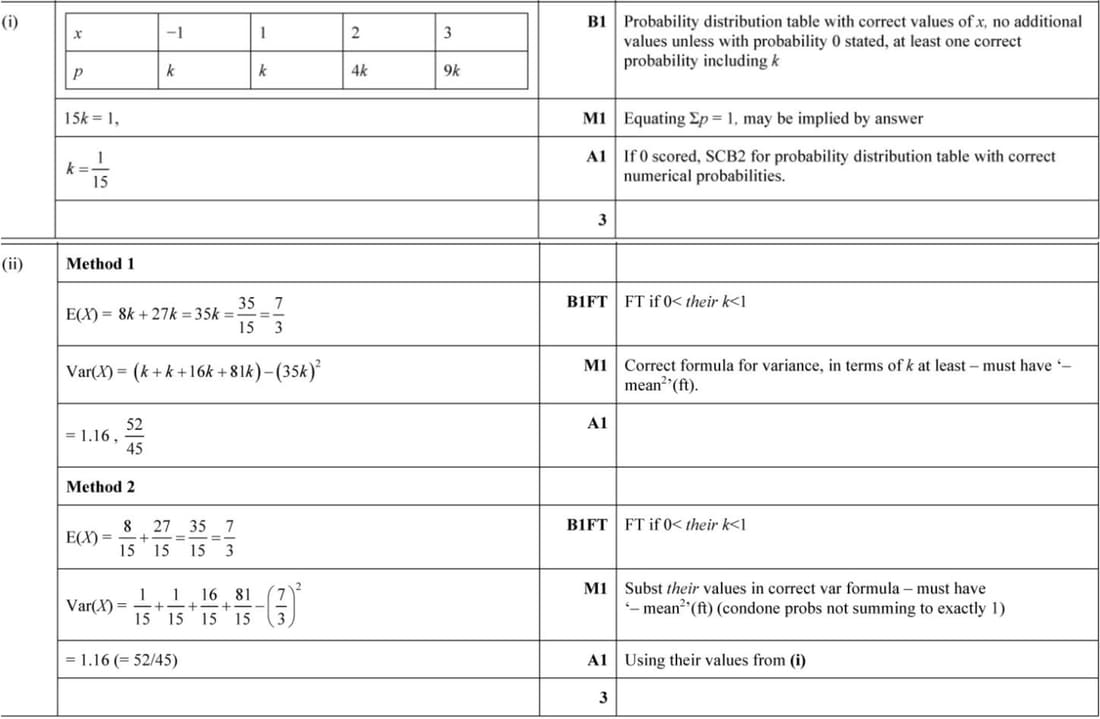
The random variable X takes the values -1, 1, 2, 3 only. The probability that X takes the value x is kx2, where k is a constant.
- Draw up the probability distribution table for X, in terms of k, and find the value of k.
- Find E(X) and Var(X).
9709 P63 - Nov 2018 - Q2
A fair 6-sided die has the numbers -1, -1, 0, 0, 1, 2 on its faces. A fair 3-sided spinner has edges numbered -1, 0, 1. The die is thrown and the spinner is spun. The number on the uppermost face of the die and the number on the edge on which the spinner comes to rest are noted. The sum of these two numbers is denoted by X.
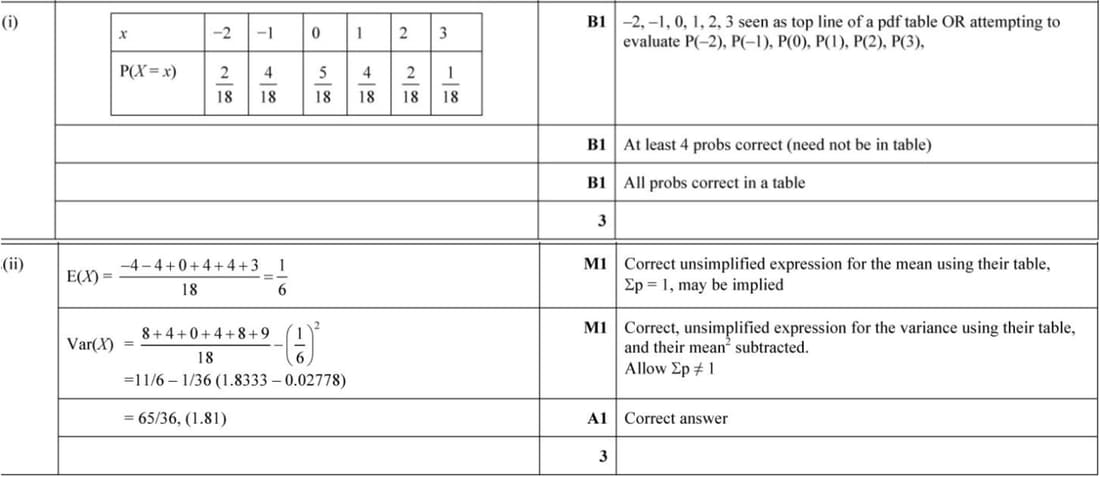
- Draw up a table showing the probability distribution of X.
- Find \(\text{Var}(X)\).
9709 P62 - Nov 2018 - Q6
A fair red spinner has 4 sides, numbered 1, 2, 3, 4. A fair blue spinner has 3 sides, numbered 1, 2, 3. When a spinner is spun, the score is the number on the side on which it lands. The spinners are spun at the same time. The random variable X denotes the score on the red spinner minus the score on the blue spinner.
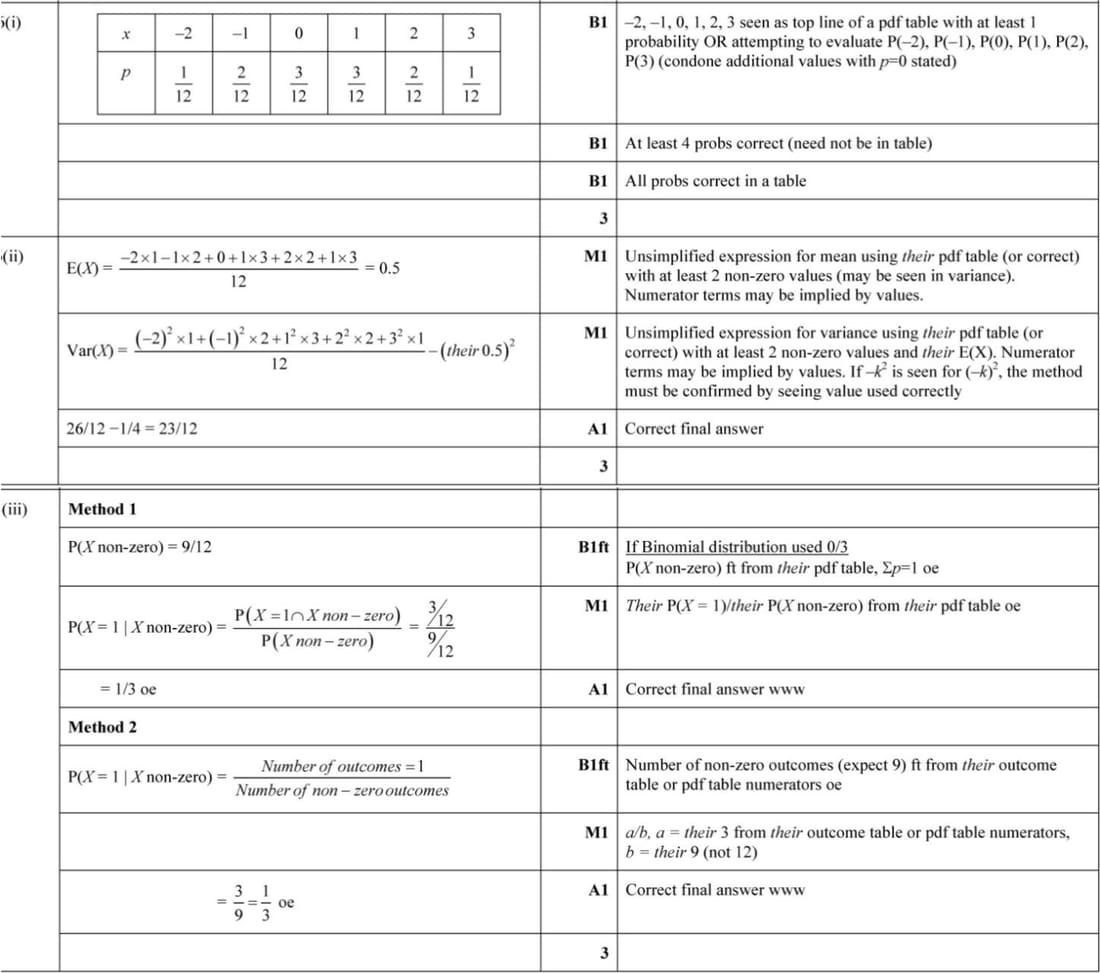
- Draw up the probability distribution table for X.
- Find \(\text{Var}(X)\).
- Find the probability that \(X\) is equal to 1, given that \(X\) is non-zero.
9709 P61 - Nov 2018 - Q2
A random variable X has the probability distribution shown in the following table, where p is a constant.
| x | -1 | 0 | 1 | 2 | 4 |
|---|---|---|---|---|---|
| P(X = x) | p | p | 2p | 2p | 0.1 |
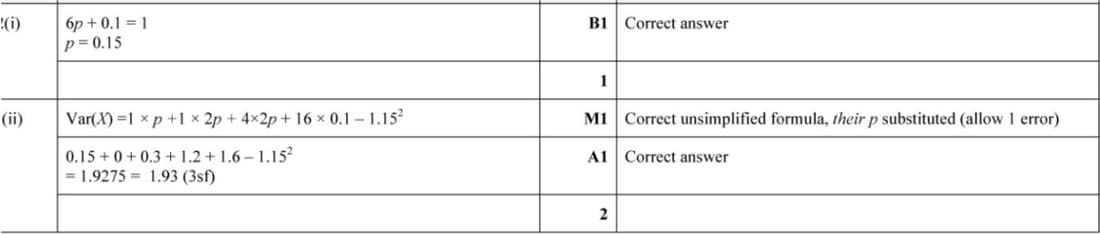
- Find the value of p.
- Given that \(E(X) = 1.15\), find \(\text{Var}(X)\).
9709 P52 - Jun 2023 - Q1
The random variable X takes the values −2, 2 and 3. It is given that
\(P(X = x) = k(x^2 - 1)\),
where k is a constant.
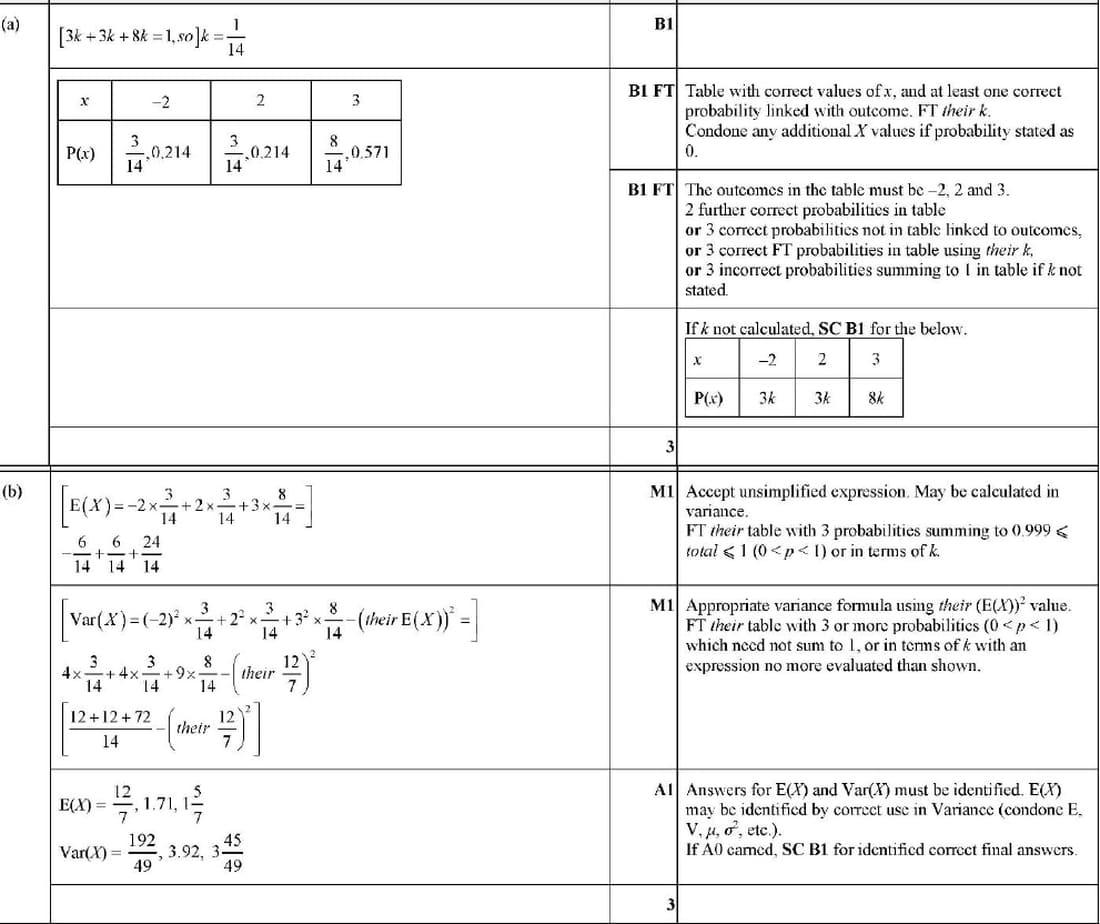
(a) Draw up the probability distribution table for X, giving the probabilities as numerical fractions.
(b) Find \(E(X)\) and \(\text{Var}(X)\).
9709 P63 - Jun 2018 - Q5
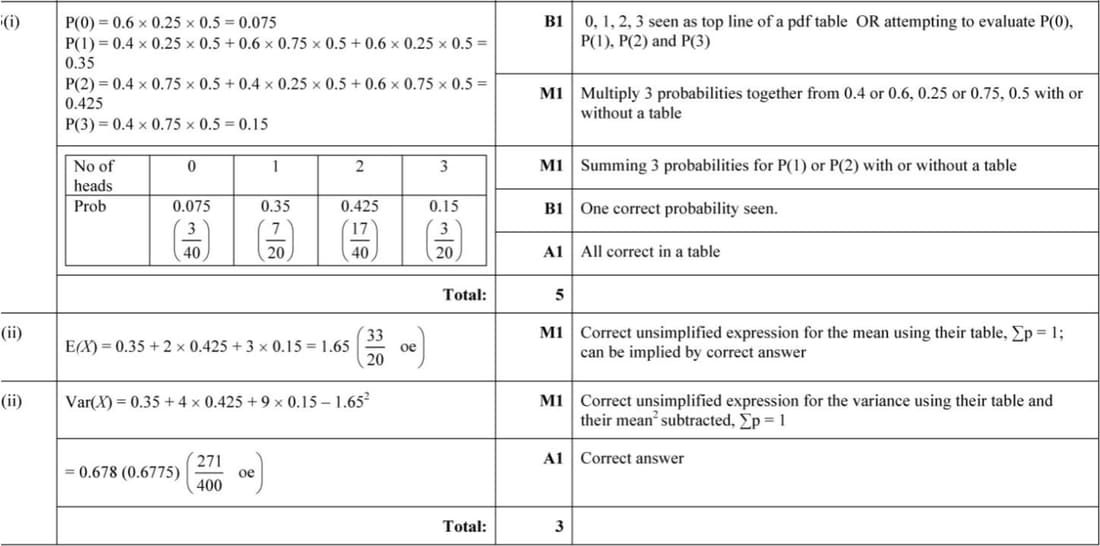
A game is played with 3 coins, A, B and C. Coins A and B are biased so that the probability of obtaining a head is 0.4 for coin A and 0.75 for coin B. Coin C is not biased. The 3 coins are thrown once.
- Draw up the probability distribution table for the number of heads obtained.
- Hence calculate the mean and variance of the number of heads obtained.
9709 P62 - Jun 2018 - Q4
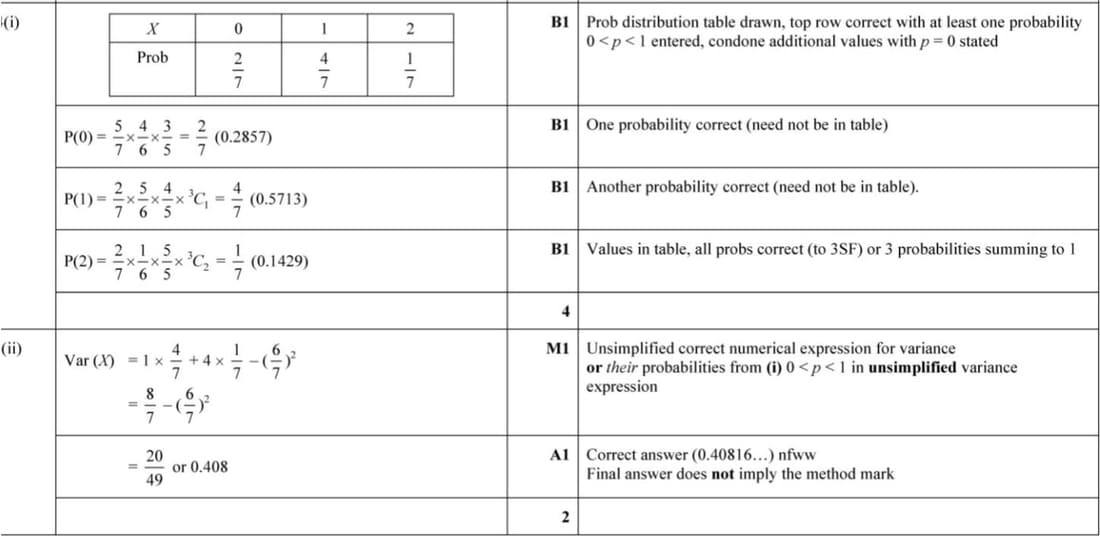
Mrs Rupal chooses 3 animals at random from 5 dogs and 2 cats. The random variable X is the number of cats chosen.
- Draw up the probability distribution table for X.
- You are given that E(X) = \(\frac{6}{7}\). Find the value of Var(X).
9709 P61 - Jun 2018 - Q3
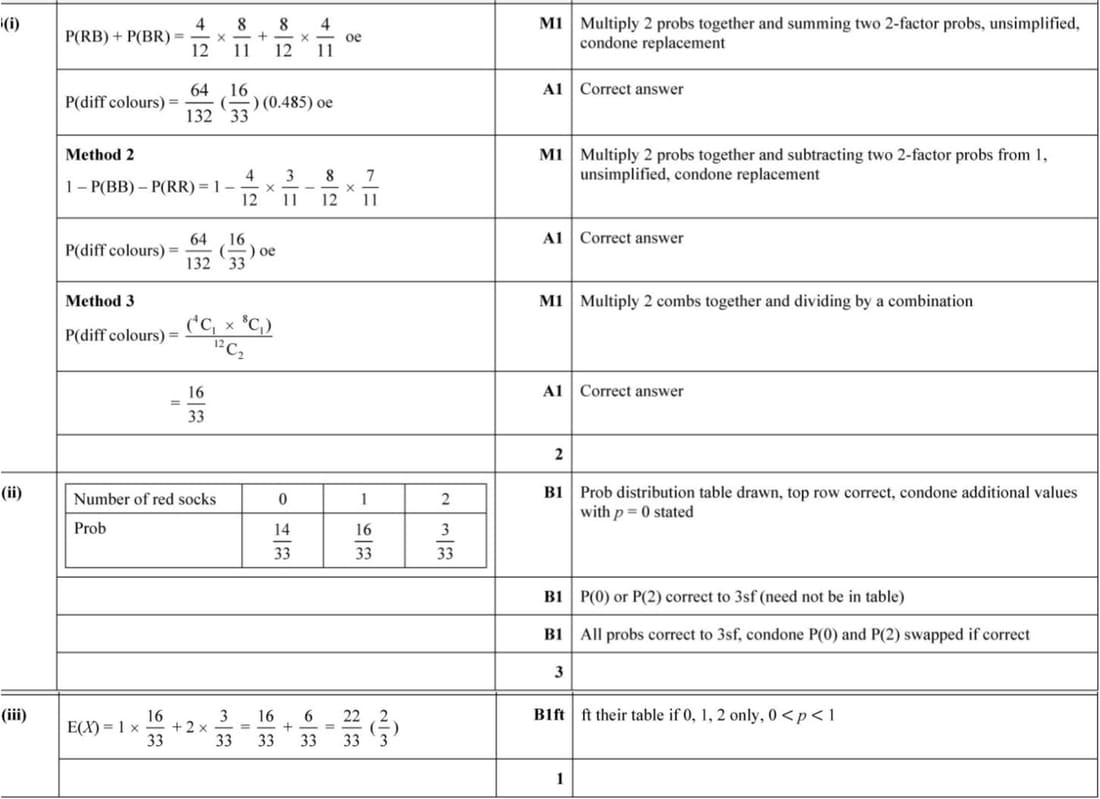
Andy has 4 red socks and 8 black socks in his drawer. He takes 2 socks at random from his drawer.
- Find the probability that the socks taken are of different colours.
- Draw up the probability distribution table for X.
- Find E(X).
The random variable X is the number of red socks taken.
9709 P63 - Nov 2017 - Q4
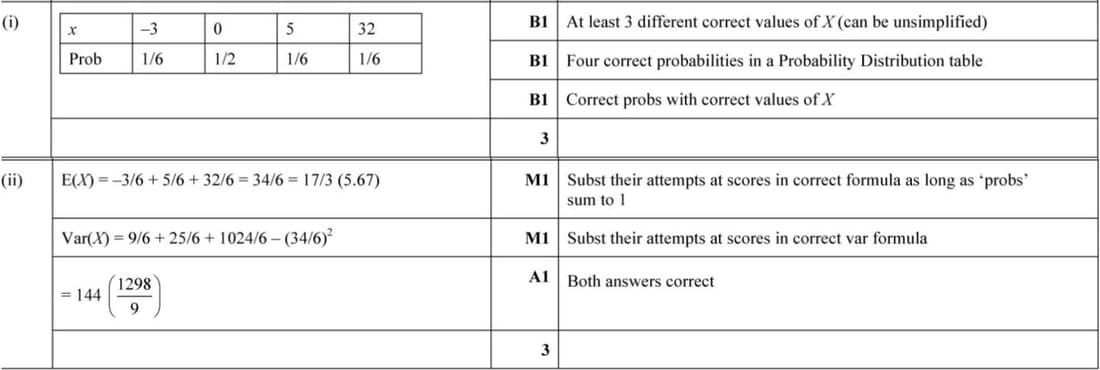
A fair die with faces numbered 1, 2, 2, 2, 3, 6 is thrown. The score, X, is found by squaring the number on the face the die shows and then subtracting 4.
- Draw up a table to show the probability distribution of X.
- Find E(X) and Var(X).
9709 P62 - Nov 2017 - Q3
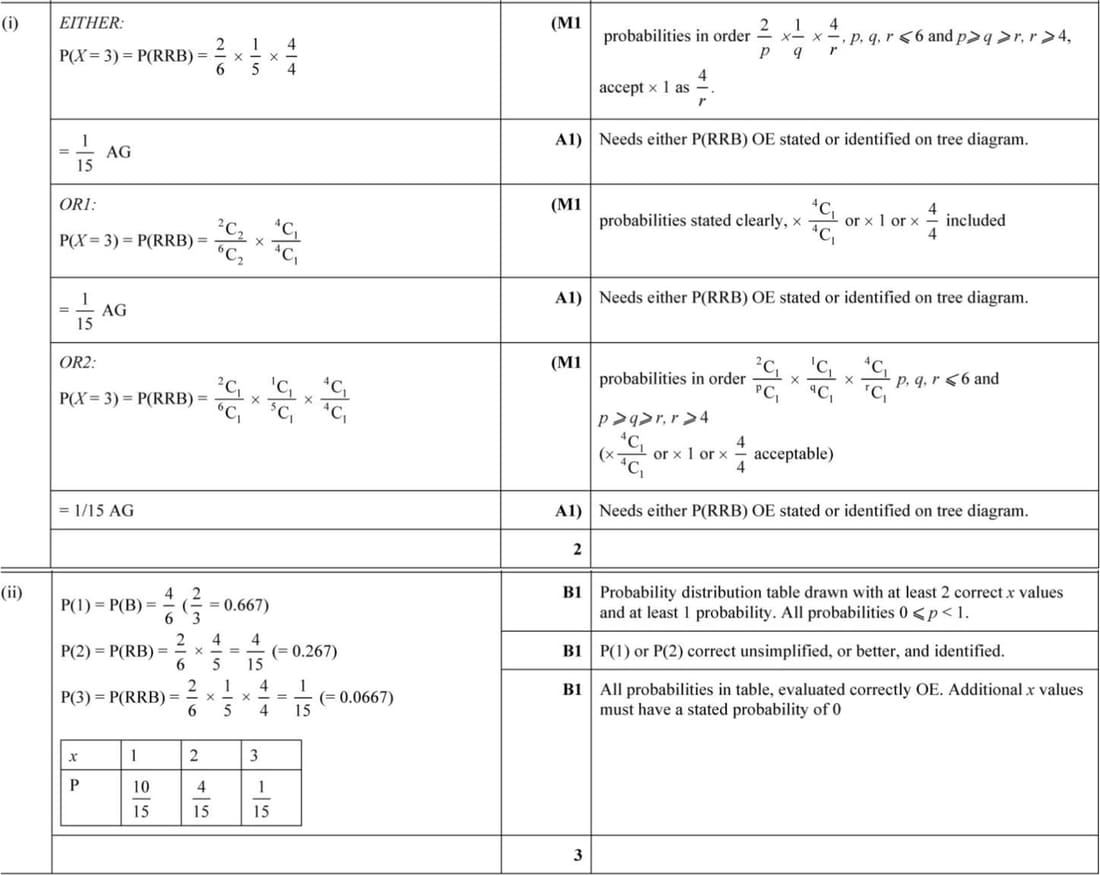
A box contains 6 identical-sized discs, of which 4 are blue and 2 are red. Discs are taken at random from the box in turn and not replaced. Let X be the number of discs taken, up to and including the first blue one.
(i) Show that \(P(X = 3) = \frac{1}{15}\).
(ii) Draw up the probability distribution table for \(X\).
9709 P62 - Jun 2017 - Q3
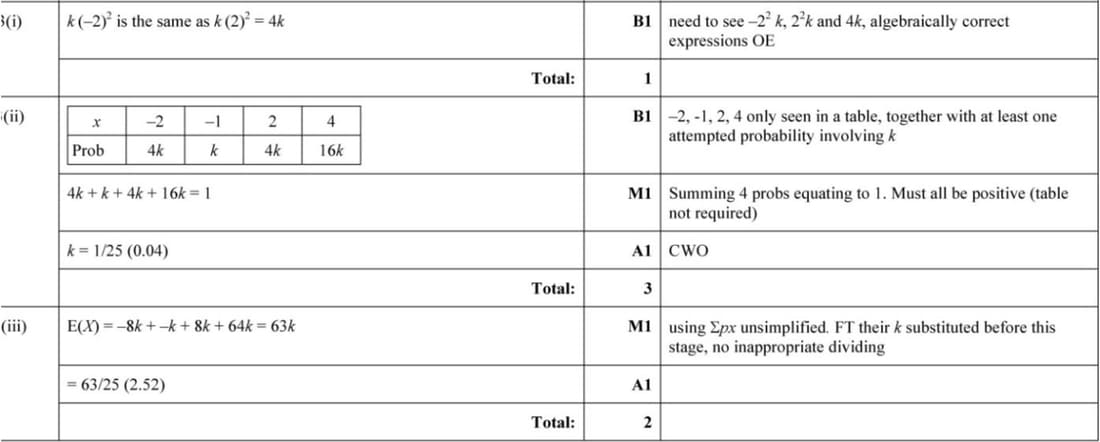
In a probability distribution the random variable \(X\) takes the value \(x\) with probability \(kx^2\), where \(k\) is a constant and \(x\) takes values \(-2, -1, 2, 4\) only.
- Show that \(P(X = -2)\) has the same value as \(P(X = 2)\).
- Draw up the probability distribution table for \(X\), in terms of \(k\), and find the value of \(k\).
- Find \(E(X)\).
9709 P62 - Mar 2017 - Q6
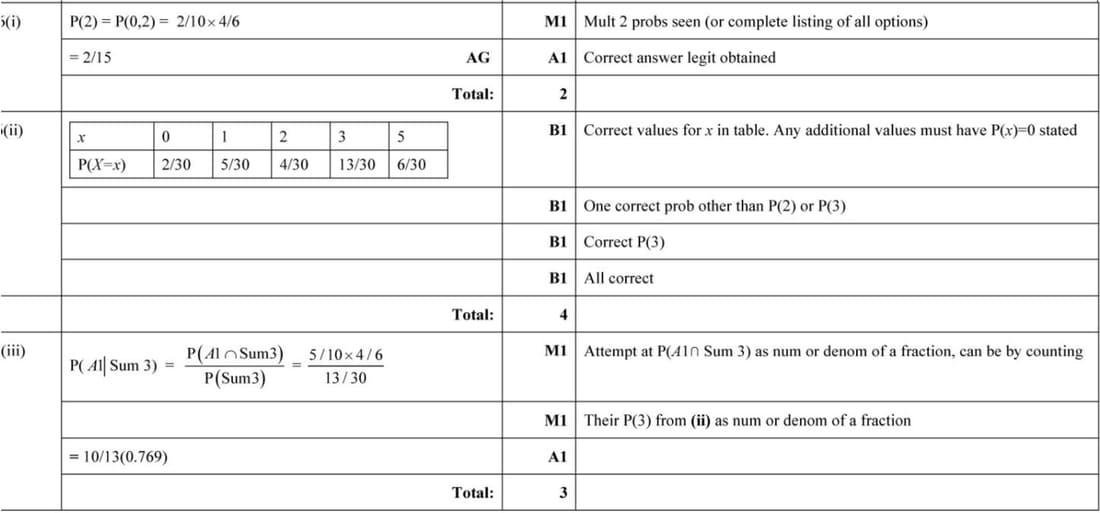
Pack A consists of ten cards numbered 0, 0, 1, 1, 1, 1, 3, 3, 3, 3. Pack B consists of six cards numbered 0, 0, 2, 2, 2, 2. One card is chosen at random from each pack. The random variable X is defined as the sum of the two numbers on the cards.
- Show that \(P(X = 2) = \frac{2}{15}\).
- Draw up the probability distribution table for \(X\).
- Given that \(X = 3\), find the probability that the card chosen from pack A is a 1.
9709 P62 - Nov 2016 - Q2
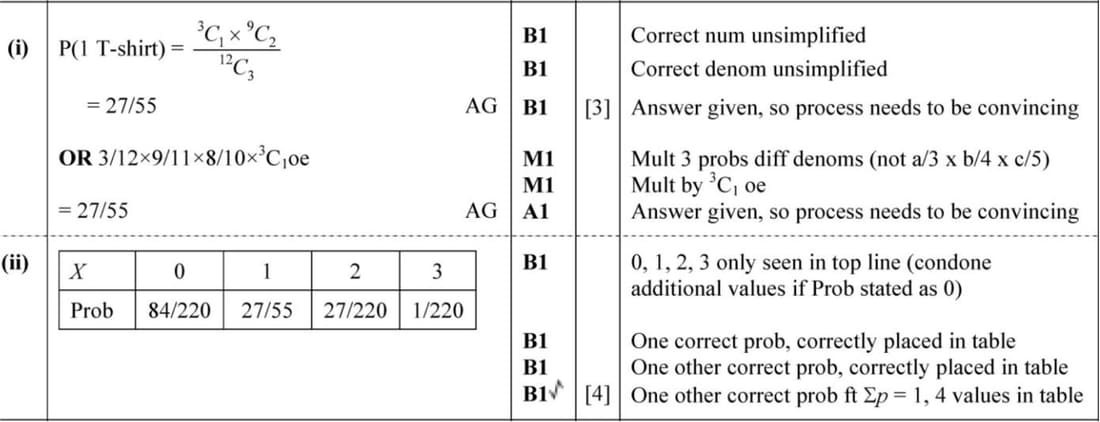
Noor has 3 T-shirts, 4 blouses and 5 jumpers. She chooses 3 items at random. The random variable X is the number of T-shirts chosen.
- Show that the probability that Noor chooses exactly one T-shirt is \(\frac{27}{55}\).
- Draw up the probability distribution table for X.
9709 P61 - Nov 2016 - Q2
Two fair six-sided dice with faces numbered 1, 2, 3, 4, 5, 6 are thrown and the two scores are noted. The difference between the two scores is defined as follows.
- If the scores are equal the difference is zero.
- If the scores are not equal the difference is the larger score minus the smaller score.
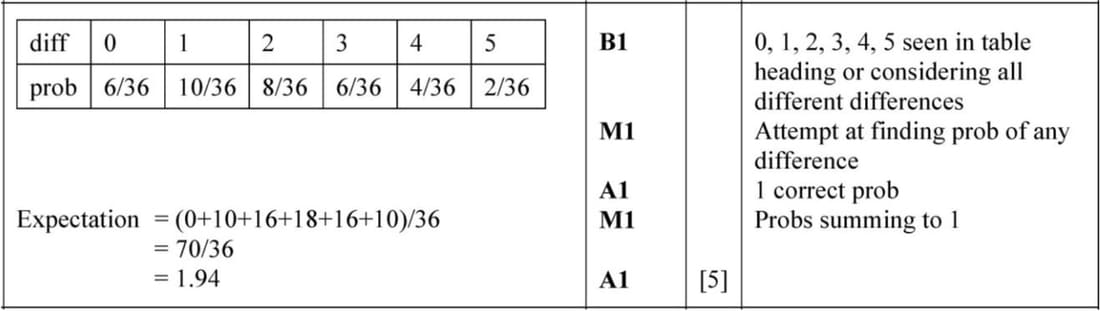
Find the expectation of the difference between the two scores.