9709 P62 - Jun 2017 - Q3
2915
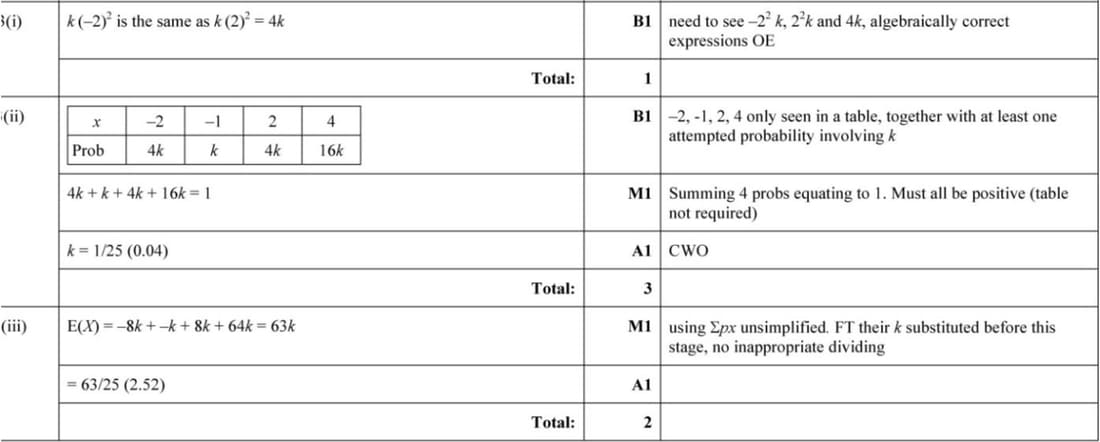
In a probability distribution the random variable \(X\) takes the value \(x\) with probability \(kx^2\), where \(k\) is a constant and \(x\) takes values \(-2, -1, 2, 4\) only.
- Show that \(P(X = -2)\) has the same value as \(P(X = 2)\).
- Draw up the probability distribution table for \(X\), in terms of \(k\), and find the value of \(k\).
- Find \(E(X)\).