Past Exam Questions
← Back9709 P63 - Jun 2016 - Q3
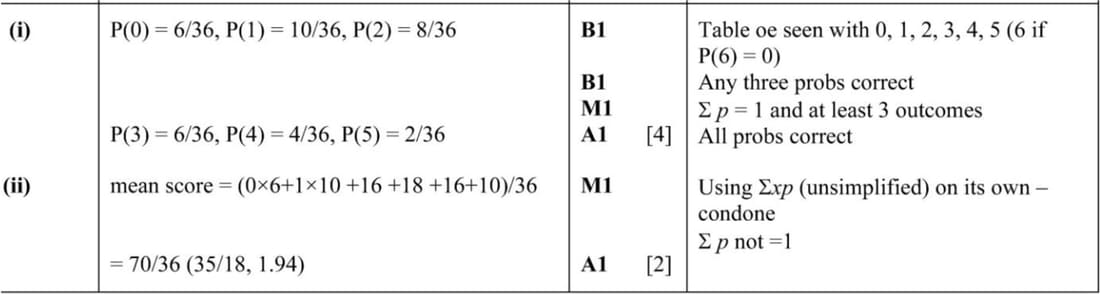
Two ordinary fair dice are thrown. The resulting score is found as follows.
- If the two dice show different numbers, the score is the smaller of the two numbers.
- If the two dice show equal numbers, the score is 0.
(i) Draw up the probability distribution table for the score.
(ii) Calculate the expected score.
9709 P53 - Nov 2022 - Q4
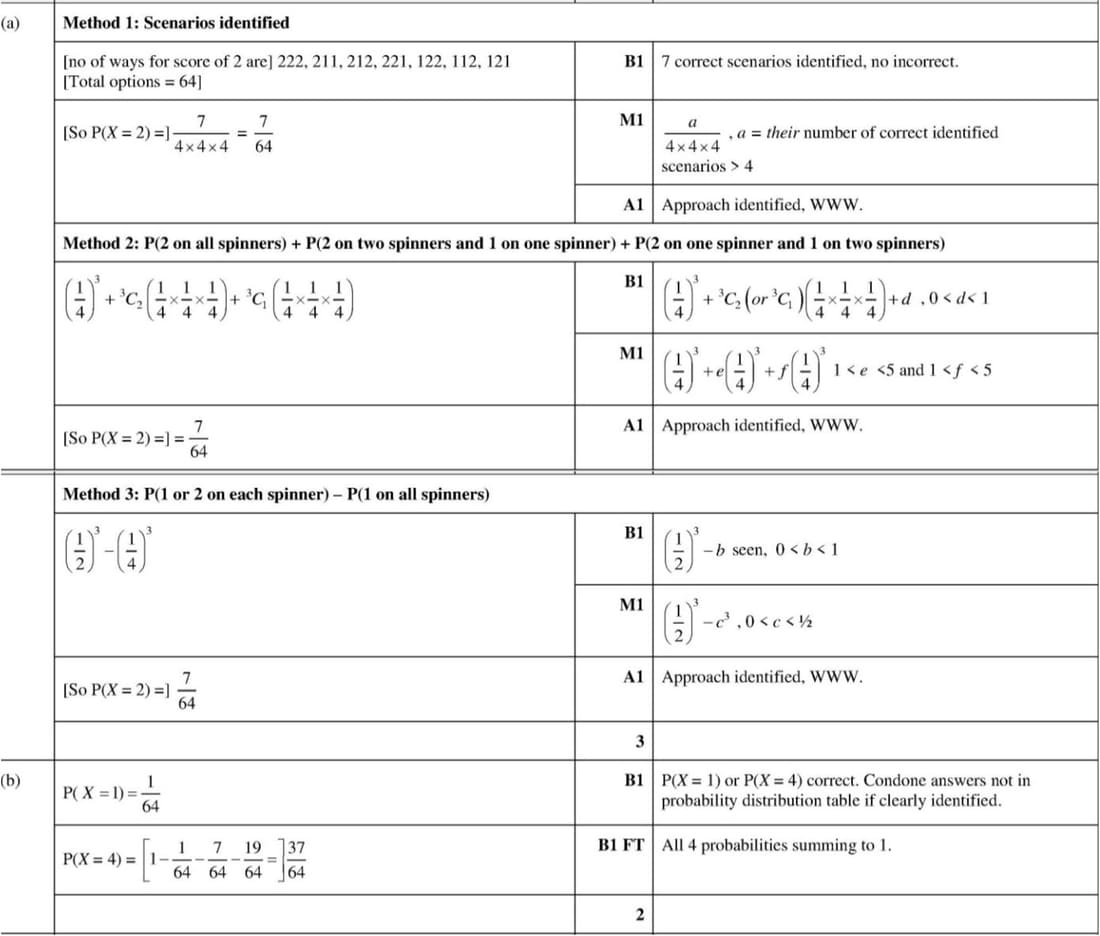
Three fair 4-sided spinners each have sides labelled 1, 2, 3, 4. The spinners are spun at the same time and the number on the side on which each spinner lands is recorded. The random variable X denotes the highest number recorded.
(a) Show that \(P(X = 2) = \frac{7}{64}\).
(b) Complete the probability distribution table for \(X\).
| x | 1 | 2 | 3 | 4 |
|---|---|---|---|---|
| \(P(X = x)\) | \(\frac{7}{64}\) | \(\frac{19}{64}\) |
9709 P62 - Jun 2016 - Q3
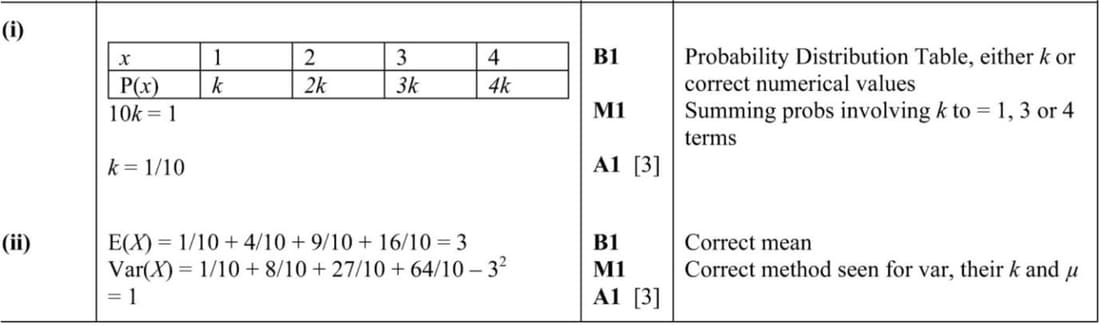
A particular type of bird lays 1, 2, 3 or 4 eggs in a nest each year. The probability of x eggs is equal to kx, where k is a constant.
- Draw up a probability distribution table, in terms of k, for the number of eggs laid in a year and find the value of k.
- Find the mean and variance of the number of eggs laid in a year by this type of bird.
9709 P61 - Jun 2016 - Q4
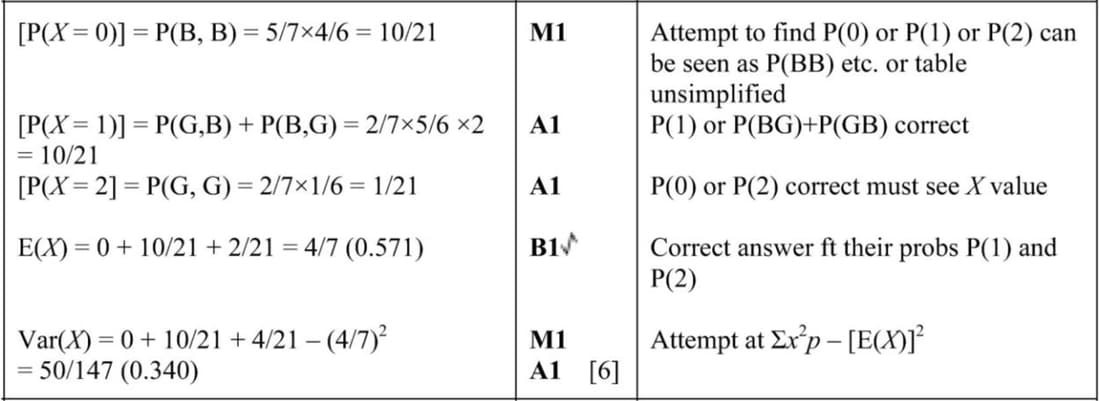
A box contains 2 green sweets and 5 blue sweets. Two sweets are taken at random from the box, without replacement. The random variable X is the number of green sweets taken. Find E(X) and Var(X).
9709 P62 - Mar 2016 - Q2
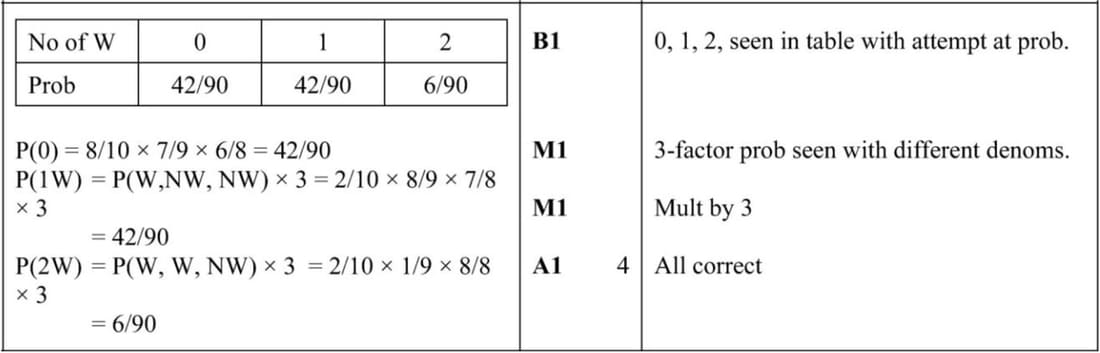
A flower shop has 5 yellow roses, 3 red roses and 2 white roses. Martin chooses 3 roses at random. Draw up the probability distribution table for the number of white roses Martin chooses.
9709 P62 - Nov 2015 - Q6
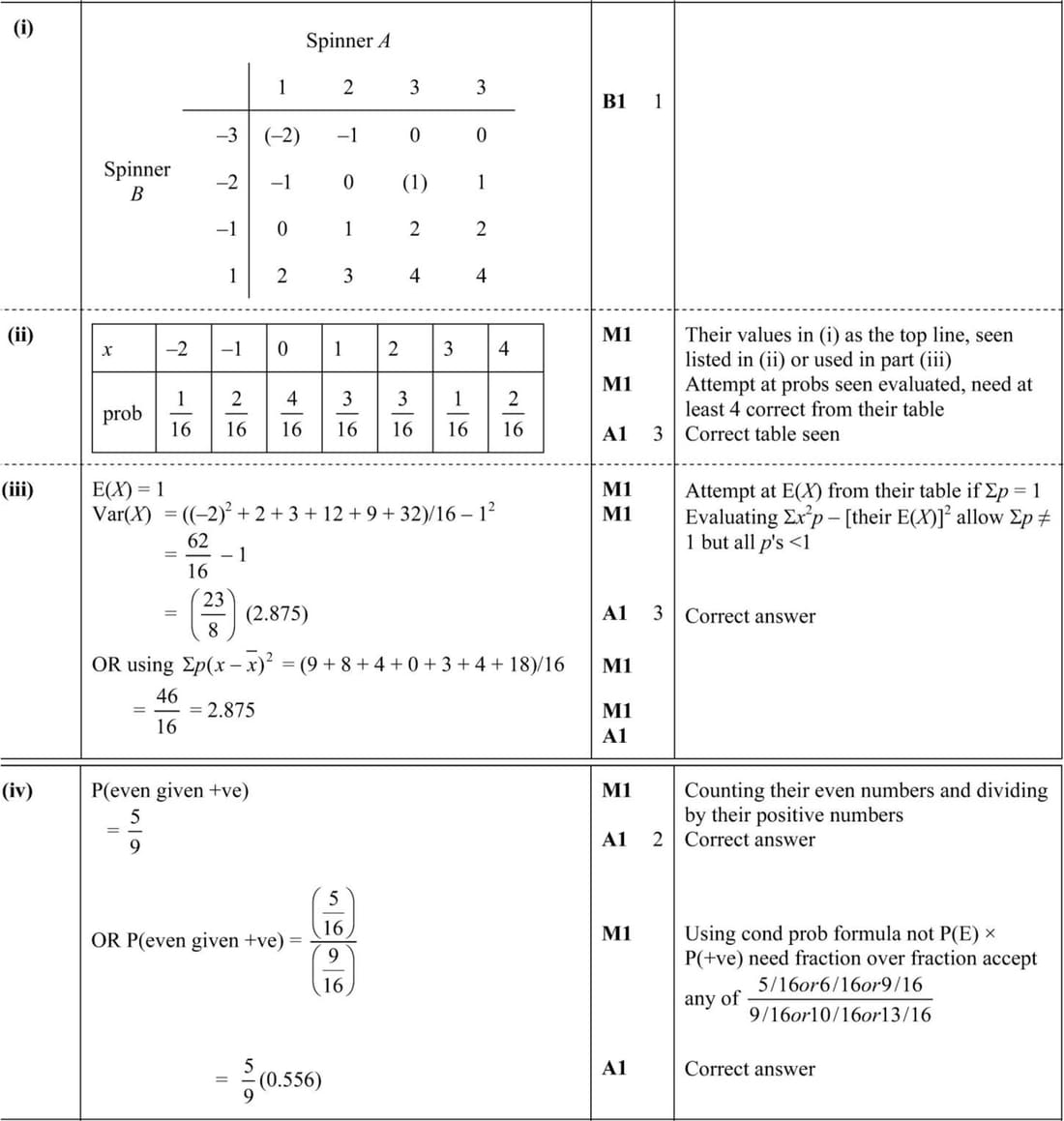
A fair spinner A has edges numbered 1, 2, 3, 3. A fair spinner B has edges numbered -3, -2, -1, 1. Each spinner is spun. The number on the edge that the spinner comes to rest on is noted. Let X be the sum of the numbers for the two spinners.
- Copy and complete the table showing the possible values of X.
| Spinner A | ||||
|---|---|---|---|---|
| Spinner B | 1 | 2 | 3 | 3 |
| -3 | -2 | |||
| -2 | 1 | |||
| -1 | ||||
| 1 | ||||
- Draw up a table showing the probability distribution of X.
- Find Var(X).
- Find the probability that X is even, given that X is positive.
9709 P61 - Nov 2015 - Q6
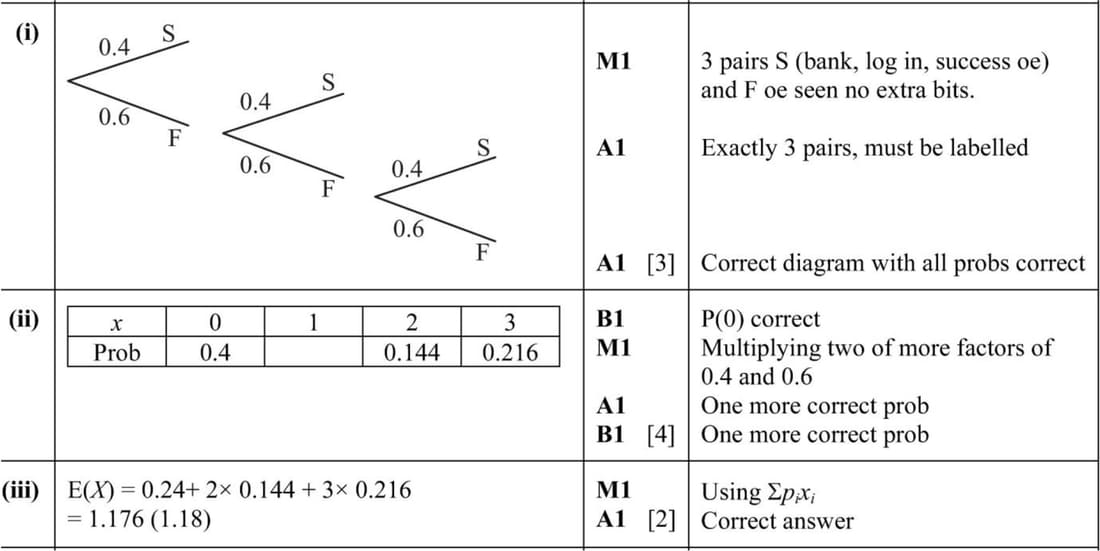
Nadia is very forgetful. Every time she logs in to her online bank she only has a 40% chance of remembering her password correctly. She is allowed 3 unsuccessful attempts on any one day and then the bank will not let her try again until the next day.
- Draw a fully labelled tree diagram to illustrate this situation. [3]
- Let \(X\) be the number of unsuccessful attempts Nadia makes on any day that she tries to log in to her bank. Copy and complete the following table to show the probability distribution of \(X\). [4]
| \(x\) | 0 | 1 | 2 | 3 |
|---|---|---|---|---|
| \(P(X = x)\) | 0.24 |
- Calculate the expected number of unsuccessful attempts made by Nadia on any day that she tries to log in. [2]
9709 P63 - Jun 2015 - Q4
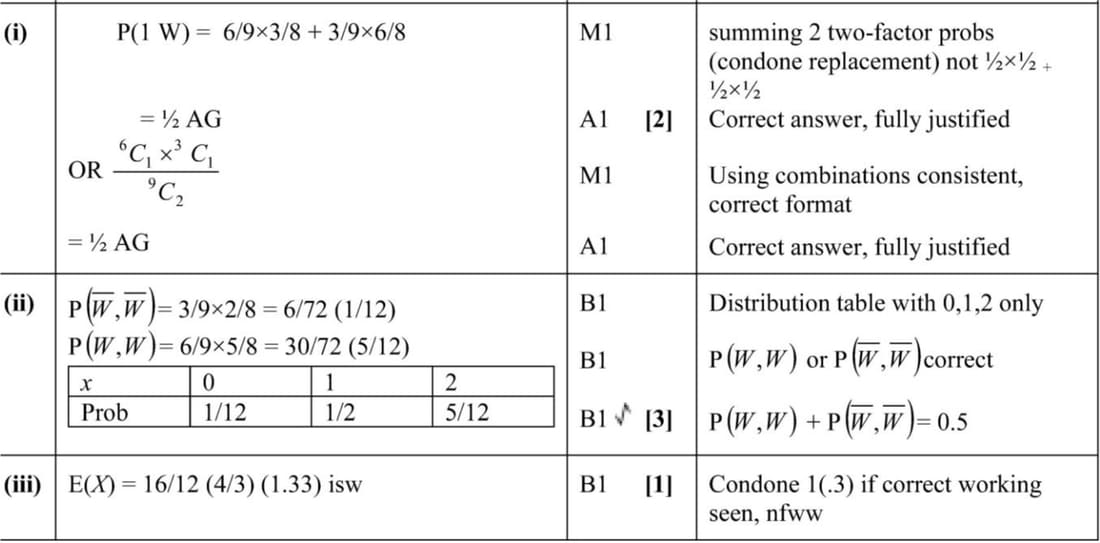
A pet shop has 9 rabbits for sale, 6 of which are white. A random sample of two rabbits is chosen without replacement.
- Show that the probability that exactly one of the two rabbits in the sample is white is \(\frac{1}{2}\).
- Construct the probability distribution table for the number of white rabbits in the sample.
- Find the expected value of the number of white rabbits in the sample.
9709 P62 - Jun 2015 - Q5
A box contains 5 discs, numbered 1, 2, 4, 6, 7. William takes 3 discs at random, without replacement, and notes the numbers on the discs.
The smallest of the numbers on the 3 discs taken is denoted by the random variable \(S\).
By listing all possible selections (126, 246 and so on) draw up the probability distribution table for \(S\).

9709 P63 - Nov 2014 - Q7
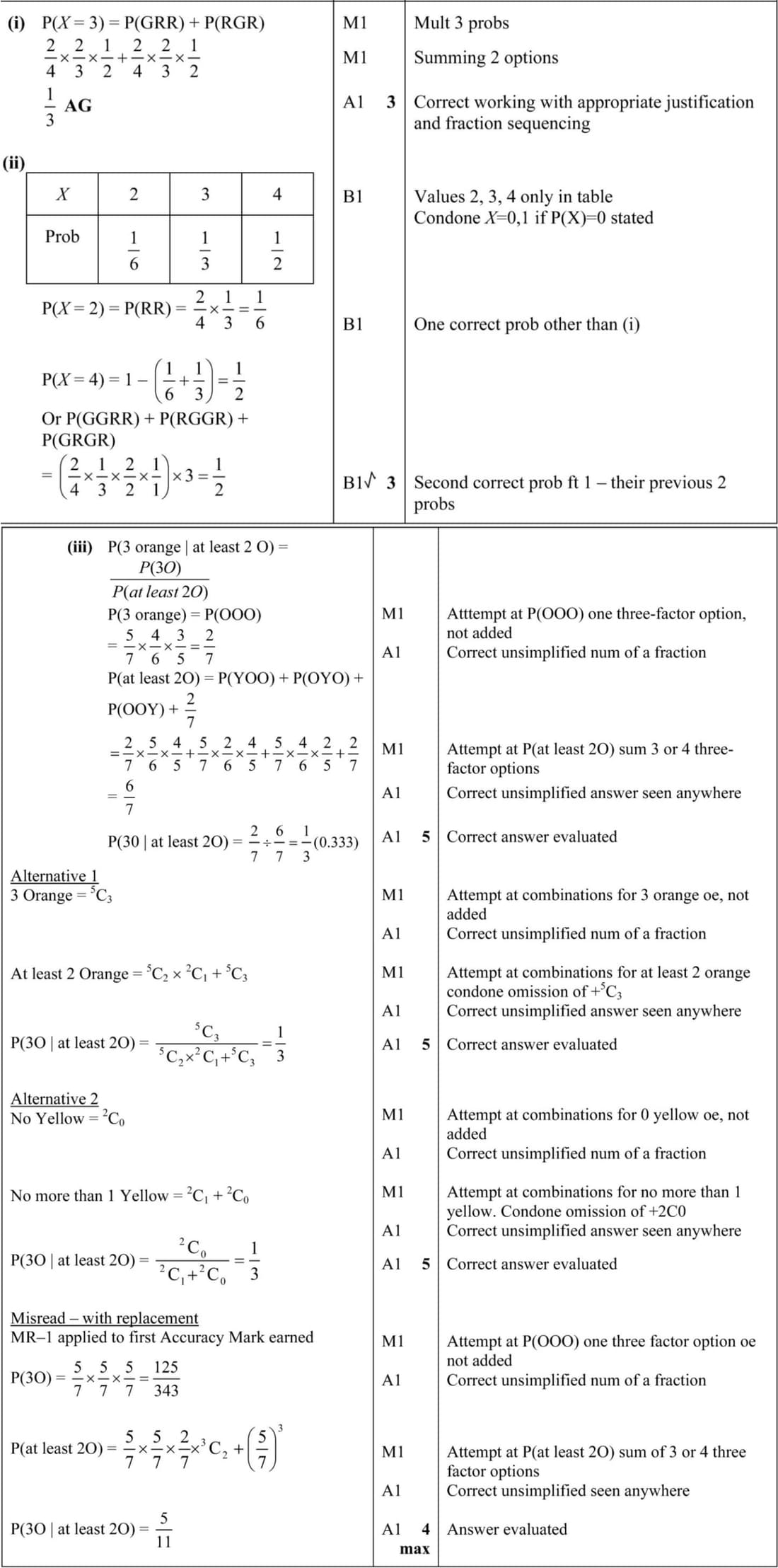
A box contains 2 green apples and 2 red apples. Apples are taken from the box, one at a time, without replacement. When both red apples have been taken, the process stops. The random variable X is the number of apples which have been taken when the process stops.
- Show that \(P(X = 3) = \frac{1}{3}\).
- Draw up the probability distribution table for \(X\).
Another box contains 2 yellow peppers and 5 orange peppers. Three peppers are taken at random from the box without replacement.
- Given that at least 2 of the peppers taken from the box are orange, find the probability that all 3 peppers are orange.
9709 P62 - Nov 2014 - Q4
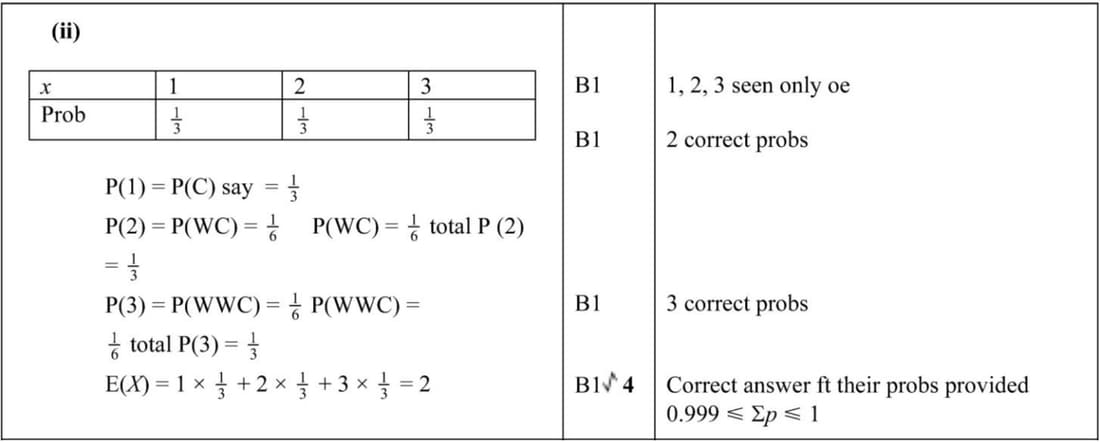
Sharik attempts a multiple choice revision question on-line. There are 3 suggested answers, one of which is correct. When Sharik chooses an answer the computer indicates whether the answer is right or wrong. Sharik first chooses one of the three suggested answers at random. If this answer is wrong, he has a second try, choosing an answer at random from the remaining 2. If this answer is also wrong Sharik then chooses the remaining answer, which must be correct.
The random variable \(X\) is the number of attempts that Sharik makes up to and including the one that the computer indicates is correct. Draw up the probability distribution table for \(X\) and find \(E(X)\).
9709 P63 - Jun 2014 - Q3
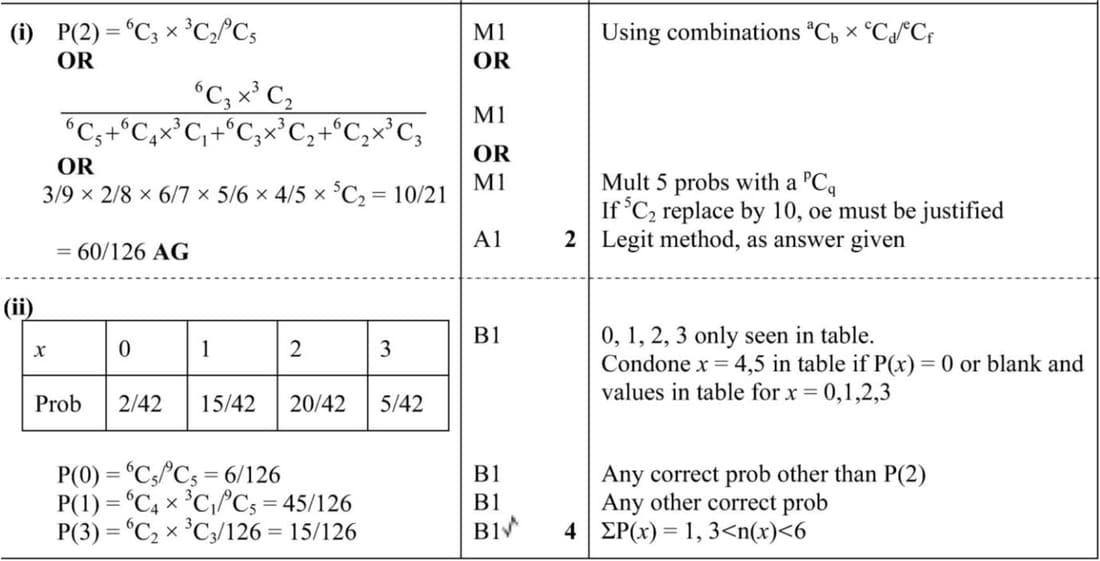
A pet shop has 6 rabbits and 3 hamsters. 5 of these pets are chosen at random. The random variable X represents the number of hamsters chosen.
- Show that the probability that exactly 2 hamsters are chosen is \(\frac{10}{21}\).
- Draw up the probability distribution table for X.
9709 P52 - Nov 2022 - Q5
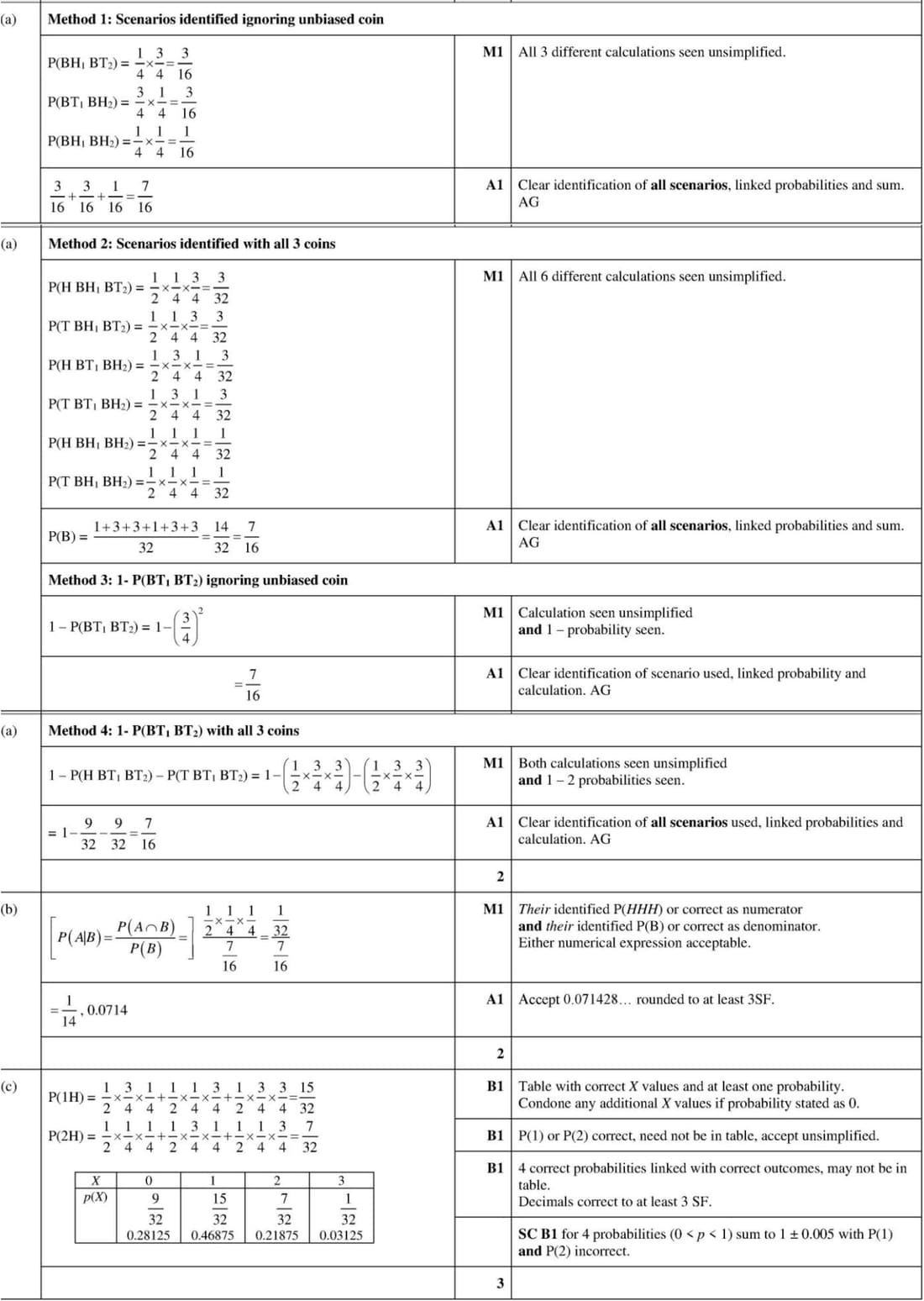
Eric has three coins. One of the coins is fair. The other two coins are each biased so that the probability of obtaining a head on any throw is \(\frac{1}{4}\), independently of all other throws. Eric throws all three coins at the same time.
Events \(A\) and \(B\) are defined as follows.
\(A\): all three coins show the same result
\(B\): at least one of the biased coins shows a head
(a) Show that \(P(B) = \frac{7}{16}\).
(b) Find \(P(A \mid B)\).
The random variable \(X\) is the number of heads obtained when Eric throws the three coins.
(c) Draw up the probability distribution table for \(X\).
9709 P62 - Jun 2014 - Q4
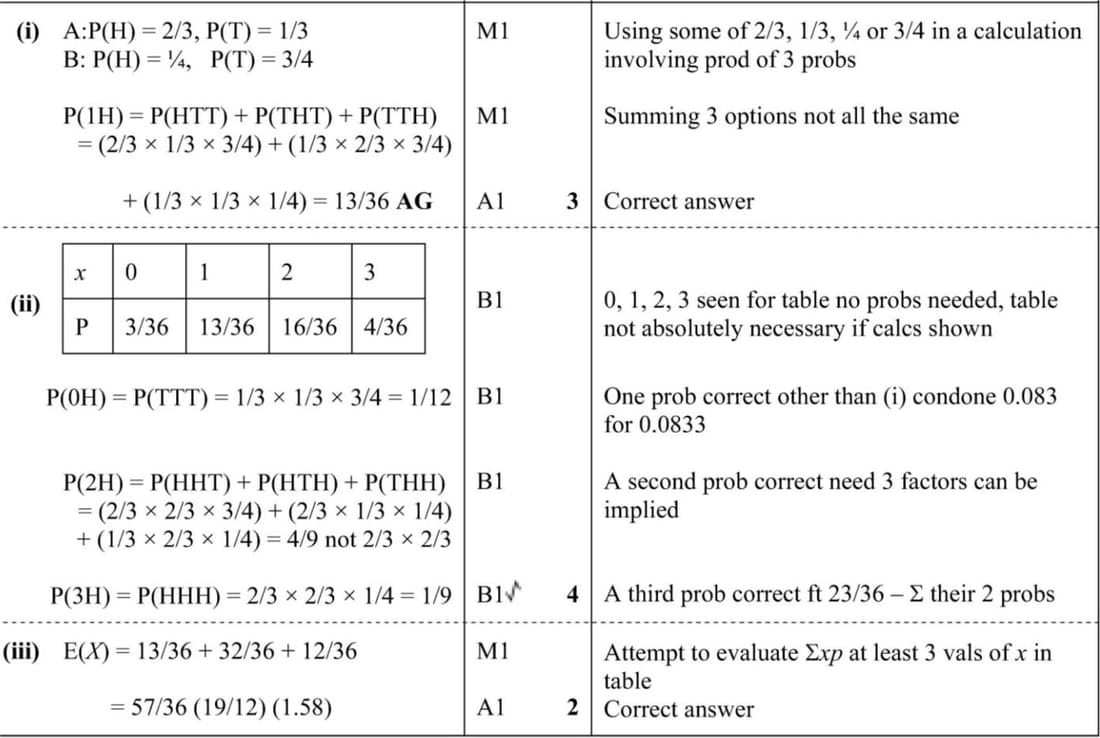
Coin A is weighted so that the probability of throwing a head is \(\frac{2}{3}\). Coin B is weighted so that the probability of throwing a head is \(\frac{1}{4}\). Coin A is thrown twice and coin B is thrown once.
- Show that the probability of obtaining exactly 1 head and 2 tails is \(\frac{13}{36}\).
- Draw up the probability distribution table for the number of heads obtained.
- Find the expectation of the number of heads obtained.
9709 P61 - Jun 2014 - Q4
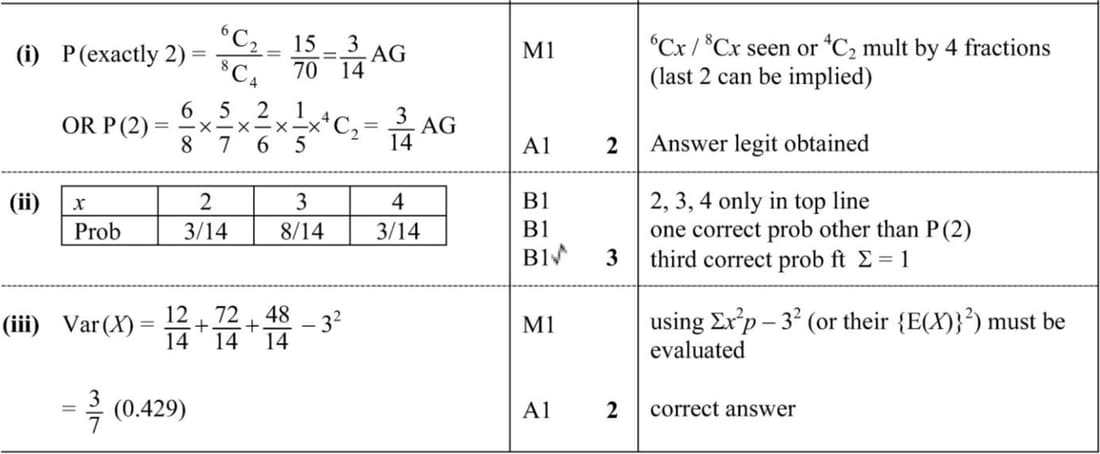
A book club sends 6 paperback and 2 hardback books to Mrs Hunt. She chooses 4 of these books at random to take with her on holiday. The random variable X represents the number of paperback books she chooses.
- Show that the probability that she chooses exactly 2 paperback books is \(\frac{3}{14}\).
- Draw up the probability distribution table for X.
- You are given that \(E(X) = 3\). Find \(\text{Var}(X)\).
9709 P63 - Nov 2013 - Q7
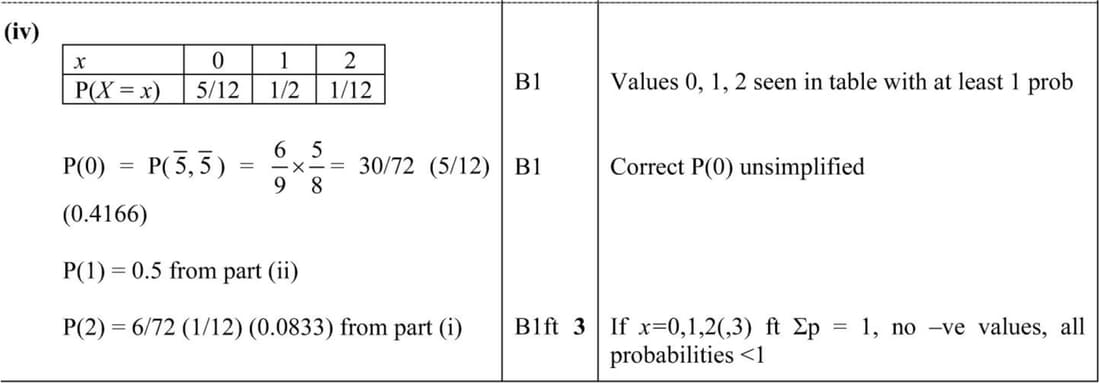
Dayo chooses two digits at random, without replacement, from the 9-digit number 113 333 555.
The random variable \(X\) is the number of 5s that Dayo chooses. Draw up a table to show the probability distribution of \(X\).
9709 P62 - Nov 2013 - Q7
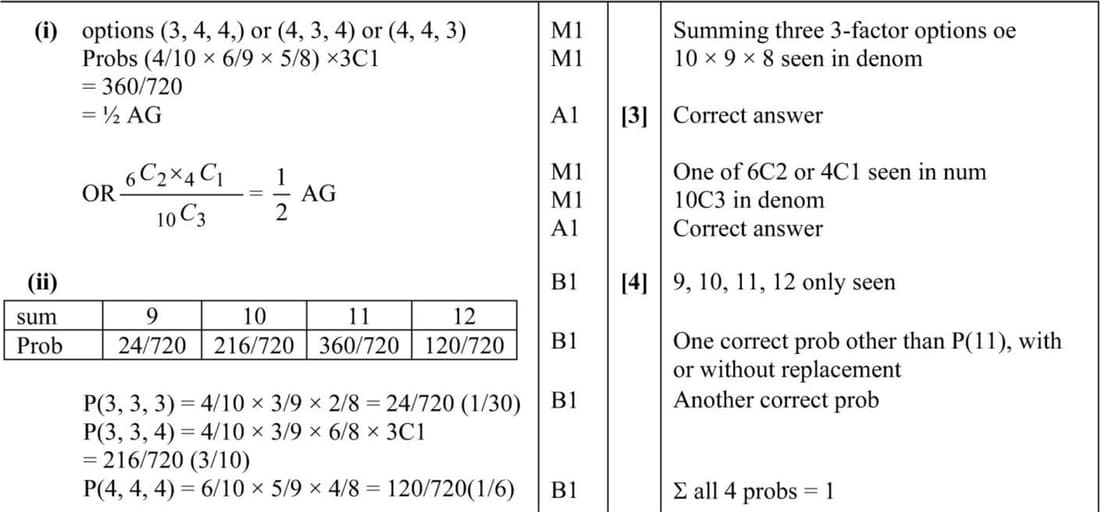
Rory has 10 cards. Four of the cards have a 3 printed on them and six of the cards have a 4 printed on them. He takes three cards at random, without replacement, and adds up the numbers on the cards.
- Show that P(the sum of the numbers on the three cards is 11) = \(\frac{1}{2}\).
- Draw up a probability distribution table for the sum of the numbers on the three cards.
9709 P61 - Nov 2013 - Q7
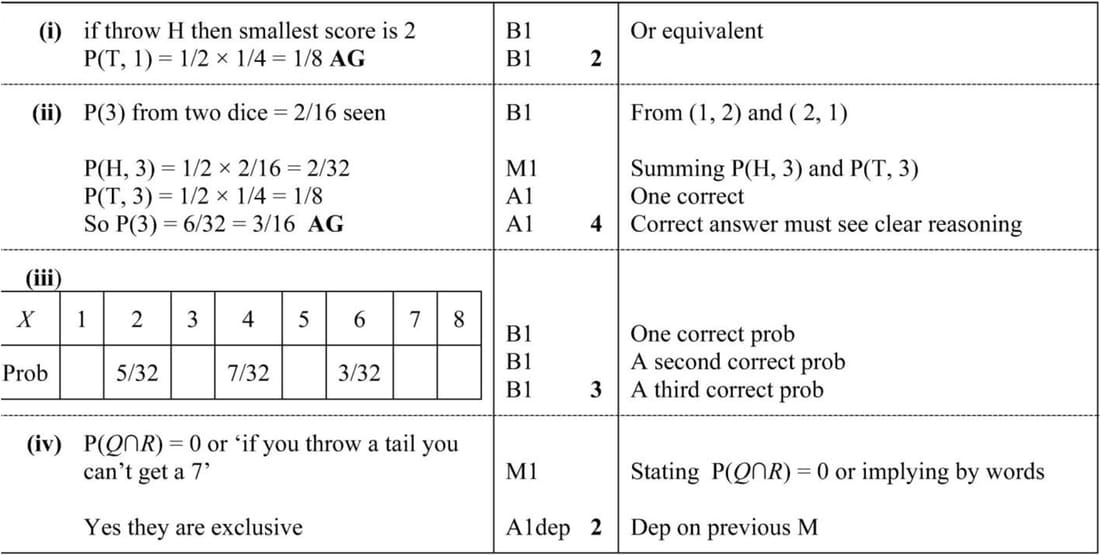
James has a fair coin and a fair tetrahedral die with four faces numbered 1, 2, 3, 4. He tosses the coin once and the die twice. The random variable X is defined as follows.
- If the coin shows a head then X is the sum of the scores on the two throws of the die.
- If the coin shows a tail then X is the score on the first throw of the die only.
(i) Explain why X = 1 can only be obtained by throwing a tail, and show that P(X = 1) = \(\frac{1}{8}\).
(ii) Show that P(X = 3) = \(\frac{3}{16}\).
(iii) Copy and complete the probability distribution table for X.
| x | 1 | 2 | 3 | 4 | 5 | 6 | 7 | 8 |
|---|---|---|---|---|---|---|---|---|
| P(X = x) | \(\frac{1}{8}\) | \(\frac{3}{16}\) | \(\frac{1}{8}\) |
Event Q is ‘James throws a tail’. Event R is ‘the value of X is 7’.
(iv) Determine whether events Q and R are exclusive. Justify your answer.
9709 P62 - Jun 2013 - Q7
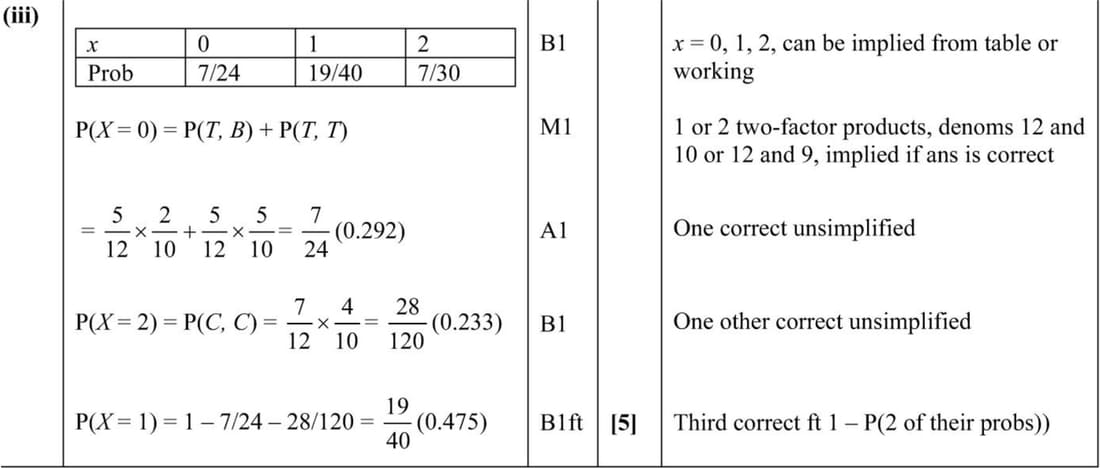
Susan has a bag of sweets containing 7 chocolates and 5 toffees. Ahmad has a bag of sweets containing 3 chocolates, 4 toffees and 2 boiled sweets. A sweet is taken at random from Susan’s bag and put in Ahmad’s bag. A sweet is then taken at random from Ahmad’s bag.
The random variable X is the number of times a chocolate is taken. State the possible values of X and draw up a table to show the probability distribution of X.
9709 P62 - Nov 2012 - Q6
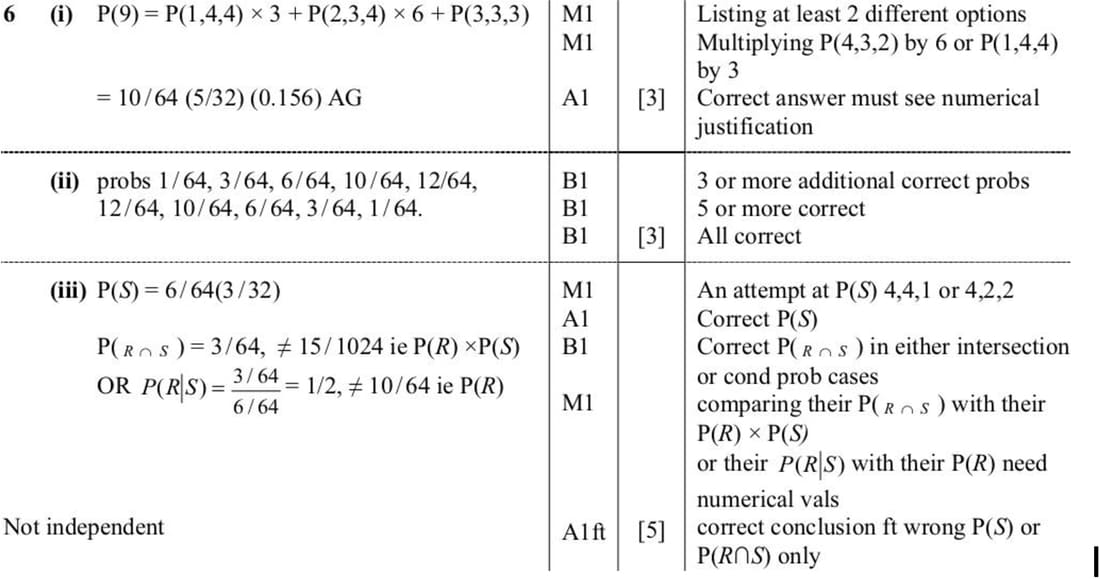
A fair tetrahedral die has four triangular faces, numbered 1, 2, 3, and 4. The score when this die is thrown is the number on the face that the die lands on. This die is thrown three times. The random variable X is the sum of the three scores.
(i) Show that \(P(X = 9) = \frac{10}{64}\).
(ii) Copy and complete the probability distribution table for \(X\).
| x | 3 | 4 | 5 | 6 | 7 | 8 | 9 | 10 | 11 | 12 |
|---|---|---|---|---|---|---|---|---|---|---|
| \(P(X = x)\) | \(\frac{1}{64}\) | \(\frac{3}{64}\) | \(\frac{12}{64}\) |
(iii) Event \(R\) is ‘the sum of the three scores is 9’. Event \(S\) is ‘the product of the three scores is 16’. Determine whether events \(R\) and \(S\) are independent, showing your working.