Past Exam Questions
← Back9709 P61 - Nov 2012 - Q1
Ashok has 3 green pens and 7 red pens. His friend Rod takes 3 of these pens at random, without replacement. Draw up a probability distribution table for the number of green pens Rod takes.

9709 P63 - Jun 2012 - Q4
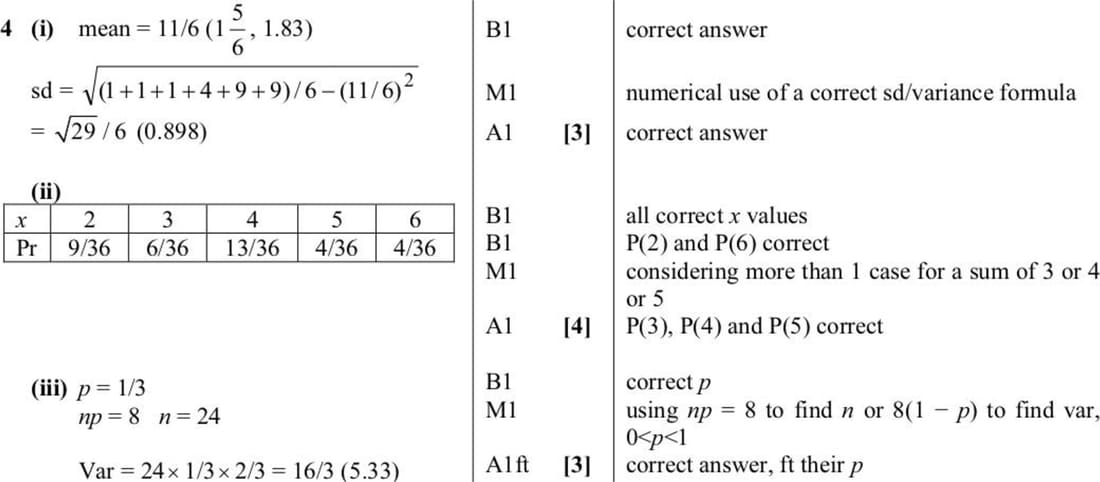
The six faces of a fair die are numbered 1, 1, 1, 2, 3, 3. The score for a throw of the die, denoted by the random variable W, is the number on the top face after the die has landed.
- Find the mean and standard deviation of W. [3]
- The die is thrown twice and the random variable X is the sum of the two scores. Draw up a probability distribution table for X. [4]
- The die is thrown n times. The random variable Y is the number of times that the score is 3. Given that E(Y) = 8, find Var(Y). [3]
9709 P62 - Jun 2012 - Q2
The random variable X has the probability distribution shown in the table.
| x | 2 | 4 | 6 |
|---|---|---|---|
| P(X = x) | 0.5 | 0.4 | 0.1 |
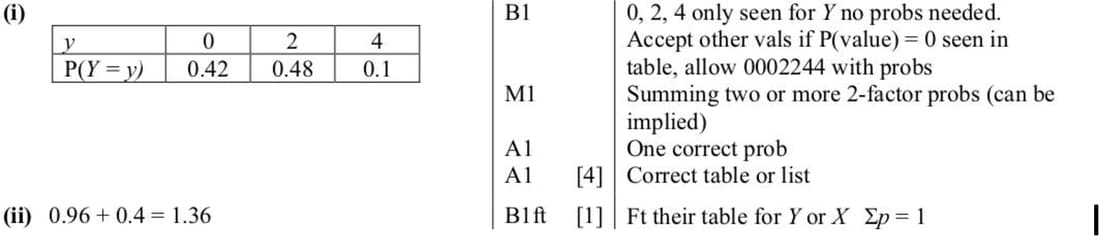
Two independent values of X are chosen at random. The random variable Y takes the value 0 if the two values of X are the same. Otherwise the value of Y is the larger value of X minus the smaller value of X.
- Draw up the probability distribution table for Y.
- Find the expected value of Y.
9709 P53 - Jun 2022 - Q3
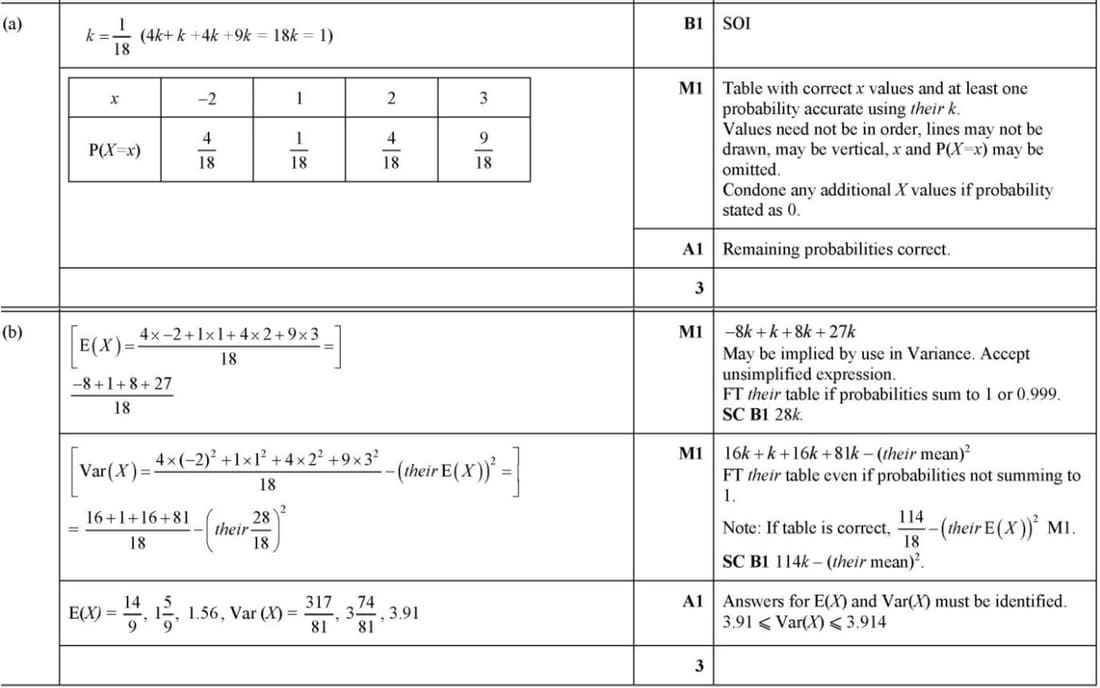
The random variable X takes the values −2, 1, 2, 3. It is given that \(P(X = x) = kx^2\), where \(k\) is a constant.
- Draw up the probability distribution table for X, giving the probabilities as numerical fractions.
- Find \(E(X)\) and \(\text{Var}(X)\).
9709 P63 - Nov 2011 - Q3
A factory makes a large number of ropes with lengths either 3 m or 5 m. There are four times as many ropes of length 3 m as there are ropes of length 5 m.
One rope is chosen at random. Find the expectation and variance of its length.

9709 P61 - Nov 2011 - Q3
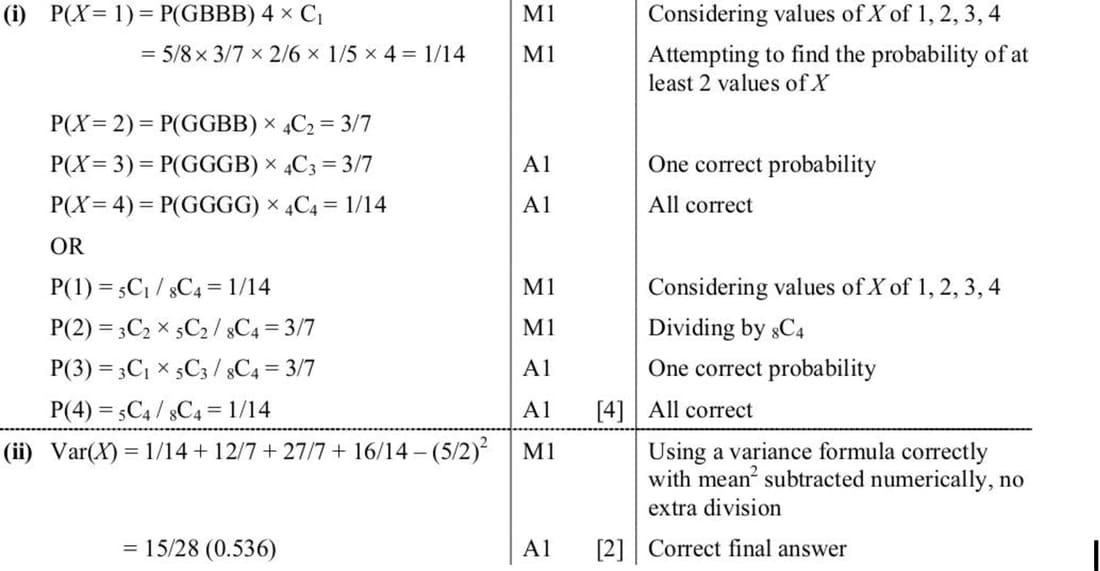
A team of 4 is to be randomly chosen from 3 boys and 5 girls. The random variable \(X\) is the number of girls in the team.
- Draw up a probability distribution table for \(X\).
- Given that \(E(X) = \frac{5}{2}\), calculate \(\text{Var}(X)\).
9709 P62 - Jun 2011 - Q7
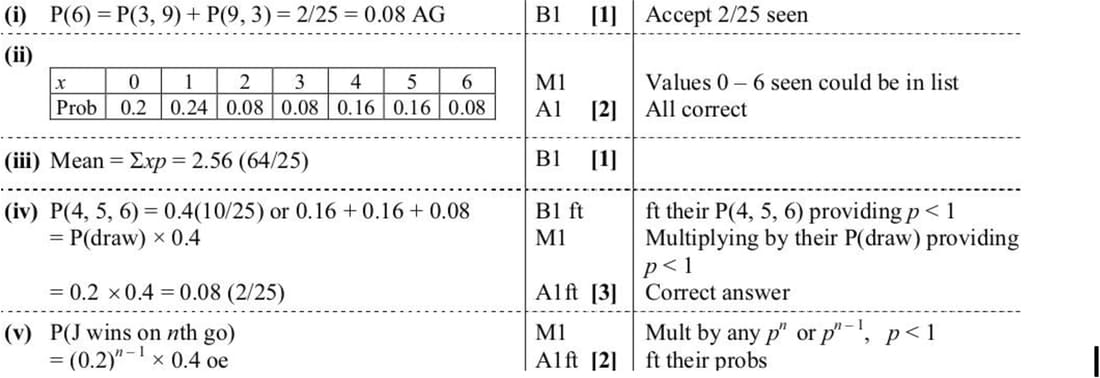
Judy and Steve play a game using five cards numbered 3, 4, 5, 8, 9. Judy chooses a card at random, looks at the number on it and replaces the card. Then Steve chooses a card at random, looks at the number on it and replaces the card. If their two numbers are equal the score is 0. Otherwise, the smaller number is subtracted from the larger number to give the score.
(i) Show that the probability that the score is 6 is 0.08.
(ii) Draw up a probability distribution table for the score.
(iii) Calculate the mean score.
If the score is 0 they play again. If the score is 4 or more Judy wins. Otherwise Steve wins. They continue playing until one of the players wins.
(iv) Find the probability that Judy wins with the second choice of cards.
(v) Find an expression for the probability that Judy wins with the nth choice of cards.
9709 P63 - Nov 2010 - Q2
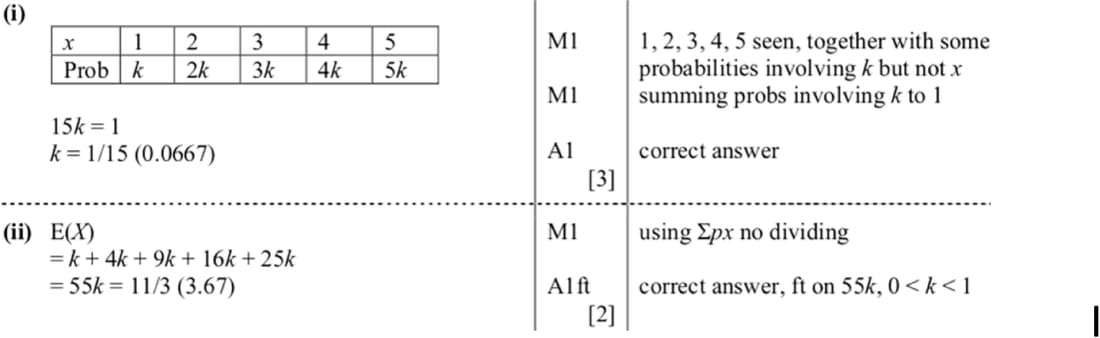
In a probability distribution the random variable \(X\) takes the value \(x\) with probability \(kx\), where \(x\) takes values 1, 2, 3, 4, 5 only.
- Draw up a probability distribution table for \(X\), in terms of \(k\), and find the value of \(k\).
- Find \(E(X)\).
9709 P63 - Jun 2010 - Q5
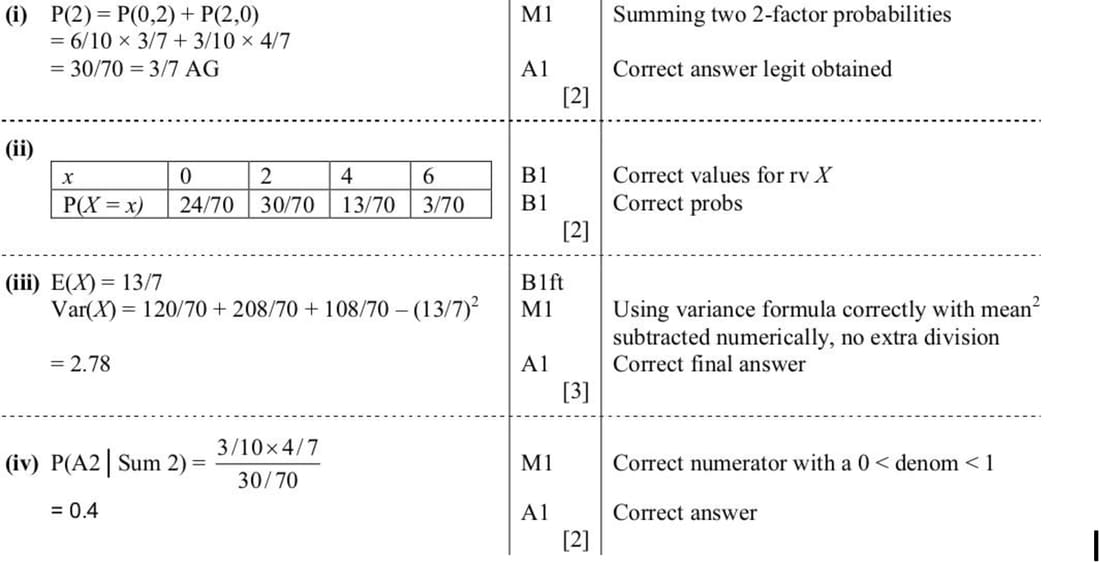
Set A consists of the ten digits 0, 0, 0, 0, 0, 0, 2, 2, 2, 4.
Set B consists of the seven digits 0, 0, 0, 0, 2, 2, 2.
One digit is chosen at random from each set. The random variable X is defined as the sum of these two digits.
- Show that \(P(X = 2) = \frac{3}{7}\).
- Tabulate the probability distribution of X.
- Find \(E(X)\) and \(\text{Var}(X)\).
- Given that \(X = 2\), find the probability that the digit chosen from set A was 2.
9709 P62 - Jun 2010 - Q6
A small farm has 5 ducks and 2 geese. Four of these birds are to be chosen at random. The random variable \(X\) represents the number of geese chosen.
- Draw up the probability distribution of \(X\).
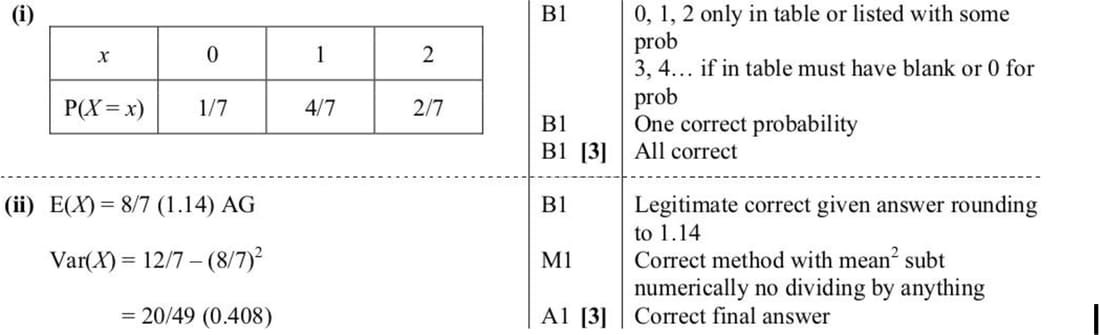
- Show that \(E(X) = \frac{8}{7}\) and calculate \(\text{Var}(X)\).
9709 P62 - Nov 2009 - Q5
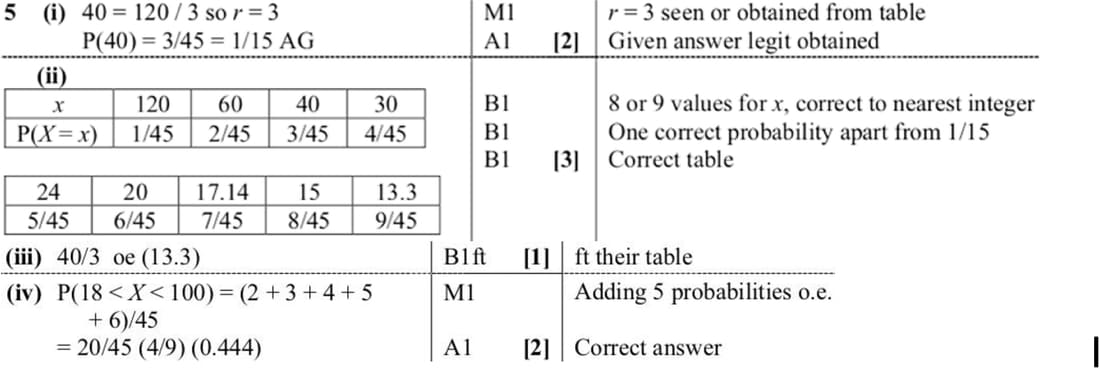
In a particular discrete probability distribution the random variable \(X\) takes the value \(\frac{120}{r}\) with probability \(\frac{r}{45}\), where \(r\) takes all integer values from 1 to 9 inclusive.
- Show that \(P(X = 40) = \frac{1}{15}\).
- Construct the probability distribution table for \(X\).
- Which is the modal value of \(X\)?
- Find the probability that \(X\) lies between 18 and 100.
9709 P6 - Nov 2008 - Q7
A fair die has one face numbered 1, one face numbered 3, two faces numbered 5 and two faces numbered 6.
The die is thrown twice. Let \(X\) be the sum of the two scores. The following table shows the possible values of \(X\).
| Second throw | ||||||
|---|---|---|---|---|---|---|
| First throw | 1 | 3 | 5 | 5 | 6 | 6 |
| 1 | 2 | 4 | 6 | 6 | 7 | 7 |
| 3 | 4 | 6 | 8 | 8 | 9 | 9 |
| 5 | 6 | 8 | 10 | 10 | 11 | 11 |
| 5 | 6 | 8 | 10 | 10 | 11 | 11 |
| 6 | 7 | 9 | 11 | 11 | 12 | 12 |
| 6 | 7 | 9 | 11 | 11 | 12 | 12 |
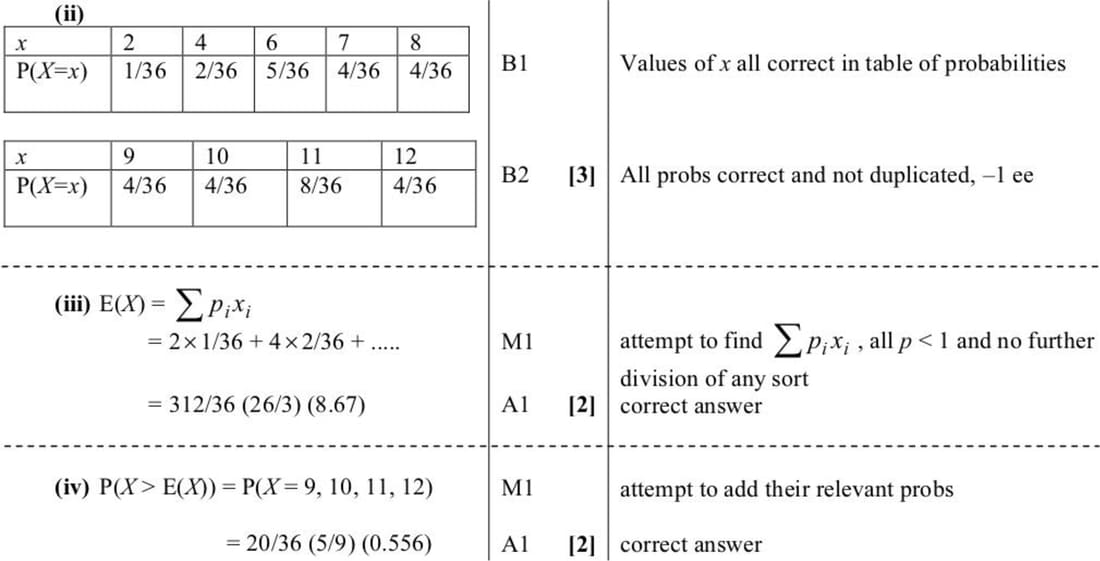
- Draw up a table showing the probability distribution of \(X\).
- Calculate \(E(X)\).
- Find the probability that \(X\) is greater than \(E(X)\).
9709 P6 - Jun 2008 - Q6
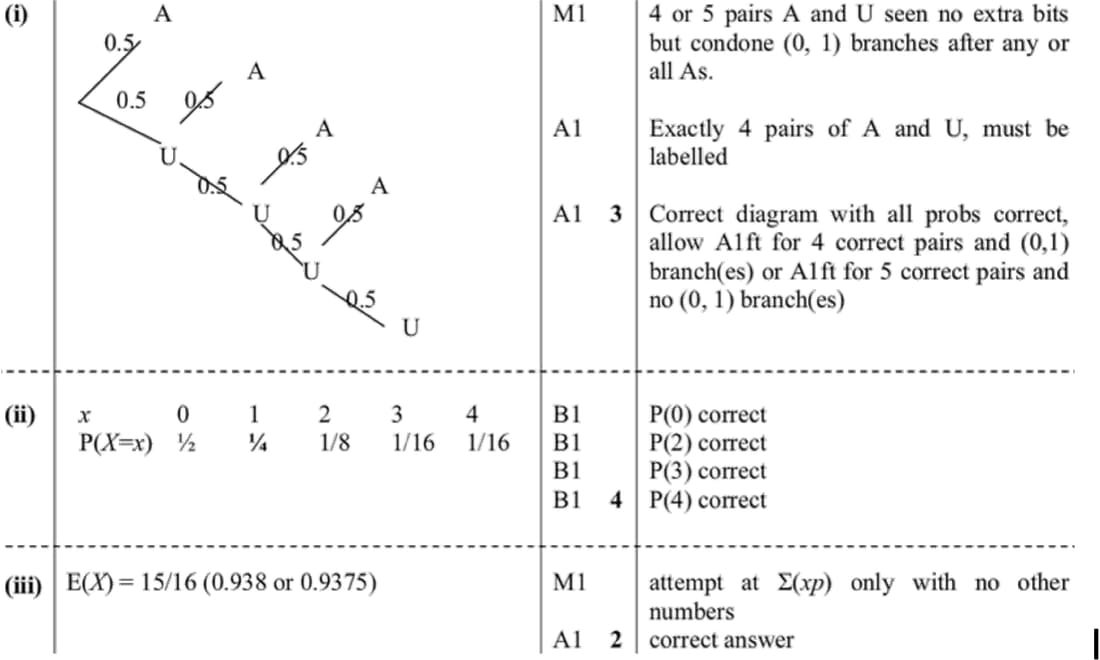
Every day Eduardo tries to phone his friend. Every time he phones there is a 50% chance that his friend will answer. If his friend answers, Eduardo does not phone again on that day. If his friend does not answer, Eduardo tries again in a few minutes’ time. If his friend has not answered after 4 attempts, Eduardo does not try again on that day.
(i) Draw a tree diagram to illustrate this situation.
(ii) Let \(X\) be the number of unanswered phone calls made by Eduardo on a day. Copy and complete the table showing the probability distribution of \(X\).
| \(x\) | 0 | 1 | 2 | 3 | 4 |
|---|---|---|---|---|---|
| \(P(X = x)\) | \(\frac{1}{4}\) |
(iii) Calculate the expected number of unanswered phone calls on a day.
9709 P6 - Nov 2007 - Q7
Box A contains 5 red paper clips and 1 white paper clip. Box B contains 7 red paper clips and 2 white paper clips. One paper clip is taken at random from box A and transferred to box B. One paper clip is then taken at random from box B.
The random variable X denotes the number of times that a red paper clip is taken. Draw up a table to show the probability distribution of X.

9709 P52 - Jun 2022 - Q2
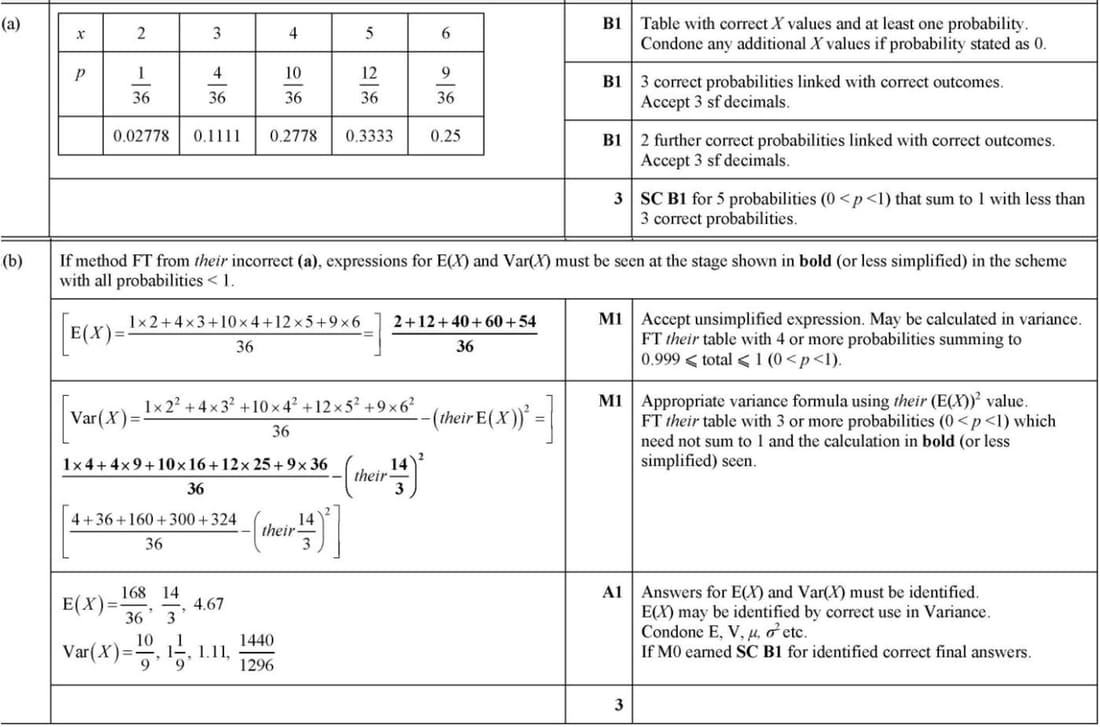
A fair 6-sided die has the numbers 1, 2, 2, 3, 3, 3 on its faces. The die is rolled twice. The random variable X denotes the sum of the two numbers obtained.
(a) Draw up the probability distribution table for X.
(b) Find E(X) and Var(X).
9709 P6 - Jun 2007 - Q7
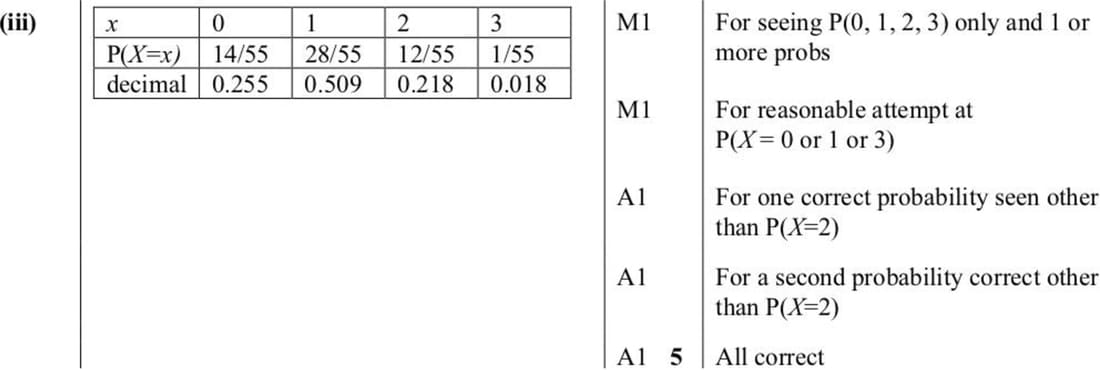
A vegetable basket contains 12 peppers, of which 3 are red, 4 are green and 5 are yellow. Three peppers are taken, at random and without replacement, from the basket.
The number of green peppers taken is denoted by the discrete random variable X. Draw up a probability distribution table for X.
9709 P6 - Nov 2005 - Q6
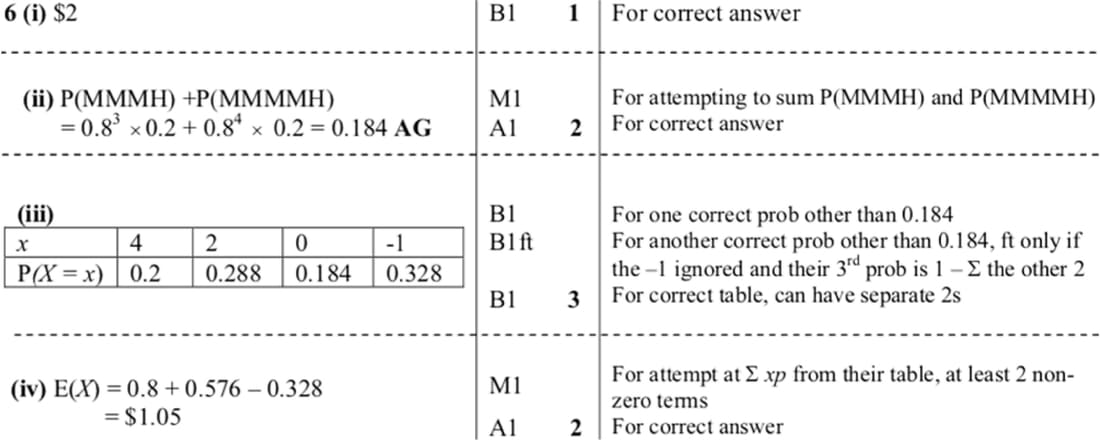
In a competition, people pay $1 to throw a ball at a target. If they hit the target on the first throw they receive $5. If they hit it on the second or third throw they receive $3, and if they hit it on the fourth or fifth throw they receive $1. People stop throwing after the first hit, or after 5 throws if no hit is made. Mario has a constant probability of \(\frac{1}{5}\) of hitting the target on any throw, independently of the results of other throws.
- Mario misses with his first and second throws and hits the target with his third throw. State how much profit he has made.
- Show that the probability that Mario’s profit is $0 is 0.184, correct to 3 significant figures.
- Draw up a probability distribution table for Mario’s profit.
- Calculate his expected profit.
9709 P6 - Jun 2005 - Q3
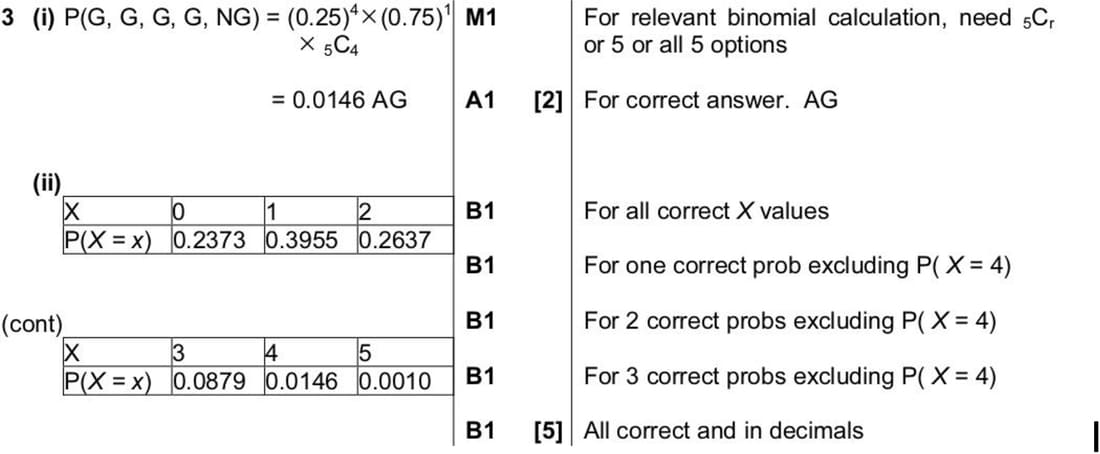
A fair dice has four faces. One face is coloured pink, one is coloured orange, one is coloured green and one is coloured black. Five such dice are thrown and the number that fall on a green face are counted. The random variable \(X\) is the number of dice that fall on a green face.
(i) Show that the probability of 4 dice landing on a green face is 0.0146, correct to 4 decimal places.
(ii) Draw up a table for the probability distribution of \(X\), giving your answers correct to 4 decimal places.
9709 P6 - Nov 2004 - Q6
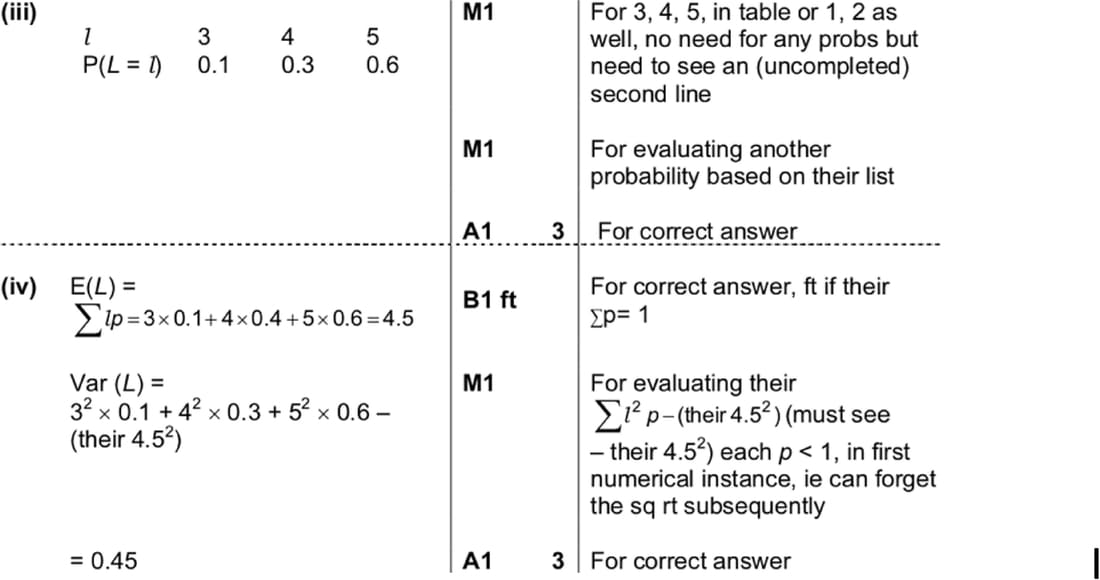
A box contains five balls numbered 1, 2, 3, 4, 5. Three balls are drawn randomly at the same time from the box.
The random variable L denotes the largest of the three numbers drawn.
(iii) Draw up a table to show the probability distribution of L.
(iv) Calculate the expectation and variance of L.
9709 P6 - Jun 2004 - Q3
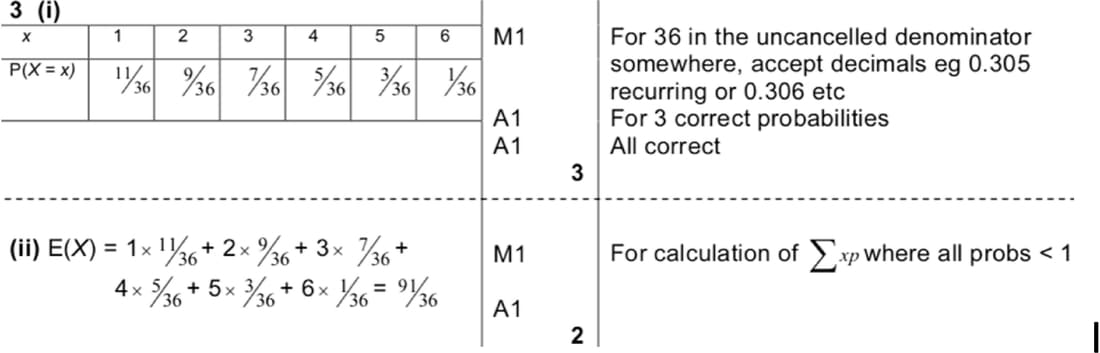
Two fair dice are thrown. Let the random variable \(X\) be the smaller of the two scores if the scores are different, or the score on one of the dice if the scores are the same.
(i) Copy and complete the following table to show the probability distribution of \(X\).
| \(x\) | 1 | 2 | 3 | 4 | 5 | 6 |
|---|---|---|---|---|---|---|
| \(P(X = x)\) |
(ii) Find \(\mathbb{E}(X)\).