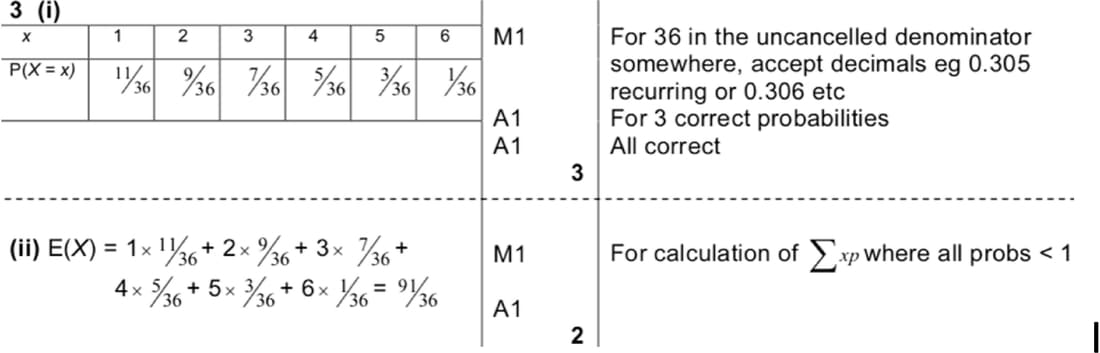
(i) To find the probability distribution of \(X\), we consider all possible outcomes of throwing two dice. There are a total of 36 outcomes.
- For \(x = 1\), the outcomes are \((1,1), (1,2), (1,3), (1,4), (1,5), (1,6), (2,1), (3,1), (4,1), (5,1), (6,1)\). There are 11 outcomes, so \(P(X = 1) = \frac{11}{36}\).
- For \(x = 2\), the outcomes are \((2,2), (2,3), (2,4), (2,5), (2,6), (3,2), (4,2), (5,2), (6,2)\). There are 9 outcomes, so \(P(X = 2) = \frac{9}{36}\).
- For \(x = 3\), the outcomes are \((3,3), (3,4), (3,5), (3,6), (4,3), (5,3), (6,3)\). There are 7 outcomes, so \(P(X = 3) = \frac{7}{36}\).
- For \(x = 4\), the outcomes are \((4,4), (4,5), (4,6), (5,4), (6,4)\). There are 5 outcomes, so \(P(X = 4) = \frac{5}{36}\).
- For \(x = 5\), the outcomes are \((5,5), (5,6), (6,5)\). There are 3 outcomes, so \(P(X = 5) = \frac{3}{36}\).
- For \(x = 6\), the outcome is \((6,6)\). There is 1 outcome, so \(P(X = 6) = \frac{1}{36}\).
| \(x\) | 1 | 2 | 3 | 4 | 5 | 6 |
|---|
| \(P(X = x)\) | \(\frac{11}{36}\) | \(\frac{9}{36}\) | \(\frac{7}{36}\) | \(\frac{5}{36}\) | \(\frac{3}{36}\) | \(\frac{1}{36}\) |
(ii) To find \(\mathbb{E}(X)\), we calculate:
\(\mathbb{E}(X) = 1 \times \frac{11}{36} + 2 \times \frac{9}{36} + 3 \times \frac{7}{36} + 4 \times \frac{5}{36} + 5 \times \frac{3}{36} + 6 \times \frac{1}{36}\)
\(= \frac{11}{36} + \frac{18}{36} + \frac{21}{36} + \frac{20}{36} + \frac{15}{36} + \frac{6}{36}\)
\(= \frac{91}{36}\)