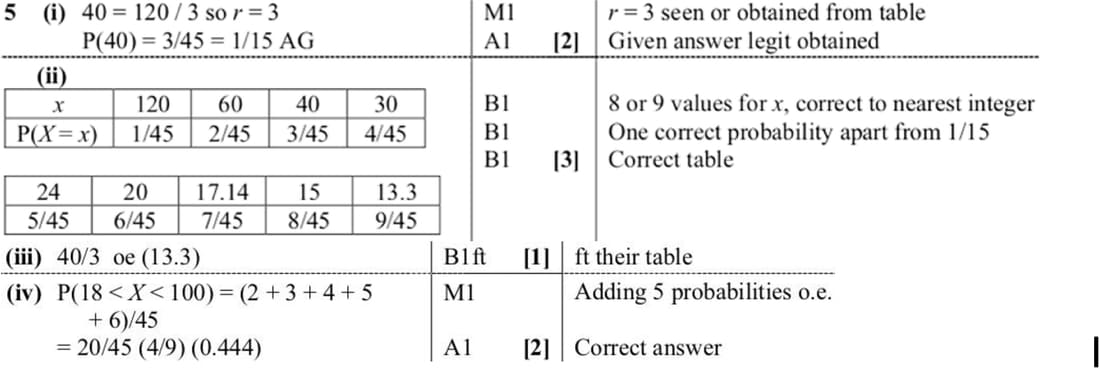
(i) To find \(P(X = 40)\), we need to find the value of \(r\) such that \(\frac{120}{r} = 40\). Solving for \(r\), we get:
\(40 = \frac{120}{r}\)
\(r = \frac{120}{40} = 3\)
Now, substitute \(r = 3\) into the probability formula:
\(P(X = 40) = \frac{3}{45} = \frac{1}{15}\)
(ii) Construct the probability distribution table for \(X\):
| \(x\) | 120 | 60 | 40 | 30 | 24 | 20 | 17.14 | 15 | 13.3 |
|---|
| \(P(X = x)\) | \(\frac{1}{45}\) | \(\frac{2}{45}\) | \(\frac{3}{45}\) | \(\frac{4}{45}\) | \(\frac{5}{45}\) | \(\frac{6}{45}\) | \(\frac{7}{45}\) | \(\frac{8}{45}\) | \(\frac{9}{45}\) |
(iii) The modal value of \(X\) is the value with the highest probability. From the table, \(X = 40\) has the highest probability of \(\frac{3}{45}\).
(iv) To find the probability that \(X\) lies between 18 and 100, sum the probabilities for \(X = 20, 24, 30, 40, 60\):
\(P(18 < X < 100) = \frac{6}{45} + \frac{5}{45} + \frac{4}{45} + \frac{3}{45} + \frac{2}{45}\)
\(= \frac{20}{45} = \frac{4}{9}\)