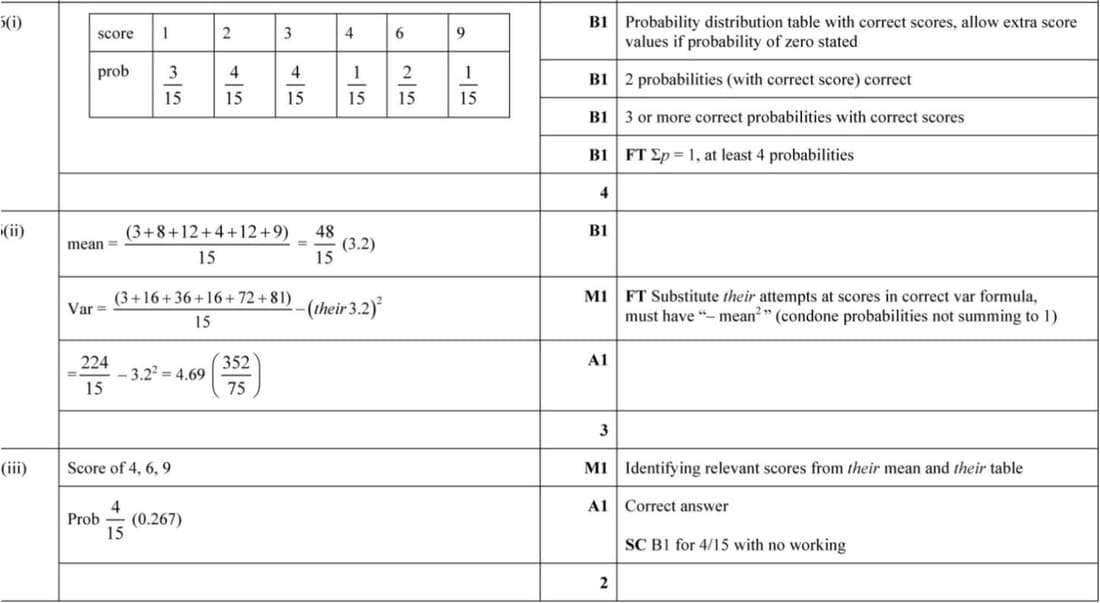
(i) The possible scores are calculated by multiplying the outcomes of the two spinners. The five-sided spinner outcomes are \(1, 1, 1, 2, 3\) and the three-sided spinner outcomes are \(1, 2, 3\). The scores are:
| Score | 1 | 2 | 3 | 4 | 6 | 9 |
|---|
| Probability | \(\frac{3}{15}\) | \(\frac{4}{15}\) | \(\frac{4}{15}\) | \(\frac{1}{15}\) | \(\frac{2}{15}\) | \(\frac{1}{15}\) |
(ii) To find the mean, use the formula \(\mu = \sum x_i p_i\):
\(\mu = \frac{3 \times 1 + 4 \times 2 + 4 \times 3 + 1 \times 4 + 2 \times 6 + 1 \times 9}{15} = \frac{48}{15} = 3.2\)
To find the variance, use the formula \(\sigma^2 = \sum x_i^2 p_i - \mu^2\):
\(\sigma^2 = \frac{3 \times 1^2 + 4 \times 2^2 + 4 \times 3^2 + 1 \times 4^2 + 2 \times 6^2 + 1 \times 9^2}{15} - 3.2^2\)
\(\sigma^2 = \frac{224}{15} - 3.2^2 = 4.69\)
(iii) The scores greater than the mean (3.2) are 4, 6, and 9. The probability is:
\(P(X > 3.2) = \frac{1}{15} + \frac{2}{15} + \frac{1}{15} = \frac{4}{15}\)