Past Exam Questions
← Back9709 P12 - Jun 2017 - Q8
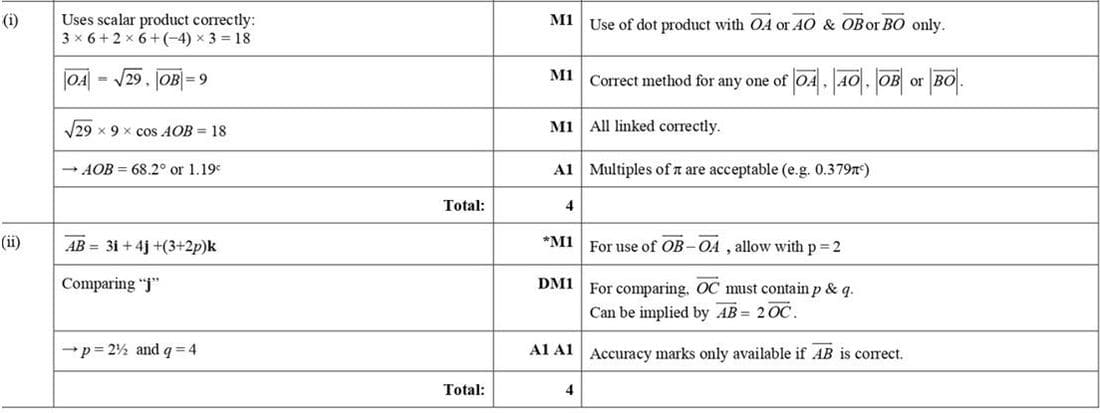
Relative to an origin O, the position vectors of three points A, B and C are given by
\(\overrightarrow{OA} = 3\mathbf{i} + p\mathbf{j} - 2p\mathbf{k}, \quad \overrightarrow{OB} = 6\mathbf{i} + (p + 4)\mathbf{j} + 3\mathbf{k} \quad \text{and} \quad \overrightarrow{OC} = (p - 1)\mathbf{i} + 2\mathbf{j} + q\mathbf{k},\)
where \(p\) and \(q\) are constants.
(i) In the case where \(p = 2\), use a scalar product to find angle \(AOB\). [4]
(ii) In the case where \(\overrightarrow{AB}\) is parallel to \(\overrightarrow{OC}\), find the values of \(p\) and \(q\). [4]
9709 P11 - Jun 2017 - Q2
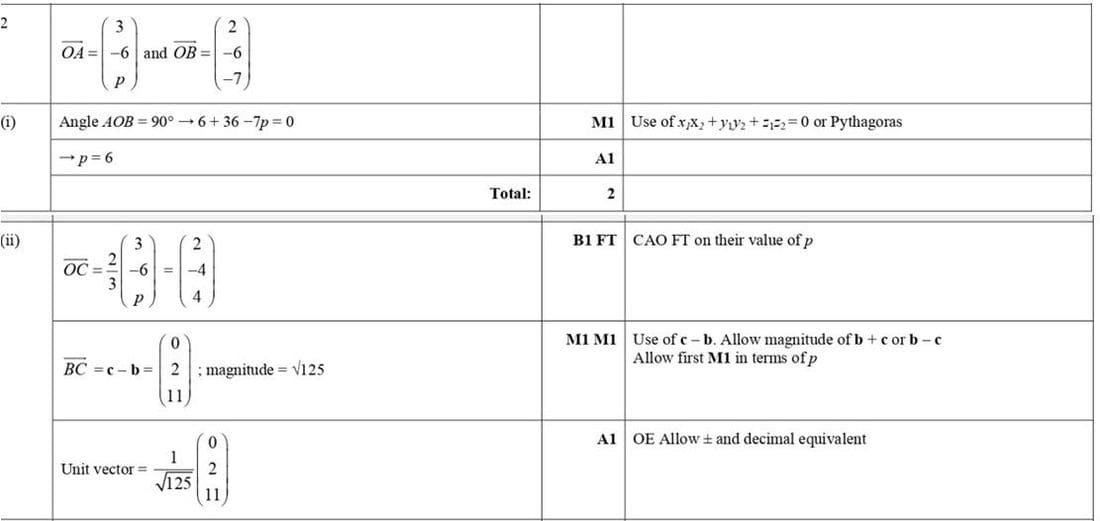
Relative to an origin O, the position vectors of points A and B are given by
\(\overrightarrow{OA} = \begin{pmatrix} 3 \\ -6 \\ p \end{pmatrix}\) and \(\overrightarrow{OB} = \begin{pmatrix} 2 \\ -6 \\ -7 \end{pmatrix}\),
and angle \(AOB = 90^\circ\).
(i) Find the value of \(p\).
The point C is such that \(\overrightarrow{OC} = \frac{2}{3} \overrightarrow{OA}\).
(ii) Find the unit vector in the direction of \(\overrightarrow{BC}\).
9709 P12 - Mar 2017 - Q6
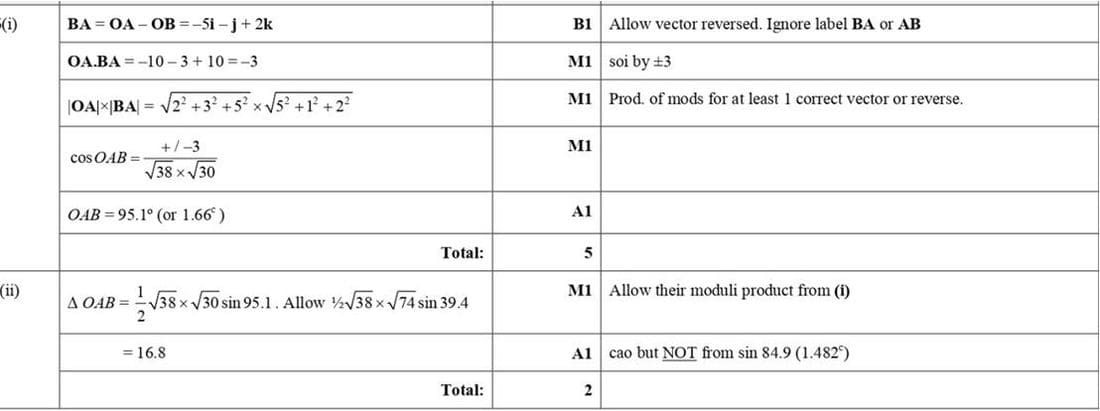
Relative to an origin O, the position vectors of the points A and B are given by
\(\overrightarrow{OA} = 2\mathbf{i} + 3\mathbf{j} + 5\mathbf{k}\) and \(\overrightarrow{OB} = 7\mathbf{i} + 4\mathbf{j} + 3\mathbf{k}\).
- Use a scalar product to find angle \(OAB\).
- Find the area of triangle \(OAB\).
9709 P12 - Nov 2016 - Q9
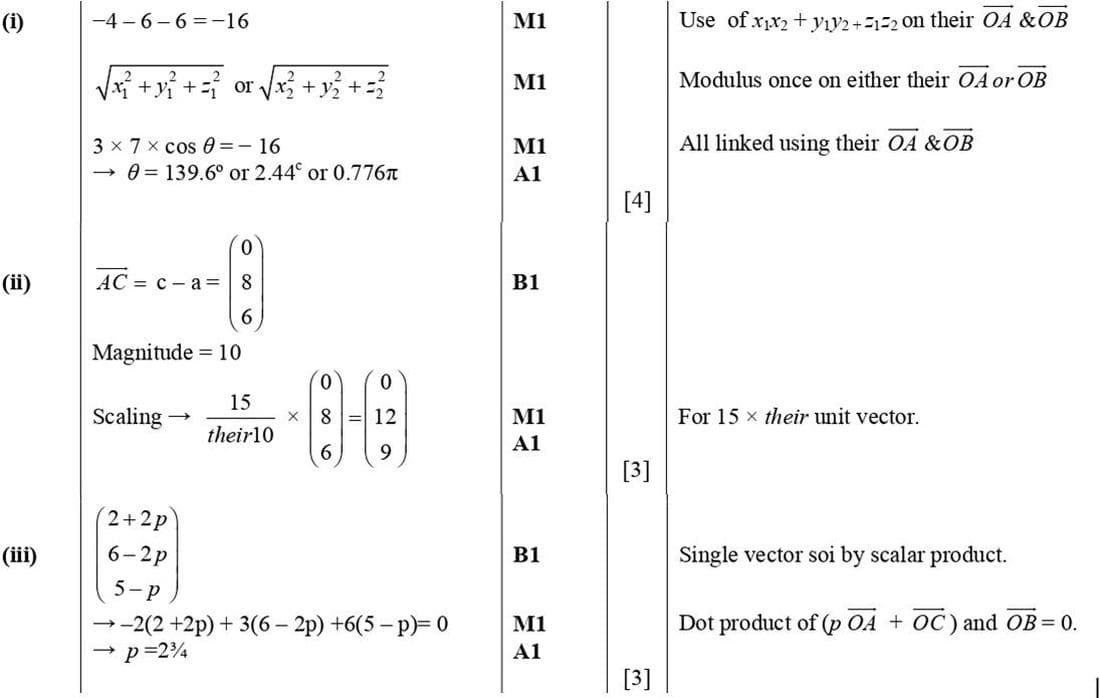
Relative to an origin O, the position vectors of the points A, B and C are given by
\(\overrightarrow{OA} = \begin{pmatrix} 2 \\ -2 \\ -1 \end{pmatrix}, \quad \overrightarrow{OB} = \begin{pmatrix} -2 \\ 3 \\ 6 \end{pmatrix} \quad \text{and} \quad \overrightarrow{OC} = \begin{pmatrix} 2 \\ 6 \\ 5 \end{pmatrix}.\)
- Use a scalar product to find angle \(AOB\).
- Find the vector which is in the same direction as \(\overrightarrow{AC}\) and of magnitude 15 units.
- Find the value of the constant \(p\) for which \(p\overrightarrow{OA} + \overrightarrow{OC}\) is perpendicular to \(\overrightarrow{OB}\).
9709 P13 - Jun 2016 - Q9
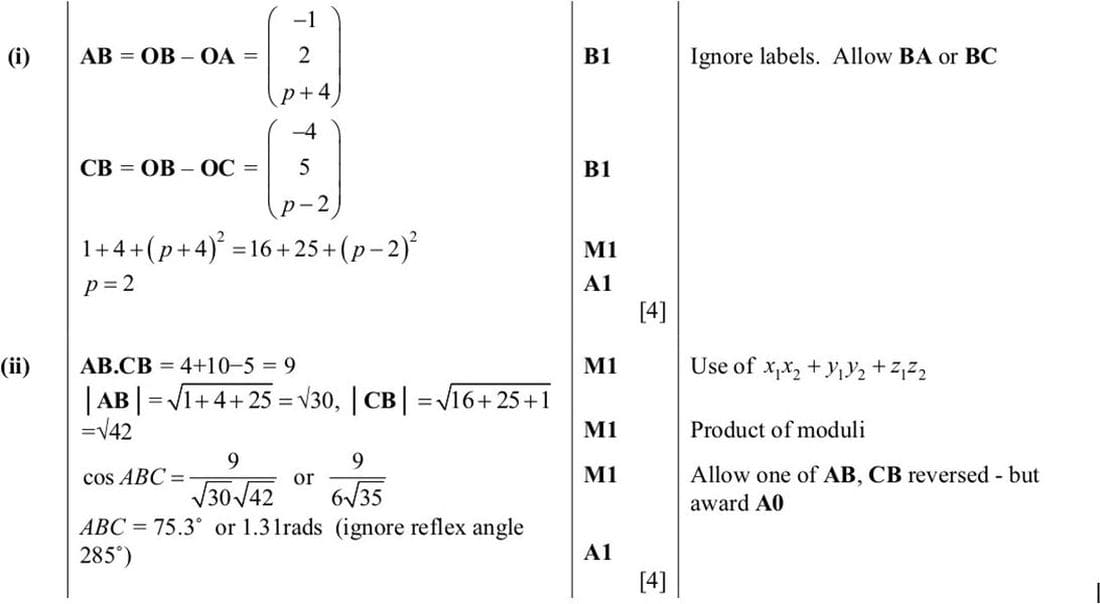
The position vectors of A, B and C relative to an origin O are given by
\(\overrightarrow{OA} = \begin{pmatrix} 2 \\ 3 \\ -4 \end{pmatrix}, \quad \overrightarrow{OB} = \begin{pmatrix} 1 \\ 5 \\ p \end{pmatrix} \quad \text{and} \quad \overrightarrow{OC} = \begin{pmatrix} 5 \\ 0 \\ 2 \end{pmatrix},\)
where \(p\) is a constant.
(i) Find the value of \(p\) for which the lengths of \(AB\) and \(CB\) are equal.
(ii) For the case where \(p = 1\), use a scalar product to find angle \(ABC\).
9709 P12 - Jun 2016 - Q3
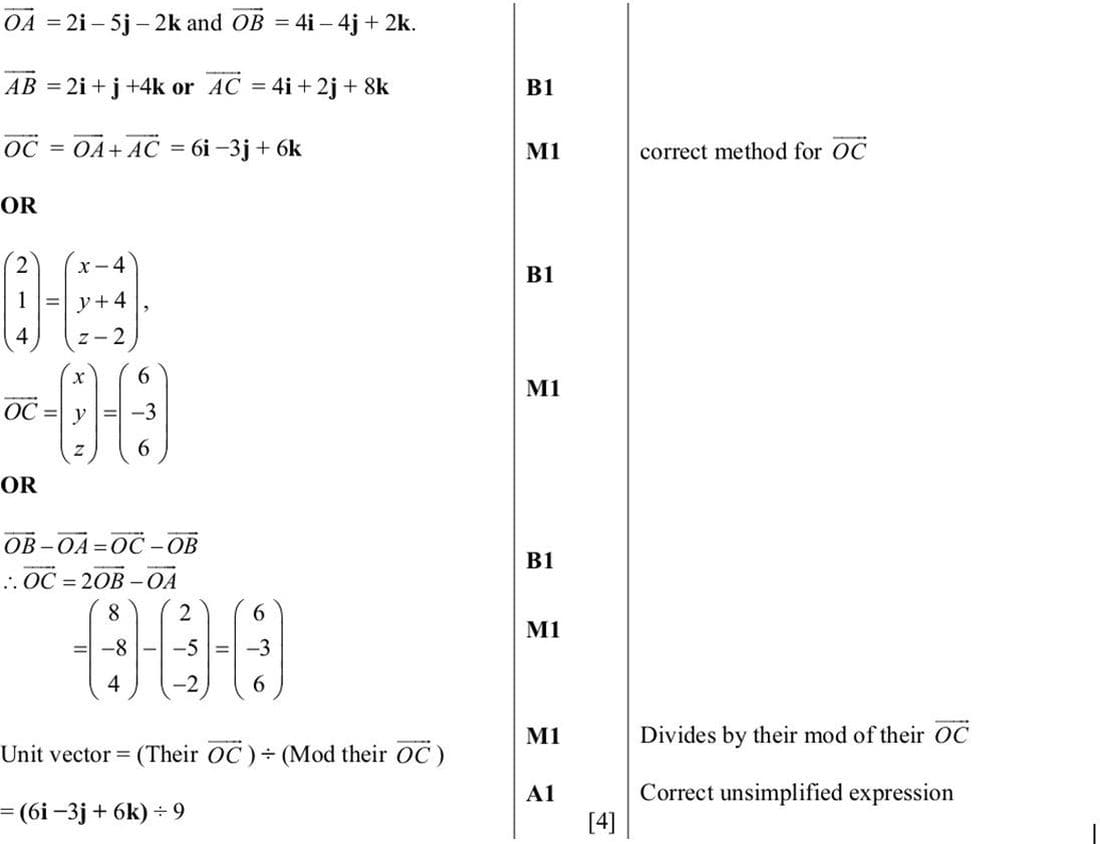
Relative to an origin O, the position vectors of points A and B are given by \(\overrightarrow{OA} = 2\mathbf{i} - 5\mathbf{j} - 2\mathbf{k}\) and \(\overrightarrow{OB} = 4\mathbf{i} - 4\mathbf{j} + 2\mathbf{k}\).
The point C is such that \(\overrightarrow{AB} = \overrightarrow{BC}\). Find the unit vector in the direction of \(\overrightarrow{OC}\).
9709 P11 - Jun 2016 - Q10
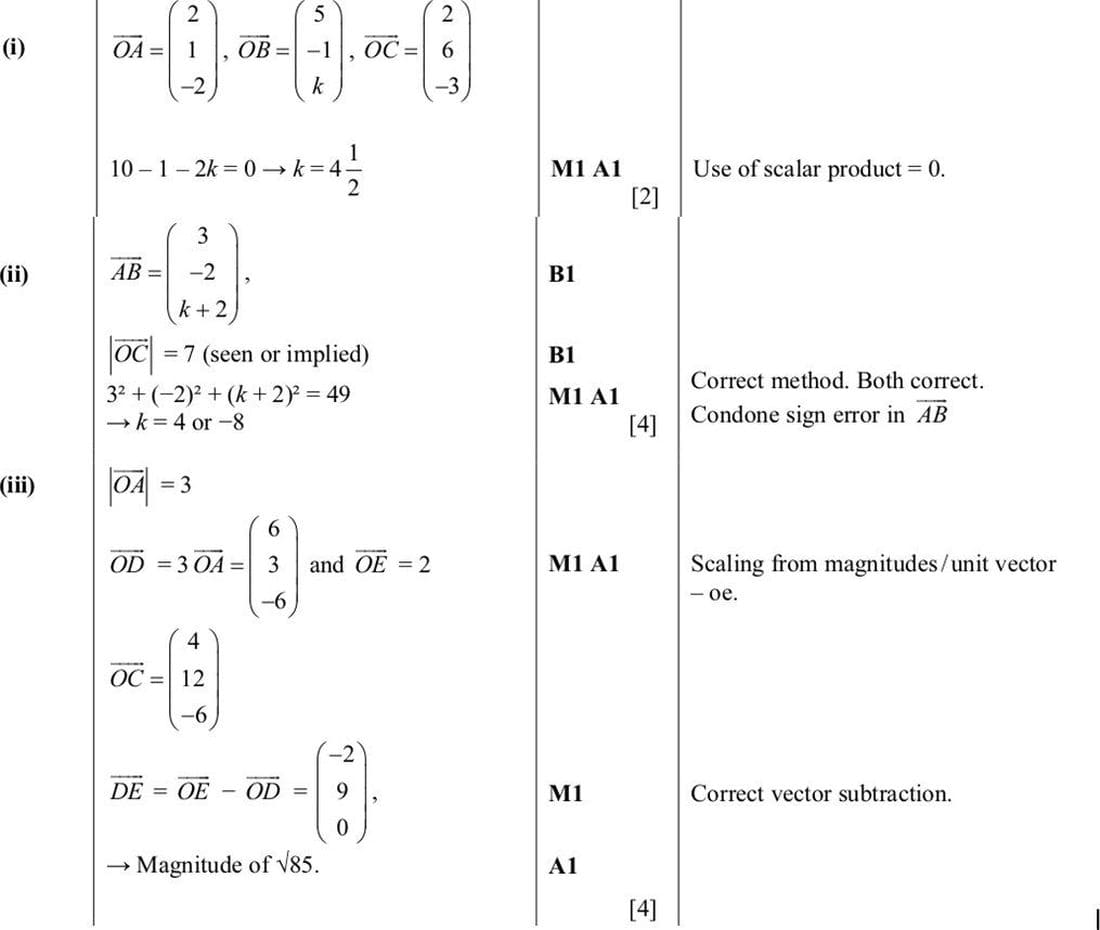
Relative to an origin O, the position vectors of points A, B and C are given by
\(\overrightarrow{OA} = \begin{pmatrix} 2 \\ 1 \\ -2 \end{pmatrix}, \quad \overrightarrow{OB} = \begin{pmatrix} 5 \\ -1 \\ k \end{pmatrix} \quad \text{and} \quad \overrightarrow{OC} = \begin{pmatrix} 2 \\ 6 \\ -3 \end{pmatrix}\)
respectively, where \(k\) is a constant.
- Find the value of \(k\) in the case where angle \(AOB = 90^\circ\).
- Find the possible values of \(k\) for which the lengths of \(AB\) and \(OC\) are equal.
- The point D is such that \(\overrightarrow{OD}\) is in the same direction as \(\overrightarrow{OA}\) and has magnitude 9 units. The point E is such that \(\overrightarrow{OE}\) is in the same direction as \(\overrightarrow{OC}\) and has magnitude 14 units.
- Find the magnitude of \(\overrightarrow{DE}\) in the form \(\sqrt{n}\) where \(n\) is an integer.
9709 P13 - Nov 2015 - Q5
Relative to an origin O, the position vectors of the points A and B are given by
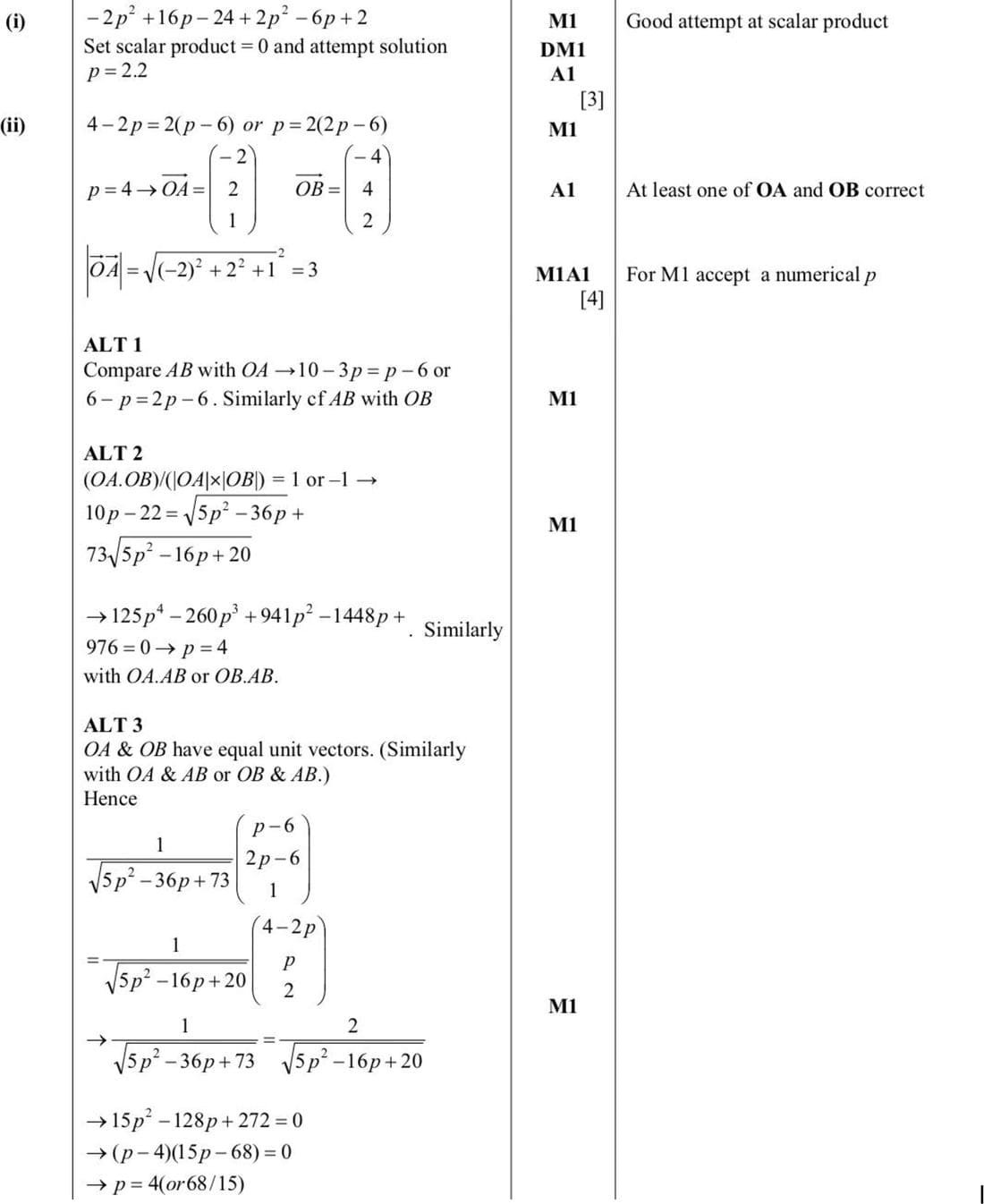
\(\overrightarrow{OA} = \begin{pmatrix} p-6 \\ 2p-6 \\ 1 \end{pmatrix}\) and \(\overrightarrow{OB} = \begin{pmatrix} 4-2p \\ p \\ 2 \end{pmatrix}\),
where \(p\) is a constant.
(i) For the case where OA is perpendicular to OB, find the value of \(p\).
(ii) For the case where OAB is a straight line, find the vectors \(\overrightarrow{OA}\) and \(\overrightarrow{OB}\). Find also the length of the line OA.
9709 P32 - Nov 2022 - Q6
Relative to the origin O, the points A, B and C have position vectors given by
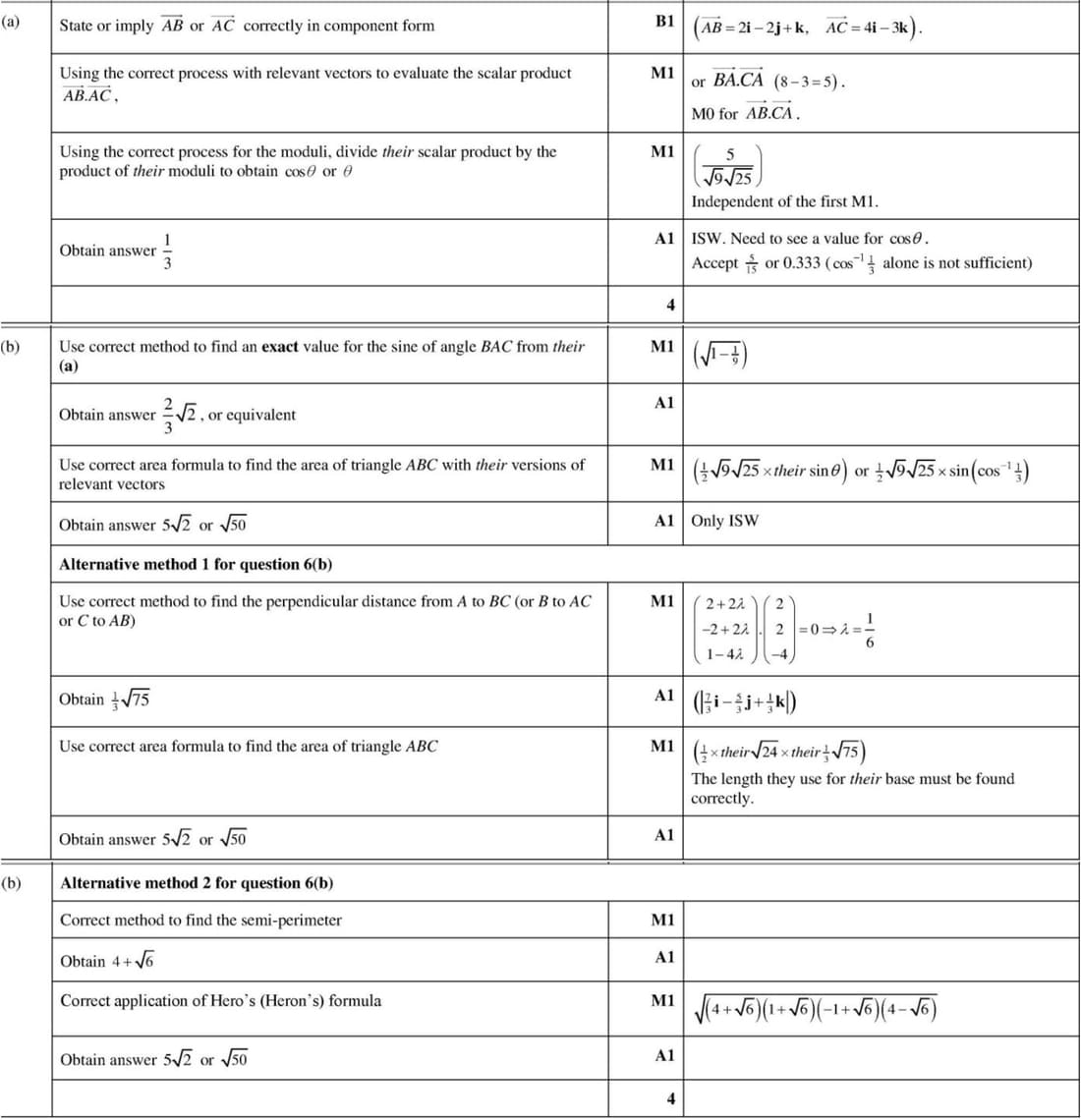
\(\overrightarrow{OA} = \begin{pmatrix} 1 \\ 3 \\ 1 \end{pmatrix}, \quad \overrightarrow{OB} = \begin{pmatrix} 3 \\ 1 \\ 2 \end{pmatrix} \quad \text{and} \quad \overrightarrow{OC} = \begin{pmatrix} 5 \\ 3 \\ -2 \end{pmatrix}.\)
(a) Using a scalar product, find the cosine of angle BAC.
(b) Hence find the area of triangle ABC. Give your answer in a simplified exact form.
9709 P12 - Nov 2015 - Q7
Relative to an origin \(O\), the position vectors of points \(A, B\) and \(C\) are given by
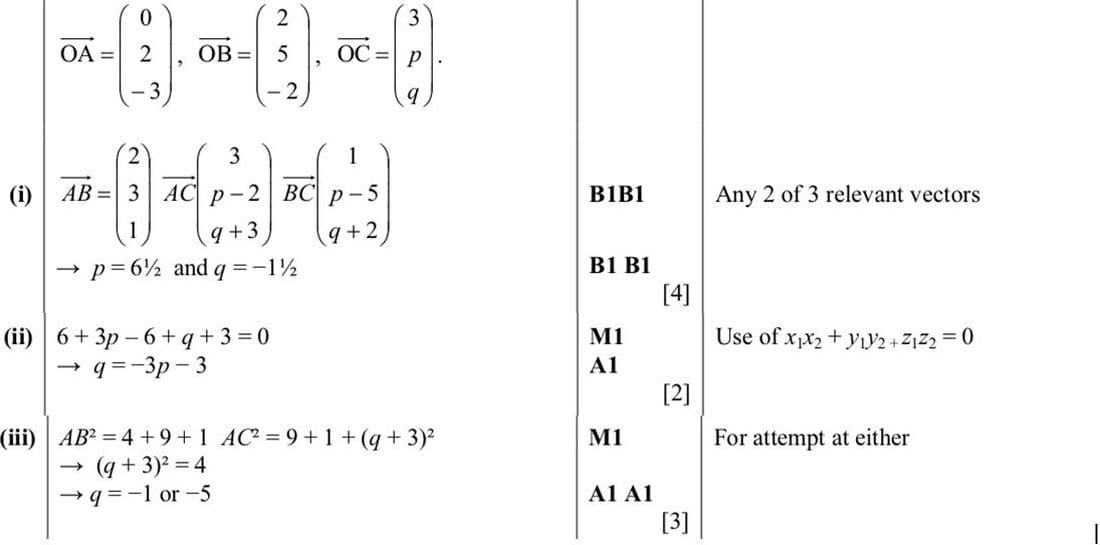
\(\overrightarrow{OA} = \begin{pmatrix} 0 \\ 2 \\ -3 \end{pmatrix}, \quad \overrightarrow{OB} = \begin{pmatrix} 2 \\ 5 \\ -2 \end{pmatrix} \quad \text{and} \quad \overrightarrow{OC} = \begin{pmatrix} 3 \\ p \\ q \end{pmatrix}.\)
(i) In the case where \(ABC\) is a straight line, find the values of \(p\) and \(q\).
(ii) In the case where angle \(BAC\) is \(90^\circ\), express \(q\) in terms of \(p\).
(iii) In the case where \(p = 3\) and the lengths of \(AB\) and \(AC\) are equal, find the possible values of \(q\).
9709 P13 - Jun 2015 - Q5
Relative to an origin O, the position vectors of the points A, B and C are given by
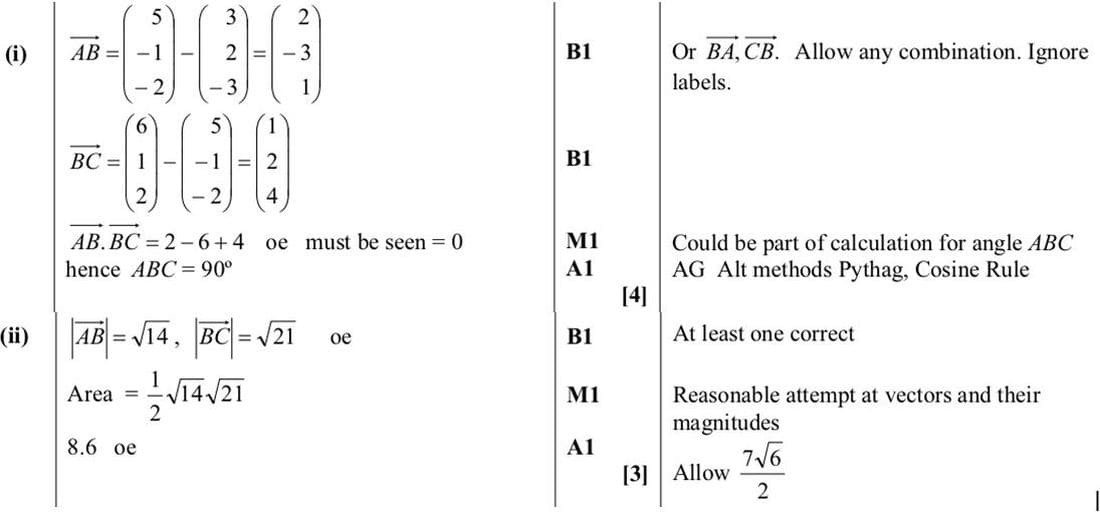
\(\overrightarrow{OA} = \begin{pmatrix} 3 \\ 2 \\ -3 \end{pmatrix}, \quad \overrightarrow{OB} = \begin{pmatrix} 5 \\ -1 \\ -2 \end{pmatrix} \quad \text{and} \quad \overrightarrow{OC} = \begin{pmatrix} 6 \\ 1 \\ 2 \end{pmatrix}.\)
(i) Show that angle \(ABC\) is \(90^\circ\).
(ii) Find the area of triangle \(ABC\), giving your answer correct to 1 decimal place.
9709 P12 - Jun 2015 - Q9
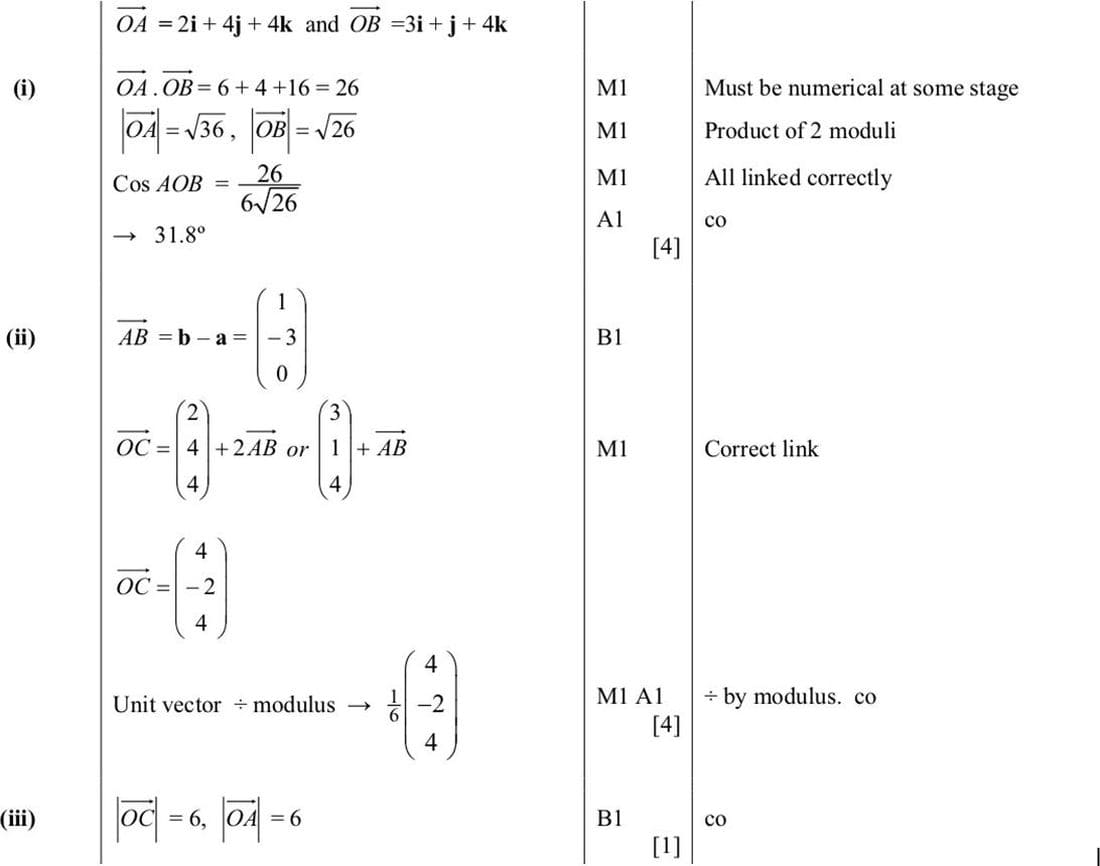
Relative to an origin O, the position vectors of points A and B are given by \(\overrightarrow{OA} = 2\mathbf{i} + 4\mathbf{j} + 4\mathbf{k}\) and \(\overrightarrow{OB} = 3\mathbf{i} + \mathbf{j} + 4\mathbf{k}\).
(i) Use a vector method to find angle \(AOB\).
The point C is such that \(\overrightarrow{AB} = \overrightarrow{BC}\).
(ii) Find the unit vector in the direction of \(\overrightarrow{OC}\).
(iii) Show that triangle OAC is isosceles.
9709 P11 - Jun 2015 - Q4
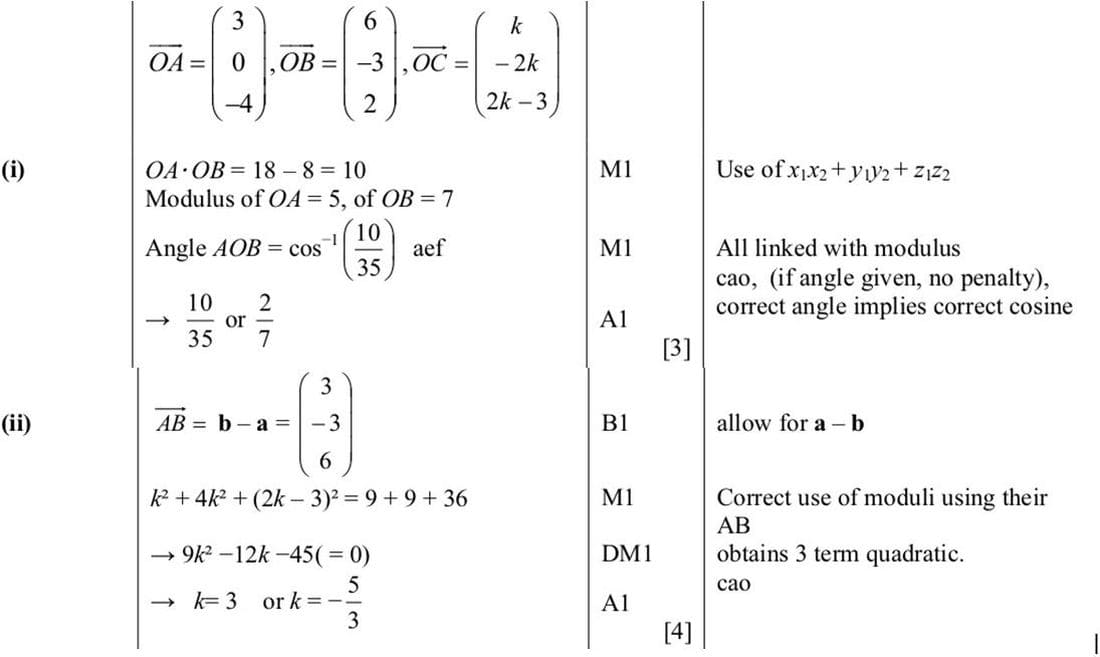
Relative to the origin \(O\), the position vectors of points \(A\) and \(B\) are given by
\(\overrightarrow{OA} = \begin{pmatrix} 3 \\ 0 \\ -4 \end{pmatrix}\) and \(\overrightarrow{OB} = \begin{pmatrix} 6 \\ -3 \\ 2 \end{pmatrix}\).
(i) Find the cosine of angle \(AOB\).
The position vector of \(C\) is given by \(\overrightarrow{OC} = \begin{pmatrix} k \\ -2k \\ 2k - 3 \end{pmatrix}\).
(ii) Given that \(AB\) and \(OC\) have the same length, find the possible values of \(k\).
9709 P13 - Nov 2014 - Q7
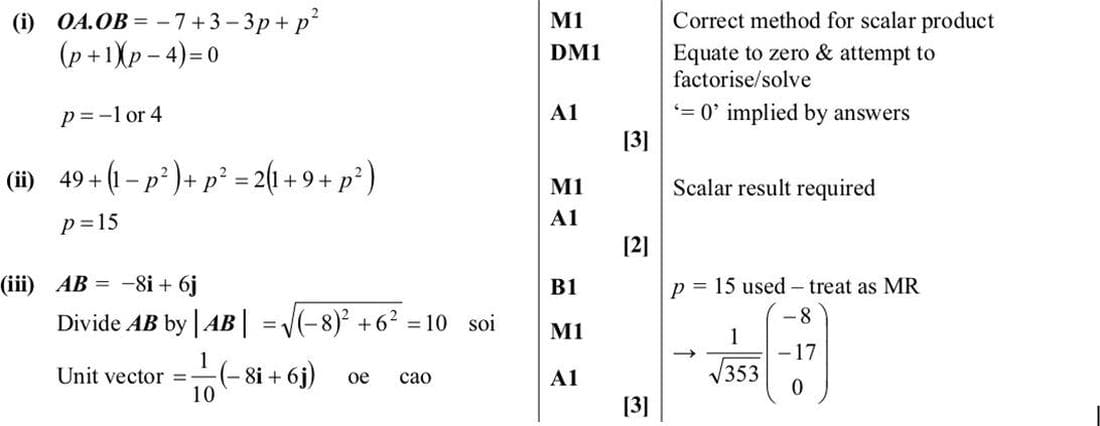
Three points, O, A and B, are such that \(\overrightarrow{OA} = \mathbf{i} + 3\mathbf{j} + p\mathbf{k}\) and \(\overrightarrow{OB} = -7\mathbf{i} + (1-p)\mathbf{j} + p\mathbf{k}\), where \(p\) is a constant.
(i) Find the values of \(p\) for which \(\overrightarrow{OA}\) is perpendicular to \(\overrightarrow{OB}\).
(ii) The magnitudes of \(\overrightarrow{OA}\) and \(\overrightarrow{OB}\) are \(a\) and \(b\) respectively. Find the value of \(p\) for which \(b^2 = 2a^2\).
(iii) Find the unit vector in the direction of \(\overrightarrow{AB}\) when \(p = -8\).
9709 P11 - Nov 2014 - Q6
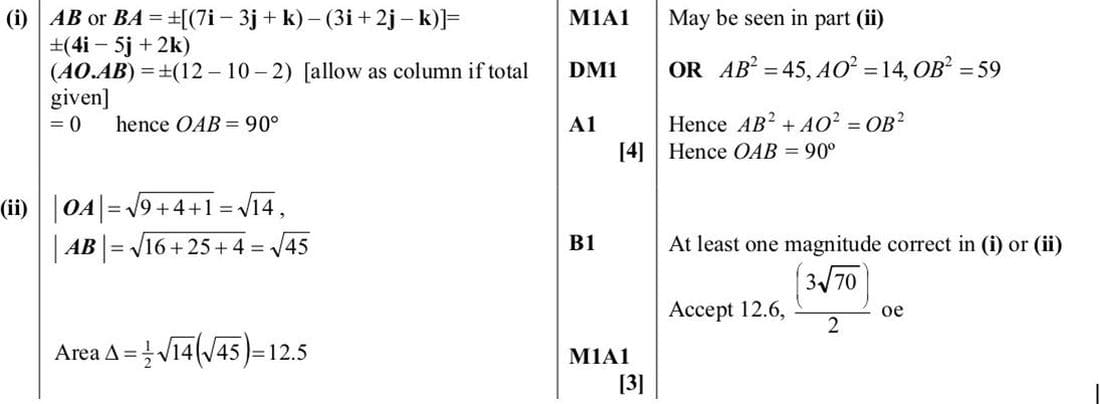
Relative to an origin O, the position vector of A is 3i + 2j - k and the position vector of B is 7i - 3j + k.
- Show that angle OAB is a right angle.
- Find the area of triangle OAB.
9709 P13 - Jun 2014 - Q7
The position vectors of points A, B and C relative to an origin O are given by
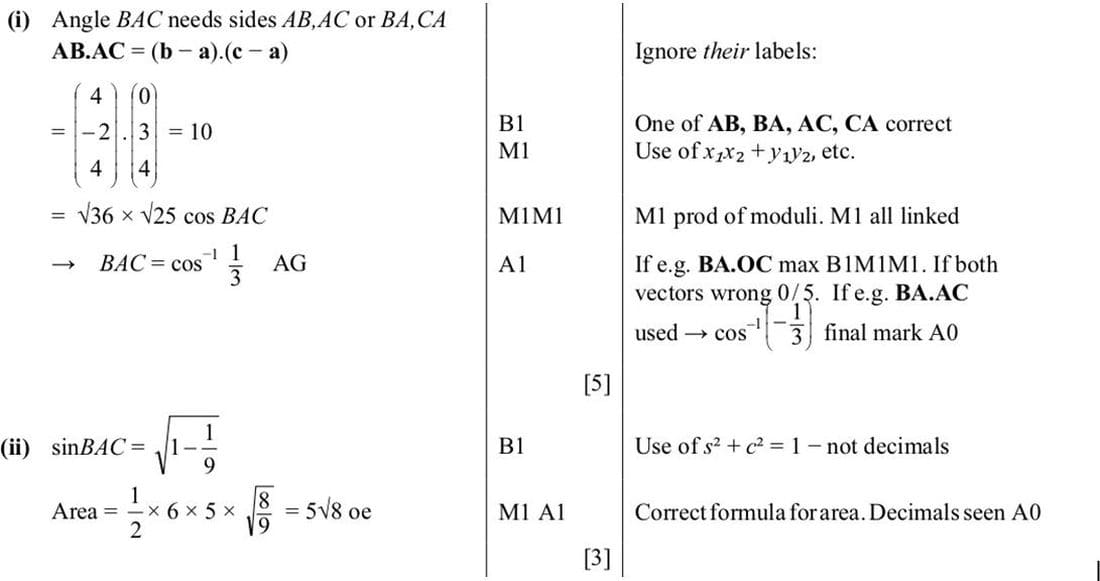
\(\overrightarrow{OA} = \begin{pmatrix} 2 \\ 1 \\ 3 \end{pmatrix}, \quad \overrightarrow{OB} = \begin{pmatrix} 6 \\ -1 \\ 7 \end{pmatrix} \quad \text{and} \quad \overrightarrow{OC} = \begin{pmatrix} 2 \\ 4 \\ 7 \end{pmatrix}.\)
(i) Show that angle \(BAC = \cos^{-1}\left(\frac{1}{3}\right).\)
(ii) Use the result in part (i) to find the exact value of the area of triangle \(ABC.\)
9709 P11 - Jun 2014 - Q8
Relative to an origin O, the position vectors of points A and B are given by
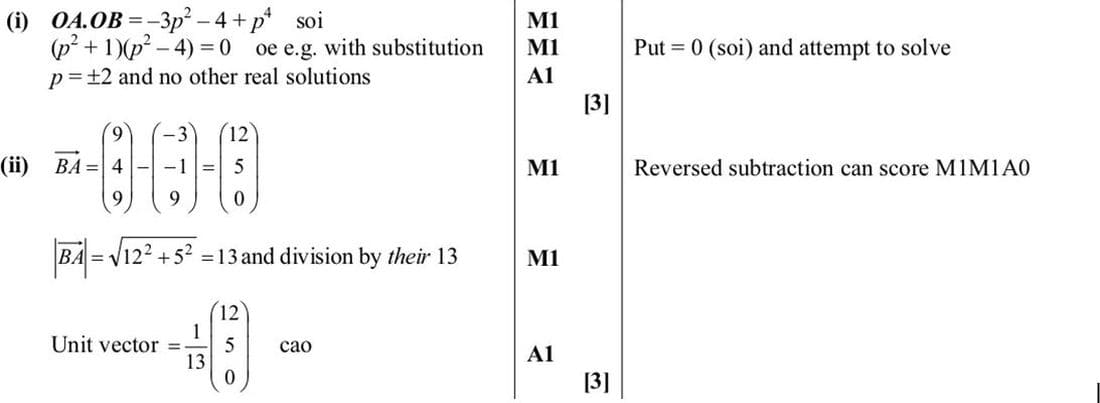
\(\overrightarrow{OA} = \begin{pmatrix} 3p \\ 4 \\ p^2 \end{pmatrix}\) and \(\overrightarrow{OB} = \begin{pmatrix} -p \\ -1 \\ p^2 \end{pmatrix}\).
(i) Find the values of \(p\) for which angle \(AOB\) is 90°.
(ii) For the case where \(p = 3\), find the unit vector in the direction of \(\overrightarrow{BA}\).
9709 P12 - Nov 2013 - Q4
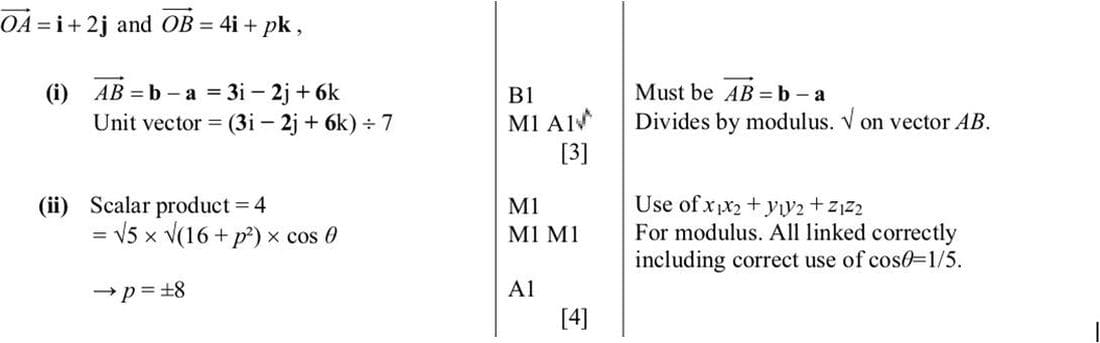
Relative to an origin O, the position vectors of points A and B are given by \(\overrightarrow{OA} = \mathbf{i} + 2\mathbf{j}\) and \(\overrightarrow{OB} = 4\mathbf{i} + p\mathbf{k}\).
(i) In the case where \(p = 6\), find the unit vector in the direction of \(\overrightarrow{AB}\).
(ii) Find the values of \(p\) for which angle \(AOB = \cos^{-1}\left(\frac{1}{5}\right)\).
9709 P12 - Jun 2013 - Q6
Relative to an origin O, the position vectors of points A and B are given by
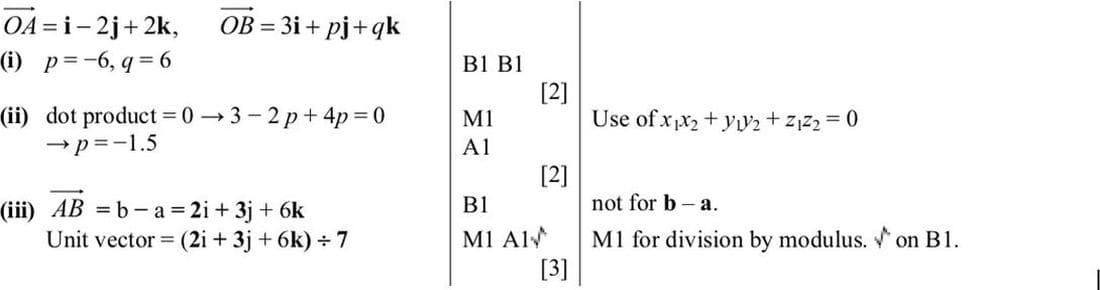
\(\overrightarrow{OA} = \mathbf{i} - 2\mathbf{j} + 2\mathbf{k}\) and \(\overrightarrow{OB} = 3\mathbf{i} + p\mathbf{j} + q\mathbf{k}\),
where \(p\) and \(q\) are constants.
- State the values of \(p\) and \(q\) for which \(\overrightarrow{OA}\) is parallel to \(\overrightarrow{OB}\).
- In the case where \(q = 2p\), find the value of \(p\) for which angle \(BOA\) is \(90^\circ\).
- In the case where \(p = 1\) and \(q = 8\), find the unit vector in the direction of \(\overrightarrow{AB}\).
9709 P32 - Jun 2021 - Q11
With respect to the origin O, the points A and B have position vectors given by \(\overrightarrow{OA} = 2\mathbf{i} - \mathbf{j}\) and \(\overrightarrow{OB} = \mathbf{j} - 2\mathbf{k}\).
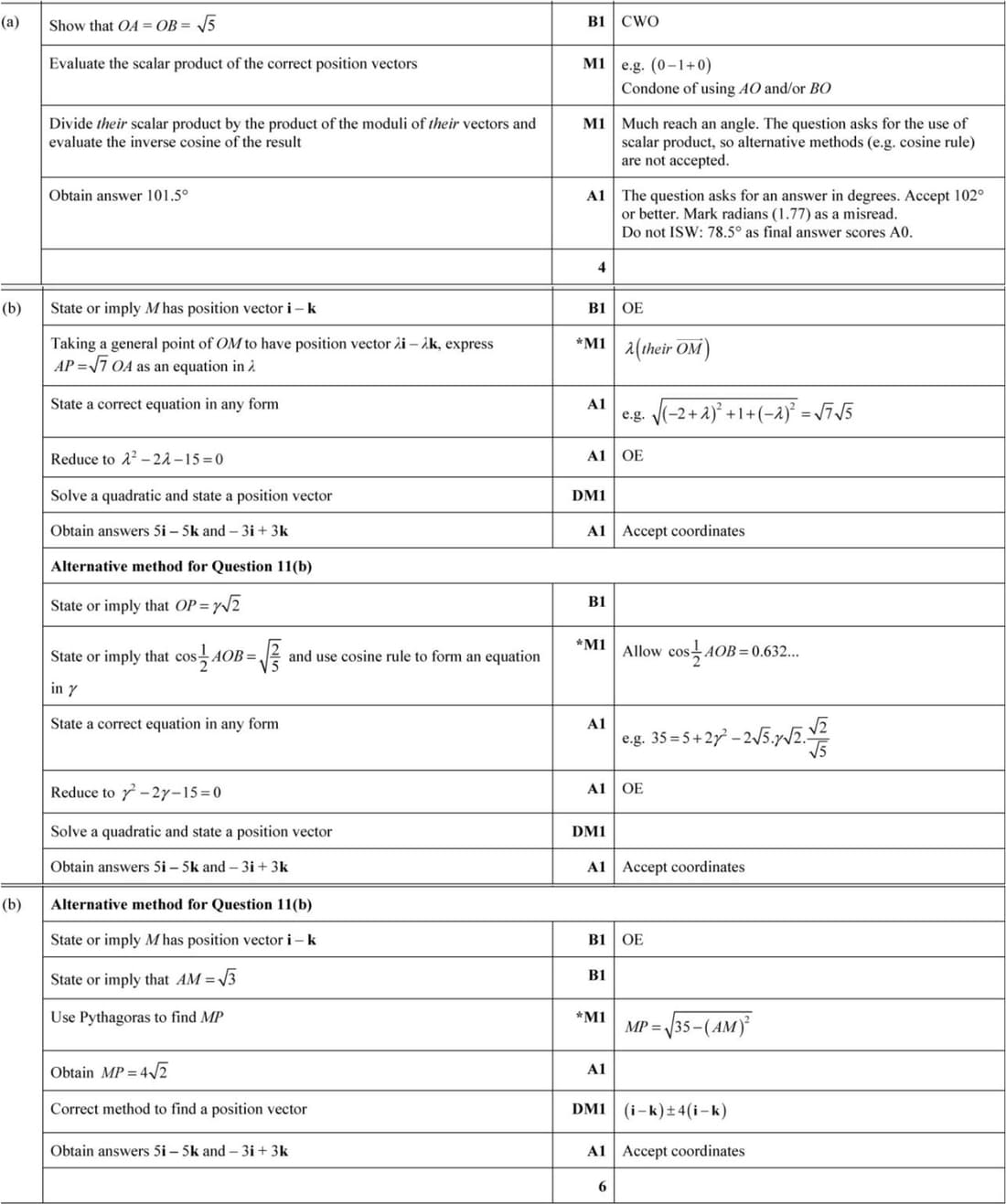
(a) Show that \(OA = OB\) and use a scalar product to calculate angle \(AOB\) in degrees.
The midpoint of \(AB\) is \(M\). The point \(P\) on the line through \(O\) and \(M\) is such that \(PA : OA = \sqrt{7} : 1\).
(b) Find the possible position vectors of \(P\).