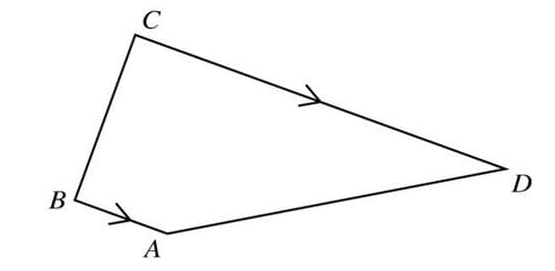
(i) To show that \(AB\) is perpendicular to \(BC\), we calculate the vectors \(\overrightarrow{AB}\) and \(\overrightarrow{BC}\):
\(\overrightarrow{AB} = \overrightarrow{OB} - \overrightarrow{OA} = \begin{pmatrix} 1 \\ 3 \\ 2 \end{pmatrix} - \begin{pmatrix} 3 \\ 4 \\ 0 \end{pmatrix} = \begin{pmatrix} -2 \\ -1 \\ 2 \end{pmatrix}\)
\(\overrightarrow{BC} = \overrightarrow{OC} - \overrightarrow{OB} = \begin{pmatrix} 4 \\ 5 \\ 6 \end{pmatrix} - \begin{pmatrix} 1 \\ 3 \\ 2 \end{pmatrix} = \begin{pmatrix} 3 \\ 2 \\ 4 \end{pmatrix}\)
Calculate the dot product:
\(\overrightarrow{AB} \cdot \overrightarrow{BC} = \begin{pmatrix} -2 \\ -1 \\ 2 \end{pmatrix} \cdot \begin{pmatrix} 3 \\ 2 \\ 4 \end{pmatrix} = (-2)(3) + (-1)(2) + (2)(4) = -6 - 2 + 8 = 0\)
Since the dot product is zero, \(AB\) is perpendicular to \(BC\).
(ii) To find the position vector of \(D\), first find the unit vector in the direction of \(CD\):
\(\overrightarrow{CD} = \pm 4 \times \overrightarrow{BA} = \pm 4 \times \begin{pmatrix} -2 \\ -1 \\ 2 \end{pmatrix} = \begin{pmatrix} 8 \\ 4 \\ -8 \end{pmatrix}\)
Given \(CD = 12\), the position vector \(\overrightarrow{OD}\) is:
\(\overrightarrow{OD} = \overrightarrow{OC} + \overrightarrow{CD} = \begin{pmatrix} 4 \\ 5 \\ 6 \end{pmatrix} + \begin{pmatrix} 8 \\ 4 \\ -8 \end{pmatrix} = \begin{pmatrix} 12 \\ 9 \\ -2 \end{pmatrix}\)